


Opinion: Hope for freedom on horizon as Iran's mullahs face street pressure
What is unfolding inside Iran meets the legal threshold for crimes against humanity

By: Ardeshir Zarezadeh
By taking to the streets in massive numbers, Iranians have created a historic opening, one that could finally end the Islamic Republic’s long-standing nuclear and missile challenge and reshape a regional security order defined for decades by coercion and threat.

tap here to see other videos from our team.
AP explains as Trump says Iran wants negotiations and pro-goverment rally held in Tehran Back to video
tap here to see other videos from our team.
For over four decades, the Islamic Republic has been a source of instability in West Asia and beyond, including confrontations with Israel and the United States. Through sustained financial and military support for armed non-state actors such as Hezbollah and Hamas, and through the systematic export of violence and ideological extremism, the Islamic Republic has undermined regional and global security.
The current nationwide uprising is not only a struggle for political freedom inside Iran, but a moment of consequence for the international system confronting a brutal state whose survival strategy has depended on repression at home and disruption abroad.
I write as a former Iranian student leader and political prisoner, and as someone who has spent many years in Canada advocating for human rights. Long before the current uprising, I warned that the Islamic Republic’s reliance on violence would not remain confined within Iran’s borders. The regime has actively cultivated transnational networks, advanced proxy forces and sought to influence political discourse in the U.S., Canada and Europe through intimidation, foreign interference and indirect pressure. This has posed a sustained challenge not only to Iranians but to democratic societies themselves.
Several U.S. policymakers, including Senators Ted Cruz and Lindsey Graham, have argued that the current moment represents a rare opportunity to confront the Islamic Republic decisively. Inside Iran, protesters have gone further, openly chanting the name of U.S. President Donald Trump and calling for international intervention. Outside Iran, Iranians and others have echoed those calls.
At the same time, the Islamic Republic has itself reached out to the Trump administration. After years of publicly rejecting negotiations with Washington as illegitimate, the regime is now seeking talks, which reflects growing vulnerability as domestic control erodes.
-
 EDITORIAL: Iran’s popular uprising is our fight as well
 -
 Iranians urge Canada to help anti-government protesters in Iran
 - Advertisement 1Story continues below
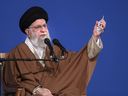

Trump has stated that the use of lethal force against protesters would trigger consequences and has described Supreme Leader Ali Khamenei as a major threat to U.S., Israeli and Middle Eastern security. He has pledged to support Iranians, though he has not yet met with Prince Reza Pahlavi, whom many protesters regard as a possible representative voice for a transitional alternative. These political dynamics underscore a broader reality — the regime’s internal crisis is now directly intersecting with international power calculations.
What is unfolding inside Iran — widespread and systematic attacks against unarmed civilians — meets the legal threshold for crimes against humanity. Under international law, such acts do not merely provoke moral condemnation; they trigger legal responsibility.
- Advertisement 2Story continues below


At the 2005 United Nations World Summit, member states unanimously endorsed the principle of Responsibility to Protect, which affirms that when a state is unwilling or unable to protect its population from crimes against humanity, the responsibility shifts to the international community to respond using appropriate means.
Sovereignty is not a licence to kill.
This is therefore not a debate about ideology, regime preference or geopolitical alignment. It is a question of legal obligation and international credibility.
The U.S., Canada, U.K. and allied democracies now face a stark choice. They can allow fear to be reimposed through bloodshed, reinforcing a familiar cycle of repression and impunity. Or they can act lawfully and decisively to prevent mass killings by dismantling a system built on terror and coercion, thereby bringing to an end decades of exported violence and intimidation.
I have waited many years to see Iran reach this moment. The courage of Iranians is already evident. What remains uncertain is whether the international community will recognize this uprising, not as another episodic protest, but as a decisive test of the rules-based order it claims to defend.
Ardeshir Zarezadeh is a former student leader and political prisoner in Iran. A journalist and legal professional in Canada and Australia, he is president of Toronto-based International Centre for Human Rights.
Postmedia is committed to maintaining a lively but civil forum for discussion. Please keep comments relevant and respectful. Comments may take up to an hour to appear on the site. You will receive an email if there is a reply to your comment, an update to a thread you follow or if a user you follow comments. Visit our Community Guidelines for more information.
Conversation
All Comments