


The State, The See, and Mass Migration
Let Fly the Banners of the Ghibelline!

What else could you expect from a Brazilian? The cardinals wanted a new-style pope. For the universal Church, they said. Well, they certainly got one! I knew him well when he was still a bishop, badgering Europe with his pitiful tales of Third World despair. I remember telling him one day that by wearing down the wayward mother he would only harm the children all the more. You know what he answered? That poverty is all there is worth sharing!
—Raspail, The Camp of the Saints
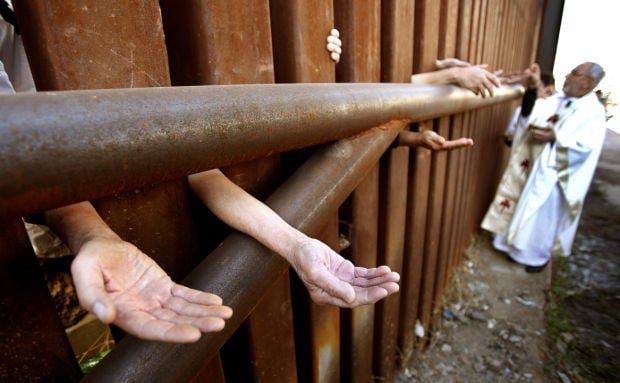
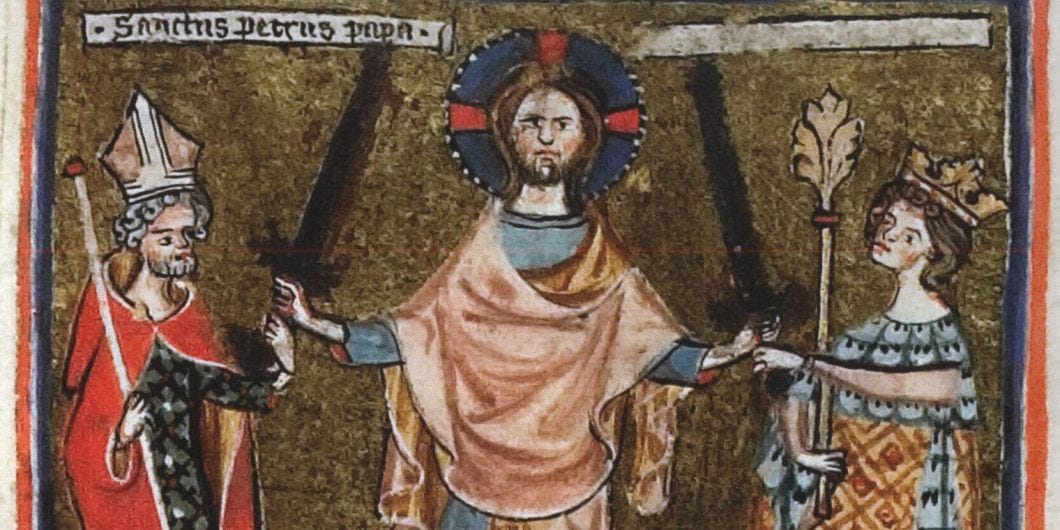
The soil of the Occident is no stranger to the bloody meeting of these banners—both bearing a cross inverting the other. Many times before has the issue been settled—no, delayed—with contests of spear and wit. At Campaldino, surely (as Dante tells us first-hand), but also at Lützen, Castel Bolognese, and San Germano; perhaps the first of these may be found under the ruins of Amarna. What has driven so many distant men to shield and sunder was nothing short of the inheritance of all worldly and otherworldly power, the right to render, and the right to reign. In our diminished age, this ever-present contest between the priest and the ruler is conducted in manners far less glamorous than the romance of column and cavalry, yet still it rages on, no less important today than it was before.
It is important to frame the conflict as such from the onset, otherwise we enter the confusion of the assertions of “Marxist infiltration”, “the error of Vatican II”, or “the desacralization of the world” in ignorance of what is simply intrinsic to our nature. Where the statesman seeks to erect one world order, the priest seeks one of his own—any temporary agreement between these two characters is nothing short of a rare but welcome act of God.
The age of nation-states and democracy, surely, has only greatly complicated the matter by transforming the conflict into an asymmetrical one. In fact, it provided the priest with what has since proved his most cherished armament: the voting mass. It was Leo XIII first who, in response to the failure of Boulanger and the Ralliement, and Bismarck’s Kulturkampf too, officially ended all hopes of a restoration of the old agreements and turned to the common man. In a Europe in which all learned men and aristocrats held a level of animosity toward Rome, what other choice did they have but to conscript these prospective pilgrims in the armory of “Catholic social teaching”? With this, Leo generated into existence the phenomenon of liberal Catholicism, a political and ideological force of its own which operated within the confines of the nation-state to maintain the role and worldview of the priest against that of the statesman. This period at the fin de siècle transitioned naturally into the response of the Church against a new century of tyrannical governance ruled over by the German and Soviet, and the Church has remained true to Leo’s position ever since.
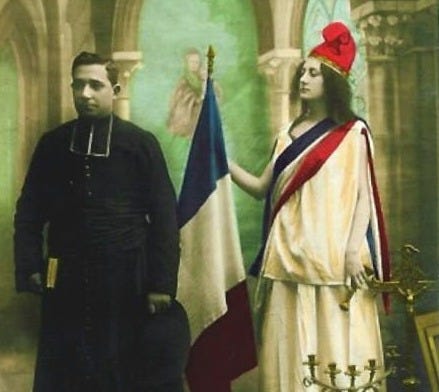
It is no coincidence that the Pontifex of our time has too chosen this name, himself stating that he intends to carry this teaching—this tactic—into the new millennium:
I chose to take the name Leo XIV. There are different reasons for this, but mainly because Pope Leo XIII in his historic Encyclical Rerum Novarum addressed the social question in the context of the first great industrial revolution. In our own day, the Church offers to everyone the treasury of her social teaching in response to another industrial revolution and to developments in the field of artificial intelligence that pose new challenges for the defense of human dignity, justice and labor.
—Address to the College of Cardinals in the New Synod Hall, May 10, 2025
Yet, Leo XIV’s chosen is not merely the downtrodden agrarian folk of an industrializing Europe that Leo XIII had burdened himself with, but a novel class of its own: the migrant. To be sure, the Catholic Church is an old face in this arena; in fact it is its founding father, and today remains the single most influential and impactful agent in regards to this entirely inorganic endeavor we label “mass migration”. One may think of the Hesburgh Commission at Notre Dame, which provided the bishop-approved template for what later became Reagan’s amnesty and our visa & refugee programs, or he may think of Catholic testimony at the annual National Council of Churches, which, in harmony with most other Christian institutions at the time, maneuvered every lever and valve in its possession to convince the nation to absolve itself of the sin of racism and enact what became the Hart-Celler reform. These are not exactly esoteric claims; the USCCB’s Migrant and Refugee services proudly claims its status as the top resettler in the world. We leave the dead horse of the Church’s impact in regards to the sum of historical mass migration to be beaten further by previous (and future) articles, and turn back to the mission of Leo himself and his magisterium.


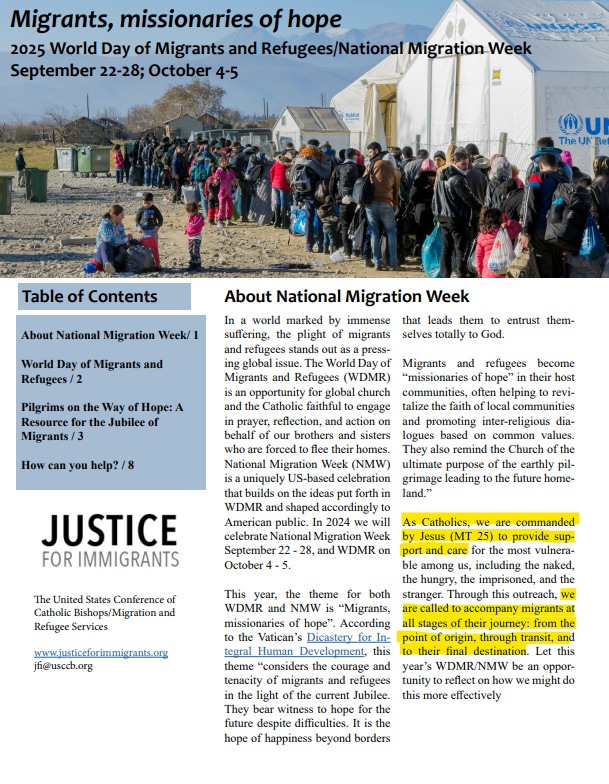
In the autumn of 2025, the banners the whole of the Catholic institution—its bishops, a multitude of NGOs and volunteer groups, lawyers, speakers, financiers, and the Pope himself—mustered for a rapid chevauchee upon the people of the West in service of the migrant. In keeping with the plans and wishes of Francis, the entirety of 2025 was deemed a Jubilee Year for the migrant, “pilgrims of hope”, featuring a number of events, festivals, and directives. The USCCB hosted its 45th annual National Migration Week in September, hosted by the Justice for Immigrants non-profit: a coalition of dozens of Church-affiliated and Church-founded organizations such as Catholic Legal Immigration Network (CLINIC), Catholic Charities, and the USCCB’s own Migrant Relief Services. This was culminated by, at the request of Francis, the Church’s World Day of Migrants and Refugees and two-day Jubilee of Migrants. Leo XIV himself gave to an eager St. Peter crowd his Homily to the migrants, which after a courteous and brief reminder of the horrors of Auschwitz, tells us:
Brothers and sisters, today a new missionary age opens up in the history of the Church. […] Those boats which hope to catch sight of a safe port, and those eyes filled with anguish and hope seeking to reach the shore, cannot and must not find the coldness of indifference or the stigma of discrimination!
Documents and fliers advertising the events declare that Catholics are “commanded by Jesus (MT 25) to provide support and care” for the migrant, and that “we are called to accompany migrants at all stages of their journey: from the point of origin, through transit, and to their final destination”.
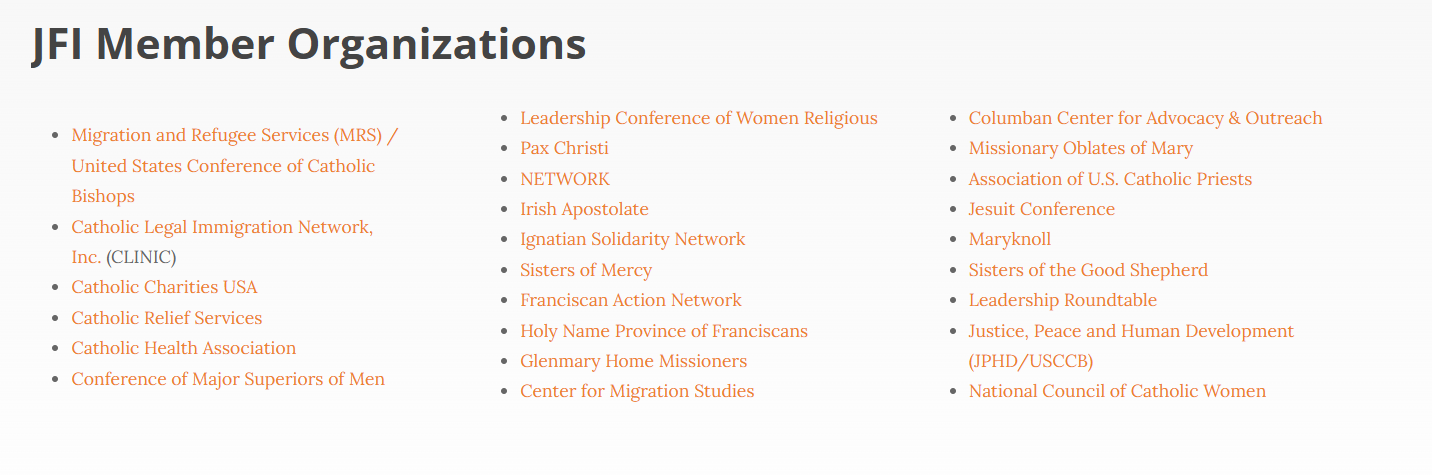
Indeed, this is precisely how the network of Catholic NGOs trafficking migrants across the globe works. To suggest that these organizations simply wait at the border for someone to request aid is naïve, and refuted by this network’s very structure. Take, for example, the notorious Catholic Charities—one of the single largest and most impactful trafficker of migrants into the US. Aside from being founded by the Church itself in 1910 as the National Conference of Catholic Charities, it remains integrated into the structure of the Church itself through its administration under Caritas Internationalis, together with Catholic Relief Services. Caritas is headquartered in the Vatican out of the Palazzo San Callisto, with branch offices in 200+ countries and territories across every corner of the globe. Thus, organizations such as Catholic Charities, while on the surface appear independent of the Church, are fundamentally intertwined with and in fact administered out of the Vatican itself, in direct communication with the numerous forward operating bases across the third world—at all stages of their journey, from the slums of Port au Prince to your own back yard.
We hope the position of the Church is no longer in question, though prepared we are to offer hours more of evidence and illustrations, and return to the question of this article. Leo, of course, assumed his duties at almost the precise moment a slim majority American people acted to bring back their champion to the seat of the nation-state for a mission which in many ways stands in polar opposition to the sought ends of the Vatican; and this is precisely the problem. Thus, red and white colors have been raised once more—only today, symbolically, seen only on the pins and ties of lawyers and bureaucrats.
Conflicts between the Church and the Trump administration were immediately evident, and have only since intensified. For decades the USCCB had enjoyed billions of dollars in taxpayer funds to the cause of mass migration, but just a couple of months into the year, cuts and reorganization downstream from the larger “DOGE” project forced the USCCB to end these programs entirely, at least for now. Vice President Vance, himself a Catholic, openly accused the Church of using these funds to facilitate illegal immigration into the country, causing a bitter divide between him and the bishops which lasts to this day. As a matter of fact, he was personally rebuked by a signed letter from Francis to the U.S. Bishops which criticized the administration:
I exhort all the faithful of the Catholic Church, and all men and women of good will, not to give in to narratives that discriminate against and cause unnecessary suffering to our migrant and refugee brothers and sisters. With charity and clarity we are all called to live in solidarity and fraternity, to build bridges that bring us ever closer together, to avoid walls of ignominy and to learn to give our lives as Jesus Christ gave his for the salvation of all.
As for Leo himself, he has been a faithful inheritor of the message of Francis, though many had hoped it would have died with him. With typical libtard crass fresh off a Facebook feed, he frequently questions if the Republicans are truly “pro-life” if they treat migrants so poorly. He rejected an invitation to the US’s 250th anniversary celebration, offered in-person by JD Vance, in favor of his prior commitments to visit migrants on the Italian island of Lampedusa, where a native population of under 6,000 has been forced to suffer some 120,000 migrants in the last 2 years. He has thus made himself clear.
So we must set forth the question: what exactly is a Catholic supposed to do when he is situated between the points of Two Swords? When your very own Pope Obama, the Nicar of Christ himself, looks down upon you and demands the emptying and eventual destruction of the people you swore—to God—to protect, what then? We can show how the Hohenstaufen reacted with swift effectiveness, but this is not an option in our time. The position of the Church is now unequivocally made, and it stands in direct opposition to what is perhaps the central justification of the administration: the curtailing of mass migration, and a reassertion of the nation against the universal. Of all those religions, institutions, and components of humanity that stand in opposition to national sovereignty, the Church is by far the most overlooked. No longer.
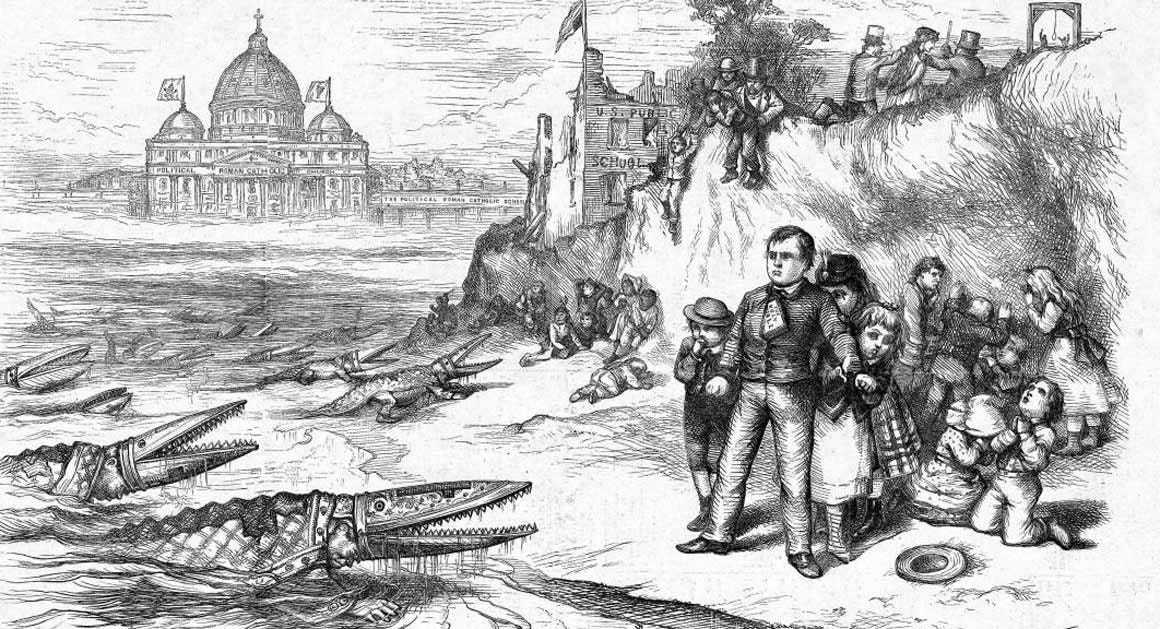
The right is no stranger to the problem of institutional capture, but this is no typical institution. It’s the body of God, a 2000-year-old structure which has carried the West to and through its most pivotal moments, for better or for worse. If a university, media company, or board of directors seems to fall into the errors of misjudgment, it can in some way be pressured into reform either through financial or political incentives—offers of a variety it cannot refuse. If the statesman himself or his government does not fulfill his duties, he is immediately replaced by one who will. Even for monarchies the abilities and power of the crown are directly linked to the support and activity of the nation itself. None of this is true for Rome today, as the genius of old Leo's strategy has specifically circumvented this check. It no longer has to rely on the statesman for wealth and protection as it did during the age of the Franks and Ottonians, and today it speaks only to God and his reflection in a mass of lifejackets coming to port.
Recent adjustments by the Church have come only due to its unpopularity among its worshipping body, perhaps best exemplified by the mission of Vatican II to modernize itself in a new age. But we should expect no demands to come from this new congregation, nor should we wait for one to serve as yet another Replacement for our own objections. Maybe the correct answer is more direct, as unpleasant as it may be. Maybe this sordid collective is “but an institution” as Goethe called it in his Strasbourg dissertation, reduced to little more than a bundle of Earth Day NGOs covered but superficially with the thin gold leaf of “holiness”. Maybe what lies underneath has long since dispossessed itself of any relation to God, and damn the naivety of those “desert fathers” who thought it could last for an eternity. Yet, though some surely have secularized or pursued other avenues of religion due to the political engagement of denominations before (such is the entire basis of the Evangelical churches today), even today it seems fantastical to threaten the Church with its nonexistence inside the confines of the West if it does not correct its course. Not only does it likely not care—this replacement is their response to such a fate!—but the remaining faithful evidently do not have the stomach to force the issue.
It seems there is only one choice left for those who would rather not embrace the fate of saintly Lampedusa, martyred under the weight of its own suicidal altruism: empower the statesman, and raise the banner of the Ghibelline. Like before, this in no way entails a rejection of God or religious principles, though surely men in red will come to inform you of your error in judgement, or perhaps even your excommunication. But as “the anti-Christ” Frederick once proved, even such an order as this is negotiable, his salvation returned in exchange for the end to his confidently-progressing campaign into Italy. If the Church cannot be begged out of its insistence to bring the Third World to our shores with only the slightest deceitful lip service to “the integrity of nations”, then the nation itself must find someone within itself to resist the Church. It has no other choice given the demands.
This poses an immediate problem for the current coalition of the right in America and elsewhere, which has formulated itself on explicitly Christian terms. This is perhaps the grandest of all contradictions on the right today, particularly those few crowds in D.C. which have taken to popularizing a wish-casted “Catholic takeover” as the inevitable rising tide of a new “based generation of trad youths”: in order to fulfill the clear directives it has been sent by the people to accomplish, it must first overcome the stated mission of the Church itself. Will it? How can we expect these people to respond to a fierce rebuke from the very representative of God on these issues right after they instruct us that the true and actionable avenue to right-wing dominance in the West is through the Church, who has explicitly stated other intentions for over two centuries? Perhaps we can take some comfort in the proposition that few of this crowd are as zealous of believers to take serious stock in the idea and consequences of excommunication, yet surely, we would prefer more iron guarantees.
Leo has already provided us with a clear example of the consequences of this entrapment. In Spain, the ultranationalist and traditionalist VOX Party has put forth a hope of a Spain that returns to its strong Catholic values, invoking the Reconquista against a new wave of Islamic invaders. It espouses the same simple calculus that is familiar to the worldview of many other right-wing groups across the West: our culture and values, which we exist to protect, are inextricably connected to our Christian heritage. Yet, the Church reacted predictably, with Pope Leo going as far to say that the “far right” (that is, VOX) is the single greatest threat facing Spain today—not economic stagnation, not Islam, not even the mass secularism currently shredding the country—but VOX, who has simply requested that Spain be Spain, all of the Catholicism included! The right in Spain undeniably suffers from this division, as it is now struggling to find out how exactly to root its conception of identity under such stress, and without the Church. Time will tell if they will be able to.
Thus, we must be incredibly skeptical of repeating the same mistakes in following the questionable pleas among those on the right who seek to “Catholicize” the country. We can expect neither friendship nor assistance in our goals from the Church, and in fact, it is difficult to find an institution that is more potently dedicated to our undoing than it. Short of the rejection of Catholicism itself, an avenue that has long since departed and will not present itself again for some time, our only other is to “render unto Caesar”, that is, embrace the statesman in his struggle against the priest. Only here can we wield the appropriate power to ensure the physical and cultural constitution of our nations through an era that poses to destroy them like no other era before. The Church, whatever its spiritual significance may be to the man of God, can be resisted—must be—through the open hand of the king. We have no other “world-historical” examples of another way, and looking forward we see only this struggle reasserting itself as it had before.
What theological problems arise for the Catholic as a result, I leave for him to contend with. We assume his resolution would ultimately be more charitable than ours. Nevertheless, it should be kept in healthy mind that the Church has unequivocally presented itself as an enemy to the right across the entire world. The days of crusades and Falanges bravely protecting the desecrated bodies of nuns have long since departed, and we are left to ourselves to find new ways to justify our own existence. To whatever extent the Cross is relied on for an answer, the institution that is Catholic Church itself cannot, it is even concurrently rejecting the offer. We advise the right, particularly its Catholics and converts, to take upon them the lessons of history and confront the harsh realities of the present.


The Church started as the enemy of the State, and it ends as an enemy of the State…poetic.
What if we tried wishcasting harder?