


Great Heathens IV: Thomas Taylor
England's High Priest of Platonism

Great Heathens is a series which details figures in recent history who, while typically not open and practicing pagans, were drawn in and contributed greatly to its worldview. The series details their lives, thoughts, and actions; and how they contrasted with the modern culture they lived in.
Our previous article looked at the forgotten Lebensphilosopher and myste of Dionysus, Ludwig Klages.

This article will transition to a starkly different conception of pagan philosophy through the still-venerated Thomas Taylor, perhaps one of the single most consequential translators and advocates of ancient thought in history.


All bounteous Hermes, hear my fervent prayer,
And make my future life thy constant care,
Teach me what rites th’ offended gods may please,
And what the means their anger to appease […]
—Hymn to Mercury, composed by Thomas Taylor
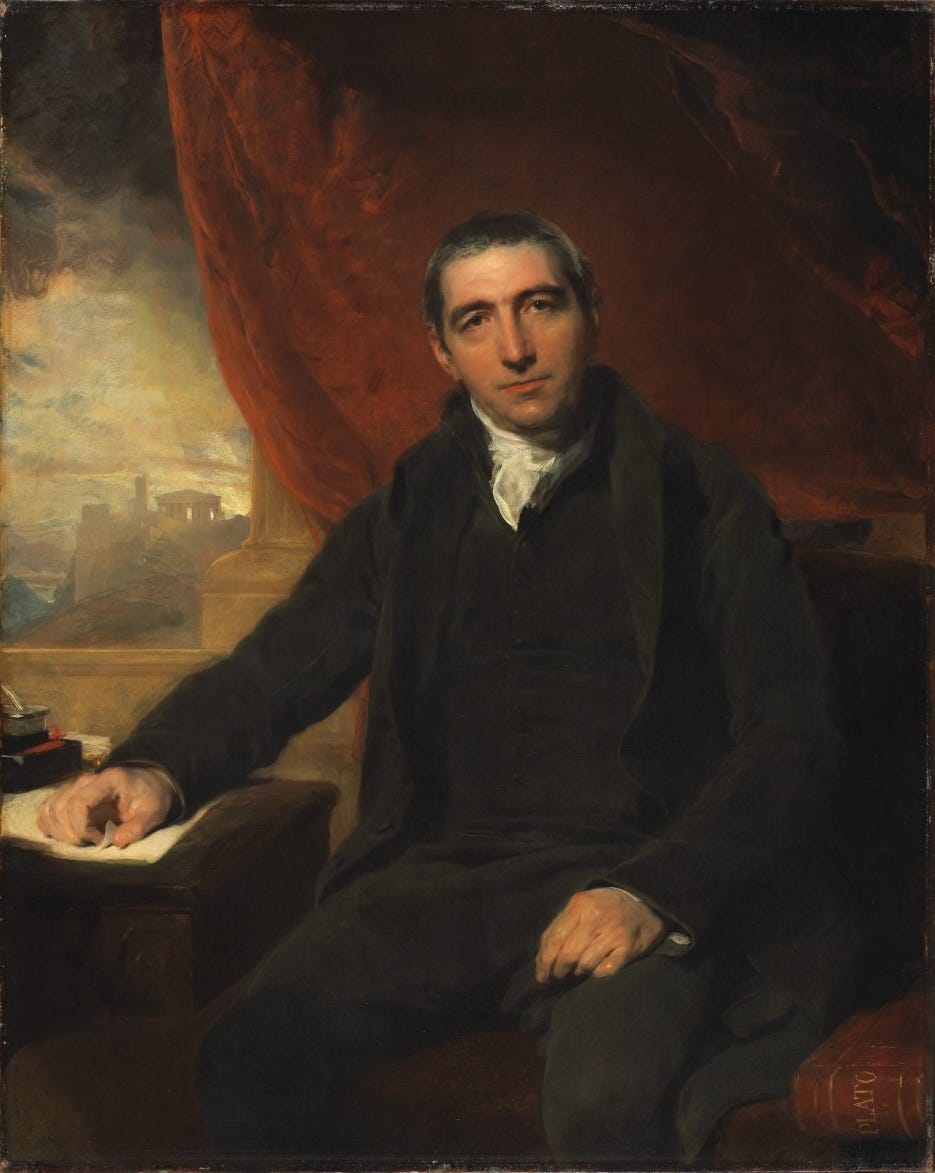
It is said that the entry and departure of great men is coronated by a procession of heavenly objects, most commonly of a bright-streaking comet which beckons all below to hear its message: “The heavens themselves blaze forth the death of princes” (Shakespeare, Julius Caesar, II, ii). Thus in 1758, and again in 1835, the comet of Edmund Halley was visible over London, carrying to and away one of the most remarkable patrons of the ancients to have ever shared breath with our air. Upon his death bed he asked of talk of the comet’s reappearance, and upon hearing a confirmation of its presence above stated: “Then I shall die; I was born with it and shall die with it.”1
When one picks up an English translation of the many works of the Neoplatonists such as Plotinus, Proclus, or Iamblichus, he will be frequently greeted by one name: Thomas Taylor. Indeed, of the corpus of texts available to us today, essentially all of them are either direct translations into English by Taylor or would have been otherwise impossible without his early contributions. Consider the following feat: Taylor was the first man to translate into English the entire sum of the works of Plato and Aristotle, something that has not been attempted again to date. Thus his legacy is no contemptible or forgettable one: the revival of the light of Platonic & Neoplatonic philosophy and its enduring presence in the Anglophone world. Yet to go further, we may additionally claim that he may have even been personally responsible for, as we shall see, the explosion of a sort of polytheistic revival whose heart had beat through the Victorian empire.
What might be most remarkable about the life of Taylor is that nothing indicated in advance his venerable Fate. He was reared in a quiet and typical life of the then-blooming London middle class, the son of a tailor and himself under study to offer himself to the service of God’s ministry. Yet the gods had other plans, and his heart was tugged by the lure of mighty Eros: he married his school sweetheart Mary Morton whom he had known since fourteen years of age after learning that she was soon to be married off to a wealthy tradesman by her father. Disowned by each of their families for the act, the two entered “a wonderful life” of poverty, struggle, and hardship, living on what little Taylor brought home from his less-than-glamorous job as a bank teller.
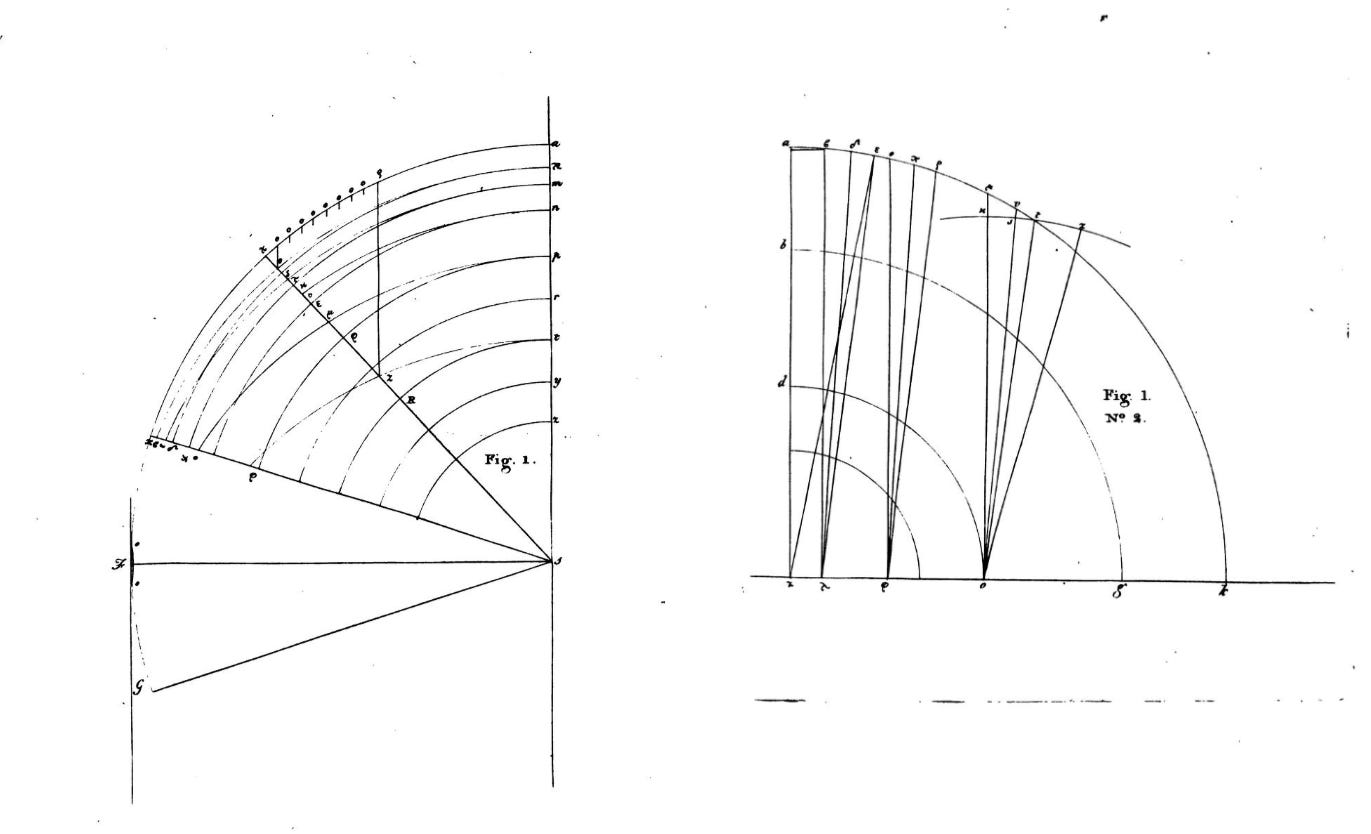
Despite the circumstances, like many other great philosophers across history Taylor took to a number of intellectual interests purely for his own enjoyment and fulfillment, without pay, and without recognition: mathematics, chemistry, physics, and philosophy. In the intro to his first known contribution to literature, The Elements of A New Method of Reasoning in Geometry (1780), he says the following in defense of himself and his upbringing:
The author of the following small tract is not ashamed to confess, that it has been the employment of his leisure hours for a considerable time. If he has failed in the execution, he can, however, safely affirm he has not been wanting in the most earnest endeavors towards the completion of his purpose. He considered that the object of his search and enquiry, although arduous, was at the same time glorious, and that the discovery of Truth is always a sufficient recompense for the difficulty attending its investigation.
In short, animated by a sincere Love of Truth, he flatters himself the integrity of his intentions will in some measure atone for his want of greater genius and abilities. […] while Error sinks into the abyss of forgetfulness, TRUTH alone swims over the vast extent of the ages.
Yet, Taylor’s life would not begin in earnest until his discovery of the ancients. It is not known when or how exactly Taylor stumbled upon them, though surely through the inevitable mentioning of those such as Plato and Aristotle that could be find in any individual academic work in the Western library. It was said that he—we assume at the great displeasure of wife and mother of his children—developed a habit of nocturnal study, which granted him but a few hours of rest between his family, his studies, and that damnable bank job that called him away into distractions each fast-approaching morning. Those of us who often find ourselves in a similar predicament understand why he continued to do so: it was worth it. So at his lamplit desk deep in a sleeping England, Taylor worked at a pace and level of craftsmanship that has still today not been matched.
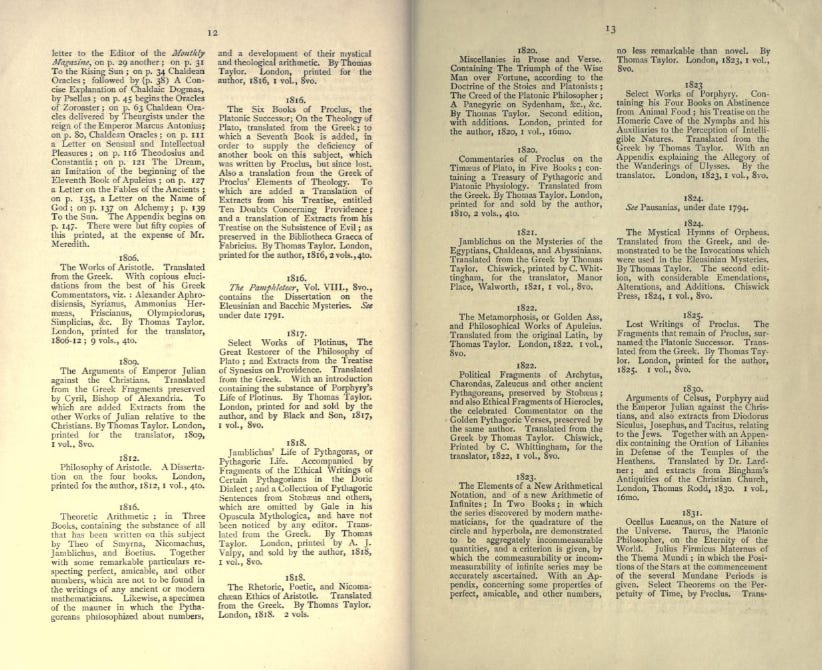
To the fruit of countless restless nights, at the age of 29 Taylor burst forth with his great works: he published the first English translations & commentary on the Hymns of Orpheus, Euclid’s Elements and Elements of Theology by the great Neoplatonist Proclus, and a number of essays, articles, and books detailing the Platonic system of thought. From here, Taylor was suddenly thrust into something utterly foreign to him—fame. A number of wealthy patrons stepped forward to offer him handsome payments for his continued work, including a full English translation of the entirety of Plato’s body of known writings. He even attracted at least one super fan, the young Marquis de Valady, who begged Taylor to initiate him in the fullest wisdoms of the Pythagorean tradition. A typical Frenchman, the Marquis also saw it necessary to suggest to Taylor that he should share the pleasures of his wife with him. Taylor sent him away on his own path. De Valady later remarked in frustration of the episode, “I have overcome Diogenes, and am returning to Alexander.” He was later beheaded by the guillotine at the order of Robespierre in 1793.2
It should be noted that Taylor was more than a mere translator, simply churning out into English what Ficino had put into Latin some centuries prior. Taylor was interested only in a full and comprehensive understanding of the Platonic system itself, and therefore delved further into the commentaries of others within the Platonic Academy over its many centuries. Thus, Taylor was able to illustrate for the reader in many compendiums and footnotes a proper exegesis of the Platonic tradition. In a remarkable anecdote, Taylor was later validated in his understanding when he was forced to “fill-in” incomplete manuscripts of Proclus’, writing in what he believed would have been written by Proclus himself. Some decades later more complete manuscripts were found, and Taylor had not even remotely erred in his assumption.
Of course, there remains a distinction between a mere translator of ancient texts and a genuine heathen, so, what can be said about Taylor’s personal belief? For starters, we can assert that someone who dedicates himself to the translation and enthusiastic promotion of these works for decades without much pay (and, as we shall see, plenty of scorn from his contemporaries) must have found something admirable in these texts—but more must be said. Unlike most other Greats which this series has and shall continue to reanimate, we are given a difficulty with Taylor in that he very rarely speaks of himself and his own views of the world. Indeed, how can one talk of Taylor without simply repeating what is known about Platonism, thanks to him? It would not be proper here to simply detail out the system of Platonic thought that had struck him, though he would certainly approve of the move. Rather, we will have to dig through the rare instances in which Taylor offered his own thoughts on the matter, as well as a handful of rumors pertaining to Taylor’s “practices”.
We may begin with a hidden footnote in Taylor’s 1788 The Philosophical and Mathematical Commentaries of Proclus, which is attached to a discussion on the Chaldean Oracles and the goddess Isis. After a lengthy illustration of Proclus’ ritual practices which entailed an observance of lunar cycles and bodily purification, the attached footnote reads:
The religion of the Heathens, has indeed, for many centuries, been the object of ridicule and contempt: yet the author of the present work is not ashamed to own, that he is a perfect convert to it in every particular, so far as it was understood and illustrated by the Pythagoric and Platonic philosophers.3
Taylor was also the author of a “Platonic Philosopher’s Creed”, found attached to his On the Theology of the Greeks (1820), which details out what should be considered the starting point of the philosophy he dedicated himself to. We provide a few helpful excerpts of this Creed:
1. I believe that there is one first cause of all things, whose nature is so immensely transcendent, that it is even superessential; and that in consequence of this it cannot properly either be named or spoken of, or conceived by opinion, or be known, or perceived by any being.
7. I believe that the most proper mode of venerating this great principle of principles is to extend in silence the ineffable parturitions of the soul to its ineffable co-sensation; and that if it be at all lawful to celebrate it, it is to be celebrated as a thrice unknown darkness, as the God of all Gods, and the unity of all unities, as more ineffable than all silence, and more occult than all essence, as holy among the holies, and concealed in its first progeny, the intelligible Gods.
14. I believe that a divine nature is not indigent of any thing. But the honours which are paid to the Gods are performed for the sake of the advantage of those who pay them. Hence, since the providence of the Gods is extended every where, a certain habitude or fitness is all that is requisite for the reception of their beneficent communications. But all habitude is produced through imitation and similitude. On this account temples imitate the heavens, but altars the earth. Statues resemble life, and on this account they are similar to animals. Herbs and stones resemble matter; and animals which are sacrificed, the irrational life of our souls. From all these, however, nothing happens to the Gods beyond what they already possess; for what accession can be made to a divine nature? But a conjunction of our souls with the gods is by these means effected.4
25. Lastly, I believe that souls that live according to virtue, shall in other respects be happy; and when separated from the irrational nature, and purified from all body, shall be conjoined with the Gods, and govern the whole world, together with the deities by whom it was produced.
Taylor’s work was not exactly esoteric in his day, and he drew upon himself the ire of many in England. One must recall that for essentially all of Christian history, and certainly during the time of Taylor, it was the position of the faithful to characterize Plato as one of those patronized by the absurd concept of “virtuous pagans”, who were said to have unknowingly and accidentally adhered to the revealed word and law of the triune God. To speak of Plato was to speak of his ethics and wisdom which heralded the birth of Christ, and no further. Taylor was unique in his efforts, and therefore a loathsome foe of many of the English clergy and universities, who rejected his clear insistence to buck the trend: he, rather, spoke of the necessity of a multitude of gods, the enrichment to be found in the myths and initiatory rites of antiquity, and a variety of hymns to the gods which he regularly published—some of which he composed himself. Neither did his frequent chiding and criticism of the Christian worldview do him any good in this regard, such as in the introductions of many of his translations where he delicately explains to the ignorant that Plato’s God, The One, has nothing to do with and is indeed contradictory to the triune God of Nicaea. Or where he, according to Isaac D’Israeli (father to Benjamin), stated: “[the Christian religion is] a bastardized and barbarous Platonism.”5
It is nothing short of a miracle, or perhaps thanks to friends in high places, that this openly sincere heathen was not subjected to the many blasphemy laws available at the time. His Christian contemporaries, however, did bestow upon him a number of mocking and honoring titles: “the modern Pletho”, “the apostle of Paganism”, and “the Gentile priest of England”.6 They backed this up with a number of charges towards Taylor’s personal practices, some of which are clearly legendary, but not all. Some rumors have him in Norwich sacrificing rams to Jupiter, others where he refuses to answer his door before he first reciting a hymn to Apollo. Another legend states that above his study loomed a crystal orb which diffracted the incoming light, which he associated with Zeus, moving about the room to follow this light as it changed throughout the day. An 1875 magazine recounts further legends some decades after his death:
It was one of the dreams of his life to establish in London a Pantheon, in which the worship of the deities should be performed in an appropriate and decorous manner. Failing this, he turned one of his rooms at Walworth into a sacrarium, in which at times he offered up sacrifices to his favorite gods. There is even a tradition that one night, when the fury of the French Revolution was at its height, the sleepy old Charlies who guarded the City were astonished by the appearance of a procession of priests, with Taylor at their head as Arch-flamen, who performed the sacred rites of lustration in front of the Old Exchange, formally receiving once more the sleeping city into the dominion of the king of the gods.7
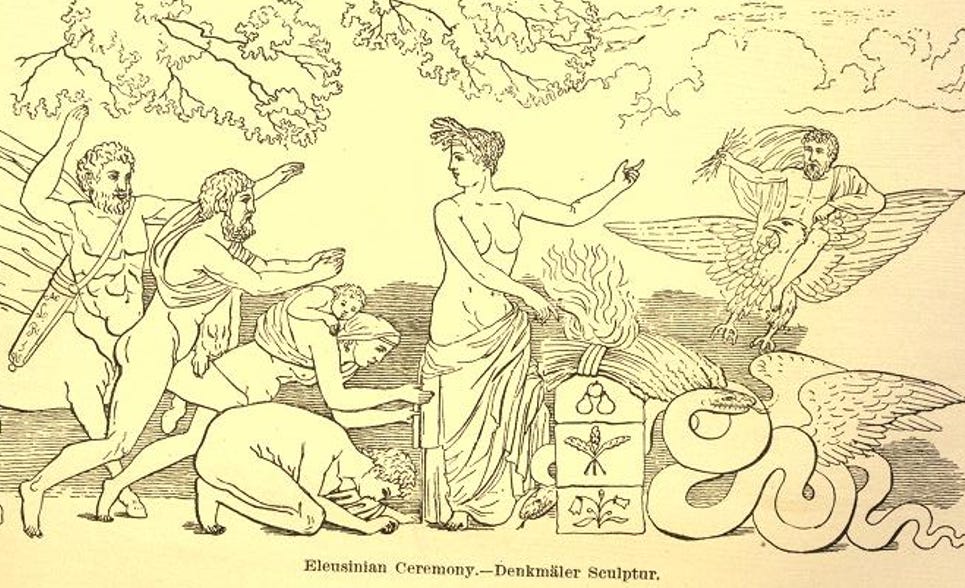
While many of these accounts are highly unlikely, the common thread among these stories (and Taylor’s own self-admitted confessions) is that he was indeed a worshipper of the gods just as instructed by the Greeks, and it was imperative to him that he correctly understood this religious and philosophical system. We can see now why Taylor’s translations remain the gold standard of all Platonic texts in the English tongue, far superior to the few attempts to manage even the extent of work that he had in his leisurely hours. Unlike the various academics and teams of international professors sedated by their sinecures, who held firm to either the old Christian or new “critical” modes of thought, Taylor actually lived the Platonic tradition. Every day he spoke prayers and recited hymns in the language of the Platonists, meditating and giving offerings in the application of this tradition as it was actually intended by the ancients: to honor the gods, and to bring man but one infinitesimal step closer to them. To err for the contemporary academic was to risk his reputation, but for Taylor it was sacrilege and a grave offense to the gods. No other evaluation could be fit to explain the quantity and quality of Taylor’s work as well as the man himself.
Taylor’s open paganism had a profound and immediate impact on the Anglophone world, sparking what turned out to be a period of genuine heathen revivalism. Contemporaries such as John Fransham too would be said to have offered libations to Jupiter, although for John these offerings was far less committed as they found themselves going “down his own throat”.8 The Romantic poetry of Keats, Shelley, Blake, Coleridge, and Swinburne—each with varying pagan souls of their own—is owed to the fact that all of them had Taylor’s books on their shelves and consumed them with the utmost pleasure. Blavatsky, Crowley, and other neopagans frequently lauded Taylor as their progenitor. The American Transcendentalist movement was arguably even more enraptured by Taylor:
The American transcendentalist movement, too, regarded Taylor as one of their prime authorities, and relied on his translations for their access to Greek philosophical thought. Emerson is said to have expressed incredulity on visiting England a few years after Taylor’s death that he (Taylor) was virtually unknown, when, he said, “every library in America has books by him.”9
The century following Taylor’s death, the Victorian Era, is most commonly remembered for its strict and puritanical character, emphasizing good commerce and conduct above everything else. Yet it must be noted that an undercurrent of genuine pagan revivalism was taking place simultaneously. Fortune telling and other occult practices were common sights on the coal-dusted streets of London, Druidric fascination with the stone monuments across the landscape was becoming fashionable, and essential literature on the topic—such as Fraser’s Golden Bough (1890)—were being found in bookstores. Occult orders such as the Golden Dawn, too, were being founded across the country. Surely, these movements were likely far too chthonic for Taylor’s taste, and there are many reasons for this resurgence. But Taylor was one of them.
Where may we place Taylor in relation to other Great Heathens? Unlike the Romantics and Transcendentalists whom he directly inspired, Taylor took to a Pagan philosophy which prioritized the intellectual and the spiritual over the body and nature. It is still fiercely debated today to what extent Platonism, be it through Plato on one end or the vegetarian Porphyry10 on the other, was effectually dualistic or world-rejecting in some sense. In some presentations it shows itself as a rather monistic or at least panentheistic worldview in which nature can be counted on to mirror and thereby reveal the divine, rather than a more gnostic one which teaches to take flight from the world at all costs. For Taylor himself, however, we can assess that his view of religion did indeed prioritize the mind, the Intellect, and the soul over the body and nature in the same way it did for many of the late Platonists. In his five personally-composed hymns attached to his translation of Sallust’s On The Gods and The World, one will see a common rehearsal of sentiments that describe the body as a prison, from which the soul is liberated from at the moment of death, a moment which the philosopher trains himself for through the intellectual and ritualistic purification of the soul. As one recent paper illustrates, “wisdom” may have even been his daimon:
Taylor claimed to have a muse who was, significantly, not one of the chorus of nine led by Apollo. Taylor called his muse Phronimus. He dedicated this Cupid and Psyche to a gentleman friend, probably his patron William George Meredith, whom he praised in a panegyric poem at the end of his introduction. Taylor wrote:
Yes, PHRONIMUS, my muse, in lib'rallays,
This friendly tribute to thy merit pays;
And ardent hopes that ages yet unborn
May see well pleas'd thy name her works adorn!
His muse Phronimus, the Latin transliteration of the Greek phronimos (φρόνιμος), was a personification of practical wisdom or prudence; it was also the Pythagorean term for the number 'three', which might have held some significance for Taylor the mystical mathematician. The Greek term phronesis means practical wisdom, being in control of one's senses and judicial prudence.11
Certainly, the three preceding Great Heathens of this series—Goethe, Lawrence, and Klages—were in their own ways critical of this approach, which risks the danger of a world-rejecting dualism in its prioritization of the unseen world over the material. Klages went as far as to describe the philosophy of the late Platonists as “the highest cornice on the Babylonian Tower of life-denying detachment from the world which the mental confusion of paganism in its final burst could attain” (Sämtliche Werks II, p. 870). Yet Taylor’s overabundance of critics is a result of his inescapable influence in reviving, for the first time in thousands of years, a genuine form of Hellenism—the worship of the Greek gods through the understood philosophy of the Platonists. Thus, Taylor is owed an incalculable debt, billed to us as an unrepayable gratitude to his life of labor and devotion without concern of fortune, fame, or health. Indeed, the propulsion of a reemerged paganism into the 19th and 20th centuries is impossible to explain without him.
Axon concludes his biography justly:
The life of Thomas Taylor, the Platonist, is one which will receive a tribute of admiration from the thoughtful. However much of an anachronism a Pagan philosopher may seem in the London of the nineteenth century of Christianity, it must be acknowledged that a man who devotes himself to poverty and study in an age and country famous for the pursuit of wealth; who has the courage to adopt and the sincerity to avow opinions that are contrary to every prejudice of the time; who runs the risk of persecution and imprisonment; a man who “scorns delights and lives laborious days,” is entitled to our admiration and respect. And such was Thomas Taylor, the Platonist, whose name should be remembered by all friends of learning and freedom of thought.
Final Note: If the reader is interested in further investigation into the work of Thomas Taylor or Platonism in general, I highly recommend The Prometheus Trust. Every article, book, and topic of research pertaining to Taylor can be found for purchase and download there.
William E.A. Axon, Thomas Taylor The Neoplatonist (1890), p. 14. This quote is not cited, so it is potentially a legendary account of Taylor’s last words.
"Modern Platonism". The Annual Register, Or, A View of the History, Politics, and Literature for the Year 1797. London: 1800, p. 439.
The Commentaries, I, p. 17. See also Steven Critchley’s 2005 PhD dissertation, PAGAN TAYLOR: THE EMERGENCE OF A PUBLIC CHARACTER 1785-1804. AN ENQUIRY INTO THE LIFE AND SELECTED WORKS OF THOMAS TAYLOR THE PLATONIST.
This can be considered a perfect summary, with true vocabulary, of Sallust’s On the Gods and the World, which Taylor first translated into English.
William E.A. Axon, Thomas Taylor The Neoplatonist (1890), p. 1
Public Characters of 1798 (Dublin), pp- 100-124, as cited in William E.A. Axon’s biography Thomas Taylor, The Platonist.
Frazer’s Magazine, The Survival of Paganism (1875), pp. 643-648
Ibid, p.648
Thomas Taylor, Wisdom’s Champion. Temenos Academy, November 2008. Access: Prometheus Trust
Porphyry: “To the extent anyone longs for the body and the things related to the body, to that extent is he ignorant of God and darkens God’s vision of him, even if in the eyes of all men he may be honored as a god [...]. Let the soul obey the intellect; then, of course, let the body be subservient to the soul.”
See note 3, Critchley’s 2005 dissertation.


His translation of Sallust's "On the Gods and the World" is a great starting point on neoplatonic thought as the original work was written for the layman/Gaius Q. Publicius.
I'm reading De Mysteriis at the moment and it's remarkable how how little of himself Taylor inserts into his translation. Other than the introduction and an occasional footnote scoffing at Thomas Gale's translation, I've only come across one personal opinion so far:
"What is here asserted by Iamblichus is perfectly true, and confirmed by experience, viz. that the passions, when moderately gratified, are vanquished without violence... a moderate gratification of the passions does not resemble the pouring of oil on fire; since this similitude is only applicable to them when they are immoderately indulged." (Chap. XI, footnote 1)
It's only one data point, but seems to clear his name against allegations of world-rejection or life-denial.