


Atheoi and Monotheoi
The Drive From Many to None

In the spring of early religious interests, I was intrigued by the philosophy of the Neoplatonic school—particularly through its comforting ability to provide complicated yet thorough philosophical structure to a religious system of cults, ritual, and practice. It was the first dips into a refreshing creek of more mystical and mythical thinking, which contrasted deeply with the pandemoniac howling of Ken Ham contra Darwin, the accessibility of salvific grace to Australopithecus. One memorable concept, regardless of its validity which I leave aside for others, was that of “the Plotinian None”. You may already be familiar with the Plotinian One—in essence, God—though this is a description of God unlike the one of Abraham: wholly unthinking, unknowable, and indivisible. The One is the “just” principle of the potential (δῠ́νᾰμῐς, dynamis) behind all of being and non-being. All well and good—but where did it come from?
Ask a Christian, and the answer is: “nowhere”. Or rather that the question misses the point: God simply is, as it was told in the tetragrammaton of יהוה, and it is this quality which binds all of existence into its extra-worldly root. Yet for the Neoplatonists and many others, they offered one explanation further, at the very rim of the knowable. Many ancient cosmogonic myths actually do start with nothing; no time, no space, no One or God. This is typically the default of the world to the Greek’s cosmogony. This stateless state, however, was a pregnant void; thus, the empty set contains all possible sets, and the factorial of zero is one. Or, in the (shockingly) more approachable words of Heidegger, “the nothing itself nihilates”, and per Kitaro Nishida absolute nothingness (zettai mu, 絶対無) is the overflowing wellspring of all of existence. In short, the None necessarily flagellates itself into the whole and indivisible One—it can do no other thing.
Very interesting. Now, what about the inverse? What if One, gripped in the anxiety of its totality, necessarily whips itself into nothing? Surely the reader of Hegel would appreciate such a concept, but I only illustrate this concept to introduce a more practical one: the monotheistic drive of spirit (Klages):
Geist’s essentially monotheistic drive motivates those scholars who seem to be compelled to subordinate everything that exists to one regnant principle. Geist aims at universal rule: it unites the world under the ego or under the logos. When Geist attained to hegemony, it introduced two novelties: the belief in historical progress on the one side, and religious fanaticism on the other. The Geist utilizes force to eliminate all possible rivals. Over the warring and agitated primordial forces, Geist erected the tyranny of the formula: for some it announces itself as the ‘ethical autonomy of the individual’; the Catholic Church, on the other hand, still relies on the idea of holiness. (Rhythmen und Runen, p. 306)
In the farthest reaches of antiquity we observe a multitude, if not an infinitude, of the number of gods. They were as infinite as the number of possible experiences—to experience at all was to experience a god—and indeed the names of gods stamp the initial experience of the “momentary god”. Turn a few pages more and you will see gods of not one phenomenologically unique experience, but of many. They became special gods: Perkwunos—the strike of thunder—became the enneagonal Perun, now associated also with law, fertility, weapons, horses, and mountains.1 In some cases, old gods were consumed and replaced by new ones which entirely digested their place: Amun and Ra became the singular Amun-Ra, and further after the roaring armies of Alexander he became Zeus-Ammon. Three gods, yet one. Across the development and urbanization of peoples we see this transition from animism to pantheism, the progression from gods of the moment to special gods of temples, polis, and patronage. Many gods were consumed in the process.
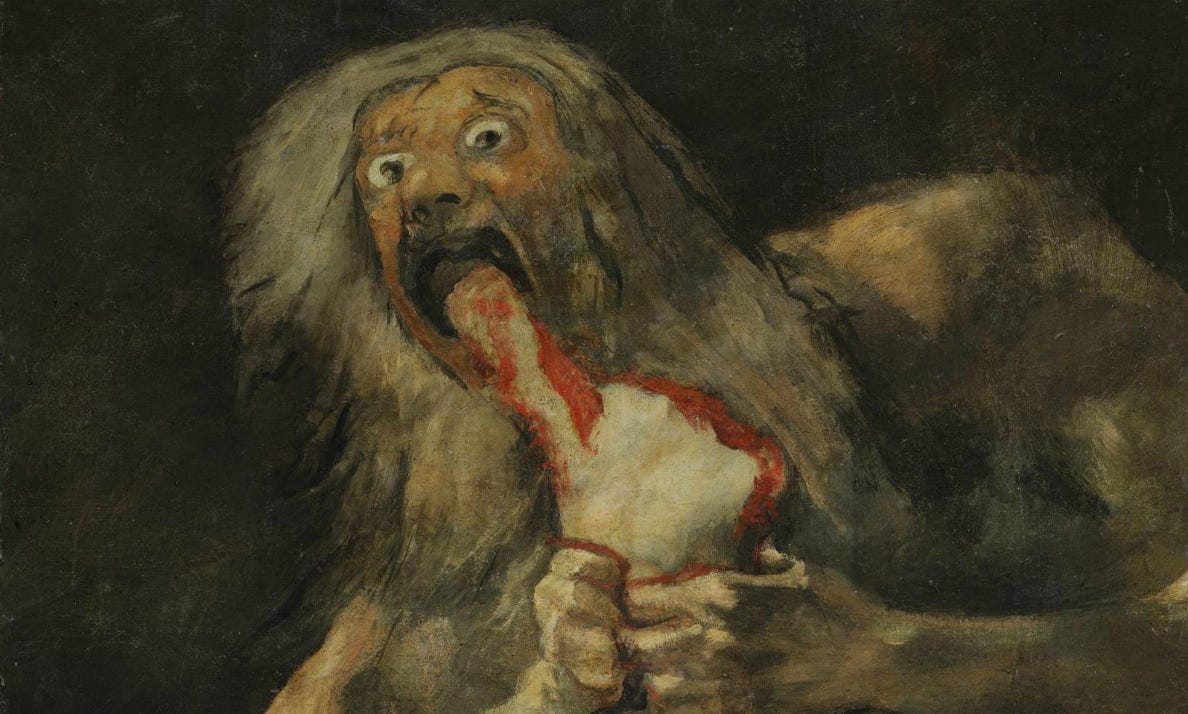
No god better exemplifies this hunger than God himself, Yahweh of the Israelites. Originally a lesser member of the court of El associated with storms, floods, and conquest, his Saturnine passion consumed the whole of Levantine religion: first he dethroned El and himself became “King of Heaven”, so convincingly so that modern peoples cannot tell the difference. Next came Ba’al Hadad, him too a god of storms and conquest; his priests butchered by Elijah’s men at the peak of Mount Carmel. Asherah, the consort of Hadad, became the possession of Yahweh until she too was consumed into what was finally left as only One: “no god but I.” Even after the crucifixion of Christ the consuming of gods into One continued in full force. The feasts, harvests, and boons of man were taken from the old gods and given to God, and what could not be reasonably attributed to him were given to his saints, angels, and often demons—which replaced that noble concept of the daimon with a being which pursues neither nurturing nor essence, but only evil. Yahweh is the devouring god, ceaseless in his hunger, unrelenting in his glutton… and now, there is no god left but him.
Necessarily, what occurs when we are left with a singular, all-encompassing force that only knows to consume? Self-annihilation, and eventually, nothing. Indeed, the commonplace slur towards Christians during the late Roman Empire was that of atheoi, god-deniers, as recorded by St. Justin Martyr: “Hence are we called atheists. And we confess that we are atheists, so far as gods of this sort are concerned…”2 What else can transpire other than the approaching of this ominous, liminal shade between One and None? Man cannot comprehend the infinite. As the edges of perception vanish onto the horizon, one cannot even pick out the blur. One iota of doubt, and the entire straining to focus on this vision gives in; it evaporates into nothingness.
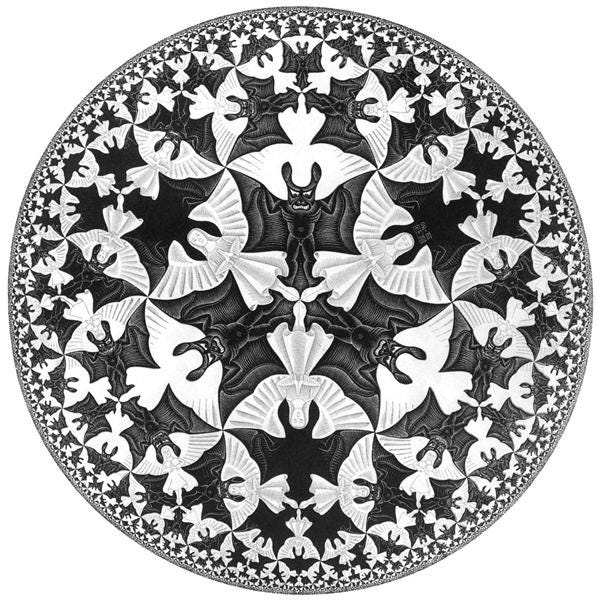
Thus, the principle of “deconstruction” enters the highest towers of Christian institutions. In order to drive at a proper exegesis of all textual and religious matters pertaining to the faith, one begins only with the outright assumption of atheism—lest he be led astray by assumptions! The true nature and attitude of God is deconstructed, the inerrancy and dependability of scripture is deconstructed, the formulas of soteriology, eschatology, and even Christology—a term which itself proves the point, the meticulous deconstructive study of the son of God himself!—all serve to disassemble the body of God; woe to the believer if he finds one atom of this disassembled body out of place. It was reasoning and willing which drove the Cross over the kurgans and groves of old, utterly ceaseless and unquenchable willing, and now it has consumed God himself. Nothing is left but the since-deified anthropocentric man, now purely made in the image of his own divine self. This is precisely what happened to the European mind, leading to Nietzsche’s heralding of a corpse. For Gauchet Christianity was “the religion of the exit from religion”, and for Weber “the disenchantment of the world”.
Spirit, timeless will, is inherently ceaseless in its cravings… the One Father soon came under assault by the knives, and was reasoned into fiction. God was tossed into a landfill of every other plastic idol that came before him and to whom he directed his followers to cast out, a decision came about in thanks to the very Logos that he was said to have given to man. At the end of this deconstruction laid only the true essences of what lay behind “man’s foolish mind” (Goethe): progress, reason, and morality. In the ultimate proof of the ongoing thesis, there lies the Nicene Creed of the modern atheist.
As indicated with a number of pre-Christian examples in the leading paragraphs, Christianity is not the progenitor of the monotheistic tendency, which can end only in atheism. It is merely its flagship and finality, the last stage of religion prior to irreligion. Antiquity is rife with the habitude of aggregating multiple deities into one, and one could spend days detailing the contributions of Platonic philosophy to the Abrahamic metaphysical tradition. Indeed, it is a tendency which seems as old as religion itself: observe it at any point in time, and you will observe it to be in motion towards atheism. The Jews were not even the first monotheists; this title belongs to the Egyptians—it was Akhenaten who first declared the cult of the One God (Aten), destroying and outlawing the innumerable cults and practices towards all other gods in approximately 1340BC. Klages, too, makes special note of this:
As an embodiment of the hostility of the allegedly monotheistic, but in actuality atheistic, attitude of thought towards the polytheistic vision, the history of religious beliefs provides one instance that, in its immediate, illustrative force, surpasses even the development of Jewish “monotheism.” We allude to the attempt of the Egyptian monarch Amenhotep IV, who adopted the name Akhenaton, i.e., “the shining disc of the sun,” to overturn the innumerable daimonic cults of his people, and to replace them with the worship of the “one true godhead”… These were the results: on the Pharaoh’s side, a bitterly fanatical struggle against all the cultic sites of the polytheists…On the side of the people, whom he had sought to please with his “higher wisdom,” a passionate and ever-increasing opposition, which, in just a few years, led to the annihilation of his work, the shattering of his great temples, the consigning of the emperor’s teachings to the death of forgotten things, and the reestablishment of an unlimited polytheism, which was to last until the very end of the history of Pharaonic Egypt! (Sämtliche Werke II p. 1266)
I find it interesting that the Sun is most commonly associated with the monotheistic drive. It therefore may be more appropriate to warn one of the Apollonian drive, as we take stock of his many aggregated qualities: healing, the silver bow, music, rites of passage… the illumination of reason and philosophy against instinct and superstition, the progress of mankind from beastly bottomlands to the clean and elevated halls of Parnassus, the impulse to dominate and control—the Will to Power. Progress and reason brought the Hyperborean’s “icy wind” that Schiller tells us of3, compressing a plethora into One. The shining beams of the Sun cling to the skin of the pharaoh, the tyrant, and the hero; it serves to elevate the individual above all else. Apollo is the god which drives pure unearthen spirit, the pure “projection” of ceaseless willing, the pure Logos; Faust and Plus Ultra, a will-of-the-wisp, a ball of burning fire which blindly incinerates as it flails across a landscape it cannot immerse itself into. We can find no greater exemplification of this drive among neopagans, the rejection of Earth in favor of spirit, than in the writings of Julius Evola, a staunch advocate for the “solar” principle:
Thus, as far as the destiny of the soul after death is concerned, there are two opposite paths. The first is the “path of the gods,” also known as the “solar path” or Zeus’s path, which leads to the bright dwellings of the immortals. This dwelling was variously represented as a height, heaven, or an island, from the Nordic Valhalla and Asgard to the Aztec-Inca “House of the Sun” that was reserved for kings, heroes, and nobles. The other path is that trodden by those who do not survive in a real way, and who slowly yet inexorably dissolve back into their original stocks, into the “totems” that unlike single individuals, never die; this is the life of Hades, of the “infernals,” of Niflheim, of the chthonic deities.
—Evola, Revolt Against the Modern World
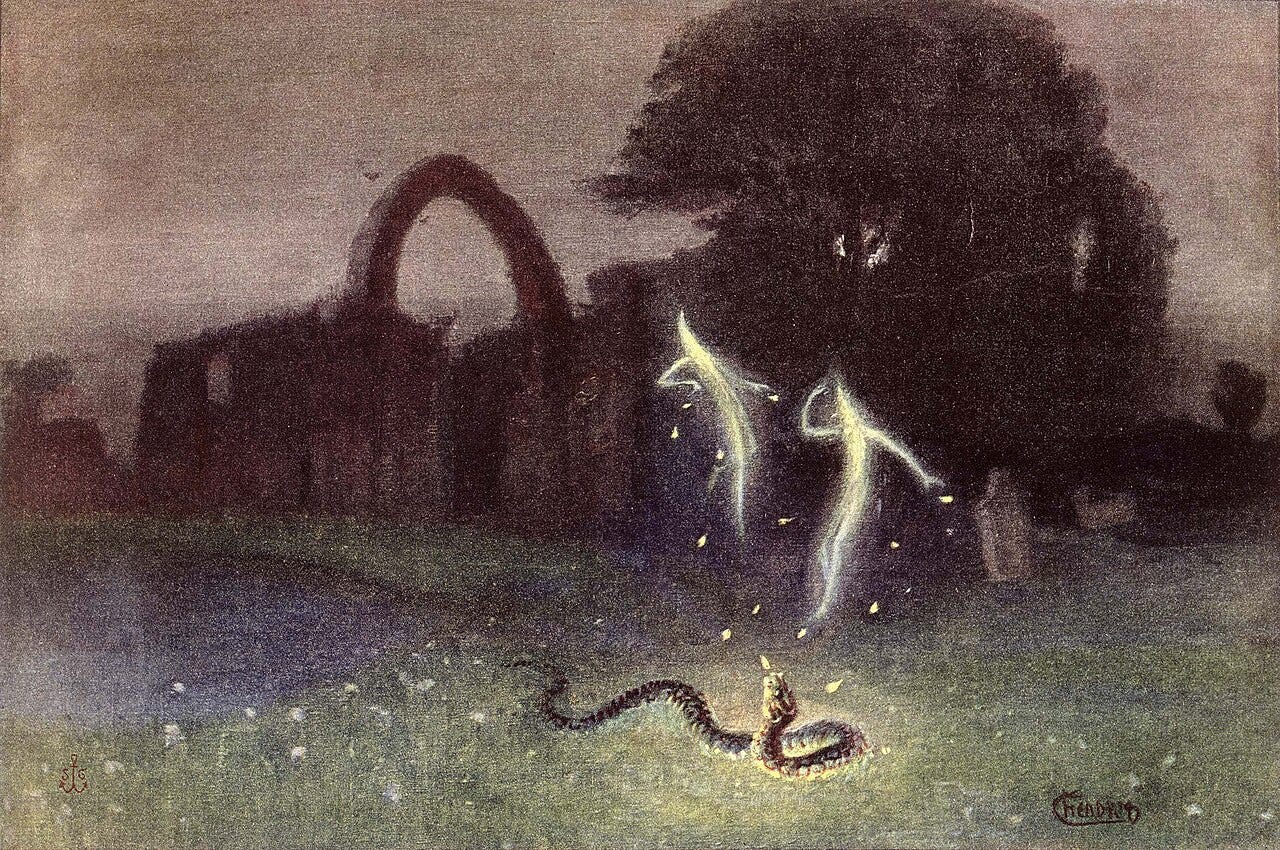
The Sun’s necessarily “puritanical” essence, through its elevation of progress, reason, and the individual, therefore stands firmly against the Dionysian principles of ecstasy (to be outside of one’s “self”, his ego), and pulse (flux, πάντα ῥεῖ). The Apollonian elevates the spirit-possessed mind above the blood, while the Dionysian acts as the body’s exorcist of this Geist. Ergo, the festivals to Apollo featured philosophical and athletic contests, while those to Dionysus featured the consumption of raw meat by wandering, entranced processions who vanished into the wild. How can anyone possibly say that the solar principle is “vital”? In its own right, it has nothing to do with it in any remote sense, and in fact, it serves to antagonize it. This conception is only possible through the idea that life is understood in its capacity for or to do something, to bring the body some place, rather than what it may be described as by its own right.
Of course, even the Christian has readily adopted the image of the Sun into his own monotheistic drive: Christ as the Solar Redeemer, the King of Kings; Yahweh reshaped in the heavenly and Earth-subduing image of Dyaus. To the silver bow they readily flock, only here to claim yet more ownership: the Logos which previously belonged to Apollo now belonged to a Sun King of their own. Progress, reason, history, morality, and civilization: they claim all of it for the Cross! Only now, using the imagery of antiquity with no hint of contradiction as many Christians have done before, they proclaim the “revolt” against the Earth itself, latching onto the myths of heroic man vanquishing nature: Gilgamesh against Ishtar and the cedar-grove of Huwawa, virile Perseus slaying Medusa, Theseus or Achilles vanquishing the Amazons. They believe they see in ancient myth a heralding of their own King and their prescribed relationship to Nature, but in fact, it is something far more primordial having its way with them. As proof, scratch the Atheoi or Monotheoi, and he will bleed thus: have you considered ethics, the nature of consciousness, or what built Western civilization?

Klages devises the idea of “Geist”, spirit, as a force which uniquely effects man “from the outside”, descending upon him at some temporal point in the not-so-distant past. Like all other contemporaries he readily identifies the Earthly with the “Pelasgian”, and the Logos with the Aryan, though only he stated an ultimate preference for the former. I do not think I can follow him down his treaded path—not because of a necessary preference for the Aryan over the pre-Aryan, or of the bottomland over the heroic, but simply because it is futile for one to attempt to kill a god, in any case. It is one thing to illustrate polarity, it is another to break the magnet in half altogether. Perhaps the lively multitude of gods was intended to protect us from the worship of One—be it Aten, Zeus, or Kristos—and Nature, too, her terrifying and destructive allure which so many myths and Romantic poetry go to great lengths to warn us of.
Access to life’s vitality is only possible through the polarity and intensification which rules its telluric and animated poles. Otherwise, it stands as an idle obelisk without a soul, or a wisp in frantic search of a suitable body. The conception that one must be rejected is precisely the problem, chiseling away at the problem with conceptions of Good and Evil one finds himself with less than he had before. One would be remiss to propose a world without the heroic adventure, without the order of temples, and without our plenty of Promethean gifts. He would likewise be in error to propose “pure reason”, the conquest and ownership of Nature, and the unmitigated Will to Power. In one chasm we are forever beasts of the wood, in the other we have departed from Nature entirely. One should act as if he were Faust descending into the formless realm of the Mothers: respecting it for the primordial chaos it is, turning the key given to him by the Light-bringer, and shaping the void into the beauty of Helen.
Caution must be exercised, an understanding reached. Otherwise, the hungering Sun will devour many gods into One, and the One into None. In either case, may we hope that the void we find ourselves in today is as fertile as all others.
Faust [terrified]. Mothers!
Mephistopheles. Do you fear?
Faust. The Mothers! Mothers! Strange the word I hear.
Mephistopheles. Strange is it. Goddesses, to men unknown,
Whom we are loath to name or own.
Deep must you dig to reach their dwelling ever;
You are to blame that now we need their favour.

See Hermann Usener, Götternamen, 1896.
Martyr’s First Apology, Ch. 5. https://www.newadvent.org/fathers/0126.htm
Schiller’s Gods of Greece.


It is very interesting how religions tend to drift into a monotheism devoid of spirit. I am sometimes reminded of contemporary neopagans who only pay attention to one God (like Wotan), or obsess over “solar vitality” and whatnot. It is also interesting to note that, while Evola characterized the Sun as masculine, the Germanic peoples always saw the Moon instead as a masculine deity, and more appropriately characterized the Sun as feminine.
The problem with the thinkers is that they always overthink. In truth, man and life itself cannot exist without the two extremes. Life and matter alike came to be within the warm gap between the fire and ice. No life is possible without male/ female , life and death, day and night, man and women, and so far. In some respect, Apollo and Dionysus are mere two faces of the striker for fortune