


Goethe and Schopenhauer as Darwinists (II)
Schopenhauer, Evolution, and the Vital Will

Urge and urge and urge,
Always the procreant urge of the world.
—Wittman, Song of Myself (1892)
Our previous article delved into the curious, but now apparent, inverse association between Platonic and Darwinian thought. So apparent and so convincing is this relationship that the evolutionary biologist Ernst Mayr credited it to being a major stopping block in the delayed advancement of evolution as a science. Additionally, we have set forth the notion that Darwinian evolution can be thought of as a return to pre-Socratic thinking in that it rejects eternal discontinuities in nature in favor of the conception of “flux,” and we have evidenced the first fresh breaths of this return to pre-Socratic wisdom and scientific achievements in the Naturphilosophie of J.W. Goethe.
Goethe and Schopenhauer as Darwinists (I)

Progress has not followed a straight ascending line, but a spiral with rhythms of progress and retrogression, of evolution and dissolution.
We spent a second or two illustrating the concept of “Goethean Science”, in comparison to Goethe’s evolutionist thought, through his renowned Farbenlehre, or theory of color—the principles of “intensification” and “polarity” driving his phenomenological approach to both color and organic life. Goethe was not alone in developing this theory of color; indeed, he was no exception in the longstanding academic tradition of selecting a worthy pupil to take under his wing for a period of time. The young man that Goethe selected for this endeavor is one very familiar to us today: Arthur Schopenhauer.
The two eventually split during this endeavor due to intellectual differences pertaining to their theories, with Schopenhauer going as far as to publish his own theory in competition to that of Goethe’s through his 1816 On Vision and Colors. Nevertheless, Goethe’s was a theory that Schopenhauer openly praised and admired its creator for its basis, whatever their disagreements may be. Much of the same can be said of Schopenhauer’s own flavor of “evolutionary” thought: there exists a tinge of the pre-Socratics, a salt lick of his mentor’s image—but, mostly, a treasure trove of his own maverick ingenuity. Such is Schopenhauer’s influence, as we will see, that strains of his thought can be seen in both vitalism and modern evolutionary thought.
Those who are more acquainted with Schopenhauer’s philosophy are already muttering to themselves, “Schopenhauer, a repudiation of Plato…? He deified him!” And for many reasons, they would be entirely correct. The aroma of Platonism seeps into every crevice of Schopenhauer’s philosophy: he happily borrows the concept of Form/Ideals precisely as defined by Plato, accepts discontinuities in nature, and does not permit them to change over any period of time or stress. That is the precise inverse of pre-Socratic and evolutionary thought, and we can see as much in the first volume of The World as Will and Representation (or Idea, Vorstellung):
Accordingly, what follows, and this has already impressed itself as a matter of course on every student of Plato, will be in the next book the subject of a detailed discussion. Those different grades of the will’s objectification, expressed in innumerable individuals, exist as the unattained patterns of these, or as the eternal forms of things. Not themselves entering into time and space, the medium of individuals, they remain fixed, subject to no change, always being, never having become. The particular things, however, arise and pass away; they are always becoming and never are. Now I say that these grades of the objectification of the will are nothing but Plato’s Ideas.
Further, the inverse relationship between Platonic and evolutionary thought is doubly reinforced through Schopenhauer’s use of the Platonic system within his own. For him, organic life too was such a “Representation” of the Ideal, and therefore, fundamentally immutable in terms of its population’s character and form. Of course species may go extinct, but the dog may not grow wings and become a bird, and the sludge of an agar of bacterium may not develop into a stalk of kelp. He explains:
This desire [of a species’ will to self preservation], regarded from without and under the form of time, shows itself in the maintenance of that same animal form throughout infinite time by means of the continual replacement of each individual of that species by another… in other words, in that alternation of death and birth which, so regarded, seems only the pulse-beat of that form (εἶδος, species) which remains constant throughout all time.
Even in Schopenhauer’s 1836 Über den Willen in der Natur, published just two decades before Darwin’s Origin of Species, we find Schopenhauer leveling a number of serious critiques against the (already not even Darwinian) theory of life from Jean Baptiste de Lamarck. For Schopenhauer, the idea that an organism could change in response to its environment was completely ludicrous—the animal’s structure was willed into existence, not forced upon it by the other way around. Put it this way: if the Will is what is responsible for a species’ Ideal, and the Will is purely outside of time and space, how could the Ideal of a species possibly change? This was a central assault on Schopenhauer’s early philosophy, and as Mayr had assessed for the other German Idealists, was a disparity which largely prevented him from engaging in the genuine evolutionist thought that would soon be put forth by Darwin and Haeckel. Or, as Kuno Fischer more bluntly put it, “Schopenhauer blames De Lamarck for representing animal species as evolved through a genetic and historical process, instead of conceiving of them after the Platonic manner.”
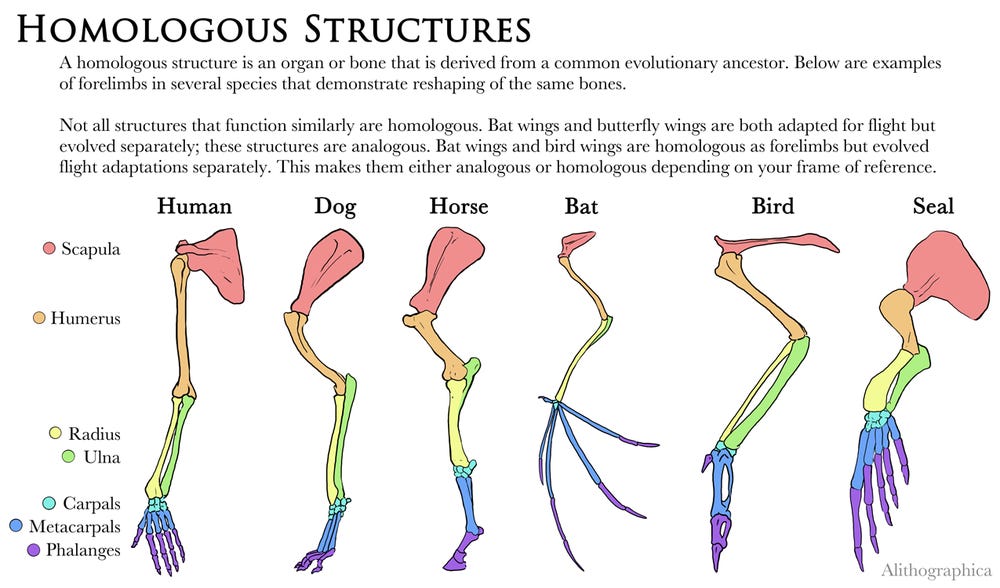
At least, this is the more simplistic view of Schopenhauer’s philosophy that the historian Arthur Lovejoy so beautifully dispensed with in his 1911 Schopenhauer As An Evolutionist. As Lovejoy points out, just a few pages down from this excessively Platonic conception of nature and species, one will begin to read in Schopenhauer’s explicitly evolutionist framing. More importantly, he does so by referring to what is still today one of the strongest arguments in favor of the idea of “descent with modification”—homologous structures. Strangely for him this was not evidence of modification as such or any notion of change, but rather the permanence of structures as generated by the Will:
But if [an animal] wishes to fly through the air as a bat, not only are the os humeri, radius and alnus prolonged in an incredible manner, but the usually small and subordinate carpus, metacarpus and phalanges digitorum expand to an immense length, as in St. Anthony’s vision, outmeasuring the length of the animal’s body, in order to spread out the wing-membrane. If, in order to browse upon the tops of very tall African trees, it has, as a giraffe, placed itself upon extraordinarily high fore-legs, the same seven vertebræ of the neck, which never vary as to number and which, in the mole, were contracted so as to be no longer recognizable, are now prolonged to such a degree, that here, as everywhere else, the neck acquires the same length as the fore-legs, in order to enable the head to reach down to drinking-water. […] In accordance with these transformations, we see in all of them the skull, the receptacle containing the understanding, at the same time proportionately expand, develop, curve itself, as the mode of procuring nourishment becomes more or less difficult and requires more or less intelligence; and the different degrees of the understanding manifest themselves clearly to the practiced eye in the curves of the skull. […]
We must therefore assume this anatomical element to be based, partly on the unity and identity of the will to live in general, partly on the circumstance, that the archetypal forms of animals have proceeded one from the other […] No other explanation or assumption enables us nearly as well to understand either the complete suitableness to purpose and to the external conditions of existence I have here shown in the skeleton, or the admirable harmony and fitness of internal mechanism in the structure of each animal, as the truth I have elsewhere firmly established: that the body of an animal is precisely nothing but the will itself of that animal brought to cerebral perception as representation—through the forms of Space, Time and Causality—in other words, the mere visibility, objectivity of Will. For, if this is once pre-supposed, everything in and belonging to that body must conspire towards the final end: the life of this animal. Nothing superfluous, nothing deficient, nothing inappropriate, nothing insufficient or incomplete of its kind, can therefore be found in it; on the contrary, all that is required must be there, and just in the proportion needed, never more. For here artist, work and materials are one and the same. […] Each organism is therefore a consummate master-piece of exceeding perfection.
—Schopenhauer, Über den Willen in der Natur, [273-277]
In a lesser-known essay of Schopenhauer’s titled Philosophy and Natural Science (Parerga and Paralipomena, Vol II), we read in Schopenhauer an increasing awareness of evolutionary evidence. He indicates that humans likely originated in the tropical Old World due to the lack of short-tailed apes in the New World, that Europeans acquired pale skin due to a long process climatological adaptation that affects all life, and even postulates that some species were generated from previous ones. As Lovejoy argues, this is likely due to the influence of two key early Darwinian theories circulating at the time. The first was Herbert Spencer’s “synthetic philosophy” in his First Principles, and the second Robert Chambers’ Vestiges of the Natural History of Creation. Both set forth the conception that all of existence was in continual change with its current forms springing forth from earlier and more primitive forms, a process that included even inorganic matter such as stars and planets.
Of course, he mostly accuses Chambers and others such as Agassiz of making themselves “ridiculous by speaking of the origin of nature like old women” with “a mix of the crassest materialism and the crudest Jewish superstition, which are shaken together in their skulls like vinegar and oil”. Yet his forced awareness of fresh evolutionary evidence is apparent, and this, I believe, finally shows what Schopenhauer is trying to do exactly. He finds himself combatting to different elements in thought in Europe: on one flank the “Hebrew superstition” of Christianity and arguments of a “benevolent Creator”, and on the other flank the increasingly-popular materialism of the natural sciences—both of which are well represented by Spencer and Chambers, respectively. Thus, he requires an explanation for nature that does not rely on the trappings of either camp. The result is an early form of the biological vitalism of men such as Henri Bergson, the belief that mechanical or causal interactions alone cannot explain the inner workings of life:
For whoever denies life force basically denies his own existence, and therefore can boast of having reached the highest peak of absurdity. However, insofar as this cheeky nonsense has emanated from physicians and apothecaries, it moreover contains the basest ingratitude, since it is the life force that overwhelms illnesses and leads to the cures for which those gentlemen afterwards pocket the money and write receipts. – If it is not a unique force of nature, for which operating purposively is as essential as it is for gravity to bring bodies together, that moves the whole complicated machinery of an organism, steering, ordering and manifesting itself in it like gravity in the phenomena of falling and gravitation, or electric force in all the phenomena produced by the friction machine or the voltaic pile and so on – well then life is a false illusion, a deception, and in truth every being is a mere automaton, i.e., a play of mechanical, physical and chemical forces brought to this phenomenon either by accident, or by the intention of some artist who simply likes it this way. – Of course physical and chemical forces are at work in the animal organism, but what holds them together and guides them so that a proper organism comes of it and exists – that is the life force; it accordingly controls those forces and modifies their effect, which is therefore only a subordinate one in this case. On the other hand, to believe that they alone could bring about an organism is not merely false, but as I said, stupid. – In itself that life force is the will.
—Parerga and Paralipomena Vol II, §94
Biological vitalism was arguably entering its most prominent period during the mid-19th. At about the same time, Carl Reichenbach had published his theory of the “Odic force”, which imbued life with its electromagnetic properties. Even when Louis Pasteur refuted the idea of spontaneous generation from his famous experiments, he settled upon the notion that this was the case because of life’s inner vital force. Thus, Schopenhauer has plenty of company in his critiques of the mechanical (Darwinian) and Creationist arguments pertaining to life. Yet this cannot take away from the fact that in this one statement, “In itself that life force is the will”, Schopenhauer reminds us of his essential role in the generation of both biological vitalism and Lebensphilosophie more generally. How interesting given his ascetic (and often suicidal) inclinations!
In the history of Western thought, this is an important and remarkable conception, as it finds itself sitting right atop the knife’s edge of its Platonic past and its “mechanical” future. One can sense, from a very distant bird’s eye view, a sense of bargaining in the biological vitalist found in Schopenhauer as he seeks to create a new theory of life in contest of the other two. On one hand we are presented with a static universe full of discontinuities, seen in the existence of homologous structures which, for Schopenhauer, is somehow evidence of the unchanging form of the species itself. No greater discontinuity can be found than the sharp distinction between the living and non-living, and indeed, this is the entire impetus of biological vitalism. In this sense, Schopenhauer’s criticism of Lamarck, Spencer, and Chambers is somewhat similar to contemporary arguments pertaining to “irreducibly complex structures”, albeit in a purely metaphysical tone. The structures as possessed by these species are subtle variations of one primordial structure—the Urstruktur, if you will— otherwise, in the distant past of Lamarck’s evolutionary history we would see animals entirely without bodies, not yet willing towards anything! To go further, every animal is a perfect Representation of what it has Willed to be—otherwise, it could not exist, and would die from its own want.
On the other hand we have, as an indication of what was rapidly becoming common in Western thought, the conception that these forms are somehow related to each other through means of descent. Only for Schopenhauer, it was differences in how these species willed towards some phenomenon within its unique environment that spurred the variation. Nevertheless, the injection of descent into the discussion was crucial for the coming Darwinism.
In the previous article on Goethe, we discussed Ernst Mayer’s notion that the lasting residue of Platonism within Western thought greatly delayed the advancement of evolutionary thought and particularly so for the Germans. Schopenhauer can certainly serve as a clear example of this problem: his confrontation with the growing scientific evidence of the evolutionary process within life was forced to pass through a Platonic filter of his own insistence, and thus the bastard child of biological vitalism was born. It would not be until the late 1960s until this theory of life was completely defeated through the discovery of DNA and increasingly confident experiments and theories pertaining to abiogenesis, which made clear that life was fundamentally driven by chemical processes (the Central Dogma) and arose gradually from inorganic matter.
However, this is not to say Schopenhauer’s Lebensphilosophie more generally is to be cast out with the tumor. The illustration of nature as fundamentally a struggle for existence is essential to the Darwinian model, as is the notion that something which exists must necessarily will to do so. In this way, Schopenhauer’s philosophy can survive through a “generalized vitalism” which applies its concepts to all of existence rather than attempting to elevate biological life above the inorganic, all the way up to modern evolutionary theory. Consider the following passage from Richard Dawkins’ The Selfish Gene, which remains a core aspect of evolutionary theory today:
Darwin’s ‘survival of the fittest’ is really a special case of a more general law of survival of the stable. The universe is populated by stable things. A stable thing is a collection of atoms that is permanent enough or common enough to deserve a name. It may be a unique collection of atoms, such as the Matterhorn, that lasts long enough to be worth naming. Or it may be a class of entities, such as rain drops, that come into existence at a sufficiently high rate to deserve a collective name, even if any one of them is short-lived. The things that we see around us, and which we think of as needing explanation—rocks, galaxies, ocean waves—are all, to a greater or lesser extent, stable patterns of atoms. Soap bubbles tend to be spherical because this is a stable configuration for thin films filled with gas. In a spacecraft, water is also stable in spherical globules, but on earth, where there is gravity, the stable surface for standing water is flat and horizontal. Salt crystals tend to be cubes because this is a stable way of packing sodium and chloride ions together. In the sun the simplest atoms of all, hydrogen atoms, are fusing to form helium atoms, because in the conditions that prevail there the helium configuration is more stable. Other even more complex atoms are being formed in stars all over the universe, ever since soon after the ‘big bang’ which, according to the prevailing theory, initiated the universe.
—Ch. 2, The Replicators
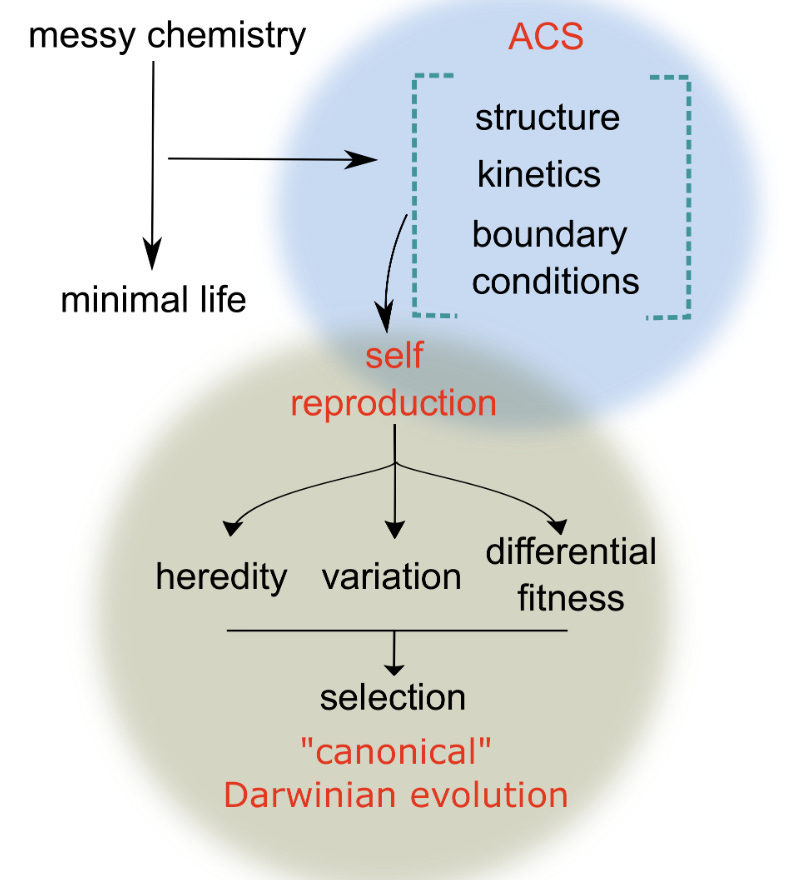
Doubtless, this is an echoing of the arguments made by Spencer and Chambers that Schopenhauer criticized so harshly. Yet there is an irony involved in that the Will can serve as a fascinating explanation for evolution and the origin of life, provided it is permitted to operated as a generalized vitalism. The will to exist may be interpreted as Dawkins’ “stable chemistry”, as that which does not strive towards or possess it ceases to be—tautologically. Even more interesting is that this harsh confrontation with death and nonexistence upon every glimmer of reality is the driving force of evolution found in selection: “stable” or “willing” things will tend towards variation and a stronger likelihood in its own survival through self-reproduction over an infinite time frame, or die! The existence of our own genes at the present, generated from an infinite past of such “willing” stable states, is firm and immediate evidence of this conception. Looking back upon the many ways this “immortal coil” has mutated to bring us into existence is a worthy meditation on the play between the pre-Socratic principle of flux and the Platonic principle of form.
Schopenhauer would surely object to much of this in some way if he were alive, as he would object to the materialism in Darwinian thought more generally. Yet as critics have been happy to point out to Dawkins and the rest of the mainstream of evolutionary science since the 1960s, the principle of the selfish gene achieves its finality in the destruction of the individual. It is not the species which evolves, it is not even the individual who is in control of his own body, rather he is a hostage to these willing replicators which had thrown him into existence a blink of the eye ago. Yet, rather than the inborn vital will of an organism stretching out into nature, it is the cold talons of nature herself which strikes and cudgels life into its diverse graveyard of fruits and errors. One wonders what a trove of lovely and terrifying thoughts someone like Schopenhauer would have to say on the matter. For these things, we leave to future thoughts.


Carl Reichenbach's Odic Force changed how I saw nature and reality. I learned of that maybe in early highschool. It sent me down a long and esoteric path that I still do not fully understand (because I am retarded). These most recent articles of yours have helped put some of that into better framing for me.
I’ve imagined Schopenhauer’s vitalism was more generalized and less biological. From “The Will in Nature”:
… not only the voluntary actions of animals, but the organic mechanism, nay even the shape and quality of their living body, the vegetation of plants and finally, even in inorganic Nature, crystallization, and in general every primary force which manifests itself in physical and chemical phenomena, not excepting Gravity,—that all this, I say, in itself, i.e. independently of phenomenon (which only means, independently of our brain and its representations), is absolutely identical with the will we find within us and know as intimately as we can know anything;