


Goethe and Schopenhauer as Darwinists (I)
Greek View of Life; Goethe's Evolutionary & Vitalist Thought

Progress has not followed a straight ascending line, but a spiral with rhythms of progress and retrogression, of evolution and dissolution.
—J.W. Goethe
Contrary to the typical historical illustration, by the time Darwin had published his Origin of Species the West was already accustomed to his general trajectory of “evolutionist” thought. The relationship of species upon their homologous organs and structures was already long an accepted theory, advancements in geology had shown that the age of the Earth was certainly more than a few thousand years, and intellectuals such as Saint-Hilaire, Chambers, and Cuvier had already put forth a number of models showing the increasing diversification and complexity of organic life over distant eons. Darwin’s achievement was not so much as shocking the world—a duty belonging to the aforementioned—but more in making it comfortable for the public, now certain and beyond all possible disbelief in what would be called “evolution”.
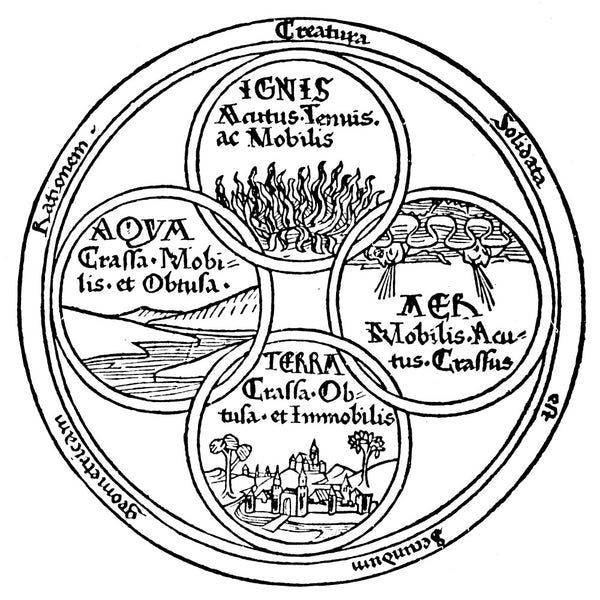
Of course, strains of evolutionary thought can be seen even in the distant pre-Socratic Greeks, who offered no shortage of different theories on the essence and qualities of nature. Empedocles is often credited with the first naturalist theory of evolution, whereby organic life arose naturally by and remained driven by the push of “Strife” and the pull of “Eros” between the four classical elements. Perhaps most interestingly, he offered up the possibility that such a cosmogonic drama was bound to make innumerable strange mistakes: necks without heads, legs without feet, and even the mythological beasts of multiple combined natures—the minotaur, centaur, gryphon, and sphinx. Most of these mistakes were incompatible with nature, perishing immediately or eventually; those which were compatible or offered an advantage would persist. Thus, as distant as the 5th Century BC, we have shimmerings of the concept of “the survival of the fittest”. Yet even further back we may look to Thales and Anaximander, who offered that the essence of the world (Ἀρχή, first principle) was water—fluid, dynamic, and alive (τὸν κόσμον ἔμψυχον, the world lives). The fluid nature of the world could be, for the Meletians, symbolized by the mythological Proteus, that mythical shapeshifting ἅλιος γέρων (old man of the sea). Heraclitus in a similar but unique fashion postulated the first principle to be that of fire, of ceaseless and unending change which consumes the once-fixed position of all things.
Yet the strain of thought that was favorable to the naturalistic view of organic life would soon be replaced by another: that life-denying “instrument in the disintegration of Hellas” (Nietzsche, Twilight of the Idols) that was put to work in the philosophy of Plato and Socrates, which in its intellectual and moralistic discomfort with “flux” set atop our world another of permanence and unchanging “Ideals”. The result of this shift in philosophy produced a set of ideas that earned Plato the title of “the great anti-hero of evolutionary thinking” according to the biologist Ernst Mayer, who attributed to this shift four distinct concepts:
There are four concepts that appear particularly important in Agassiz’ [a critic of Darwin] thinking: (1.) a rational plan of the universe, (2.) typological thinking, (3.) discontinuism, and (4.) and ontogenetic concept of evolution. Each of these concepts is rooted in Greek philosophy, particularly that of Plato, and we will not be able to discuss the evolutionary consequences without an occasional reference to the philosophical basis.
—Mayr, Agassiz, Darwin, and Evolution (1959)
Through its proud and long-lived daughter in the Christian Church, the Platonic conception of nature had rested its laurels on top of the West with this understanding for thousands of years. The world was rationally ordered in the higher realm, and from it came a certain “plan” that produces the material realm. This plan produced organisms which belonged to certain immutable categories or “body-types”, a fundamental discontinuity which could not be transgressed by mechanical causes; the concept of “species” is denied as a material reality and only a “category of thought” (Agassiz), in a clear Platonic spirit. One can see all of these philosophical assumptions in the whole of the Creationist reply to evolutionary theory even today, in its insistence that—to give a couple of examples—“a dolphin could not evolve from a dog” (violation of immutable types or “baramins”), or that “random mutation could not possibly explain the aggressive mimicry of the rove beetle, or of the spider-tailed viper” (appeal to the rational plan of the world). Looking at you, Bennett!
Thus, the relationship of Platonism and its slow repudiation across the history of Western thought remains an underappreciated element in explaining why the theory of evolution arose when and where it did. The first cracks of the eggshell which returned to the pre-Socratic world of ceaseless change, fully imbued with the life of the divine gods (πάντα ῥεῖ, πάντα πλήρη θεῶν), can be understood as a significant contribution to the genesis of evolutionary thought—even if their respective thinkers retained significant residues of Platonism in other respects.
As a matter of fact, the germinating seeds of evolutionary thought were so plentiful throughout the 18th and 19th centuries that one could wonder what took it so long to finally be presented as a cohesive and unique theory of life. Perhaps it was because there was an innumerable quantity of varied “philosophies of life” sprouting and spreading throughout this period: lebensphilosophie, idealism, naturphilosophie, vitalism, Romanticism, and so on. Mayr was of the belief that the residual Platonism in these systems of thought explained why German zoologists in the 19th century struggled to explain what the Englishman so effortlessly put to print. However, in each of these systems, it is not too difficult to detect both direct and indirect influences upon the later scientific evolutionary theory. Strangely, a system of thought which was intended to rebuke the “mere materialism” of its English and French contemporaries found itself as a key scaffold for the later whole of evolutionary theory between Darwin and Dawkins.
A fitting example of this philosophical inquiry towards organic life that heralds the future evolutionary dogma can be found in the works of J.W. Goethe, who himself was a key contributor to a number of “evolutionist” breakthroughs. During his travels to Italy in his 30’s, he studied the organs and structures of plant life in search of what he called the Urpflanze, the singular plant from which all other plant life could generate from. Though even the description of one species being produced from another is revolutionary, he went further in formulating the first theory of homologous structures in his Metamorphosis of Plants (1790), which showed that certain organs and structures of plant life were common to different species and, potentially, generated from the same ancient source. He even went as far to describe the nature of plant life as “Protean”, referring to that mythical god of ceaseless change and disguise which so perfectly illustrates the evolutionary perspective. To boot, some years later he would again display the importance of homologous structures by discovering the previously-mythical premaxilla bone in humans, which was at the time thought to have belonged only to apes—not man.
In Goethe’s early evolutionist thought we see two concepts utterly essential to the later theory of Darwin: 1.) the relationship of all life through modification, and 2.) the inclusion of man into this theoretical framework of nature. For thousands of years had the Platonic concept of the “Great Chain of Being” stood tall, enforcing not only a rigid and changeless description of nature with each species representing its designated “ideal form”, but the primacy of mankind atop all others as closest to divine perfection. Now, through Goethe and his contemporaries, we see the first inklings of its inevitable collapse. For the first time since the pre-Socratics, we were taking seriously the proposition that all of Nature is fundamentally interconnected into one—diversified only by degree, and never by kind.
However, one must remember Goethe’s position as the standard-bearer of Romanticism—it was not his intention, and would be his disgust, to simply formulate a material or subject-less science. Goethe and his contemporaries were more accurately “metaphysicians” of Nature, who sought to descend into the depths and essence of life, and in stark opposition to the materialism of Bacon and Descartes who sought to erect firm barriers between observer and the observed. This experiential approach to science was the basis of his namesake “Goethean Science”, which served as his guiding light for not just his own endeavors, but later philosophical approaches to science such as phenomenology, too.
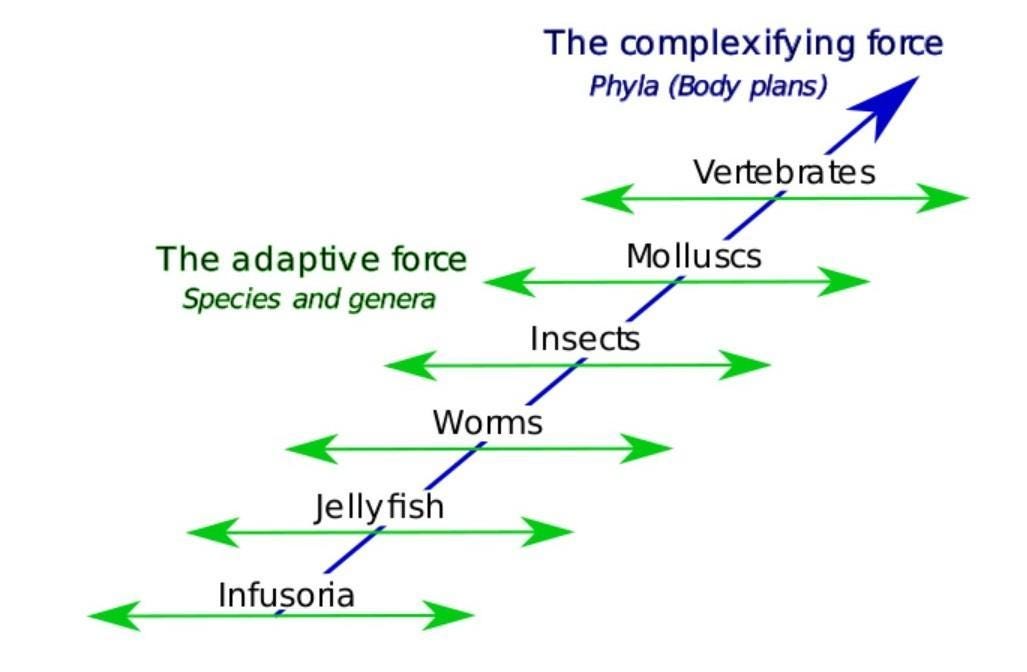
We still see the residue of Platonism in Goethe’s evolutionism in that be describes organic life as ceaselessly “striving” (Streben)—just like his Faust, who himself delved into the eeriness of shadowy and formless realms—towards some preordained and perfect end. True to this general belief, in Metamorphosis he attributes the homologous structures of life to two natural forces he termed as “polarity” and “intensification” (Steigerung). While polarity more mystically refers to the push and pull of opposites (such as in sexuality, color, magnetism, chemistry, and other phenomena), intensification or “enhancement” refers to life’s unending striving towards complexity and perfection. For Goethe, and at some level not entirely incorrectly, this was the natural explanation for how more simple plant-types such as ferns could become the vibrant and reproductively-complex angiosperms from the same “primordial” leaf. Therefore in applying his own flavor of orthogenesis that is not too dissimilar from that of Lamarck, Goethe most significantly differs from Darwin in that he believed the variation in nature came not from the organism’s interaction with external nature, but from within life itself, from its own vital essence. The result is a teleological structure of nature where life—conscious of it or not—”strives” ever higher towards more complex, more perfect, more fit forms. In Goethe we can still see clearly something of a “Great Chain”, though now it is something which is in a perpetual state of self-driven flux.
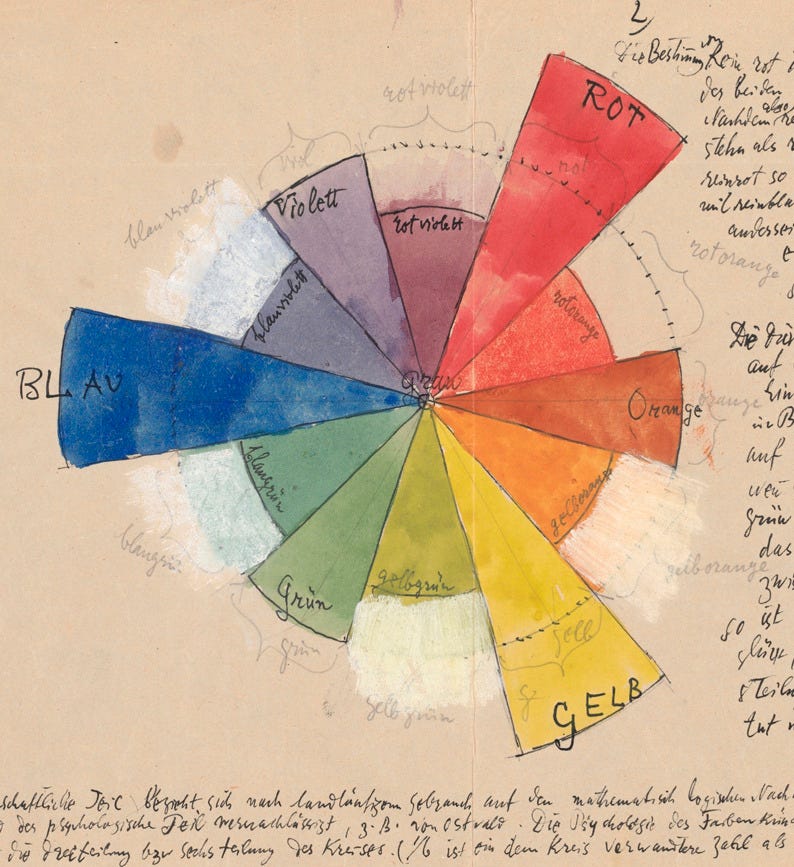
To provide what may be an illuminating adjacent example, much of the same is visible in Goethe’s theory of color (Farbenlehre). Firstly, it too was presented specifically to counter a materialist theory, in this case Newton’s theories of light in Opticks. In doing so, Goethe once again relies on a primordial, immaterial existence of an Urphänomen which manifests itself in physical reality: color does not arise out of the diffraction of pure light as it does for Newton, but from the energy generated by the polarity between light and darkness. Each color has its polar opposite, and can be further manipulated by the force of intensification. For example, as the Sun lowers in the day and loses its power, yellow-white is darkened into red. So too is it the case for plants, and all of organic life: it is generated firstly out of the polarity between organic and inorganic, depends yet further on polarity for its (sexual, chemical) regeneration, and can be further intensified into different forms. In both theories of Goethe, as well as the whole of his approach to nature and science, we see clearly his emphasis on underlying, guiding forces which are external to mere materiality.
Goethe, who was adored by so many as an influential hero beyond all others, had one hero of his own that he repeatedly called back to in all of his endeavors—Baruch Spinoza—and it is here where his early theory of evolution is most clearly understood. The influence of Spinoza’s monistic philosophy on Goethe is precisely why he believed that scientific inquiries should reflect upon the wholeness of existence, rather than meticulously isolating, or “controlling”, various phenomena as a Baconian would. It further encouraged him along these endeavors in the first place, as according to Spinoza, “the more we understand particular things, the more we understand God.”
Ergo, Goethe’s Urpflanze is not an actual common ancestor as what would be shown in later Darwinian theory, but the archetype of “the plant” itself produced by an overabundant flowing of nature—natura naturata produced by natura naturans. This was no small thing: for the first time, the classification of organisms was being treated in a concrete rather than abstract sense of “body plans”. In a strange way, this metaphysical thinking provided a newfound basis for the art of taxonomy, to which modern scientists are still indebted to:
Goethe’s Spinozistic insight is that the grouping of things in a class is only symptomatic of their partaking in an underlying concrete thing. As such, their participation in a genus is not merely predicative, as in Linnaean taxonomy, but concrete. The theory behind this assertion is resoundingly Spinozistic: what makes me what I am is not the class I belong to but the thing I am modificatory of. In the context of Goethean morphology, the archetypal leaf, or the modular vertebra, or the vertebrate body plan are not categories but names for concrete processes that express themselves divergently, in certain and determinate ways. Ultimately, Goethe’s notion of the archetype takes us from a taxonomy of distinct species to a pre-classificatory field of generative processes. Ernst Cassirer brilliantly summed it up by saying he was the one who “completed the transition from the previous generic view to the modern genetic view of organic nature.”
—Michail Vlasopoulos, Spinoza’s God in Goethe’s Leaf: The Spinozist Foundation of Goethean Morphology
Where does all of this leave Goethe in our “Great Chain” of naturalistic philosophy? In many respects, Goethe is (like Spinoza) still a Platonist at heart: he relies upon the existence of “higher absolutes” to drive life in some direction, and had no conception of the idea of “common descent”. Yet despite the clear differences with contemporary evolutionary theory, Goethe still provided a clear template for organic life to change, adapt, and generate new form—the central essence of evolutionary theory in its rejection of Platonism. His was an illustration of nature that did not feature static and fixed forms decided upon some few thousand years ago by a benevolent Creator, but one of ceaseless flow, change, and evolving states of being. And so, in reflection of such an ever-changing and dynamic world, Goethe returned to the wisdom of the pre-Socratic Heraclitus:
If we look at all these ‘forms’ [Gestalten], particularly the organic ones, we will discover that nothing in them is permanent, defined, or at rest—but all is in a flux of continual motion [πάντα ῥεῖ]… When something has an acquired form, it immediately metamorphoses into the next.


I’ll wait for part two, but I think that suggesting Anaximander’s Apeiron as inclusive to a kind of process ontology or pantheism is a disservice.
His rendering of the ultimate is notably far more abstract and immaterial, as it’s an indeterminate principle that’s responsible for the dependencies we find in nature or conditioned things.
If what you mean to say is that he has an idea about moisture being primordial factor in the development of things, it could be inclusive. But I feel like Apeiron specifically is more dianoetic than Thale’s theory of water or Heraclitus’s Fire, and that this was an important departure from what he was inspired by. It would be more along the lines of something like Brahman rather than a more immanent vitalist kind of monism.
Nitpicking obviously but it’s interesting you included it.