


The Graveyard as a Place of Life
On Death & Immortality

I have long engaged in prevarication on the question of my coming internment. Oh, the options!—so many options. Perhaps down in a plot amongst thousands in a well-kept sanctuary, or entombed deep below coursing sands with a sacrificed pet or two to keep me company, maybe set ablaze atop a grand pyre and ashes kept in a jar above the hearth; why not, far from the asphalt, simply sloped next to a fledgling oak for whom my bones may feed? I grant myself too much of a romantic vision, it could be my fate is to be pecked by crows as I rot in a small iron cage. Prevaricating, still. The truth is, the question troubles me substantially more that dying. There’s nothing to be done about one’s end, but here, the way I end my life and propel its memory into the world yet to come—if at all—is something where actions will be of consequence.
The graveyard is rightly seen as a place of the dead. For most, this is an antiphrasis of sorts—the graveyard is more accurately hallowed, haunted, a liminal keeping where spirits may be appeased by family or offended by thrill-seeking children. But the sentimentality I often find myself in knows the graveyard as truly a dead place. A place of nothing. They frighten me not by presence but by lack, and the sight of thousands of neatly-rowed tombstones where an individual is lost to the mass of human history is utterly forgotten. Here is the ignoble passing of everyday time, where new bodies pile besides yours in the mechanical work of a rented backhoe which shocks a funeral’s sacral nature into an abrupt end.
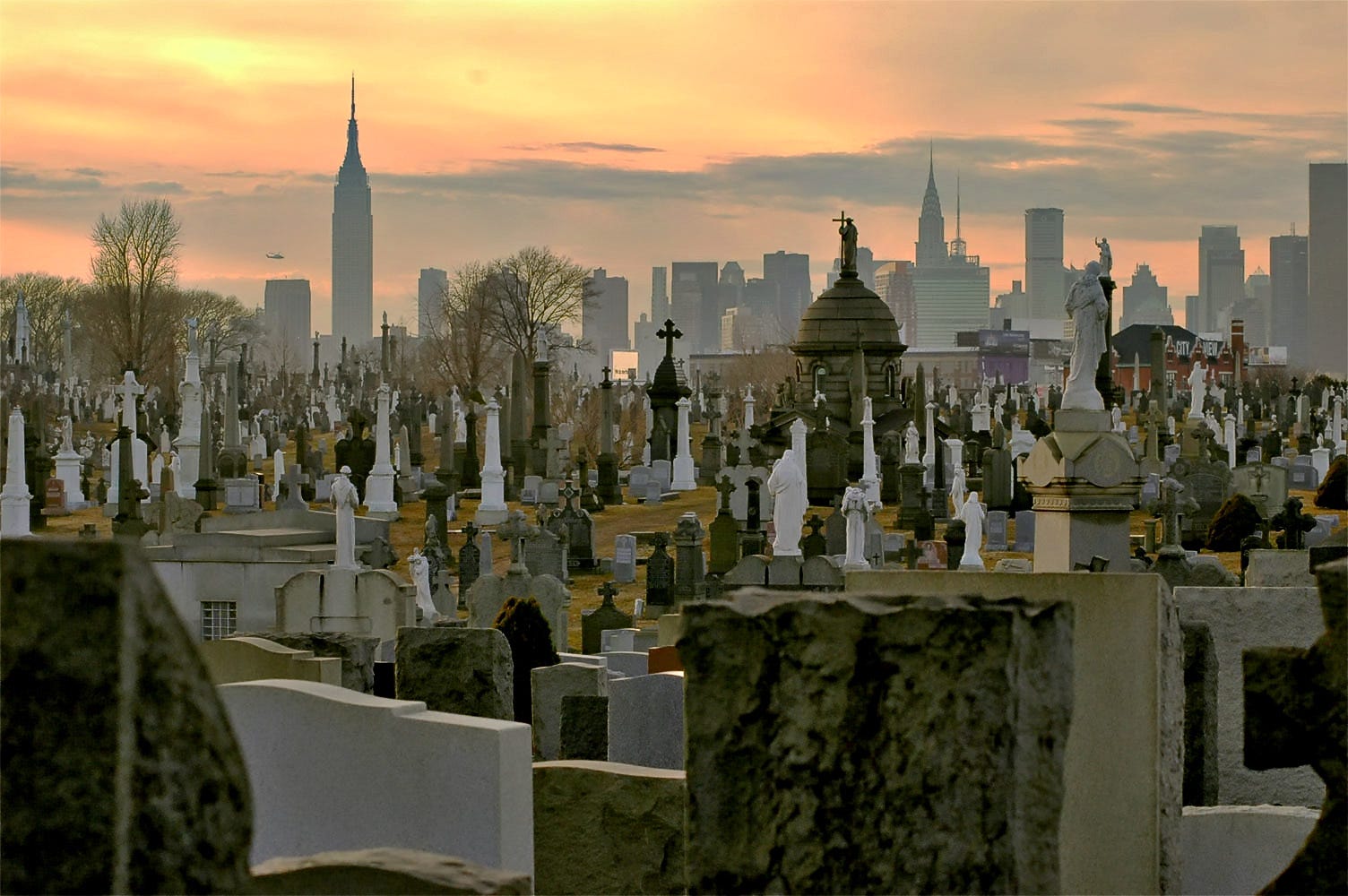
It can often be difficult to identify cultural practices in the West which are unique products of Christendom, unscathed by the inculturations of the converted heathen. This is less substantially a problem for our approaches to death and inhumation, which in many ways bear clear distinctions from the old understanding. For the Christian, the utmost care and respect is to be given to the dying and to the dead, as their bodies will one day be needed again. One day, for which no man knows the hour, the dead will rise out of their graves and embark on a grand procession of the un-dead to the end of the world. One would prefer to still have his limbs and tongue for this great day, and so for centuries the burial practices of the West entailed an elaborate art of preservation which went well beyond chucking someone into an exposed pit. We can be reminded of this conception’s staying power by the fact that at the end of the 17th Century, Robert Boyle was performing experimental proofs that such a “general resurrection” was possible under the laws of natural science. Today, this understanding is unconsciously carried forth by the embalming of the body and pumping-full of preserving formaldehyde, with the finishing touch of one’s Sunday best for when he meets his creator. Many other Christian rites retained this ancient character of the delicate care for the dead and dying, perhaps best seen in the Roman Catholic traditions of the anointing of the sick and Feast of All Souls, where candles are lit upon the tombstones of ancestors in their memory and their honor. It’s a lovely thing, something I have forced my own family to partake in.
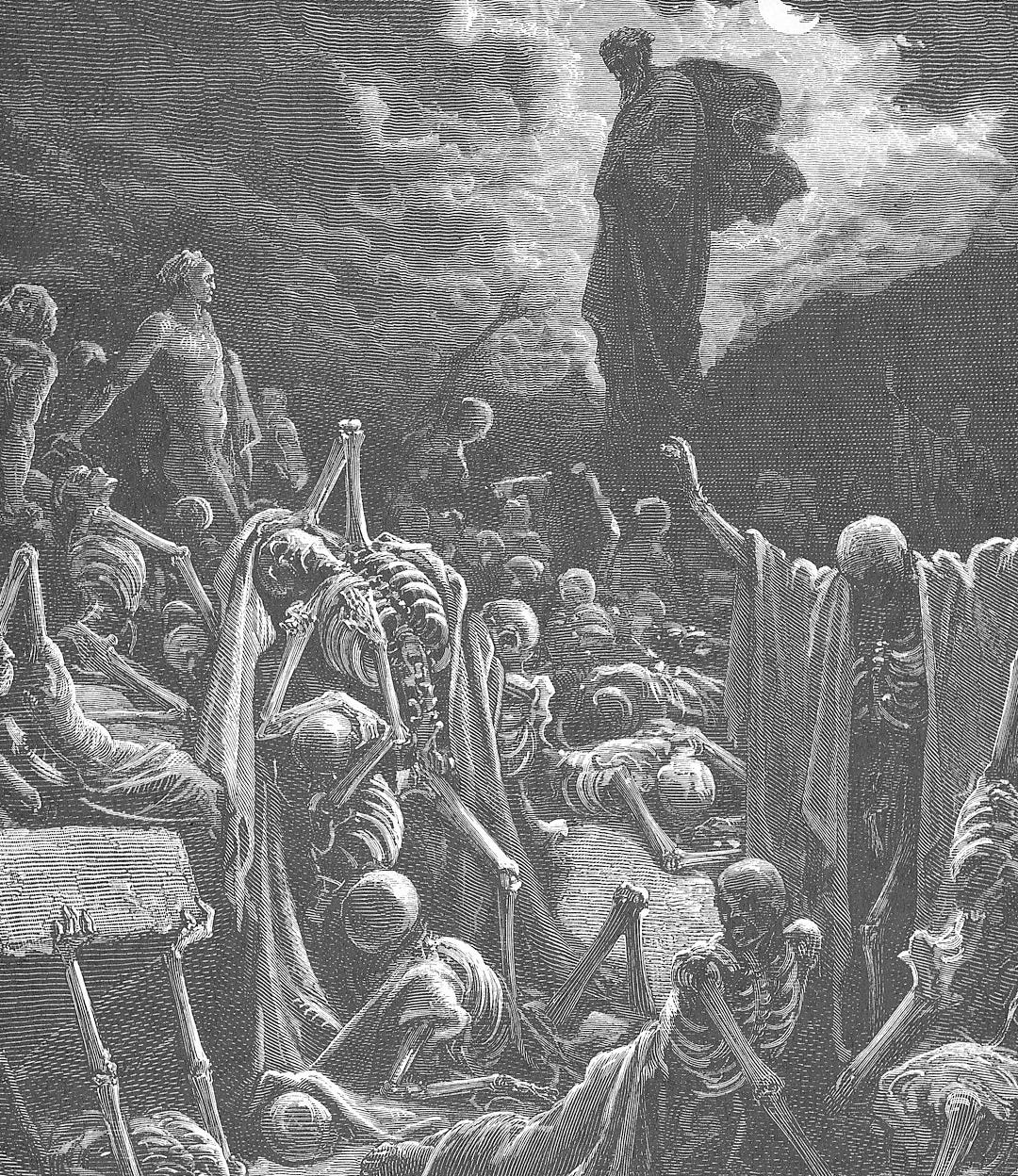
Yet our contemporary understanding is much different, even if presented as only a technical addition to previous beliefs. Whether or not it is “true” to Christendom or native only to a few denominations, I leave aside, noting only what I witness among the many. Ours holds deeply to the idea of the soul—that is, the self—and its existence after death. When one dies, he shuts his eyes but only for an instant, and then he awakes in a corporeal form of his living body, and takes in an awareness of his Judgement. Perhaps it’s something of a court drama, where God takes his time rewinding your life’s moments before you. Or, maybe you just open your eyes and find yourself laying in either a golden meadow or scorching brimstone. To the point: you are not there, lifeless in your now-lowering casket, as strangers and old friends will be sure to console your family with the fact of your presence “in a better place”. The importance of the graveyard, as a result, suffers dearly. Pave over it if you’d like, these are but cadavers and dust who no longer bear any relation to the purified and eternally happy souls “beyond” in the bosom of God.
I do not know what “eternal life” means, only that it in actuality points away from life entirely—”not here”. I do not believe in it at all, this separation between an immortal soul and a perishing body as we understand it, and under the best circumstances of this belief I could only manage the conception of where it returns to its godly origin and loses all distinction—that is, finds its annihilation. But I do understand and believe in immortality, in unending presence. This is a different understanding, perhaps the most ancient, which slumbers at length before showing itself once more as it did with Iambichlus and Ludwig Klages. The distinction between the two (seemingly synonymous but in fact antonymical) concepts is that one pertains to the preservation of what has been, while the other promises something that never will. One instills everlasting life, the other relentless creation. One promises the defeat of death, the other necessitates it.
We can investigate this distinction by recalling, for a moment, that statue of the slain Commendatore in Mozart’s Don Giovanni, who is mockingly invited to dinner by the hubristic Don Juan. The vengeful statue comes to the dinner he was jokingly invited to—Don Giovanni! A cenar teco, m’invitasti! The statue commands Don Juan to repent for his acts of rape and murder, and when he refuses, opens up the gates of hell to claim Don Juan for eternity. Perhaps it is no wonder that those Early Christians, in a rare moment of worldly wisdom, ran around the continent exorcising the statues of antiquity of their imbued “daimons”, in which they vandalized their perceptibility by chiseling off the nose and face—if only for their own safety! What the Commendatore may serve as an example of is how images, memories, or copies of oneself may “haunt” the living, especially those who make the foolish mistake of assuming such “statues” are wholly inanimate.

In 2013 the French historian Dominique Venner wrote on a small note, “I am healthy in body and mind, and I am filled with love for my wife and children. I love life and expect nothing beyond it, if not the perpetuation of my race and my mind.” This note would be found on his body after he put a gun in his mouth before the altar in Notre Dame. I believe he had an intuitive sense of what I am describing here, something available only to those of a pagan disposition—that life, far from fit to be slandered as of a “fallen” nature, is all we have. Immortality is therefore conceivable only through two paths: memory, and progeny. Venner is survived firstly by the family he brought into existence from himself that he loved so much, and secondly “the perpetuation of race and mind”: his thoughts, his worldview, his disposition, which more than a decade after his death we still discuss here. He explains this sentiment further elsewhere, which by all accounts he held true to:
We must also remember, as Heidegger puts it, that the essence of man is in his existence and not in ‘another world’. It is here and now that we play with our destiny, right up until the final second. And this final second has every bit as much importance as the life which precedes it. We must then be entirely ourselves just up to this last moment. And it is in deciding this, in wishing directly your own destiny, that you vanquish the abyss. We cannot escape the requirement: we have only this one life, a life in which it falls to us to be entirely ourselves, or be nothing.
—Venner, La manif du 26 mai et Heidegger
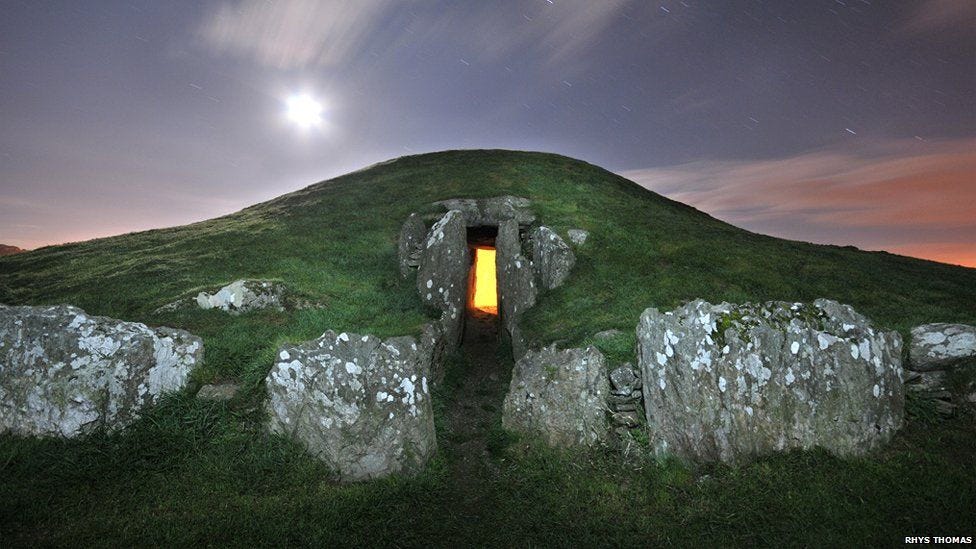
Now I know why the ancients were not gripped by the terror of death as we are. Now I know why they buried their cherished greats in towering earthen mounds, where the living situated themselves between their buried ancestors below and the blazing moons above to receive wise council and to dance with gods. Now I know why the straight-tied victors at Nuremburg decided to gather the ashes of the executed into a single heap, and scattered them in an unknown ditch so that no future pilgrims could come to honor them.
When one drags his fingers across the faintly-chiseled names of eroding tombstones, he may reflect upon the necessity of the sting that brought forth the new sprout such as he, and how immortality is conferred only through death. Here we may consider an attempt to unravel the mysteries of Eleusinian rites, where a perfect ear of corn is harvested and processed from Athens to Eleusis. Initiates flocked to this procession along the road, seeking the immortality so strangely symbolized by a grain that had already begun to wither. In the Telesterium of Eleusis, initiates are said to have descended into the realm of Hades himself, where a hierophant forced them to witness a number of certain “hardships”. One such experience may have been the revealing of that ear of perfect corn, surely by now rotten and succumbed to mold, which was then cut in half as part of a dramatic sacrifice. The initiated, now having rehearsed death, return home with a full understanding of it—and with that, a full understanding of immortality. Now the Earth would go still for the winter, Persephone slumbers in the underworld as bargained, but soon to herald the promised bursting of new life.
No, the graveyard is a site of life. The graveyard is the place not of the dead or of the “departed”, but of the immortal and ever-present. The dead are not so indescribably distant but here, beneath our feet, within the rhythms of physical life and imbued within the flesh and memory of their progeny—us! It is here we may wish to be possessed by the image of our ancestors who act upon us in this eternal moment of the present.
Prevaricating, still.
One day I will have a tomb of my own, be it a concealed ditch or a grand mausoleum. I can only hope that it will be a place that is distinguished and identifiable, where descendants and initiates alike may flock to commune with me. May they situate themselves between my bones and the gods as others have done before. If I am so lucky for any of this—and indeed many of us will serve more silent and passive roles in this procession than others. In my summer I look onwards to winter, where I find myself at the call to retire. May it be a graceful bow, and may the next set of performers keep me well in mind and body, as my sinking-in forever stamps its mark onto the eternal now.
In a closing remark, allow me to quell the apparent narcissism in what I have said thus far. There is a scene from Philip Glass’s opera Akhnaten that I have come to adore and embody, though I am unsure if it is a message which was consciously put forth. The great pharaoh Amenhotep III has just died, and his spirit looks on as his body is embalmed, wrapped, and placed into a sarcophagus during a magnificent ceremony. His consort takes his heart, cut freshly from his cold chest, and places it upon the scale—light as a feather. No time is wasted, and his son Akhnaten is coronated as the new pharaoh, father still watching. Yet it is at this point where his son decides to abandon his father’s path, declaring for the first time in recorded history a monotheistic cult, devoted to the sun-god Aten. In this moment of the opera, which acts-out the famed Window of Appearances, the spirit of Amenhotep does not haunt or shout. He lowers to his knees and genuflects before the living body of his son, who now alone bears the god-king’s torch.
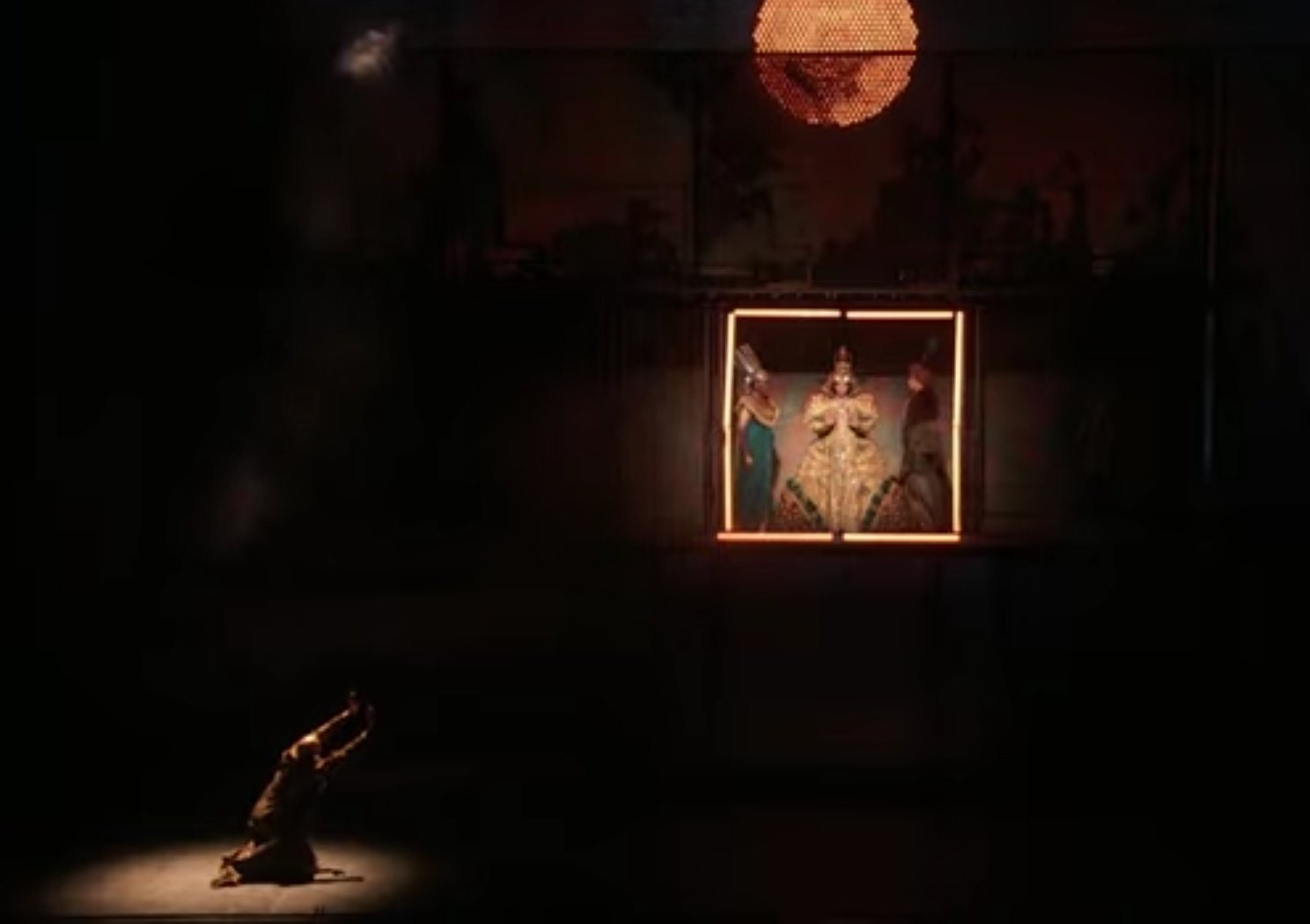
There is a way to harmonize the conceptions of ancestor worship and the dead prostrating before the living, as I have alluded, but I wish this to be an exercise left to the reader. Let that be this article’s lesser mystery. To my end I will carry this little gnosis, hoping it to be more noble than the prevailing sentiments of today—of hatred of life and fear of death.


Great article. I could've sworn this passed my inbox before now, but I realized that you've just been touching on this for a while and finally put it down in full. Glad to see it written, and your prose is getting to be the best on Substack.
"we have only this one life" from Venner...
Well, partly why I turned from Christianity when I was younger was this idea that we only live once. I disagree somewhat, but perhaps after I lay out the rest of my comment, you can dissect my thought process here. The Celts speak of the transmigration of the soul, or rather Caesar wrote about this and the Irish sagas seem to affirm it, along with sacred images such as those found on the Gundestrup Cauldron (the real "holy grail", the one warriors drink blessed alcohol from after battle, with the blessings of their superiors in victory). This idea gripped me so much that I could no longer conceive of one life, then an eternal existence either in Hell, Heaven, or some other idea presented to me in my youth. I kept thinking about my head, my soul, and the mounds of our fathers. I've visited every cemetery of my forefathers that I could find, and each time I've treated it like a meeting of sorts. They were *there* and yet, they are with me. Am I not just an extension of them? My life is an unbroken chain connected to the lives of my fathers. My life did not start with me. My life will not end with me. It is connected in a very real way to those who came before (ancestor) and those who follow after (descendants). This is immortality. This "passing of the torch" or, more viscerally, the sculpting of my flesh into the visage of my fathers. My face bears the signs of both sides of my fathers. This is the transmigration of the soul, the continuation of life. Tech Duinn may gather all sons of the Gael, but we pass through and return again.
I want my ashes to be put into a stone and that stone put into the pommel of a sword, and this sword to be used by my descendants. How prideful of me to think this could ever happen, but it's been my desire for over a decade now. At the least, I will be pleased with the continuation of my line and race. Then, my face will never fully disappear, and my words will always linger. I could not find every grave of my fathers, but their memory remains with me. This is immortality.
How much of my face and mind are echoes of my ancestors? How much will echo in my descendants? Can I truly say any of it is mine at all?
For my part I am with Ozu, I want only a bare stone marked “無” to let passers-by know that nobody at all was once here.