


Amor Fati & The Blue Flower
The Paradox of Striving Within the Inescapable

The boy lay tossing on his bed, and thought of the stranger and his talk. “It is not the treasures,” he said to himself, “that have stirred in me such an unspeakable longing; I care not for wealth and riches. But that blue flower I do long to see; it haunts me and I can think and dream of nothing else.”
—Novalis, A Romance: Heinrich von Ofterdingen (1802)
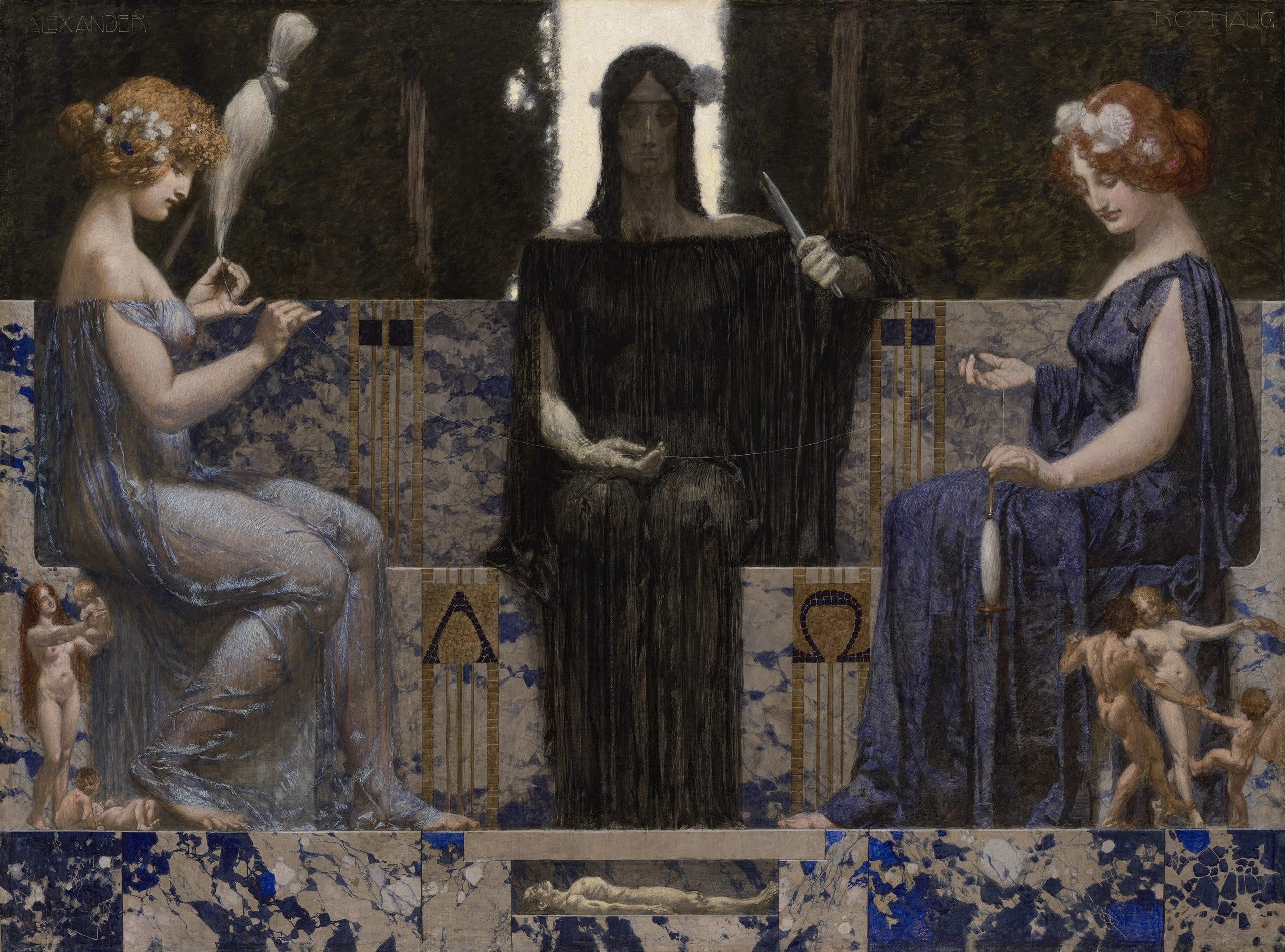
There are a number of aspects that serve as delineations between pagan and Christian religiosity, of which are endlessly litigated in terms of their perceived and actual significance. The life-affirming and life-rejecting dialectic, revealed orthodoxy against experienced phenomena, or a universalist versus tribalist ethos. Much can be said about the success and failures of these criteria to accurately describe the sheer alienness of one worldview against the other. One distinction stands out above all of the others as possessing a certain level of bite that is undeniable to either side: fate.
Christian man has all but destroyed the concept of fate, labeling it a fancy of various misunderstandings of causality; and worse, the rejection of human moral agency. Fate was cast to the street and replaced with “Providence” by Aquinas, describing it as not a tragic fact of life but as—merely—the manner in which secondary causes proceed from the First. With this unraveling of the fetters of old covenants came the supremacy of the human individual and his will, along with all of the “fallen” nature entailed. Yet the transformation was complete: few today believe in fate as such, transgressing little further than Aquinas’ description of causality. Not even the most ardent of defenders in the doctrine of “predestination” are careless enough to confuse fate for God. The result is our common conception of religiosity: there is man and his foolish and heroic acts, and above patiently and curiously observes the Lord, ordaining a will of his own.
For the heathen, fate is the singular law which binds all of reality to its snare. It is known by many names in many cultures: the Moirai of the tragic Greek; the Parcae of the ever-pressing Roman; Belisama of the terrifying and mystic Celt; wyrd and the Norns of the icy-veined Teuton. Fate was not only a law laid down upon man by the gods, most principally Zeus and Wotan, but something the gods themselves were subject to. Aeschylus tells us in Prometheus Bound, “Even he (Zeus) cannot escape what is foretold.” Wotan is told of his coming and inescapable doom by a volva, and fetters himself to the world-tree to unlock the mystery of the runes; Prometheus is chained as punishment for his violation of divine order, and the Moirai spin and weave threads of cloth which ensnare the whole of existence. So too was this imagery of binding adopted in a literal sense among the rituals of pre-Christian peoples, exemplified best by the the Semnones according Tacitus, who describes a sacred grove of which no man may enter, “unless he is bound with a cord, by which he acknowledges his own inferiority and the power of the deity.” In contrast with the Christian worldview of free agency and an looming God above, the pagan worldview recognizes the futility of resisting one’s ordained nature and end. He willingly submits to it, as his gods have set a wise example of such.
There is an apparent, curious, contradiction upon the face of pre-Christian attitudes towards fate and free will. On one hand it presents a reality where inescapable destiny rules all affairs—not even the gods can escape their coming Twilight. On the other hand, it illustrates a world of powerful heroes and the actions of truly great people, each striving towards beauty, towards perfection, and towards excellence.
We can point to no greater example of this dilemma than that of Achilles himself. The literary device of “the choice of Achilles” has fascinated and granted great meaning to men for millennia, from Homer himself, to the Roman poet Horace, to Goethe, to Spengler, and finally with Mishima: shall this warrior-king of Phthia stay in his fertile land of the Spercheios, ending his long life surrounded by his well-reared descendants… or shall he don the burden of immortality, to leave behind the Argos Pelasgikon and land fifty ships of Myrmidons upon the shores of mighty Troy, never to return? He is given a clear choice in the matter—his agency is in fact meaningful—and yet, his tragic and glorious fate has already been settled. Achilles is a doomed man; he is reminded of such constantly, and it weighs heavily upon his conscience throughout his story.
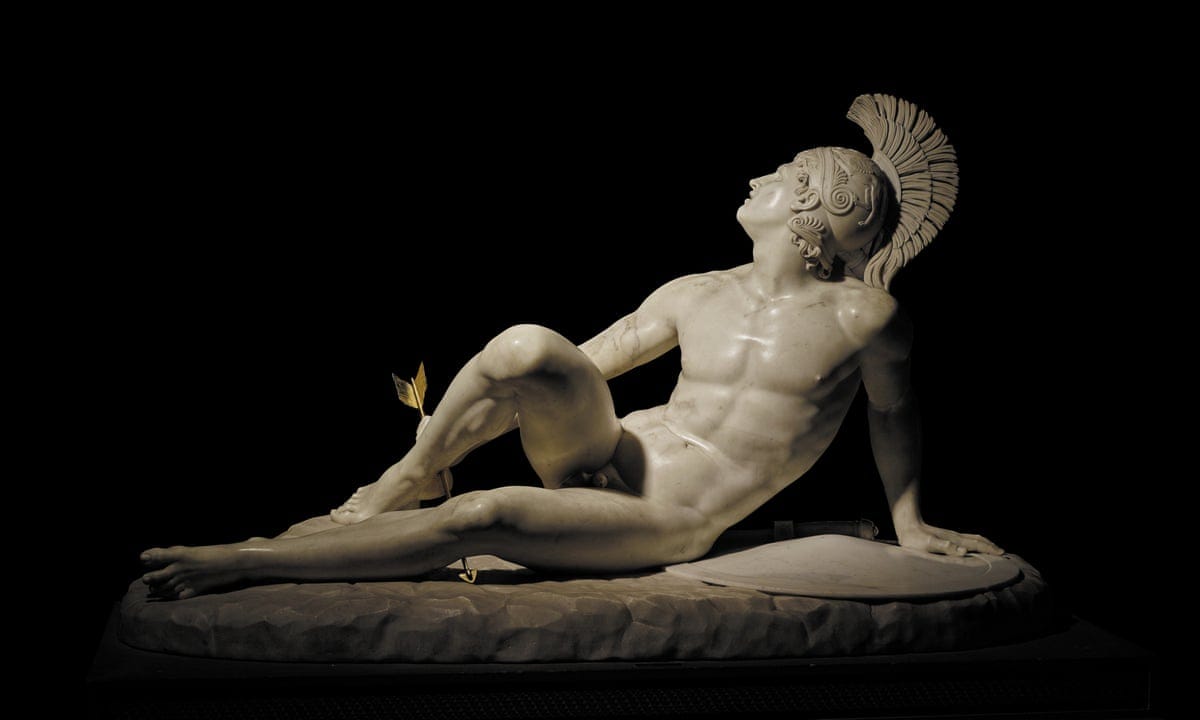
What can be said of this? The reader must forgive me for skipping over nearly 2,700 years of fair answers to what I believe is most succinct, from the hearts of Germans who were seized by the phantasmal image of the hot bronze and windy seas of heroic Aegea. The Romantic poet Novalis is quoted in his unfinished revival of the legend of the Sängerkrieg, Heinrich von Ofterdingen, with the following: “I often feel, and ever more deeply I realize, that Fate and character are the same conception”. Or, more simply, “Character is fate”—a nearly identical revival of the wisdom of Heraclitus, “ethos anthropo daimon” (ἦθος ἀνθρώπῳ δαίμων). We see now more clearly how it can be said that a god, pure of its own essential character, can be ensnared by the loom of fate!
Achilles was offered a choice, as we all are in this life of an infinite series of such choices, significant or not. Yet Achilles was still Achilles, bound by his imprinted constitution, the fact of how “my native land has breathed upon me my earliest thoughts and imperishable colors”, as Novalis says before. Ergo, there is no reality where he elects to stay in his homeland, lest he not be Achilles! Choices are made upon us in our birth and rearing which determine our own, which set us upon paths were we react yet more predictably. I do not consider this slavery, for it is simply character. I am I, and if I were not, I would not be. This is an entirely different conception than the ones echoed today by vague sentiments of “the accidents of one’s birth”. I assure you it was no accident—no other reality could exist but it. Perhaps this is what Pindar meant through that oft-quoted line, “Become such as you are, having learned what that is”.
Novalis gifted the Romantic movement with its most cherished symbol through Ofterdingen, the blue flower, an image of the longing desire for the fundamentally unattainable. The association of the blue flower with fate is redoubled by the irony that Ofterdingen was never completed, with Novalis dying of tuberculosis at just 28 years old. In the fragments which he blessed us with while living, he illustrates the dream of a young boy (perhaps a dream of his own), of an overflowing bower in the center of which stands a tall, singular, light-blue flower. He is ensnared by it, desiring it, approaching… and then wakes. Novalis had much planned for this little flower which haunted his nights, intending to use it as both an impetus for romance, the relationship between poets and poetry, and the tragedy of life itself. Much is evident from the following note of his, which aimed to remind him of his story’s outline:
He soon reaches that wonderful land in which air and water, flowers and animals, differ entirely from those of earthly nature. The poem at the same time changes in many places to a play. Men, beasts, plants, stones and stars, the elements, sounds, colors, meet like one family, act and converse like one race. Flowers and brutes converge concerning men. The world of fable is again visible; the real world is itself regarded as a fable. He finds the blue flower; it is Matilda, who sleeps and [soon succumbs to illness]. A little girl, their child, sits by the coffin, and renews his youth. This child is the primeval world, the close of the golden time. Here the Christian religion is reconciled with the Heathen. The history of Orpheus, of Psyche, and others are sung.

Heinrich was fated to hold the blue flower for but a moment until it vanished in an event of unspeakable tragedy, so goes the unfinished work of an author who succumbed to such a sorrowful fate as his own. Why, at all, do we then strive towards the unattainable? It is not possible, fruitless and pointless, non Plus Ultra. Yet we persist—why, what is the point? For the Christian this is relatively simple to answer, “With man this is impossible, but with God all things are possible” (Mt 19:26) as they are told in scripture, and the equation is similarly proofed through the blood-purchased promise of eternal life. Matilda, Novalis—they go to God. Where they do employ a sentimentality towards fate or “predestination”, it is shrouded in purely negative language, of “fear and trembling” (Ph 2:12, or Kierkegaard…), best exemplified by the fire and brimstone of later theologians. But for pre-Christian man, believing in no such thing, the worldview requires a different explanation. What existed was not a loathing and fear of fate, a hatred of the gods-who-bind and of the fates-who-weave, but rather a strangely exuberant joy and love of fate: amor fati.
Much has already been said elsewhere of the connection between Nietzsche and the Stoics, who have plenty to disagree upon, but here find themselves in harmony. It is the Emperor Aurelius who says, “The earth loves the shower; the solemn ether loves; and the universe loves to make whatever is about to be. I say then to the universe, that I love as you love.” Yet we must go further in recalling the fact that the worldview of ancient peoples, their obsession with warrior-heroism and the meaning of life itself, utterly depended upon the confines of fate. The Indo-European mythological frame entails the limitations of man in a juxtaposition with the loftiness of his gods, where there exists a Sturm und Drang with destiny in which it is laughed at in a strange reverence. It is what Goethe saves his Faust with, striving (Streben), the striving and toiling of life itself in which man “raises himself Godwards”. With one cheek he mocks fate; the turn of the other reveals a warm and playful welcoming of it. In this way man participates in the divine order, in the order of both himself and of the world, of which the tragedy of all of existence is certain:
Stronger, greater, deeper than all merely human tragedy is the tragedy of reality itself, according to which the following belong inseparably together: the perfection of life in the form of exuberant beauty, its flaming up in intoxicating bliss, its image-producing torrent and in the inexorable fate on which all life inevitably founders. After its pleasurable lusts have sounded their flute, there finally follows eternal silence.
—Ludwig Klages, Man and Earth (1913)
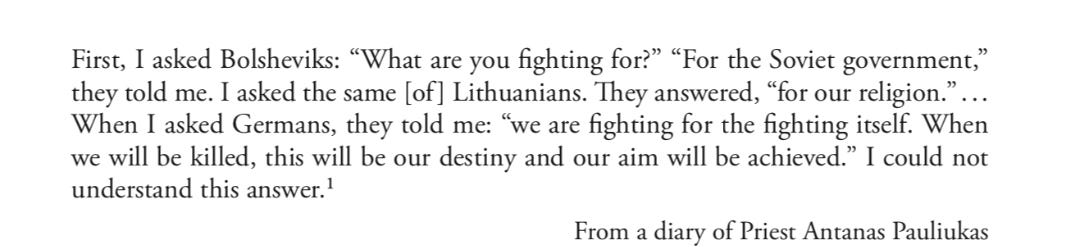
How can one defy what he embraces? This is the essential paradox, the essential struggle, of existence; it is the deliberate and constitutive essence of what it means to strive towards excellence (ἀρετή). Put it another way: what could be said of Achilles had he been completely unaware of the possibility of his doom, that what awaited at the end of his causal chain could have been an equally plausible end of vast riches and concubines, where he achieves both renown and a vast progeny? It is precisely that Achilles proceeded despite the knowledge of his fate which provides us with the template of excellence, where upon his “tragic moment” of death his life, his immortality, is fulfilled. This is but a counterfactual in the deepest violative sense: were he to act any other way, he would violate the very “spun and woven cloth” which defines his character, that is, his fate! Indeed, a true acceptance of one’s daimon can only result in both his creation and his destruction. Ergo, the Dionysian “Yes!” is born.
Above all else, the search for the Blue Flower is a search for the poetry of life—the identification of life as poetry, particularly from the perspective of the poet himself. It is an elusive thing, indescribable, only felt for the briefest moment—and then gone. It is the occupation of the artist who loves he destroys and destroys what he loves in his fleeting attempt to grasp and enslave what has enraptured his soul. Try as we may to pluck this flower from its fertile ground, though we may succeed for but a moment, this possession shall vanish. Yet in this death resides the mystical flourishing of the immortality of life. As Klages reflects upon the Eleusinian Mysteries and its harvests of grain:
Certainly it was not the immortality of ‘his’ body, of ‘his’ soul, or any thing or any other being that he would have been able to call ‘his own’; for, by contrast, it would have become clear to him, if he had previously been in any doubt, that such things will without exception irrevocably disappear. For this ear of corn will definitely wilt and die; indeed, as grown up and gathered in, it is already doomed to decline: a painful emblem of that state of having been, back into which everything in the present is destined inexorably to sink. Yet out of the transitoriness of this ear of corn and, in fact, reaffirmed by it there arises, shining and deathless, the primordial image of the ear of corn; a symbol of the eternity of the living renewal of each vital form in the womb of the Mater!
—Sämlitche Werks II, p. 1412. Trans. Paul Bishop
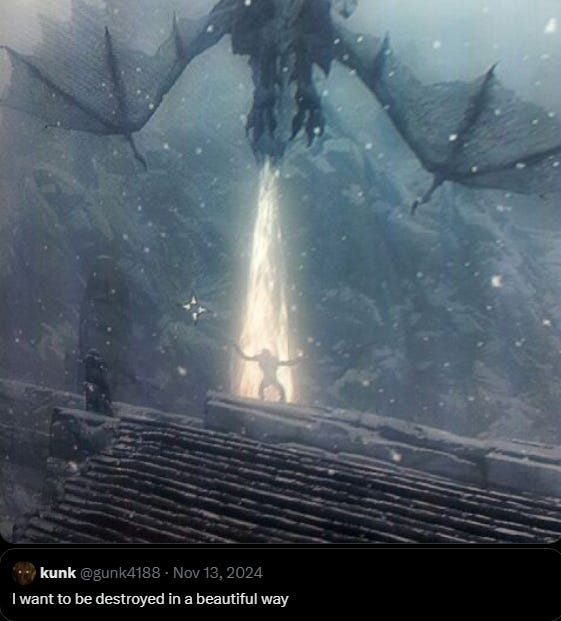
Fate, indeed, graciously presents us with a choice between two: to go happily as a dog leashed to a moving cart, or lash and bark as we are helplessly dragged along gravel as Chrysippus once told us. To die in fear and trembling, or to embody that nameless guard at Pompeii since-deified by Spengler:
We are born into this time and must bravely follow the path to the destined end. There is no other way. Our duty is to hold on to the lost position, without hope, without rescue, like that Roman soldier whose bones were found in front of a door in Pompeii, who, during the eruption of Vesuvius, died at his post because they forgot to relieve him. That is greatness. That is what it means to be noble. The honorable end is the one thing that can not be taken from a man.
—Man and Technics (1931)


That artwork of the Fates is amazing. I'm absolutely flooded by that piece.
"How can one defy what he embraces?"
My fatality.
An idol peculiar.
I regard it fearfully,
with reverence and longing.
At once it makes me whole.
Completed, my song
is ready. In its moment
I am silenced.