


An American Terroir
A forgotten theory of American identity, forged on the plains

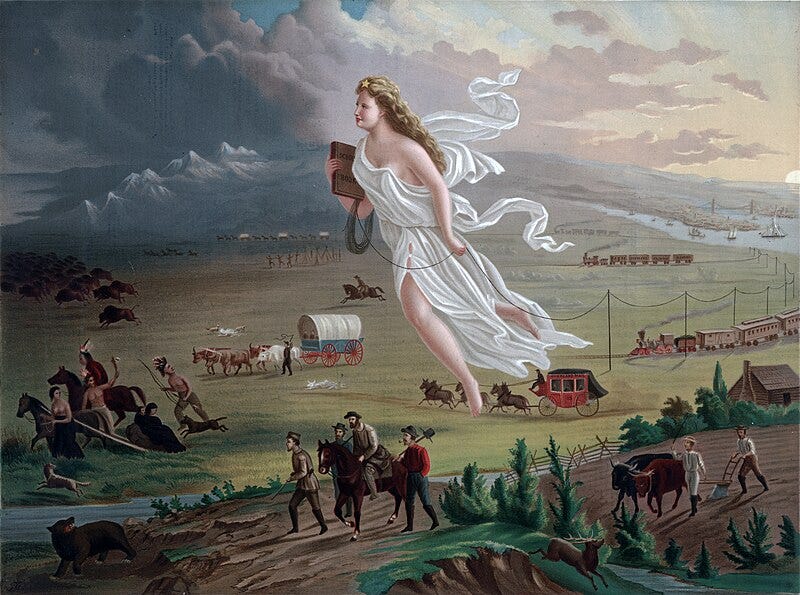
“It has often given my pleasure to observe, that independent America was not composed of detached and distant territories, but that one connected fertile, wide-spreading country was the portion of our western sons of liberty. Providence has in a particular manner blessed it with a variety of soils and productions, and watered it with innumerable streams, for the delight and accommodation of its inhabitants. A succession of navigable waters form a kind of chain round its borders, as if to bind them together; while the most noble rivers in the world, running at convenient distances, present them with highways for the easy communication of friendly aids, and the mutual transportation of their various ties. With equal pleasure I have as often taken notice, that Providence has been pleased to give us this one connected country to one united people—a people descended from the same ancestors, speaking the same language, professing the same religion, attached to the same principles of government, very similar in their manners and customs, and who, by they their joint counsels, arms, and efforts, fighting side by side throughout a long and bloody war, have nobly established general liberty and independence.” —John Jay
What is an American? One can find interesting things in a delving into his own genealogical history, and this rings particularly true for an American. I saw saddled Ulstermen who charged at Cold Harbor, and English gentry who tamed the bottomlands of Virginia. Noble enough, yet, I remember most tracing one line of my family. It began with a scraggly gravestone covered by the loblolly pine needles of the above canopy, upon which was carved the name Kuykendall—a strange name for early 19th Century Mississippi. As I unwound the generations, Mississippi became Tennessee, then North Carolina, Pennsylvania, and finally, the then newly-founded Dutch settlement of New Amsterdam.
Though I frequently chastised others for ethnic fetishism in genealogical research before, I couldn’t help but be interested. These Dutchmen were the only ancestors I could speak definitively of that hailed from north of the Mason-Dixon. Reading more of them—Calvinists in flight, company men for the WIC, shrewd traders with local Indians, and weary sentries posted upon Fort Orange—the exoticism began to subside into a sense of familiarity. Not only was their presence remarkably similar to that of other newly-erected European settlements on the continent, but within these families I began to see—thank God—more pronounceable words in the maiden names of their wives and children: Metcalf, Henry, and Taylor.
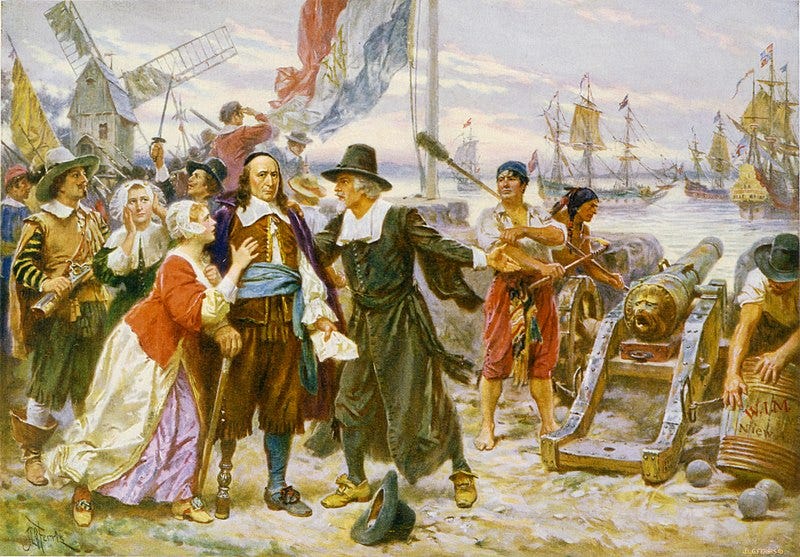
I found it odd that the English and Dutch were in such close proximity and friendship as early as the 1650s, even in the midst of the early stages of the Anglo-Dutch Wars. But this war was, for now, a 25-day voyage over 3,000 nautical miles away. Examining further, I began to understand an additional and more pressing reason why the affairs of the motherland seemed so insignificant. From 1643 until the colony's annexation under British rule in 1664, the Dutch were embroiled in ceaseless and brutal conflict with the aboriginal Lenape and Algonquin tribes. Men were butchered, women and children were kidnapped, and entire families wiped from existence by savage Indian attacks. One such event was the Peach War, where hundreds of natives occupied the entirety of the Hudson Valley in a day, taking with them the scalps of 43 colonists and over 100 women and children as captives.
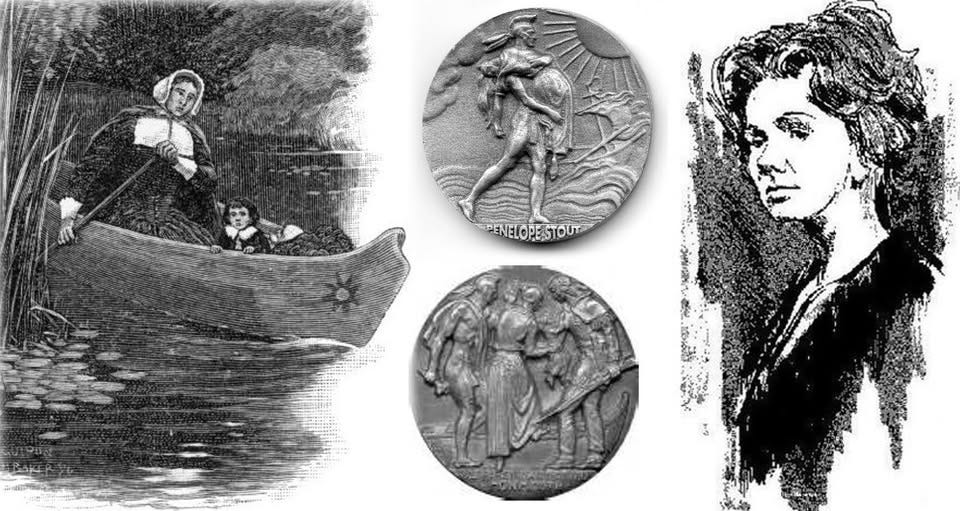
There is an analogous story in American folklore pertaining to a Penelope Stout and her husband Richard, two children of England sailing for New Amsterdam on a Dutch ship. Set off course by foul wind, the vessel ran aground several miles south on what is now Sandy Hook, New Jersey. The Dutch, keenly aware of the savagery that lurked in the landward woods, immediately abandoned the vessel and fled to the Hudson on foot. But the Stouts were left behind, as Richard was immobilized by fever and his wife could not bring herself to leave him. That night, a party of Lenape boarded the ship, butchering and scalping the defenseless Richard, “as a boy would kill a little harmless snake, for no reason whatever, except that he was able to do it”, as one account puts it. Penelope narrowly escaped, maimed and grieving, hiding in a tree trunk until her eventual capture by the Lenape. Some time later, the Dutch learned of a White woman held captive among the natives, and ransomed her back to safety. Upon her arrival to a familiar people, Penelope learned that she was the sole survivor of the voyage. The Dutch that fled on foot never made it.
At this moment, I began to understand: there was the zygote of the American ethnos. Fresh off a month-long voyage, when the colonists of the various European powers stepped foot off their ships, they touched their soles upon an utterly alien and frightful land. It oozed devastating illness from its marshes, and taunting whoops from red men echoed from the tree lines that sieged their virgin forts. Despite what matters in the Old World often forced them into, the emerging understanding of the Europeans was that they had to depend on their fellow “White men” as much as their homelands. As traders, exiles, and freed captives mixed about, as colonies changed hands from one power to another, there eventually arose an intermixed people of European stock—their back to the Atlantic, and their eyes to the Appalachians. The English, Dutch, Scot, German, and French gradually ceased to be, and the American was born.
Our generation thinks little of the Indian Wars, more concerned with new foes from Afghanistan to Mexico and everywhere in between. But we forget that these brutal wars lasted some three centuries, from the first sorties outside of Jamestown in 1609 to the last and final Apache raid against Americans in 1924. Every American generation had personal experience with this conflict until it was finally won, and the continent was made silent. We ascended up the slopes of Appalachia as colonists, but upon the peaks we saw the frontier, and upon our descent we were transformed into Americans.
This is no novel realization of mine. Fresh off the last gasp of the Indians, in the 1930s the vast majority of history departments across the country were teaching American children precisely this story. It was popularized in films such as The Big Trail (1930)—starring a 23-year-old John Wayne in his debut—which dramatized the precarious life in the covered wagons of the Oregon Trail, its freedom, its heroes, and its conflict against the warlike Indian. This theory is the Frontier Thesis of historian Frederick Jackson Turner, popularized in his book The Frontier in American History (1920), a fleshed out book on his earlier 1893 academic thesis.
In describing what an American was, many other historians and theories had made correct descriptions about the deeply significant European origin of our people. Founding father Thomas Jefferson proposed that Hengst and Horsa be represented on the Great Seal of the new nation, “the Saxon chiefs from whom we claim the honor of being descended, and whose political principles and form of government we assumed”. Indeed, much of English and in turn American folkways can be derived from the Germanic peoples: rugged individualism, nuclear families, private ownership, and local governance. While many of these are ascribed to Protestantism, one would struggle to find the theological differences with the rest of Christendom that would generate these attitudes, and would struggle much further to explain why Protestantism was almost entirely contained to Germanic peoples. What developed then was the traditional WASP-dominant understanding of America, known in some contexts as the Teutonic Germ Theory.
For Turner however, such theories were failing to accurately portray the immediately apparent uniqueness that the American presented. Though similar, its politics, religion, culture, nor blood was identical to England or any other European nation. It was fundamentally novel, and required a more nuanced description with a proper causal agent. For Turner, this was the Indian Wars and the vast frontier, which had finally been conquered:
All peoples show development; the germ theory of politics has been sufficiently emphasized. In the case of most nations, however, the development has occurred in a limited area; and if the nation has expanded, it has met other growing peoples whom it has conquered. But in the case of the United States we have a different phenomenon. Limiting our attention to the Atlantic coast, we have the familiar phenomenon of the evolution of institutions in a limited area, such as the rise of representative government; the differentiation of simple colonial governments into complex organs; the progress from primitive industrial society, without division of labor, up to manufacturing civilization.
But we have in addition to this a recurrence of the process of evolution in each western area reached in the process of expansion. Thus American development has exhibited not merely advance along a single line, but a return to primitive conditions on a continually advancing frontier line, and a new development for that area. American social development has been continually beginning over again on the frontier. This perennial rebirth, this fluidity of American life, this expansion westward with its new opportunities, its continuous touch with the simplicity of primitive society, furnish the forces dominating American character.
—Turner, The Significance of The Frontier in American History (1893)
Rather than a sudden event such as a civil war or conquest that may define a polity, the American experience of embattlement with the absolute fringes of civilization for over three centuries contributed to the formation of a new people, an American ethnogenesis. Just as one frontier is tamed, the next generation thrusts itself upon the next heeding its call into a free land. The grandchildren of Plymouth and Jamestown entered the Ohio and Tennessee, theirs into Louisiana, the next into Kansas and Wyoming, and at last into San Francisco Bay. This ceaseless experience molded the European into the American.
Turner gives several effects of this impact on American culture. The most notable is his distinction between Jeffersonian democracy and Jacksonian democracy. The republican virtues of Jefferson entail a weak federal government ruled primarily by the states and Congress, and a “natural aristocracy” where meritocracy rules. Jackson's vision, in contrast, was much more national in character, entailing a powerful executive branch and expansion of suffrage and political offices to the common man. The evolution of the latter, pressed upon the ever-moving frontier, allowed for the American national character to breathe and take a unique shape apart from its European ancestors.
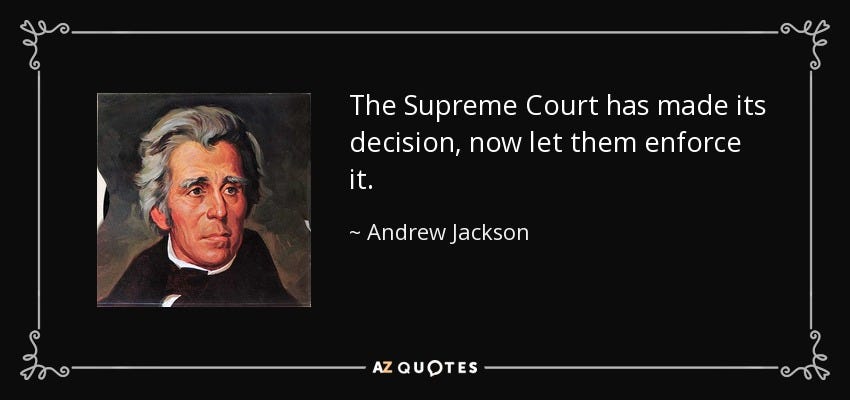
Not only this, but the adoption of Jacksonian democracy had later consequences for the issue of slavery and the Civil War. As the frontier hobbled distinct peoples together, they were forced to agree upon a single national system. Puritan abolitionism and the Southern slave-aristocracy, obviously incompatible, were inevitably going to enter a war to the death.
It was this nationalizing tendency of the West that transformed the democracy of Jefferson into the national republicanism of Monroe and the democracy of Andrew Jackson. The West of the War of 1812, the West of Clay, and Benton and Harrison, and Andrew Jackson, shut off by the Middle States and the mountains from the coast sections, had a solidarity of its own with national tendencies. On the tide of the Father of Waters, North and South met and mingled into a nation. Interstate migration went steadily on a process of cross-fertilization of ideas and institutions. The fierce struggle of the sections over slavery on the western frontier does not diminish the truth of this statement; it proves the truth of it. Slavery was a sectional trait that would not down, but in the West it could not remain sectional. It was the greatest of frontiersmen who declared: ‘I believe this Government can not endure permanently half slave and half free. It will become all of one thing or all of the other.’ Nothing works for nationalism like intercourse within the nation. Mobility of population is death to localism, and the western frontier worked irresistibly in unsettling population. The effect reached back from the frontier and affected profoundly the Atlantic coast and even the Old World.
—ibid.
Turner also makes a keen note of America’s more rambunctious nature compared to its cousins in the Anglosphere. The plains here, too, shows itself as this fact’s mother. On the frontier, law and order hold little sway. There are no towns, no authorities, no taxes, no hospitals, no jails, and no schools. There is only man, his will, and nature. This emphasis and promise of freedom is what called men to the frontier in the first place, and once it was settled, they had little intention of giving too much of it up. Hence, the further the American pushed West, the more he loved and yearned to be free. It was the East, symbolized first by Britain and later by Washington, D.C., which came to seek control. This dichotomy between the free West and the imperial East is one of Turner’s most important devices.
The frontier States that came into the Union in the first quarter of a century of its existence came in with democratic suffrage provisions, and had reactive effects of the highest importance upon the older States whose peoples were being attracted there. An extension of the franchise became essential. It was western New York that forced an extension of suffrage in the constitutional convention of that State in 1821; and it was western Virginia that compelled the tide-water region to put a more liberal suffrage provision in the constitution framed in 1830, and to give to the frontier region a more nearly proportionate representation with the tide-water aristocracy. The rise of democracy as an effective force in the nation came in with western preponderance under Jackson and William Henry Harrison, and it meant the triumph of the frontier with all of its good and with all of its evil elements…
—ibid.
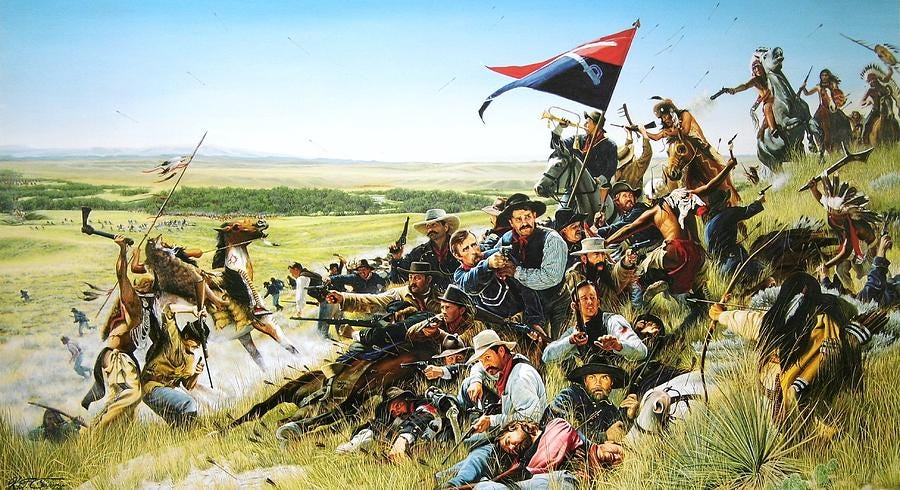
One only has to look at particular heroes of the West to see these identifications with the American ethnos to come to life. Daniel Boone, Crockett, Lewis and Clark… but above all others, and fresh on the mind of Turner, stood George Armstrong Custer. Custer loathed authority, barely graduating West Point with one bad mark shy of being expelled. Yet he proved himself as a daring and animated officer, with long and flowing hair and a personally-tailored unique uniform, he was liberated in the chaos and carnage of the Civil War. Shouting “Come on, you Wolverines!” in reply to a Confederate cavalry charge, he earned national honor leading his Union men in an effort to thwart the cavalry action of the Southerners at Gettysburg. At Appomattox, he even attempted to have Lee surrender to him, who returned that only Grant would have that honor. He too was called to by frontier’s freedom and opportunity following the war. More dashing charges, more problems with authority—even arrested for going AWOL because he had to attend to certain needs with his lovely wife. He continued to push the frontier, searching evermore for freedom and kleos-aphthiton, until he and the 7th were surrounded at Little Bighorn. Forty surviving men, among them Custer, formed a doomed circle among their dead horses, delivering volley against an ever-encroaching foe until eventually overwhelmed, and annihilated. To this day, Custer and his men are remembered as emblematic of what it is to be an American, for this calling, and this heroism.
At the time of his death in 1932, Turner lived in an America on the precipice of imperial dominance. Moreover, it was an American nation inhabited by Americans that keenly saw themselves as such. The country had absorbed and largely assimilated waves of immigrants from Eastern and Southern Europe, lowering its foreign-born population share to roughly 9%. By 1960, it would reach a low-point of 4.7%. But at this point, the certainty of American identity ends. Over the 1950s-1970s, a number of transformational changes ran its course through the American system that unwound this understanding. Immigration quotas were removed at the request of Mainline Protestants in protest of their “racist” pretenses, Civil Rights law was curbing essential freedoms of Americans in the name of equality, and taxes were heavily levied in service to an increasingly bloated empire. With a foreign born population of nearly 16% (officially), inhabited by potentially over a hundred million permanent and non-permanent foreigners, the republic of Jackson and Jefferson has gone dim.
With the frontier gone, we have forgotten what it means to be an American. There is little indication how that can be re-lived, other than some effort of Romanticism. Yet we the Americans are still here, though we are nestled in a country that is increasingly not ours. Our blood has not changed, and we have inherited by right and by tradition what it is to belong to the American people. America is not an idea. It is not an economic zone. It is not “a nation of immigrants”—an oxymoron that forgets what a nation is. It is not even a leftover of Europe. We Americans are a people, an ethnos, that is unlike anywhere else in the world. This American soil has shaped us just as much as we have shaped it, and as a result we are a unique people concretely defined as such—just like an Englishman, a Nigerian, a Russian, or an Indian. We have only the frontier to thank for it, and may we never forget it so soon!


The conflict with the oppressive Globalist system and the various imvaders are just a new stage in the frontier war, a repeat of haughty Charles II’s acts against the independent colonies. But this time, all Europe is a part of the frontier war. Wining will require the worldly wisdom of the Tidewater Virginian, the tough Backcountryman, the industrious Midwestern, and the Yankee intellect. The North is becoming more Southern from the contact with the Other, and the Europe will become more like America during this coming war.
A good article, and an interesting book. I have long pondered this as well, and have come to different conclusions than most. I don't think we have a single American ethnos. We got very close in places at certain times, but I think we have multiple ethnicities in America. They have all been falling away though, and I think we are closer than ever to a true American ethnos. To me, it has much more to do with family and genetics, family being the key point, for it's familial bonds which create an ethnos more than anything. It's not just about shared origins, national myths, or anything like that, it's a combination of all of these things overlaid onto a kin network. It's truly a familial and genetic thing. Prior to the 1900's, both sides of my families were living in ethnic enclaves. One side was from semi-recent immigration, the other side was "heritage American" and yet both dwelt in clear ethnic enclaves, sided with their local ethnos over other ones in politics, and only broke up in the early 1900's with all the other ones.
My fathers family comes from the frontier folk. My mother's did not, they came much later. One can clearly see differences in ethnic features, and in ethical/political approach with both families. Honestly, my fathers family is more American, in the sense that this article speaks about. My mother's family is more cosmopolitan. I think many Americans alive today can point out similar things. We built a nation, and we tried to build a people, and we got close but I think we are only going to get there due to what we are facing now.
If the Indian Wars created the American ethnos as you say, then this next conflict will enshrine it forever. The blood and soil connection will be stronger than ever for all Americans, regardless of when they got here and what their families did prior to all this.