


Great Heathens (II): D.H. Lawrence
Vitalist, Animist, and Lover

Great Heathens is a series which details figures in recent history who, while typically not open and practicing pagans, were drawn in and contributed greatly to its worldview. The series details their lives, thoughts, and actions; and how they contrasted with the modern culture they lived in.
Our previous article looked at the life and worldview of the Great Heathen himself, J.W. von Goethe. The miraculous architect of Faust and many others, he held a somewhat hidden adoration for the gods, particularly Artemis, to him a symbol of nature and femininity. This article will cover the Englishman D.H. Lawrence, who took Goethe’s devotions to an entirely new level.


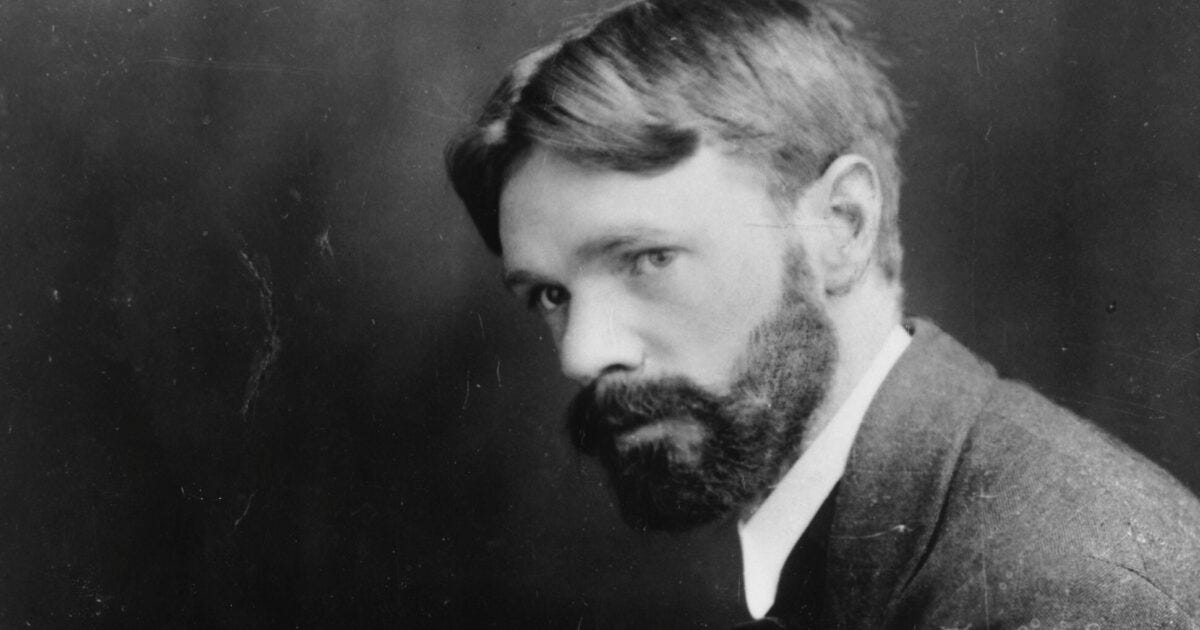
At the time of his death in 1930, English novelist D.H. Lawrence had almost nothing to show for himself. He had recently been forced out of his native country in 1917 due to espionage suspicions towards him and his German wife, his works were barely even able to be published in accordance to obscenity laws, Scotland Yard was raiding and confiscating his oil paintings, and his reputation was little more than of “a pornographer”. His final contribution to fiction was Lady Chatterley’s Lover, heavily censored in this edition, yet still depraved enough to have T.S. Eliot describe the author as “a very sick man indeed”. A number of obituaries were published by contemporaries remarking on the life and works of Lawrence, virtually all of them in a language of contempt.
This is an odd fact for a name that, today, enjoys a fair degree praise and reputation. It is not difficult to find his works in bookstores, or even assigned reading in college courses. Lawrence was, to put it in a cliché, simply born before his time. The cultural environment of the First World War and its aftermath didn’t have time or the patience for a wandering prophet of love such as he. It wouldn’t be until 30 years after his death in the 1960s, with its more lax attitudes towards his choice themes, when the works had begun to be taken more seriously. After a successful appeal to the United Kingdom, Penguin Books was allowed to publish a full, uncensored version of Lady Chatterley’s Lover in 1960. Interest, whether it was loved or hated, soon took off.
Much like the women in his books, Lawrence's literature can be at first difficult to penetrate. He is something of a serious-satirist, with each character and dialogue of his fiction attempting to say something beneath an apparently base text. Once the key to this lock is acquired, the treasure that is his thoughts, animated by the text, are free to take. His travel writings, however, are more accessible and have given him a reputation as one of the most impressive of that category. His ability to illustrate the senses and spirit of the places he visited during his long exile from England is unparalleled:
Comes over one an absolute necessity to move. And what is more, to move in some particular direction. A double necessity then: to get on the move, and to know whither.
Why can't one sit still? Here in Sicily it is so pleasant: the sunny Ionian sea, the changing jewel of Calabria, like a fire-opal moved in the light; Italy and the panorama of Christmas clouds, night with the dog-star laying a long, luminous gleam across the sea, as if baying at us, Orion marching above; how the dog-star Sirius looks at one, looks at one! he is the hound of heaven, green, glamorous and fierce!—and then oh regal evening star, hung westward flaring over the jagged dark precipices of tall Sicily: then Etna, that wicked witch, resting her thick white snow under heaven, and slowly, slowly rolling her orange-coloured smoke.
—Sea and Sardinia, I. As Far as Palermo
There are three themes which permeate through Lawrence’s works more than others: nature, sex, and women. All three are healthily represented in Lady Chatterley’s Lover. Despite the reputation, he had not intended his work to be anything approaching the modern genera of “smut”, but a preaching of his metaphysical vision of life in the rawest and most direct of terms, life as life is experienced, and best experienced in the sexual union between man and woman. Censoring or couching language would suffocate the illustration.
“But I stick to my book and my position: Life is only bearable when the mind and the body are in harmony, and there is a natural balance between the two, and each has a natural respect for the other. And it is obvious, there is no balance and no harmony now. The body is at best the tool of the mind, at the worst, the toy. … Sex lashes out against false emotion, and is ruthless, devastating, against false love.”
—Apropos of Lady Chatterley’s Lover (1930)
The protagonist Lady “Connie” Constance is fixed in a typical setting of Victorian and industrial England—one which Lawrence intended to mock—married to a stoic enterpriser described as “the negation of human contact”, one focused without fault to his mechanized duties, of which his wife was typically not included. Seeking an escape, Connie goes to a nearby wood where she sees a mother duck playing with her newborn hatchlings. Witnessing this birth, teary-eyed, she witnesses in herself a re-birth of her own: “Life! Life at last!”, she exclaims. A woodsman, Mellor, watches this interaction. Her innocence arouses his masculine sensibilities, and the two begin an affair, which Lawrence describes in great detail for the time.

This sexual union, born out of an affirmation of bodily instinct rather than marital obligation, is the entire point of the book: only through this act, this affirmation of human instinct, can life be truly experienced in the deepest sense. It is something that the sterile culture of the West utterly lacked at the time, and in some ways still lacks today. It is the body which is the locus of the deepest experience, as it is the only thing capable of achieving communion with existence (or as Lawrence terms it, the “cosmos”). In these woods, which Connie has become a priestess within, is found the antidote to modernity. Both she and her lover experience it.
It was not woman's fault, nor even love's fault, nor the fault of sex. The fault lay there, out there, in those evil electric lights and diabolical rattlings of engines. There, in the world of the mechanical greedy, greedy mechanism and mechanised greed, sparkling with lights and gushing hot metal and roaring with traffic, there lay the vast evil thing, ready to destroy whatever did not conform. Soon it would destroy the wood, and the bluebells would spring no more. All vulnerable things must perish under the rolling and running of iron.
He thought with infinite tenderness of the woman. Poor forlorn thing, she was nicer than she knew, and oh! so much too nice for the tough lot she was in contact with. Poor thing, she too had some of the vulnerability of the wild hyacinths, she wasn't all tough rubber-goods and platinum, like the modern girl. And they would do her in! As sure as life, they would do her in, as they do in all naturally tender life. Tender! Somewhere she was tender, tender with a tenderness of the growing hyacinths, something that has gone out of the celluloid women of today. But he would protect her with his heart for a little while. For a little while, before the insentient iron world and the Mammon of mechanised greed did them both in, her as well as him.
—LCL (1928 Edition)
But there is another, much less discussed theme of Lawrence's work: religion. He was, above all else, a vitalist: a firm believer in life itself, and the act of living. In a number of his writings, he explores a belief in the resurrection of the body, scorning the idea of a lofty afterlife to which one escapes life for. Lawrence was one of many struck by Nietzsche, and it was Christianity’s life-denying qualities that repulsed him the most. However, unlike Nietzsche, Lawrence at times seemed to attempt to reimagine Christianity in his own image rather than attempting to destroy it. In a late work, The Man Who Died, he rewrites the Gospels following Christ’s resurrections and final days of ministry. Rather than ascending to heaven, he discovers the value of life—natural life—and chooses to remain on the Earth, remarking: “I have not risen from the dead in order to seek death again.” He flees back to Egypt, where his wounds are healed by a priestess of Isis who beckons him as Osiris, and with whom he bears a child. The initial absurdity of the plot makes more sense when one learns that it is somewhat autobiographical; Lawrence had barely escaped death from some form of lung infection the year before.
It is easier to see Lawrence’s unique religious inclinations through this sort of contrast, and it is not something that he shies away from in any sense. In fact, it is typically the way in which he discusses religion: the ultimate failure of the modern status quo, and the hope for future nourishment by a returning to the past. Given that the modern status quo was Christianity, it was first on the chopping block. Yet, Lawrence was far more charitable than other critics—that is, except for his feelings towards Protestantism:
The early Christians tried to kill the old pagan rhythm of cosmic ritual, and to some extent succeeded. They killed the planets and the zodiac, perhaps because astrology had already become debased to fortune-telling. They wanted to kill the festivals of the year. But the church which knows that man does not live by man alone, but by the sun and moon and earth in their revolutions, restored the sacred days and feasts almost as the pagans had them, and the Christian peasants went on very much as the pagan peasants had gone, with the sunrise pause for worship, and the sunset, and noon, the three great daily moments of the sun: then the new holy day, one in the ancient seven-cycle: then Easter and the dying and rising God, Pentecost, Midsummer fire, the November dead and the spirits of the grave, then Christmas, then Three Kings. For centuries the mass of people lived in this rhythm, under the Church. And it is down in the mass that the roots of religion are eternal. When the mass of a people loses the religious rhythm, that people is dead, without hope.
But Protestantism came and gave a great blow to the religious and ritualistic rhythm of the year, in human life. Nonconformity almost finished the deed. Now you have a poor, blind, disconnected people with nothing but politics and bank-holidays to satisfy the eternal human need of living in ritual adjustment to the cosmos in its revolutions, in eternal submission to the greater laws. And marriage, being one of the greater necessities, has suffered the same from the loss of the sway of the greater laws, the cosmic rhythms which should sway life always. Mankind has got to get back to the rhythm of the cosmos, and the permanence of marriage.
—Apropos of Lady Chatterley’s Lover (1930)
In one way, Lawrence was the final reaction and end to the culture of Anglo-Saxon Protestantism, something that took just a few decades more to achieve its final victory in the 1960s. The mercantile abuse of the natural world, the prodding scientism, the strict and regulated social codes… Above all else, Lawrence loathed a Puritan, he who stifles life and nature in service of a “higher ideal”.
Out of his frustration with modernity, and out of his adoration with the themes of nature and sexuality, Lawrence found a profound love and respect for a type of paganism. Not as a form of inherited tradition among many others, but as the fundamental way in which humans were meant to experience the world. His paganism belonged to no specific pantheon, no specific time or people, though he clearly identified this paganism in the beliefs and cults of ancient peoples. For a man of his time, such writings are not only brave, but prophetic:
What man most passionately wants is his living wholeness and his living unison, not his own isolate salvation of his ‘soul’. Man wants his physical fulfillment first and foremost, since now, once and once only, he is in the flesh and potent. For man, the vast marvel is to be alive. For man, as for flower and beast and bird, the supreme triumph is to be most vividly, most perfectly alive. Whatever the unborn and the dead may know, they cannot know the beauty, the marvel of being alive in the flesh. The dead may look after the afterwards. But the magnificent here and now of life in the flesh is ours, and ours alone, and ours only for a time. We ought to dance with rapture that we should be alive and in the flesh, and part of the living, incarnate cosmos.
I am part of the sun as my eye is part of me. That I am part of the earth my feet know perfectly, and my blood is part of the sea. My soul knows that I am part of the human race, my soul is an organic part of the great human soul, as my spirit is part of my nation. In my own very self, I am part of my family. There is nothing of me that is alone and absolute except my mind, and we shall find that the mind has no existence by itself, it is only the glitter of the sun on the surface of the waters.
—Apocalypse (1931)
Or, more directly:
“Suddenly we see some of the old pagan splendour, that delighted in the might and the magnificence of the Cosmos, and man who was a star in the cosmos. Suddenly we feel again the nostalgia for the old pagan world, long before John’s day, we feel an immense yearning to be freed from this petty personal entanglement of weak life, to be back in the far-off world before men became ‘afraid’. We want to be freed from our tight little automatic “universe”, to go back to the great living cosmos of the ‘unenlightened’ pagans!
Perhaps the greatest difference between us and the pagans lies in our different relation to the cosmos. With us, all is personal. Landscape and the sky, they are to us the delicious background of our personal life, and no more. Even the universe of the scientists is little more than an extension of our personality, to us. To the pagan, landscape and personal background were on the whole indifferent. But the cosmos was a very real thing. A man lived with the cosmos, and knew it greater than himself.”
—Apocalypse (1931)
From these passages, we can further declare Lawrence an animist as well as a vitalist. He is clearly some type of a pagan, but doesn’t seem interested in making himself a devotee of Pan or any other theistic obligations. Nor does he put much stock in tradition, prioritizing lived experience to the highest degree. Additionally, we can’t say he is something like a Jungian, proto-Wiccan, or crystal-astrologist, as he puts serious and literal faith in gods, which control and steer human experience. What is he, then?
A clue can be derived from his promotion of the original religiosity of mankind, and the idea of an active, living participation in the cosmos. What he is describing is analogous to Lévy-Bruhl's Le Monde Mythique and Robert Bellah’s Primitive Religion, where the locus of religiosity is a ritualistic participation in the cosmos, where the participant in a sense becomes the divine entity itself. The world is fully-animated, and there is nothing but the fully-animated world. Lawrence was an animist par excellence, embodying the sense beyond a forced belief in some vague spiritual quality in individual atoms.
Indeed, at the end of his life, Lawrence was given the opportunity to experience this type of religion more directly at the last destination of his wanderlust, New Mexico. There, he witnessed what was left of the American Indians, and their primitive religion:
The Red Indian seems to me much older than Greeks or Hindu or any Europeans or even Egyptians. The Red Indian, as a civilized and truly religious man, is religious in perhaps the oldest sense, the deepest, of the word. That is to say, he is a remnant of the most deeply religious race still living. So it seems to me. […]
It was a vast old religion, greater than anything we know: more starkly and nakedly religious. There is no God, no conception of a god. All is god. But it is not the pantheism we are accustomed to, which expresses itself as 'God is everywhere, God is in everything'. In the oldest religion, everything was alive, not supernaturally but naturally alive. […] It was a vast and pure religion, without idols or images, even mental ones. It is the oldest religion, a cosmic religion...., not broken up into specific gods or saviours or systems. It is the religion which precedes the god-concept, and is therefore greater and deeper than any god-religion.
And it lingers still, for a little while, in New Mexico: but long enough to have been a revelation to me. And the Indian, however objectionable he may be on occasion, has still some of the strange beauty and pathos of the religion that brought him forth and is now shedding him away into oblivion.
—New Mexico (1928)
Lawrence’s religion, despite its significant similarities to primitive religions, is ultimately a personal one. As a direct consequence of his emphasis on life, religion must therefore be something that comes out of one’s experience. Further, he already had long lost hope for organized, public religions: “Where is He now? Where is the Great God now? Where has he put his throne? We have lost Him. We have lost the Great God.”, he wrote, echoing Nietzsche. The result in Lawrence is precisely this type of modern religiosity that Robert Bellah had described, as I have discussed in previous articles:
What modern religion has brought, through the midst and pandemonium of the collapse of Christianity, is a confident return to world-accepting religiosity. Concepts like dualism, monotheism, original sin - even sin itself, have increasingly soured. Crucially, modern people are no longer concerned with escaping the world, but with figuring out how to orient themselves within it. Ironically for Christianity, it was developments within its own worldview that ultimately led to this form of religiosity.
However much the development of Western Christianity may have led up to and in a sense created the modern religious situation, it just as obviously is no longer in control of it. Not only has any obligation of doctrinal orthodoxy been abandoned by the leading edge of modern culture, but every fixed position has become open to question in the process of making sense out of man and his situation. (Bellah, ibid.)

What would a resurrected Lawrence make of today? I would assume he would understand our situation in some respects, and be appalled in others. He would understand an increasingly secular society, one that rejects traditional religiosity and dogmas such as sin, in favor of making sense of one’s own condition through a world-accepting religiosity. He would understand both the problems of modernity and our reaction to it, including our association with technology and ongoing efforts to restore and protect the natural world. After all, much of our religious senses today are incredibly Laurentian.
What he would not understand, and indeed be disgusted by, is the modern approach to sexual attitudes. Despite the subcutaneous plots of his books featuring infidelity, Lawrence was a serious believer in the religious importance of marriage as a physical and natural bond between man and woman. He himself was deeply devoted to his wife Freida, with whom he remained until his death, despite idiot assertions today hinting to a “bi-curiosity”. He therefore would not be able to even comprehend a society which is simultaneously over- and under-erotic, one that elevates sterile marriages and identities above all others while divorces skyrocket above their anthropological norms. One that suffers from both widespread pornography and careless one-night fornication, while the “game” of dating becomes increasingly neurotic and increasingly silent. The purely digitized sexuality that we have today would horrify Lawrence to no end, as someone who put the bodily connection between man and woman above all other acts.
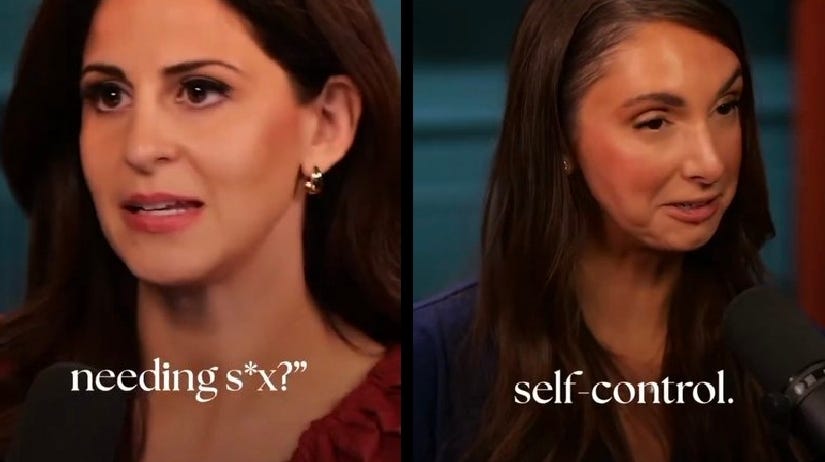
He would likewise be horrified at some reactions to modern sexual attitudes. Seeing that the traditional attitudes had been completely routed, many have flocked back to the Church and adopted strict attitudes towards sex and marriage. Counterintuitively, they are precisely the sexual attitudes of Clifford Chatterley that Lawrence had so ruthlessly mocked in the first place: a prudish and sensitive gentleman who sees sex as a mere unfortunate necessity to acquire children, a wheelchair-bound man who impotently begs for the embrace of a Magna Mater, a man who is no man at all. Take, for example, a recent podcast put out by Catholic Lila Rose, stating: “Men don’t need sex. Have we really forgotten that self-control and virtue are within reach?” The backlash she received had little to do with this belief, but that in order to prove the point she “sexualized” a Catholic priest.
It's sexual neuroticism all the way down… we are a deeply sick people. Even when one argues for complete sterility and the total suffocation of sexuality, they are censored by these reactionaries for speaking of sex too much! There is a fine line between a rake and a lover, a Puritan and an anchor: Lawrence was one of the few people to understand this.
I will conclude with one last excerpt pertaining to his religion, and it is a remarkable one. Hidden in an otherwise completely forgettable work is a sort of creed which Lawrence ascribes for himself, found in all places a tirade against the Puritanical values of Benjamin Franklin. Lawrence's heathenry is his direct reply:
The soul of man is a dark forest. The Hercynian Wood that scared the Romans so, and out of which came the white-skinned hordes of the next civilization. Who knows what will come out of the soul of man? The soul of man is a dark vast forest, with wild life in it. Think of Benjamin fencing it off! […]
Here's my creed, against Benjamin's. This is what I believe:
"That I am I."
"That my soul is a dark forest."
"That my known self will never be more than a little clearing in the forest."
"That gods, strange gods, come forth from the forest into the clearing of my known self, and then go back."
"That I must have the courage to let them come and go."
"That I will never let mankind put anything over me, but that I will try always to recognize and submit to the gods in me and the gods in other men and women."
—Studies in Classical American Literature (1923)


