


The Apostates They Deserve
Secularism & The Post-Christian Right

Our principles must never be equated with the dogmas of books supposed to have come down from heaven. We derive our inspiration, not from heaven, or from an unseen world, but directly from life. Our path is guided by the homeland we live in, the Turkish nation of which we are members, and the conclusions we have drawn from the history of nations, which records a thousand and one disasters and sufferings.
—Mustafa Kemal Atatürk, Nov. 1st 1937, Statement to the Turkish Grand National Assembly

Religion, as always, exists dear in our hearts as the ultimate and complete encapsulation of worldviews. It defines us utterly, but perhaps not in the same sense as it had before. Our worldviews have become far wider, far more hungry for evidence and justification. Religion, therefore, has bore the brunt of a never-ending salvo of -isms of the modern world of whom demand their apportioned attention: scientific realism, materialism, nationalism, liberalism, romanticism, and, of course, secularism. Though at times we question if religion had even truly survived the barrage, exist it still does, in a permanently altered state.
America is, now and historically, perhaps the single most Christian nation on Earth, depending on how one defines it. This is the case not merely in piety metrics or belief—where the dear daughters of the Church in France, Poland, or Spain are not even as religious as the most antagonistically anti-Christian states such as Vermont—but in the very way the structure of the nation and American culture exists. However, these facts exist only on relative terms. Even in the land of the Puritan John Cotton’s New Israel, the eminence of religion and religious institutions has diminished greatly. Even in America, which has traditionally been the last holdout of the Christian resistance to modernity, the Cross has lost its glare. With each successive year, individuals across every generation and demographic become less religious. With the arrival of each successive generation, the country finds itself leaning less on scripture for its beliefs, attending church less often, and bowing their heads in prayer more infrequently—anecdotes shouted from the rooftops about a “Gen Z Christian revival” have been greatly overstated.
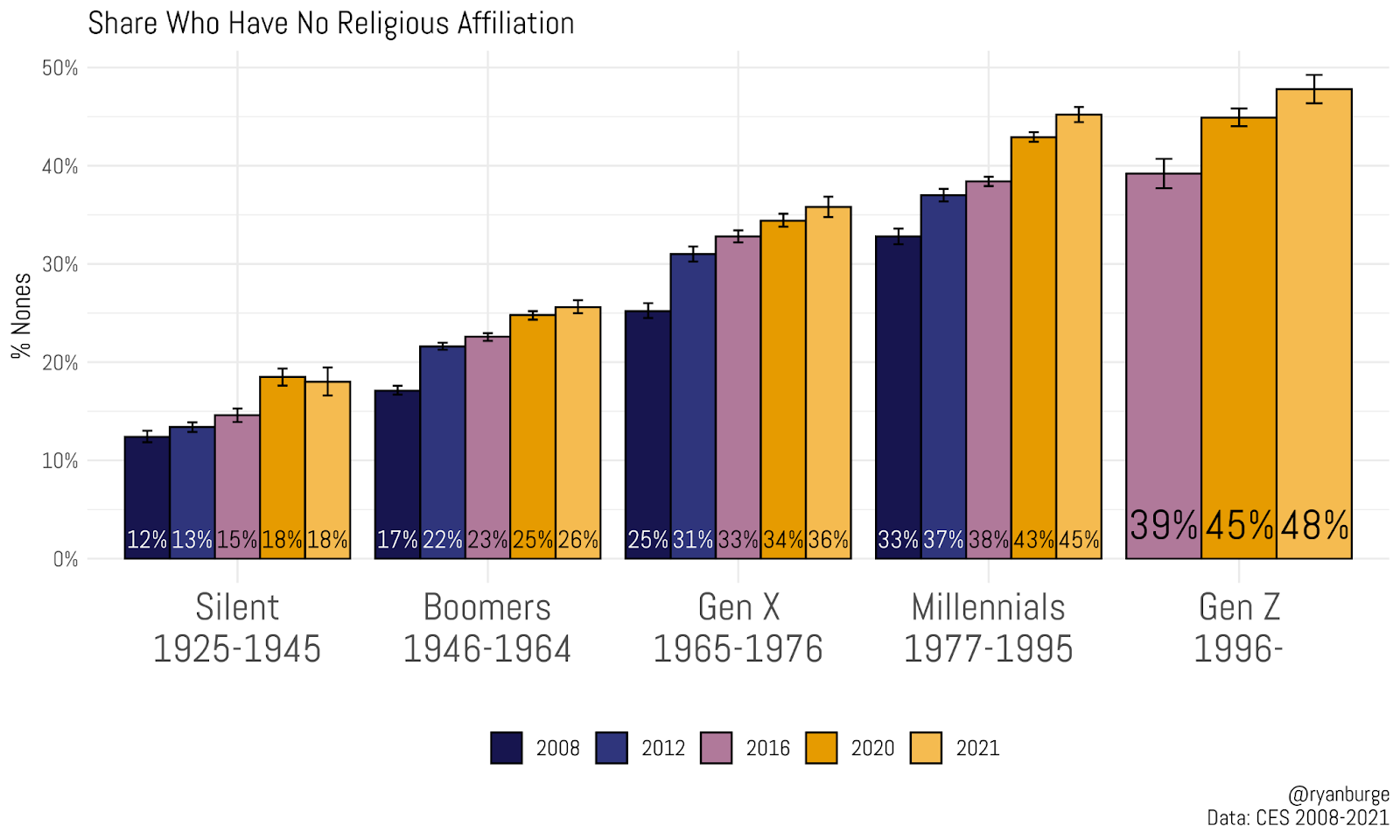
More evident is the declining significance of religion in setting the boundaries and course of culture, politics, and reason. I have covered in previous articles the transition from the dominant Christian presence in courts during the Scopes Trial, where William Jennings Bryan’s argument that revealed scripture overrules anything science may say of reality was upheld as Tennessee state law, to the modern insistence that science and Christianity remain completely harmonized on all matters of Big Bang cosmology, evolution, archaeology, and anthropology. It is increasingly rare, and more evidently pointless, to cite scripture on these matters:
This has been, and continues to be, the toughest of all pills to swallow for Christendom. It is no longer the sole, or even primary, means of discerning truth. It has lost the Mandate of Heaven. When science moves, Christianity is free to interpret, digest, and recite where it pleases - but never may it disagree. Religions have ceased to create, and can only comment - any “nay” is a purely ceremonial protest. Why rely on the Didache to make arguments against abortion when we have papers on fetomaternal microchimerism, or brainwave scans of 6-week old fetuses?

There have been two reactions to the reality of religion's greatly diminished role. One to reverse course, and one to accept the reality for what it is. Let us dwell on the former first.
We see this “religious revivalism” best in the “trad” circles of American culture, manifesting as an aborted attempt to achieve a Fifth Great Awakening, except this time towards the Catholic Church or other “traditional” religious institutions. The reasoning is straightforward: the cultural, ethical, and religious decay of America has been disastrous. The simple solution is to go back to before that trench was lost, and the river will flow once more once that dam has been busted. For some this entails more than simply going back to church; movements into SSPX, Eastern Orthodoxy, or even paganism have likewise become popular, in part, as an effort to seek out that golden nest of real traditionalism. This association has however developed into a very simplistic and incorrect heuristic that traditional Christianity necessarily entails the political ambitions they hold in tandem. Some of them, such as nationalism, are paradoxically the same interests that diminished the sacerdotal role over society in the first place. The core assumption of this reaction is that one cannot possibly be something defined as “right wing” without a Bible nestled firmly under his side. Such an assertion is utterly devoid of truth.
There are a number of problems with this. First is the immediately practical problem: how exactly are you going to restore 1950s American Christianity in an America that is consistently rejecting Christian axioms and religious participation, and in increasing rates? Second, and more importantly, is the problem of history. Was the Catholic Church not, for the last three centuries, the most eminent and powerful promoter of leftism on the planet, through its activism for progressive humanitarian ethics and laws? Are the churches of our cities not covered in the flags of global race communism, preaching the books of BLM and transgenderism from their pulpits?
Christians know this best: religious identification equates to nothing. In fact, one’s most outright political enemies are often members of the same religion and denominations, professing the same Creed, intending to do with it dramatically different things. Take for example, again, the Catholic Church. No institution has been more responsible for mass migration than Rome. They take in more money, establish more shelters, hire more lawyers and lobbyists, and traffic more people into our nation’s interior than anyone else—secular or religious:
According to the Church-affiliated ICMC, the US bishop’s (USCCB) Migrant and Refugee services are responsible for the settling of up to 30% of all refugees who come to the US, and claims itself as the largest resettlement organization in the world. USCCB affiliate Catholic Charities boasts assistance to an annual ~650,000 migrants on the record, each of whom received legal counsel, jobs, transportation, food & shelter, and contacts for further assistance inside the country. The Catholic Legal Immigrant Network (CLINIC) claims offering legal assistance to an additional 500,000 annually. Assuming no overlap, as much as over 1 million immigrants are receiving legal aid & transportation from the Catholic Church every year. 2023 saw 2.4 million encounters at the Southern border.

Most effective at exposing the Church’s sins are Catholics and Catholic institutions themselves, such as CatholicVote and JudicialWatch. Both stayed right on the heel of the Church’s operations throughout the previous administrations, issuing FOIA requests, launching lawsuits, and making the issue known to the public. Even within the traditional institutions individuals are converting to, there exists a red-hot civil war over right- and left-wing thinking. How can anyone say religious identification necessarily leads to one or the other? The new generation of Christians very clearly seeks to radically reform these institutions, not inherit them for their supposed fountain of right-wing values. If anything, that fountain is as blue as the ocean.
There is a greater problem. If returning to the traditional values of generations prior is the permanent solution, why then did those generations give us these problems in the first place? There is an assumption baked in here that people of prior times were happily lounging in their City of God, until one day an evil force known as “secularism” loomed over and enslaved them against their will to the post-war consensus. This sense forgets the phrase of ex nihilo nihil fit: if the 1950s was indeed this golden bastion of Christendom, then it was only from these power structures and Christian institutions from which the consensus was derived. It was a Christian congress that passed the Immigration and Nationality Act of 1954 over Truman’s veto, and it was again a Christian congress and Christian president who enacted Hart-Cellar into law with the loving approval of Christian institutions. It was Christian NGOs, including those founded and funded by Rome itself, who used these laws to deracinate my country and along with it the near total sum of the West. It is Christian legal clauses and structures enacted upon the premise of Christian humanitarian ethics that have and currently prevent us from undoing any of it before it’s too late. Even today, it is precisely this theocratic element which scolds and lectures any innovative means to tackle the issues they caused!
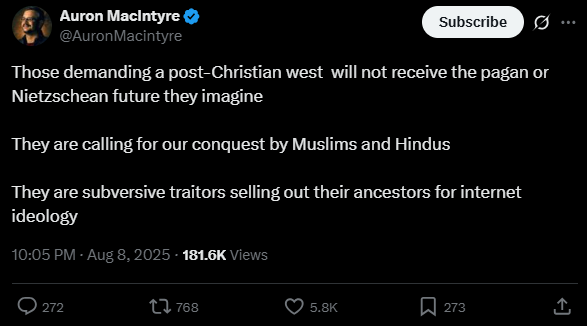
Protestants and Eastern Orthodox are by no means excused from this past: at the 1961 National Council of Churches, a federation of 25 major Protestant denominations and 8 Eastern Orthodox communions representing nearly 40 million people published open support for birth control and a repeal of racial immigration quotas:
Religious leaders representing most mainline Protestant denominations met with key policymakers in Washington, DC for two days to discuss immigration reform. Attendees believed the nation’s immigration policy during the last four decades had enforced forms of racial discrimination that favored some nationalities over others. These liberal Protestants joined a chorus of voices at the time calling for the dismantling of the national origins system, thus allowing for more diverse groups of people to enter the country. Despite the pushback they would receive from their more conservative constituents, those in attendance were convinced that the nation could maintain a Christian identity while still tolerating the cultural diversity that accompanied immigration. Many in attendance also believed that the Cold War demanded liberal reform in order to distance the United States from the godless totalitarianism practiced in the Soviet Union. The themes of Protestant relief and Cold War concerns all converged in an endorsement the delegates received while at the 1961 conference. “Consultations such as this focus attention upon an issue that is important to both our international standing and our national self-respect,” declared President John F. Kennedy in a statement sent to the gathering. “You who assume the daily burden of guiding the oppressed and the orphaned people of the world to productive and satisfying lives under the banner of freedom deserve our thanks.”
…
Mainline Protestant leaders joined the drive for mid-century immigration reform, and in the process paved the way for a more plural nation. Their denominations tried to balance a limited form of pluralism and respect for cultural diversity with the conviction that America should be a Protestant nation centered on biblical tenets and church attendance; in short, they came to a pluralistic bargain. In so doing, they contributed to their own decline as cultural gatekeepers and aided in immigration reform that allowed for a cultural revolution as non-Western immigration changed the cultural and religious landscape of the nation.
—Nicholas Pruitt, Open Hearts, Closed Doors: Immigration Reform and the Waning of Mainline Protestantism.
As it turns out, this already abortive Fifth Great Awakening is following precisely in the same footsteps of the Fourth that gave us this world. The Fourth Great Awakening (as it is called by some scholars) encapsulated a return to Christianity following a cratering prior and during WW2. The mainline Protestant churches collapsed, and replaced by them were the new evangelical churches which constitute much of American conservatism today. Yet even as individuals returned to the pews in droves and new conservative ideologies began to marinate in reaction to these developments, the aforementioned -isms continued onwards: liberalism, pluralism, and secularism grew exponentially within American culture. As an anecdote, even the ultraconservative Southern Baptist Convention held an official approval of legalized abortion until 1980. When Roe was decided, the SBC called it “an advancement of religious liberty, human equality and justice.” It would go on to affirm its stance of legalized abortion under varying circumstances in 1971, 1974, 1976, 1977, and 1979. How many children were killed as a result of these statements, one would wonder? Now, these are the same institutions and people which refuse to cooperate with the right because it will not destroy itself in an effort to totally and completely outlaw abortion? Proponents of another Great Awakening must justify to us how this time will be any different than its identical predecessors.
My conclusion from these historical and contemporary realities regarding this issue is that no particular religion outputs a particular politics by necessity. Whether or not it has always been the case, in our day and age it is often politics and ideology which spurs religious developments—not the other way around. An institution is an institution, people walk into the door of these meetings with their own preconceived notions and ideologies, seeking to reform and control rather than to learn. This is equally true for the USCCB or SBC as it is for Congress or the bar association. When people call for grandiose returns to these institutions, they may say that the salvation lies specifically within them, but the very movement of such a return is underpinned with the understanding that they are coming to reorient them to some other set of principles. The “trad” communities, many of whom who have converted for political or ideological reasons (this is not a bad thing), should understand this best.
We have so far discussed only institutions, a problem most Christians are already aware of. But what about beliefs, and the prospect of religious beliefs redefining these institutions and the political sphere? The work of the late Robert Bellah is prescient on this issue. We are discussing which institution or religion represents which politic, when individuals have already moved on from religious institutions entirely as arbiters of these things entirely. It is the day of the individual man, not the church. He writes:
To concentrate on the church in a discussion of the modern religious situation is already misleading, for it is precisely the characteristic of the new situation that the great problem of religion as I have defined it, the symbolization of man's relation to the ultimate conditions of his existence, is no longer the monopoly of any groups explicitly labeled religious. However much the development of Western Christianity may have led up to and in a sense created the modern religious situation, it just as obviously is no longer in control of it. Not only has any obligation of doctrinal orthodoxy been abandoned by the leading edge of modern culture, but every fixed position has become open to question in the process of making sense out of man and his situation. This involves a profounder commitment to the process I have been calling religious symbolization than ever before. The historic religions discovered the self; the early modern religion found a doctrinal basis on which to accept the self in all its empirical ambiguity; modern religion is beginning to understand the laws of the self's own existence and so to help man take responsibility for his own fate.
American Sociological Review, Vol. 29, No. 3 (Jun., 1964), p. 372
The religious landscape of Western society is suffering from a problem of institutional authority, making “returns” to these institutions all the more pointless. We are all living in the consequences of the Peace of Westphalia. Orthodoxy means nothing to modern peoples: as Jefferson had stated, “I am a sect myself.” Consequently, nearly every Christian in America is a heretic: 51% believe God changes and adapts, 71% are Pelagians who believe that humans are born innocent, 56% disagree that Christians even have an obligation to go to Church, and 46% believe that the biblical condemnation of homosexuality no longer applies today. What good is the fact that Christianity has this ancient compass called the Nicene Creed, which states that Christ was “begotten, not made, consubstantial with the Father”, when 73% of American Evangelicals profess the Arian heresy by believing that Jesus was made by God, the exact thing Nicaea was called to tackle in the first place? Why would I submit myself to the Catechism when I can see the damage that the Church teaching on immigration has done to my people? Why would a leftist go to church when the God in their head wouldn’t scold them hosting a lesbian book club? On that point, what gives you the authority to promote the “traditionalist” message of Christianity while James Martin enjoys all of the pontifical support in the world to promote the precise opposite? “Because it is the truth!”, shouted back a million individuals, with a million different conceptions of “truth”.
We already have a secular, post-Christian society: it exists even within our churches. Now it is time to determine what that will look like and ensure it is a right-wing one. Much of this development is precisely due to the actions and natural conclusions of developments within Christendom, and now they are getting the apostates they deserve.
All of this is necessary to preface why certain individuals have begun talking about a “secular right”, and where these sentiments are coming from. If these are the terms, then we must find a way to deal with them that do not involve reinventing the same broken wheel. I won’t claim to speak for anyone else on this issue, but my analysis revolves around this observation: You owned the world. You led its institutions, you orchestrated the movement of politics, you popularized ideologies. All of this has led us precisely to the rotten and suffocating world we have now. What other reaction did you expect than secularism?
Precisely what a “secular right” will look like, I will largely leave to far more important people. It must however be noted for now that secularism is not atheism. This is not an advocacy for a Hoxha regime or Neronian prosecutions in which religious precepts are ruthlessly attacked in every corner of life, as they are today in far left locales and institutions such as media and academia. Secular regimes are not ideologically barred from using metaphysical preconceptions to justify their right to rule or set about the manner in which they will, on the contrary, they typically utterly depend on them. The difference is that they are not dedicated to catering to the sacerdotal element at the highest level of hierarchy. They do not pull their values exclusively from scripture and are prevented from moving beyond the barriers of Revelation, but rule based on the principles of life itself which may have substantial overlap with the aims of the religious—order, vitality, and nature.
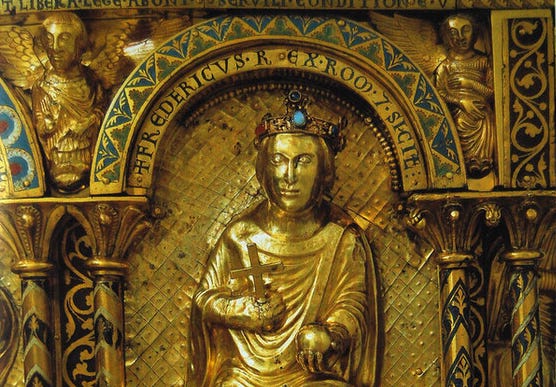
This is the distinction between a Guelph and a Ghibelline, a priest and a knight. When Frederick II, Kemal Ataturk, Otto von Bismarck, Benito Mussolini, Louis XIV, or Henry VIII sought to revoke the Church’s claim over kings and nations, by no stretch of the imagination did they believe they were undertaking an anti-Christian policy. They did, however, believe they were reclaiming a mandate to rule that was never in full effect due to the meddling and posturing of the Church. While the secular left seeks to destroy religion, the secular right seeks to control religion—animating it to the ends of the nation. Often, the religious elements of society flourish under these secular regimes, as was seen with Mussolini and Bonaparte.
A theocratic vision of “Christian nationalism” understands their position in neither history or today. This mess of a thousand and one disasters and sufferings is entirely of their doing, on a scale so unimaginable that any previous generation would have concluded the world had ended. Despite this, they demand that it is their institutions which will continue to rule over the rubble. The right-wing can no longer tolerate relentless moralizing from institutions built specifically to that end. The age of the priest is at its end, and they have no one but themselves to blame.
But my feeling changes and breaks out irresistibly the moment I enter modern times, our times. Our age knows better.... What was formerly merely sickly now becomes indecent—it is indecent to be a Christian today. And here my disgust begins.—I look about me: not a word survives of what was once called “truth”; we can no longer bear to hear a priest pronounce the word.
…
Every one knows this, but nevertheless things remain as before. What has become of the last trace of decent feeling, of self-respect, when our statesmen, otherwise an unconventional class of men and thoroughly anti-Christian in their acts, now call themselves Christians and go to the communion-table?... A prince at the head of his armies, magnificent as the expression of the egoism and arrogance of his people—and yet acknowledging, without any shame, that he is a Christian!... Whom, then, does Christianity deny? What does it call “the world”? To be a soldier, to be a judge, to be a patriot; to defend one’s self; to be careful of one’s honour; to desire one’s own advantage; to be proud ... every act of everyday, every instinct, every valuation that shows itself in a deed, is now anti-Christian: what a monster of falsehood the modern man must be to call himself nevertheless, and without shame, a Christian!
—Nietzsche, TA § 38


“ If returning to the traditional values of generations prior is the permanent solution, why then did those generations give us these problems in the first place?”
That. Is the key problem. This is why I don’t wanted to live in the past. There are many good and beautiful things to appreciate and to restore, but there were also many weaknesses and confounding stupidity that shouldn’t be repeated.
I like to joke “Constitution so perfect it’s a mystery why there is corruption and decline.” Repeat with Christianity and other stuff. I wanted to get people to at least try to understand how and why things unfold as they did. But they’re strictly in for the talisman value.
So, let us build something better and a bit more wisdom.
If a real state ever came about in the 21st century or the future, it must be led by a man like Napoleon or Alexander, men who create a new way of life in themselves, whose personage becomes the source of a morality. A real leader to tell people what is right and what is wrong. A real state would be a state which posits some knowledge or ownership of the divine and eternal, and who express a will to something historical, to which the people will be subject to. Because we don’t have any true values, nothing we hold higher than life at this point, this is the only way it can come back. This is the insight of the Nietzsche, this is the transvaluation of values, on the level of a state or civilization.
In some sense Trump has approached this, many of his most cattle like followers seem to think everything he does is divine revelation, perfect and without flaw. Very interesting.
I believe Christ is God, but I cannot participate in the Christian life which my ancestors did, because it does not exist anymore. My faith doesn’t extend beyond me and my actions, I’m an island in this sense. I believe Christ because I think he is literally God and the truth. I can’t rely on an organization to deal this to me, they are all essentially dead and corrupted, like you say. The individual must lift himself to the truth and figure it out himself, this is the only way out of nihilism, besides the Caesar I described earlier of course.
So to trust or politics to these corpses of organized religion is not viable. The individual man can decide for himself, but as a matter in society, they are too weak and splintered. Thanks for this article, I enjoyed it. This was my rant…