


Does Ancestry Actually Matter?
Thoughts on genetics, heritage, & problems with haplogroups

A central component of the cultural divide between the contemporary right and left is its relationship to the family unit: its hierarchy, its legal and cultural significance its biological and evolutionary purpose. Whereas the right continues to, more or less, seek to preserve the family unit and all that it entails, leftism continues to trend towards the complete and total abolishment of it as a significant and meaningful structure. As far back as Engels, we see leftism describing the family and the aforementioned qualities of it as “barriers to equality”. Today, sociological research has identified the contrast as an easily identifiable marker of one's ideological leanings.

The ideological presuppositions of leftism inevitably lead to confrontations with right wingers in adjacent topics, such as history, racial identity, religion, and merit. Let me know if you have heard the tired old trope before: “How can you be proud of what your ancestors did? You're not them, you didn't do anything. They lived 4,000 years ago, you're hardly even related to them!” Of course, this is a pejorative launched by people who have no such problem taking in ethnic associations and pride of their own, but that's another topic. They are directly challenging something the right has largely taken for granted as part of an inherited tradition. Does ancestry actually matter? Does it impact who we are, and are we right to identify with our ancestors?
Ancestry is, of course, tremendously important to mankind in the most general sense. Ancestral religions and cults are some of the oldest forms of religion that we know of, and ancient beliefs were centered upon the transmission of heritage from parent to offspring, be it patrilineally or matrilineally. Civilization has utterly depended upon this extension of the family structure and the concept of heritage to the matters of the tribe, eventually encompassing kingdoms, nations, and empires. Yet, all of this tells us very little about the basis of ancestry's importance on biological grounds. Why did we care at all, not sooner taking on contemporary principles of extreme individualism and the rejection of these structures? What if they were just materially convenient at the time, something we no longer have use for?
An initial defense of the importance of ancestry will leap right into genetics, as it is, in a way, the scientific inquiry into heritage. Our DNA contains the lives and bounties of thousands of generations of human ancestors, and trillions of organisms more prior to that. In a literal sense, we are a mosaic of each and every one of those ancestors, and we could not understand ourselves without understanding them. However, there are many pitfalls in more thorough discussions over this. How is any of this actually significant enough to *do* anything with?
We typically reference two technical understandings of ancestry and its importance on the genetic level: admixture and haplogroups.
Admixture is the most familiar, operating on the simple and truthful observation that you are one half of each of your parents, and they one half of theirs, and so on—as each parent contributes one of each pair of a cell’s homologous chromosomes. This accurately tracks the makeup and immediate source of most of your genes: your beliefs, behaviors, height, facial features, eye color, and disease risks. Even when one accounts for the shuffling of genetic material caused by recombination and random assortment, the contribution of individual alleles from parent to offspring, identical by descent, average out to 50% each. This is common wisdom, but in fact does little for us in regards to proving that ancestry is meaningful: with each successive generation, the explanatory significance of direct ancestral ties becomes greatly diminished. By the time you look back at Charlemagne, who all descendants of Europeans are related to, the chance you share a specific allele you inherited from him is determined by the coefficient of relationship, in this case 2⁻⁶⁰, or 0.000000000000000087%. How could you claim to possibly share anything with him with this rationale?
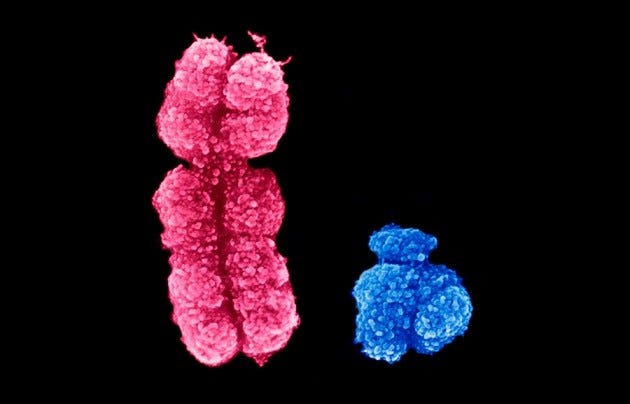
Haplogroups, conversely, provide an interesting genetic trick which allows us to preserve genetic material over thousands of years. For men, the Y-chromosome is directly inherited from the father in every instance. More importantly, the Y-chromosome interestingly does not experience recombination for the vast majority of its structure, about 95%. Groups of alleles which are comprised by that region are identified as haplogroups. This means that, generation over generation, 95% of the Y-chromosome is identical, barring the single-nucleotide mutations which prompt the identification of a new haplogroup. As a result, we are able to track an individual man’s Y-chromosome to mutation events thousands of years in the past. In my specific example, my haplogroup R-DF27, has been largely identical for my entire paternal line going back to 2500BC. Consequently, my Y-chromosome is largely identical to millions of others of European descendants.
Despite the incredible nature of this, there is a catch: this lack of shuffling and mutation has had negative effects on the Y-chromosome, and it has shrunk to a comparatively tiny size as a result. It only has room for genes related to sexual development in men, and is therefore otherwise meaningless in explaining your beliefs, behaviors, height, facial features, eye color, and disease risks that the autosomal formulation would. To put it in perspective: of our over 20,000 protein coding genes, roughly 60 are on the Y-chromosome, and nearly all maintain basic male biological function. Where we inherit genes for how our testicles develop is interesting, but not particular useful… when we believe we are like our ancestors, we think more of the relationship than spermatogenesis. Additionally, it tells us nothing about the X-chromosome, women, and matrilineal descent—which has also held some significance in families and traditions, and is one half of our story.
The technical problems with admixture and haplogroups in arguing for the significance of ancestry don't stop here. Haplogroups, additionally, aren't automatically indicative of an ethnic belonging. Imagine for example an ancestor of yours in 1600s British America, who through some moderate tomfoolery intermixes with the native population and has a half-Indian son among his European children. This half-Indian goes with his mother back to the tribe, and for 400 years he and his half-siblings, and their descendants, are entirely separated. Today, both you and his male descendants would have identical Y-chromosomes. How much is that telling us about the meaning behind ancestry?
The admixture & genetic similarity framing on the other hand could be entirely inverted: if we are so concerned about ancestry and genes, why aren't we thinking most fondly of the first eukaryotic cells, which the vast majority of our DNA come from? Why not Australopithecine hominids, why not fish? If we are interested most in the genes which define “us”, certainly we would be more interested in the ones that give us vertebrae instead of ones that subtly influence our cultural attitudes. We should just be Spinozan monists which find the same in all things, where there would be no need to talk of “my ancestors”. Suffice to say, I do not think we have thought nearly long enough about these things and are sailing a dead ship.
Here is one solution: our error is looking at shared individual beams between two buildings instead of the similarity between the whole of the architectural style. Ancestry matters only when you look at polygenic traits which define peoples rather than specific genes or the relationship between two specific individuals/lineages. At the population level, allele frequencies do not rapidly disintegrate, they are preserved generation after generation with remarkably continuity. This is due to the fact that insignificant variations upon thousands of individual alleles in a polygenic “architecture” can produce significant results.
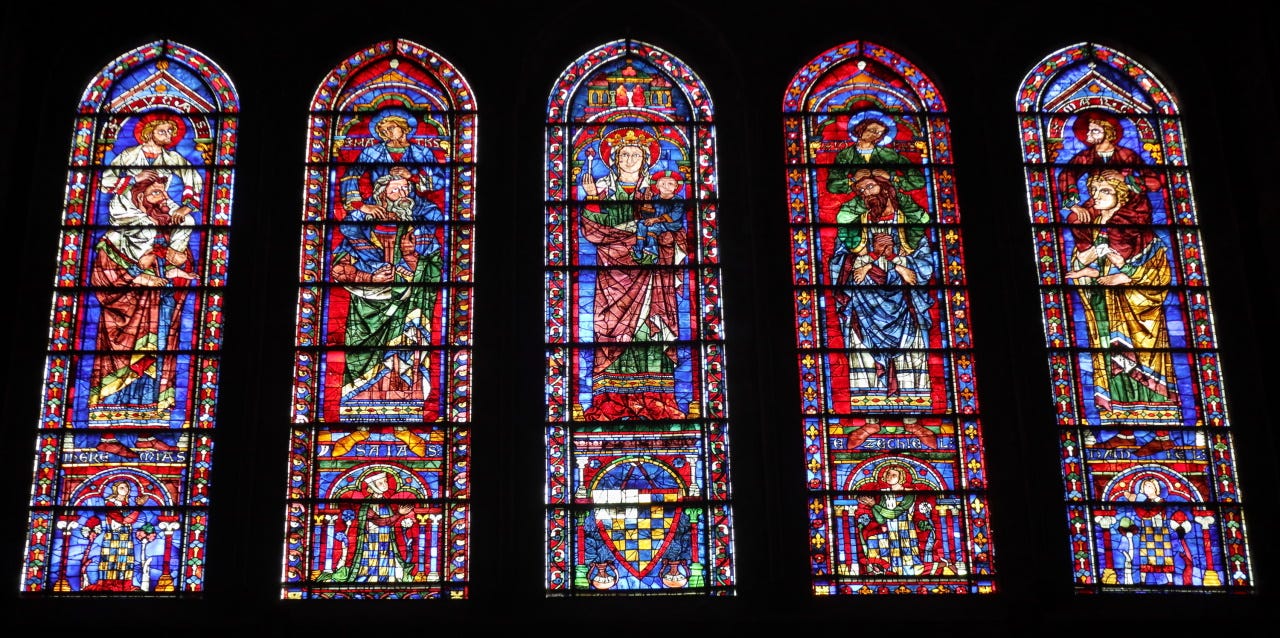
Think of a row of stained glass murals in a church, incredibly detailed, being made up of thousands of individual pieces as those of Chartres Cathedral are. The individual pieces of these murals were imbued by a talented glassmaker with the lively ability to alter themselves independently. Each piece may, at random, change from blue to green or from a triangle into an oval, and so on. Pieces could even swap with another on an identical location on the adjacent mural. Every day, the glassmaker inspects his magical murals for changes which deviate too far from what the Gospel narrative they depict—this is a church, after all. After some time, were we to look at the similarities of one piece between each of the murals, the chance that we will not be able to point out any such similarity or congruence over time is all but certain. But because all of the murals were maintained by the same glassmaker—the same environment—upon taking a step back we will notice that the murals not only look similar to their original form, but similar to each other.
The more technical name for what I am attempting to illustrate is polygenic adaptation at the population level. Traits are rarely encoded for by a single gene, but are the product of multiple genes related in function. Therefore, it is essential that any inquiry into the relatedness between groups and individuals, including our ancestors, operates at the polygenic level. Over time, a population will gradually adapt to the environment through mutations, selection, and all other forms of evolution. Yet rarely will rapid evolutionary change be generated by a mutation to a single, significant gene. Rather, multiple genes will be at play.
Indeed, this fallacy was already played out by Richard Lewontin, who in 1972 wrote a paper titled “The Apportionment of Human Diversity”, which essentially debunked race as a taxonomically valid structure in human populations. If you have heard the line, “there is more diversity within races than between them”, this is where that comes from; and Lewontin was absolutely correct—only if you compare one allele to another at a time as he did. When one takes a polygenic approach as A.W.F. Edwards and others did, the statistical existence of racial barriers miraculously reappear. To fall into the error of looking at genetics “one gene at a time” stunts your sample size to one, and justifies the critiques that leftist thinkers have been employing for decades.
Now, what does any of this have to do with ancestry and how one justifies the significance of his relationship to his ancestors? Two considerations:
It is first important to recall why we exist by this strange phenomenon of sexual reproduction in the first place. Everything dies. Reproduction is an ancient alchemical trick which cheats death, allowing someone to exist indefinitely further. Just as certain as death is, so too is change in the environment, and so variation is sprinkled in at the transition to increase one's likelihood of surviving in a novel world. That is why we have children, that is why any of us are here. In a more blunt way of putting it, you are your ancestors, reoptimized for a modern world.
Secondly, it is important to recall that evolutionary change is defined as the change of allele frequency within a population over time. While the mechanism of this change operates at the level of individual genes as its unit of selection, the effect is typically contained and best seen within a population. Only at this level can specific traits be proven as relatively better than other traits in the population, allowing for its proliferation. As a consequence of this, changes that promote an individual will inevitably spread throughout the population until it reaches either fixation or evolutionary stability.
With these two things in mind, we can see clearly that any meaning behind ancestry can only be understood as this continuity of and within a population over time. It is a belonging to a specific people, stretched back in time as it is to those alive today. It is a self-awareness of one's existence precisely in service to this continuity. Therefore, when one says “I am proud of my ancestors”, they are not speaking of specific genes or haplogroups, but a direct identification with that organism we call a people, a þiudas, an ethnos, a gnasci—a word connecting gene and nation. All other conceptions of ancestry are comparatively narrow in significance, and contain a number of problematic dead ends. It is not that things such as haplogroups or paternal inheritance do not matter, but they do not encapsulate the whole of the attitude towards ancestry, and the whole of the genetic story.
Once one goes far back enough in his family tree, he is confronted with the fact that he can know increasingly little about his ancestors. Further, the less exclusive they are to him, belonging to a number that exponentially increases each generation he goes back. The haplogroup was intended to remedy this, but runs into problems of its own. It is little more than an inherited tattoo, with barely any significance to the attitudes and behaviors we typically associate with an inherited familial tradition. Understanding ancestry on polygenic terms and belonging to populations, however, gives us meaningful continuity without any drawbacks. When I think back to the medieval, the Bronze age, or further, I understand I am those people by blood, reconfigured to thrive in a world which they likely could not. So long as my stained glass mural resembles theirs, I am right to call them my own.

So, to restate the question and to answer it. Does ancestry matter? Absolutely, yes. It defines us utterly. The question is how we go about describing why in a nuanced way that is careful to not present itself as self-defeating. Understanding ancestry as an extension of group identify, rather than attempting to engage in Lewontin's fallacy, presents itself as at least one good way of doing so. Ancestry matters most at the population level, where polygenic traits maintain continuity through stable allele frequencies.
Counterintuitive to conventional political understanding, it has been the right's philosophy which has employed collective understandings, nested within the laws of nature rather than ideology. It has been the left who, now increasingly, demands the primacy of the individual above all other individuals and combinations thereof: the individual's morality, the individual's pathologies, the individual's God. Whether it has always been the case or suddenly now, today the right finds itself conclusively in the belief of concrete groups and hierarchies between them, be they sex, age, class, or nationality. The Civil Rights Act and its “non-discriminatory” clauses is the idol of global leftism. For us however, we accept these biological qualities for what they are, and accept our role as yet another torchbearer in this great chain.


Ancestry is also cultural, one feels closer to the ancestors when he is surrounded by their works, be they art, techniques, stories and anything else
Have you ever read any of the Icelandic sagas? They start out by giving you the family history of the leads. The reason for this is simple. Certain families had certain traits. Some were known hotheads, some peacemakers, some just unlucky. You would have an idea of how things would go, just from that family history. Of course, no one now really wants to know about their ancestors.