


Great Heathens (I): Johann Wolfgang von Goethe
Faust, Artemis, and the Eternal-Feminine

Great Heathens is a series which details figures in recent history who, while typically not open and practicing pagans, were drawn in and contributed greatly to its worldview. The series details their lives, thoughts, and actions; and how they contrasted with the Christian culture they lived in.

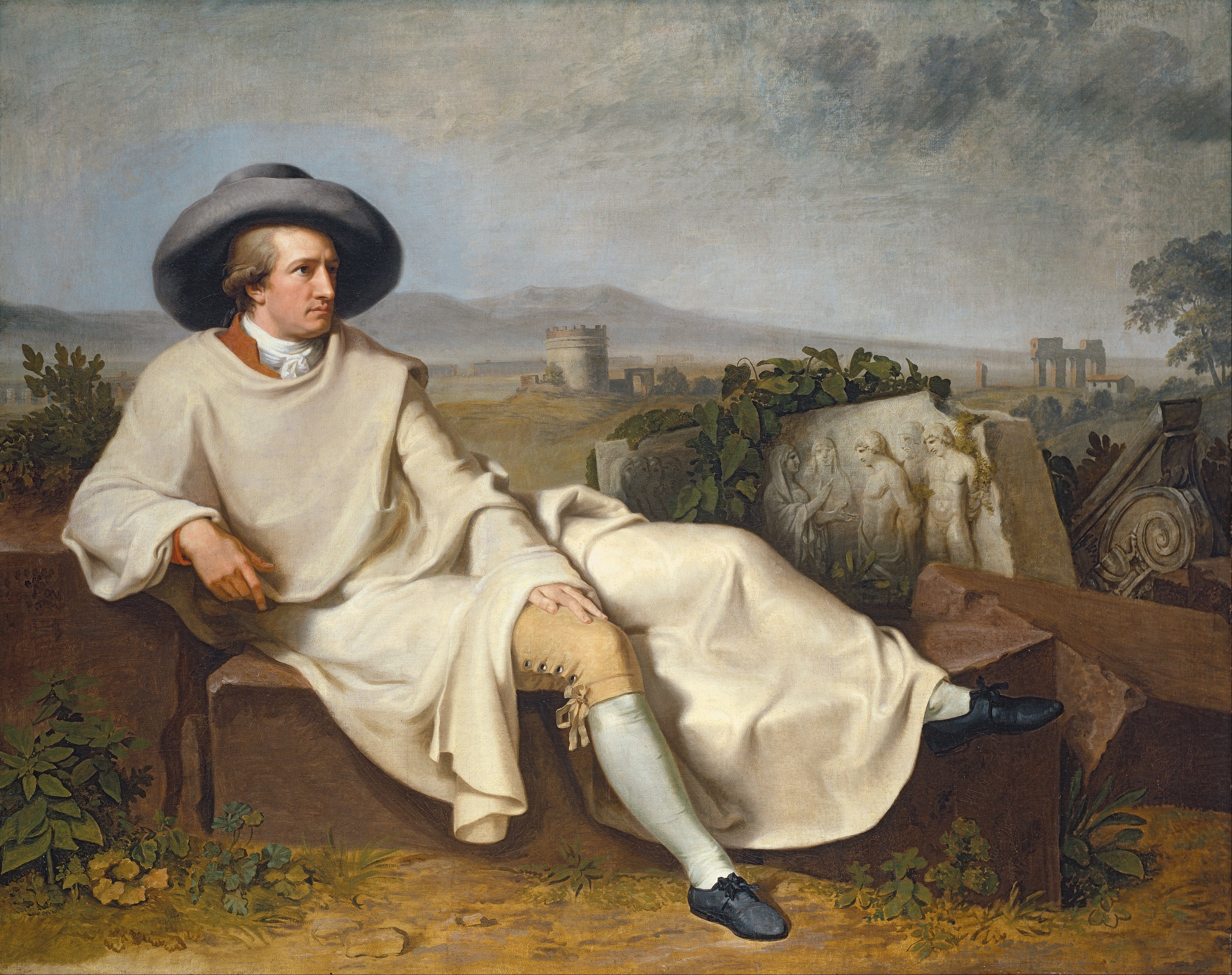
It is difficult to properly introduce a figure such as Johann Wolfgang von Goethe, other than to note that he was arguably the most consequential and most loved German to have ever lived, and widely recognized still today as worthy of such recognition. When Nietzsche envisioned his übermensch, he did not picture an illiterate warband roving across the Rus, but instead instructed us to put our hearts and minds towards this delicate poet of Frankfurt:
Goethe—a grand attempt to overcome the eighteenth century through a return to nature, through a going-up to the naturalness of the Renaissance, a kind of self-overcoming on the part of that century…He did not sever himself from life, he placed himself within it…and took as much as possible upon himself, above himself, within himself. What he aspired to was totality; he strove against the separation of reason, sensibility, emotion, will…; he disciplined himself to a whole, he created himself…
Goethe conceived of a strong, highly cultured human being who, keeping himself in check and having reverence for himself, dares to allow himself the whole compass and wealth of naturalness, who is strong enough for this freedom; a man of tolerance, not out of weakness but out of strength, because he knows how to employ to his advantage what would destroy an average nature; a man to whom nothing is forbidden, except it be weakness, whether that weakness be called vice or virtue…
A spirit thus emancipated stands in the middle of the universe with a joyful and trusting fatalism, in the faith that only what is separate and individual may be rejected, that in the totality everything is redeemed and affirmed—he no longer denies… But such a faith is the highest of all possible faiths: I have baptized it with the name Dionysus.
—Nietzsche, Twilight of the Idols
Goethe was—to provide a shortened list—a poet, botanist, physicist, stage manager, biblical scholar, novelist, philosopher, privy councilor, teacher, and anatomist. He was the “Renaissance Man” par excellence, no endeavor or activity seemed outside of his talents, and a long list of accomplishments are attached to his name as a result, including his own “Goethean science”. One such feat was what may have been the first formulation of the Darwinian theory of evolution, a natural consequence of his work on plant morphology and his discovery of the premaxilla bone in humans. Darwin of course was not a prophet, but a magnificent doctor and synthesizer of observations and theories that had been bubbling in the decades prior, partly due to Goethe:
About the end of the eighteenth century fruitful suggestions and even clear presentations of this or that part of a large evolutionary doctrine came thick and fast, and from the most divergent quarters. Especially remarkable were those from Erasmus Darwin in England, Maupertuis in France, Oken in Switzerland, and Herder, and, most brilliantly of all, from Goethe in Germany.
—Andrew White, A History of the Warfare of Science and Theology in Christendom
It is therefore easy to see Goethe himself in the singular work for which he is idolized to this day for, Faust. In it, Heinrich Faust is a scholar beyond scholars—no matter of modern science or literature was beyond his grasp. Yet, his thirst for knowledge was insatiable, and he grieved at the fact that he could not know everything: “And here, poor fool! with all my lore / I stand no wiser than before.” It was from this dissatisfaction with human limits that lead Faust into a pact with the Devil, Mephistopheles.
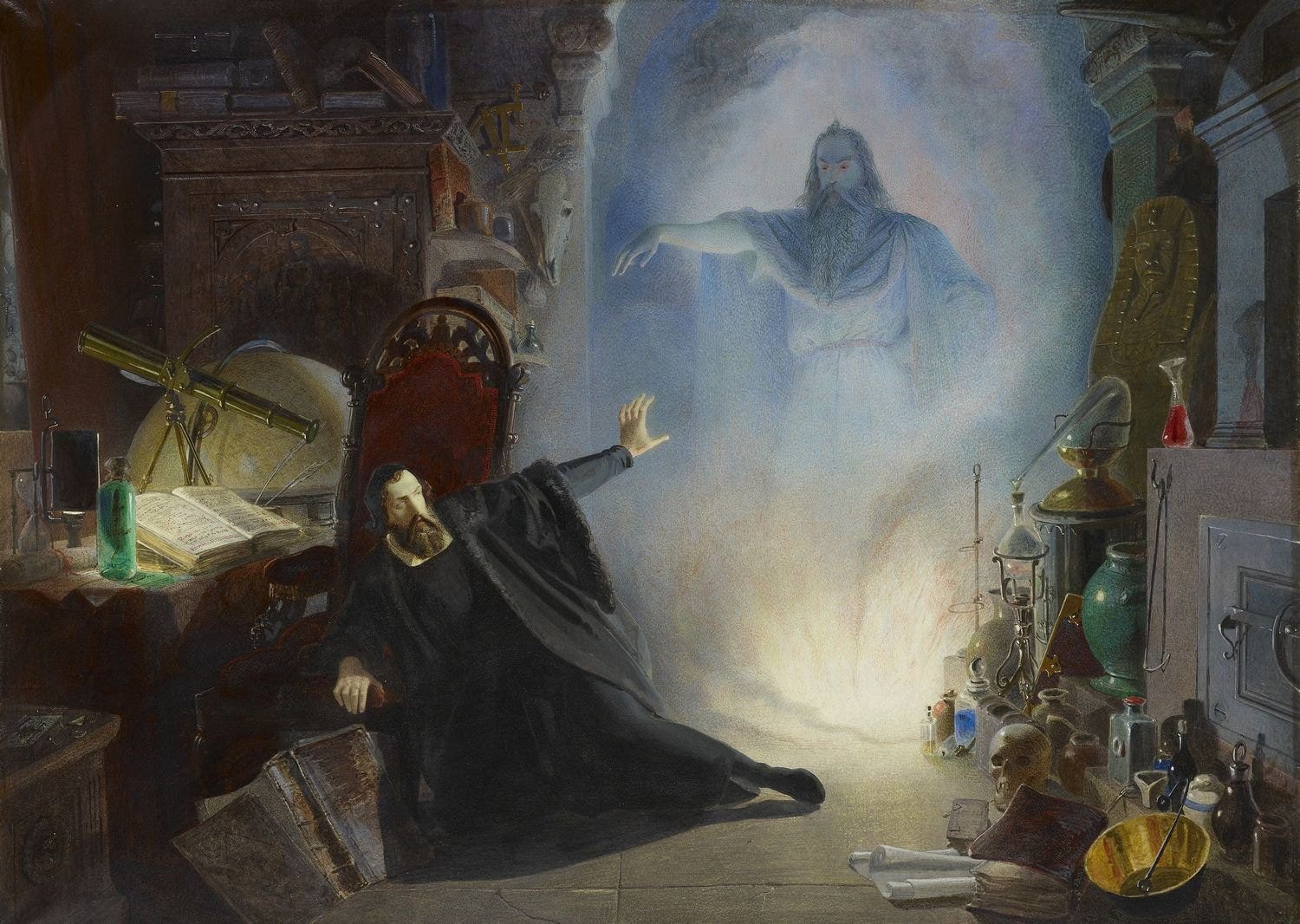
Faust is rightly remembered as a Christian work. It has clearly religious themes and messages which are either inspired by or are direct commentary on Christian matters. However, attributing this work entirely to matters of the Church is an error, and a failure to take into account the full narrative of the drama, as well as Goethe himself. Indeed, his most notable quality was his uniqueness, and his rejection of dogma.
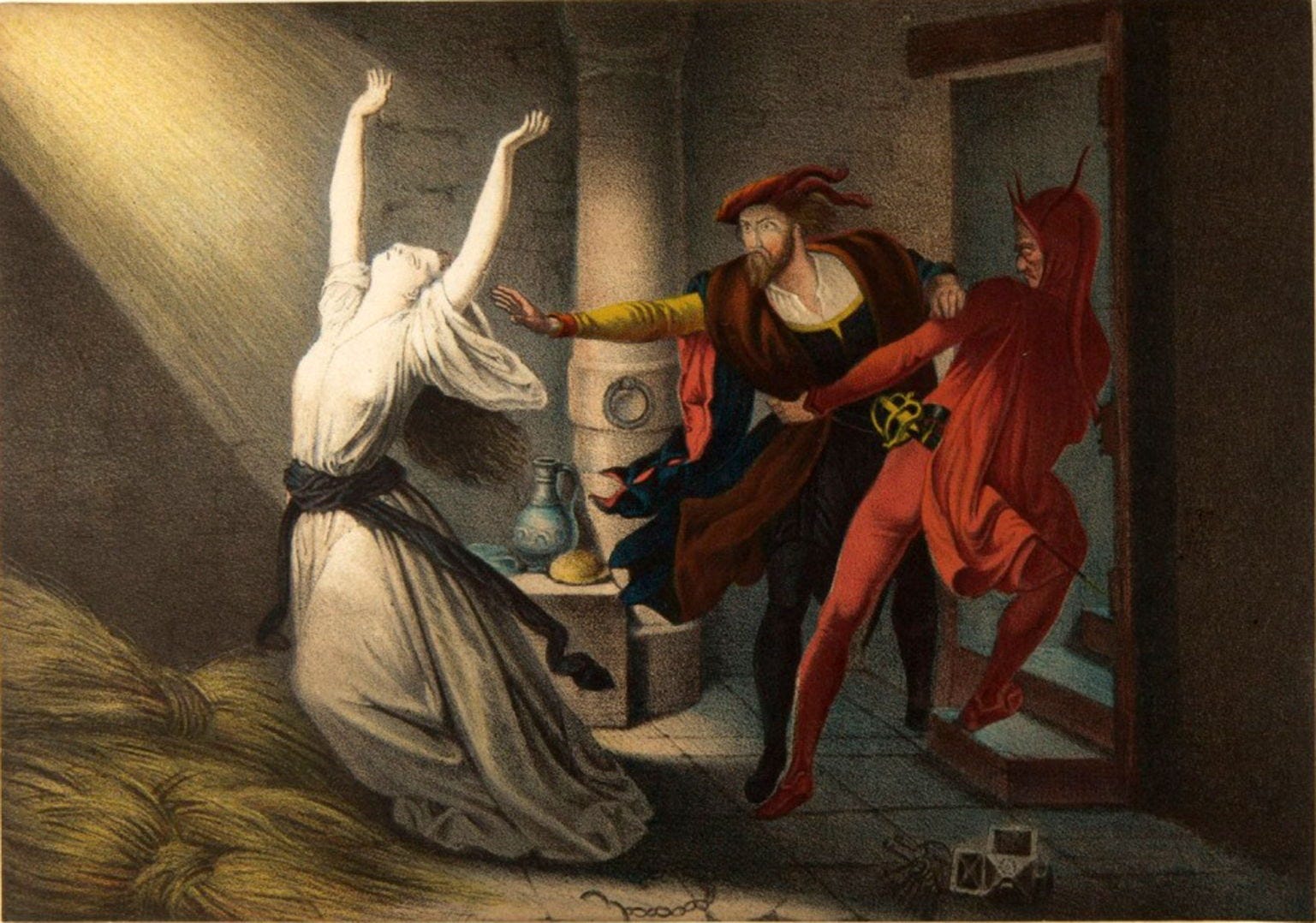
For example, Faust was not at first intended to have two parts: in earlier versions, it ends with the horror and tragedy of Gretchen's damnation, and both she and Faust are lost to the Devil—an important lesson and warning to the audience, in similar Protestant fashion to Cotton Mathers. Goethe did not finish Part II until shortly before his death, and it was published only posthumously. After a long-winded tangent through Ancient Greece—which serves as a medium for contemporary commentary on the many different matters surrounding his unique worldview—Goethe finally returns to the matter of Heinrich’s damnation at the end of Part II. In it, he is likewise an old man, who has spent his life in service to striving (Streben), toiling the land in search of beauty, creation, and harmony with nature. At the moment of his death, the Devil reappears to claim his soul as their pact had demanded, mocking, “You are mine! You are damned! You are—” … A booming voice suddenly opens the heavens, “—Saved.”, and his soul is lifted away from the Devil and into Heaven. What is intriguing about this conclusion is—firstly, Goethe's demand for a better ending than what was written before—but secondly, a salvation that is not obtained by faith, sacrifice, or martyrdom, but by human striving. He concludes Faust with a curious line of which much has been written about, and picked up by those such as Nietzsche: “Das Ewig-Weibliche zieht uns hinan”—the Eternal Feminine draws us on. In a way, it was Gretchen who had saved Faust; Christ goes curiously unmentioned. As Catholic journals later commented:
“Having rejected the doctrines of redemption and repentance on which the original Faust-legend was based, Goethe had considerable difficulty in finding a satisfactory ending for the work: indeed, without outside pressure he would probably never have completed it. As it is, the Christian reader cannot help raising an eyebrow at the way in which Faust, who has broken almost every one of the Ten Commandments in turn, is finally borne up to Heaven by angels. Even Bielschowsky, one of Goethe’s greatest admirers, complains of the absence of moral endeavours in Faust.”
—S. A. H. Weetman, Goethe and the Catholic Church, Blackfriars, Volume 30 - Issue 356 - November 1949
Goethe had clear objections to the orthodoxy of Christianity, especially towards Roman Catholicism, as he was raised into a Lutheran family. At the age of 21 while studying law at Strasbourg in 1770, his doctoral thesis was caustic of Christianity, writing: “Jesus Christ is not the author of Christianity, but rather 'tis a subject composed by a number of wise men. The Christian religion is merely a rational, political institution.” The thesis was, predictably, rejected for unorthodoxy. In response, Goethe wrote 56 theses to the University in the fashion of Martin Luther, challenging specific orthodoxes more directly. One thesis discussed what natural law is and how it extends to more than just man, and discussed (negatively) the concept of the death penalty for mothers who commit abortion. Both would later find themselves in Faust. By 1790, his disapproval of Christian matters was more direct. In his Venetian Epigrams, which were heavily suppressed at the time for its attacks on Christianity, Goethe wrote: “Four things I loathe the most, as repellant as poison and serpents, are: Tobacco smoke, bugs, garlic, and ✟”. And, by 1810, had written that “Christianity is the fairytale of Christ.” Perhaps the most direct statement of his objections to Christianity came in 1820, with a phrase later repeated by Max Planck: “God himself could not alter the course of nature.”
Nevertheless, he elsewhere espoused a clear love for something about Christianity, and about God: “I hold to faith in the divine love — which, so many years ago for a brief moment in a little corner of the earth, walked about as a man bearing the name of Jesus Christ — as the foundation on which alone my happiness rests.” Perhaps he, a man of the Enlightenment as much as he was of the Renaissance, was interested only in his own religion and his own God, fit to his experiences and understanding of the world, and undoubtedly influenced by Christianity. Perhaps he was like Nietzsche, admiring Christ the teacher, but abhorring everything about the religion which followed. Either way, as inspired he was, he evidently could not find God in the monasteries of Christendom. [See this article for citations for all of the above quotations.]
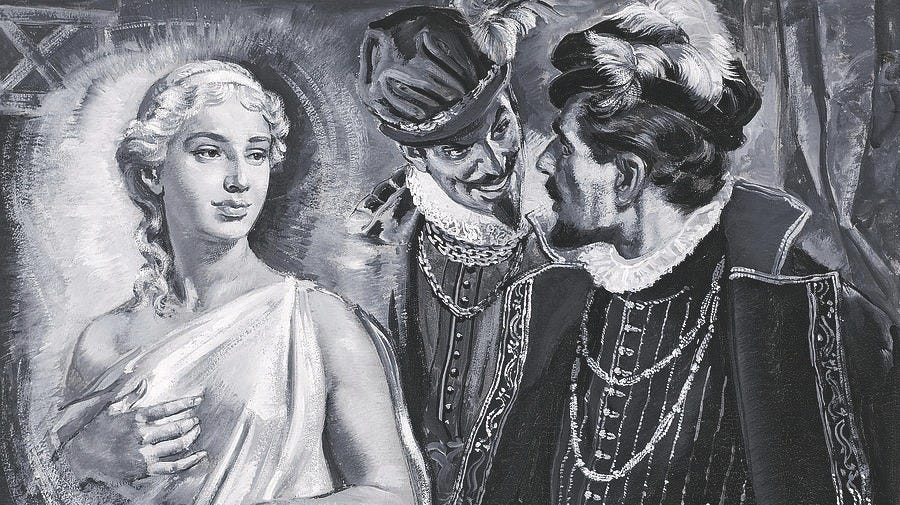
These sentiments were, more or less, common amongst the aristocracy and intellectuals of this period in Europe. What is more anomalous for the time was Goethe's affinity for polytheism, particularly that of the Greeks. The gods, as he described, were “blissfully creating forces”. In Part II of Faust, Heinrich lusts after Helen of Troy during a “A Christmas Carol”-esque visit to the past. He eventually wins her over, marrying, symbolizing Goethe's ideal of a union between the modern, individualistic spirit of Germany with the timeless beauty and wisdom of ancient Greece.
Goethe appears to have been struck by the goddess Artemis above all others; he was particularly moved by the myth of Iphigenia, daughter of Agamemnon, who is to be sacrificed to Artemis as a punishment for the Mycenaean's killing of a sacred white stag. It is a continuation of the “Curse of the Tantalids” inflicted upon the House of Atreus, in which descendants of Tantalus are driven by hatred and revenge into killing their own family. In some versions, Iphigenia is saved at the final moment and carried away by Artemis to be her priestess in distant Tauris. Following this account, Goethe reworked Euripides’ Iphigenia in Tauris into a drama, following her later life and offering commentary on the gods. The gods are shown as powerful and noble, but somewhat distant, and mortals (such as Iphigenia) are to make what they can out of the world. They are to strive.
Goethe's polytheism is most evident in another work on Artemis, a poem titled Great is Diana of the Ephesians. In Acts 19, it is written that Paul's mission in Ephesus was met with with riots by worshippers of Artemis (Diana in Latin), spurred by a silversmith. “Great is Artemis of the Ephesians!”, shouted the crowd, according to Acts 19:28. The riot ends peacefully, and Paul moves on elsewhere. Goethe's poem instead takes on the viewpoint of the smith of Artemis:
At Ephesus in his workshop sat/ A goldsmith, filing and beating/ A golden statue; he wrought thereat,/ Still improving and further completing.
As boy and as youth at the goddess's shrine,/ He had knelt and adored her form so divine;/ Below the girdle there under her breast,/ He saw so many creatures rest,/ And faithfully at home had wrought/ The image, as his father taught.
So did the artist with skill and patience/ Conduct his life and art aspirations./ And once he heard a raging crowd/ Howl through the streets, and clamor loud/ That somewhere existed a God behind/Man's foolish forehead in his mind,/ And that He was greater and loftier too,/ Than the breadth and the depth of the gods he knew.
The artist scarce noted the words of the throng,—/ He let his prentice boy run along,/ But he himself continued to file/ The stags of Diana without guile,/ Hoping that worthily and with grace/ He might succeed to chisel her face.
Should any one hold a different view,/ He may in all as he pleases do;/ But the craft of the master he must not despise,/ For he in disgrace will end otherwise.
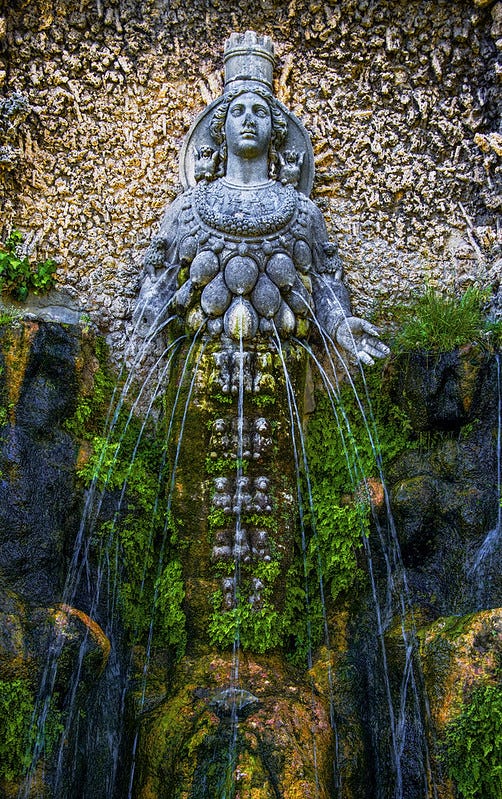
He remarks upon this poem to a friend later, writing further:
“I am indeed one of the Ephesian artists who spends his whole life in the temple of the goddess, contemplating and wondering and worshiping, and representing her in her mysterious manifestations. Thus it is impossible for me to be pleased with an apostle who forces upon his fellow citizens another and indeed a formless god. Accordingly if I were to publish some similar writing (to Jacobi's book On God) in praise of the great Artemis, I would write on the reverse of the title page: 'No one can become acquainted with what he does not love, and the more perfect our knowledge, the stronger, the more vigorous, and the more vital must be our love, yea, our passion.’ ”
A second element of Goethe's “heathenry” was his full-hearted adoption of the pantheism of Baruch Spinoza, among a number of others of his philosophical contributions. For Spinoza, God and nature were synonymous, encapsulated in the maxim Deus sive Natura. God is therefore not a personal, almighty creator enthroned above, but the sum of all that exists—which is governed by rational, deterministic laws. In turn, a sacral quality permeates all of existence, and participation in existence at all becomes a religious activity.
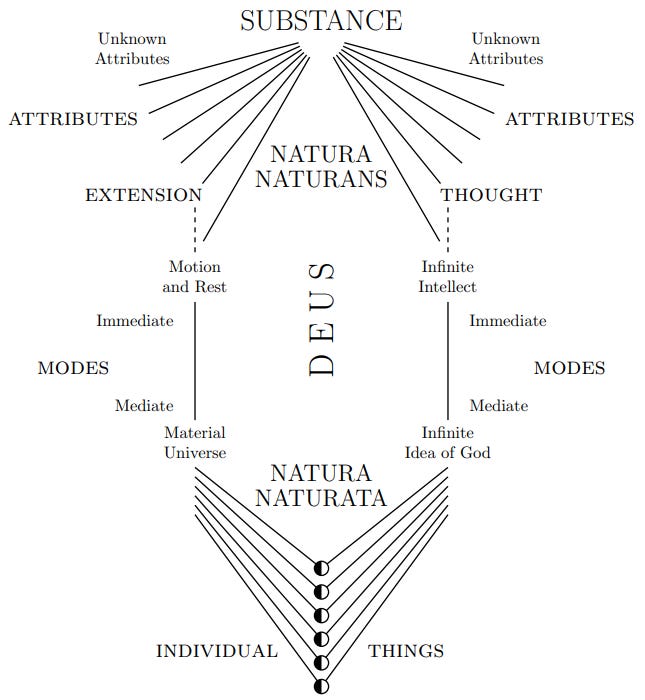
Goethe found himself particularly struck by this revelation, and it permeated throughout all of his work. In his work on botany and evolution, the notion of a singular, archetypal form came to assist him in defining a new taxonomy of plant life. In Faust, Spinoza's intellectual love of God (amor dei intellectualis) is echoed by Heinrich's initial grieving of his intellectual limitations, as well as the Streben which becomes his salvation. Ultimately, it allowed Goethe to reconcile his interests and findings within nature and natural sciences with the existential meaning of the human being within his poetry.
Perhaps it was this infatuation with nature that lead him to dwell on Artemis/Diana, who herself was a goddess of all that was of nature and the “Eternal Feminine”—the hunt, the countryside, childbirth, the night and the moon. For Goethe, the love and participation in nature and creation was man's redemption. For Goethe, great indeed was Diana of the Ephesians. Nietzche may have baptized him as “Dionysus”, but I believe I know who Goethe would have preferred. As early as age 9, Goethe was making altars to nature out of his father’s natural history collection, surrounding it with sulfur and candles.
At the end of the day, Goethe is remembered precisely because of his uniqueness, and his ability to transcend contemporary assumptions and dogmas to create something new and more true to experience. Many religions can claim him in some way, and I suspect he would be honored by such a success in his endeavor to unite different worldviews into one. In regards to paganism specifically, he would most likely reject the superstitions and public religious machinations of ancient Greece, or of Rome and the North for reasons similar to why he rejected orthodoxical Christianity: he did not believe myths and theology could fully encapsulate what it meant to be human. For this reason, all of his works focus directly on the human experience, even as gods and heavens swirl about.
Yet, his approval of both polytheism and pantheism—even as he wrote one of the most important tales of Christian theme ever written—is precisely why his more devout contemporaries fearfully mocked Goethe as “The Great Heathen”.
We tend to forget that Goethe was also rather comedic. In remedy of that, I conclude with the following poem, which he intended as a defense of himself against those who mocked him, identifying himself as a servant of Pan, yet another god of nature:
In the wilderness a holy man/ To his surprise met a servant of Pan,/ A goat-footed faun, who spoke with grace;/ "Lord pray for me and for my race,/ That we in heaven find a place:/ We thirst for God's eternal bliss."
The holy man made answer to this:/ "How can I grant thy bold petition,/ For thou canst hardly gain admission/ In heaven yonder where angels salute:/ For lo! thou hast a cloven foot."
Undaunted the wild man made the plea:/ "Why should my hoof offensive be?/ I've seen great numbers that went straight/ With asses' heads through heaven's gate.


"Up the sparks will go/when the embers glow/to the ancient gods aloft we soar.'
My own opinion is that Hestia, the sacred fire, is the source of all life and form that ever live, die, and is reformed for eternity. She is the creative mystery that made possible the many universes, many worlds, many gods, and mortals.
We all participated in her world-soul, while each of us have our own individual and clannish souls, much as the tongues of flame are separated from her fire but still shared some of her nature. The Scythians called her the Queen of Gods. The Greeks and Romans kept her in the center of the Gods and cities and homes. To her do all Gods gives honor and worship, the Alpha and Omega.
I don’t think she is impersonal, but she is much more calm than many Gods in a way that the mothers can be calm and welcoming and pure. She give to each of us our own fire that seeks its own nature, burn away things incongruous with its nature, before we return to our clan-fire before we have our fresh birth (unless our noble deed cause the Gods to raise us).