
The Myth of Barking
How were the BNP really beaten in 2010?

Here’s a story you might have heard before.
In 2006, the British National Party shocked the country by nearly taking over Barking and Dagenham Council. Labour had lost touch with their traditional white working class voters in east London, who were upset about the rapid cultural change in their area, loss of jobs, and so on. Frustrated, they had turned tothe BNP. Luckily, a couple of street-fighting old Labour types (Margaret Hodge, Morgan McSweeney, Jon Cruddas) teamed up with the anti-fascist movement (HOPE not hate, Stand Up to Racism). They listened to the concerns. They sorted out the local issues. They put in the Hard Yards. They Delivered. They Connected. And as a result, the restive cockneys were brought back into the fold, the BNP were routed at the ballot box, and everyone lived happily ever after. The Battle of Barking was won.
This is a tale that is told over and over again. It is becoming as much a part of left-wing anti-fascist history as Cable Street. It is the origin story for a dozen political careers. It featured prominently in Get In, Gabriel Pogrund and Patrick Maguire’s story of Starmer’s rise to power. It is touted as the blueprint for how Labour could stop Reform’s relentless rise.
It’s also not true.
Barking and Dagenham, one of London’s thirty-two boroughs, did return several BNP councillors in 2006. They were defeated in 2010. But everything else is a fairy story, in a way that an examination of the historical records can quickly demonstrate.
First, a reminder of who the BNP were. Unlike Reform and the mainstream rightist parties of Europe in 2025, the BNP were an explicitly white nationalist organisation. Membership was limited to whites. It was founded by the neo-Nazi John Tyndall. Members were banned from joining the police and prison service. While modern right-wing parties take the majority of their votes from white Brits, the BNP was explicit in only seeking these votes. They were also extremely incompetent.
Second, a boring but important note on how local elections work. London councils are elected using multi-member first-past-the-post constituencies. In each ward, each voter gets three votes, and the three candidates who get the most votes are elected. So if a party only stands two candidates in a ward, their supporters will have to choose between not using their third vote or voting for a different party.
In 2006 the BNP took 12 out of 51 seats with 8,576 votes; in 2010 they increased their votes to 15,092 but lost them all. Adam Bienkov (a left-wing critic of Labour) noted this in “the myth of Morgan McSweeney”—but it misses the real trend. In 2006, the BNP only stood in seven wards, and in those, did not stand three candidates in each ward. This is the marker of a shambolic election campaign: if the BNP had just stood a full slate of councillors, they may well have won control of the borough. In 2010 they did stand three candidates in each ward, meaning that the council-wide vote share is not a like-for-like comparison with 2006, as far more voters had the opportunity to vote for the party.
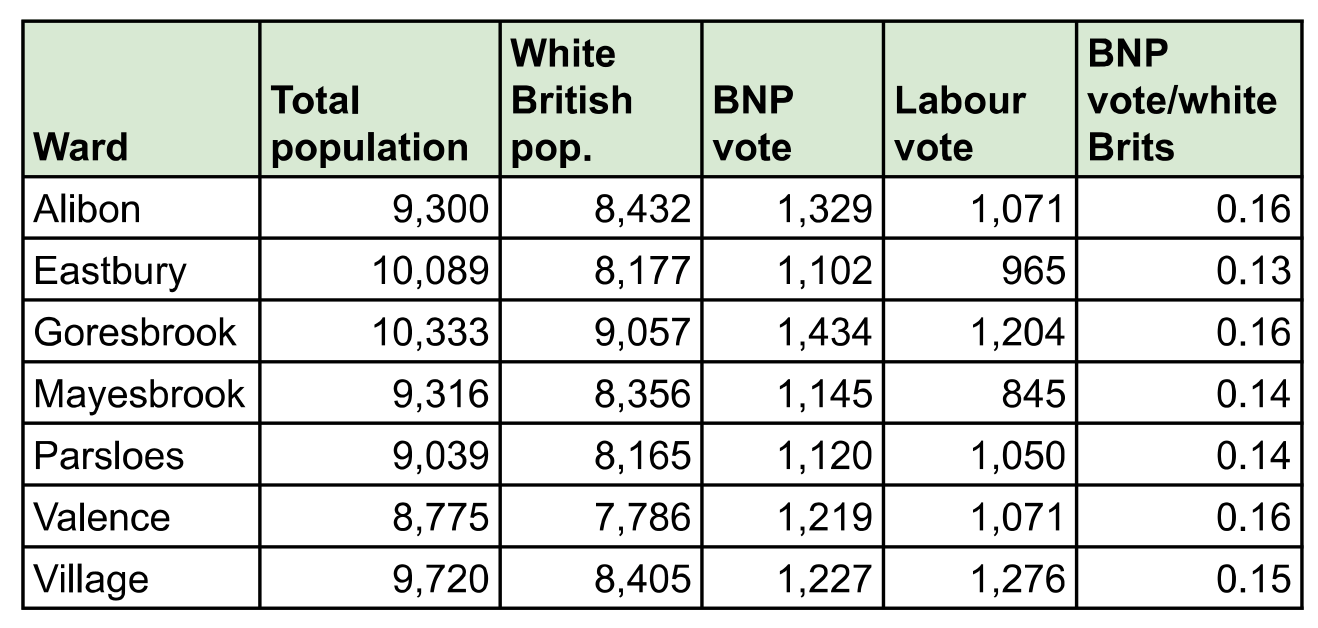
What we can instead look at is the individual wards the BNP stood in both elections: Alibon, Eastbury, Goresbrook, Mayesbrook, Parsloes, Valence and Village. These tell a much more important story.
In the early twenty-first century, Barking and Dagenham underwent one of the most rapid demographic changes in recorded history. At the 2001 census, the population was 81% white British. By 2021, this had fallen to 31%. The white British population halved from 132,566 to 67,550 as the native population left or died. The Asian population went from 9,061 to 56,583, and the black population increased from 11,440 to 46,807. This ethnic transformation was the primary driver of BNP support, as the native English population hurtled towards minority status.1


As noted above, the BNP exclusively sought the votes of white Brits. As the white Brits left Barking and Dagenham, the total number of votes available for them fell. In contrast, as the number of immigrants and non-white British increased, the votes available to Labour rose. The United Kingdom is unique in that even recent immigrants from the Commonwealth can vote—and the majority of non-white immigrants to the UK came from Commonwealth countries in Africa and Asia. Local elections at the time also allowed EU immigrants to vote, further increasing the non-BNP electorate.2
So what happened in the wards where the BNP stood both times? Our ability to make direct comparisons is limited as the elections do not align exactly with the censuses. We can, however, make inferences by comparing the 2006 election results with the 2001 census, and the 2010 election with the 2011 census.
First, the results of the 2006 election compared with the 2001 census
And below, the 2010 election results compared with the 2011 census
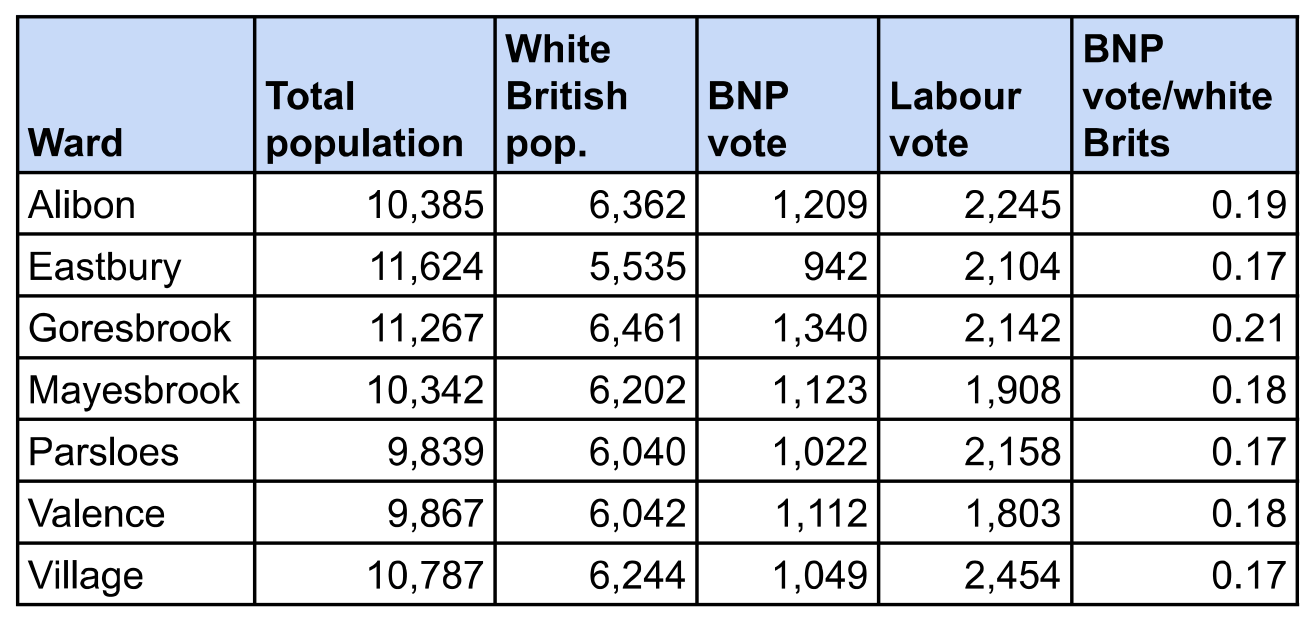
To reiterate: this is not an exact science. The white British population had almost certainly already declined by 2006. These comparisons are indicative only.
As you can see, each ward lost about 2,000 (about a quarter) white British people between the two censuses. The decline in white British population averaged 26%, and the decline in BNP vote share averaged 9%. It is impossible to know the exact extent, but we can fairly infer that the proportion of white British people voting for the BNP probably increased between the two elections. It is certainly clear that hardly anybody could have defected from the BNP back to Labour.
Despite thousands of white Brits leaving, the overall population of these wards increased by about a thousand each, as immigrants and non-white Brits moved in. In turn, Labour’s vote dramatically increased across each ward. What brought Labour victory was not winning over lost voters: it was a demographic transformation, and a successful get-out-the-vote campaign. BNP supporters were not converted. They were replaced.
After 2010, the BNP rapidly collapsed across the country. In council elections in other parts of the country in 2008 and 2012, it fell from 240,000 votes to 26,000. Regardless of the demographic changes in Barking and Dagenham, irrespective of the local campaign: the BNP’s extremism, infighting and unpleasantness would have doomed it on a national level. Yet the support for anti-immigrant parties among the remaining white British population continued: UKIP came second in the 2014 Barking and Dagenham elections, nearly matching the BNP’s 2010 vote despite only standing one or two candidates in each ward. The transition of support by individual voters from the BNP to UKIP was so total that for many years, the Labour Party continued to use the letter “B” to indicate a UKIP voter on their telephone canvassing forms.
Barking and Dagenham demonstrates what will and won’t counter Reform in 2029. The daydream of Blue Labour types that by employing more street sweepers and urban scarecrows they can win back voters radicalised by immigration is wishful thinking. What really does threaten the British right is time, incompetence and demographics.
There will have been a small number of non-EU, non-Irish, non-Commonwealth immigrants, but having reviewed the census data this consists of a tiny number of Filipinos and Albanians


