


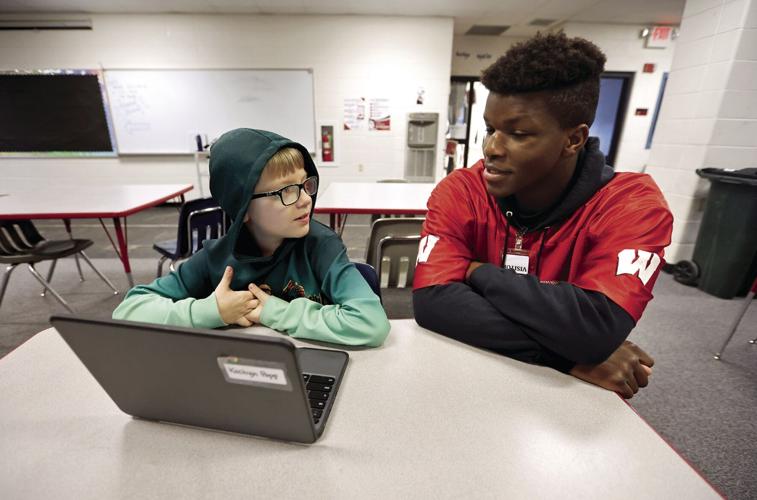
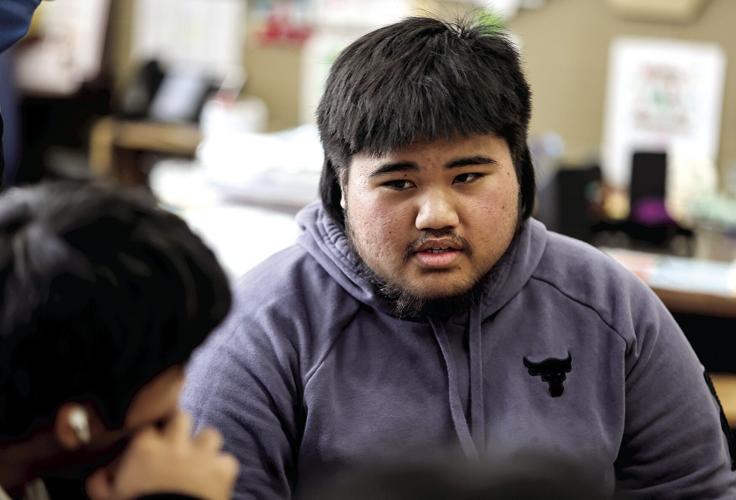

PLATTEVILLE, Wis. — Platteville High School senior Tate Zuehlke sat at a table at the district’s middle school, watching as fifth-grader Kashyn Popp used a coding program to create virtual monsters in a video game.
“They have their own sounds, so I just recorded the sounds, and I coded it so you have to press a certain button in order for it to make a sound,” Kashyn said.
“Looks like you’re a monster expert,” said Zuehlke, 18. “You could write a book.”
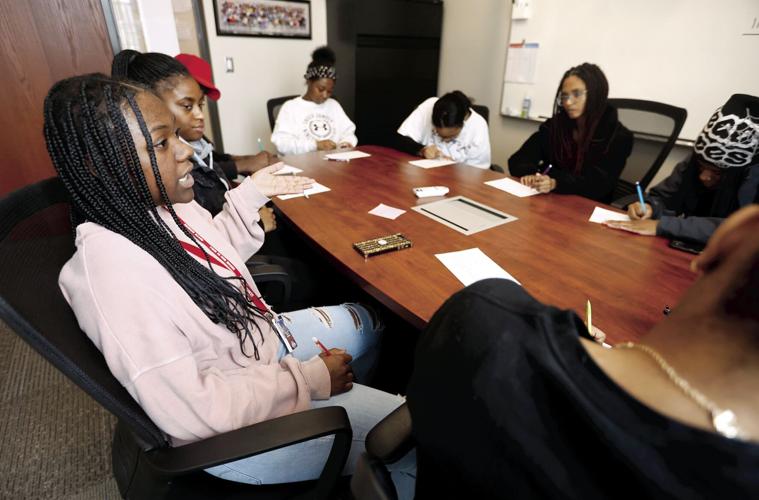
Zuehlke, who is Black, mentors 10-year-old Kashyn, who is White, through the high school’s Diverse Student Alliance, formed in 2020. The group offers a space for students of color to connect and find allies, and its members serve as mentors to elementary and middle school students of all races.
“It’s about exposing kids to people of color in a strong position as a leader … or it’s about exposing (White students) to someone who talks similar to them but may look different from them, showing them that we’re not really that different,” Zuehlke said.
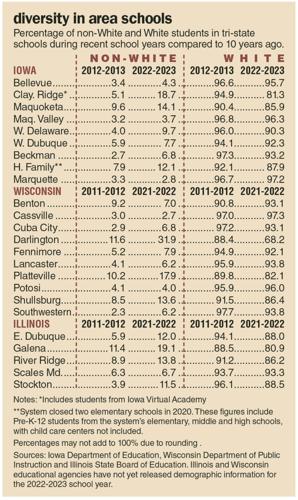
The Platteville district is one of several in the tri-state area that has seen its student body become more demographically diverse in recent years.
In the 2011-2012 school year, just over 10% of Platteville students were non-White, according to state data. By the 2021-2022 year, that figure had risen to nearly 18%. Other area districts, including Dubuque Community Schools, saw similar shifts in the past decade.
In response, school leaders are adjusting curricula, launching clubs and developing programming to support their evolving student bodies. School officials say such efforts are part of their mission to educate every student and create an environment where all learners, regardless of race, can be comfortable.
“We know that our demographics are changing and evolving constantly, and part of doing equity work is understanding what that all means in terms of an optimal learning environment for all students,” said Dierre Littleton, director of equity for Dubuque Community Schools.
By the numbers
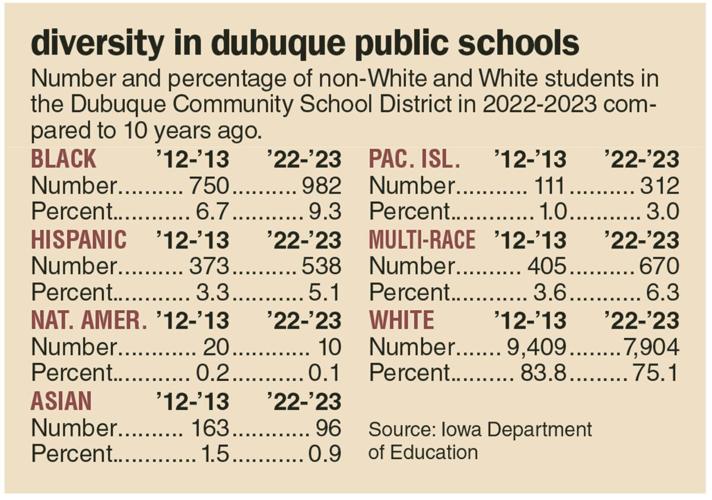
During the 2012-2013 school year, White students comprised 83.8% of Dubuque Community School District’s total enrollment, according to Iowa Department of Education data. This school year, White students make up 75.1%.
Black students are the largest minority in the district, comprising just over 9% of total enrollment this school year, at 982 students. That figure represents a 31% increase from 10 years previously, when there were 750 Black students.
Other minorities, while they make up a smaller share of the district’s total enrollment, saw even more substantial increases over the past decade.
The number of Hispanic students grew by more than 40% in the last 10 years, reaching 538 students this year. The number of multi-racial students increased by 65%, to 670.
Pacific Islander students saw the greatest percentage increase: the jump from 111 students during the 2012-2013 school year to 312 students this year represented a 180% increase in that demographic.
Anthony Allen, president of the Dubuque branch of the NAACP, also works as a behavior interventionist at Alternative Learning Center on the Dubuque district’s Alta Vista Campus. He has noticed the district’s increasing diversity, particularly in his building, and described it as something to celebrate.
“For so long, Dubuque was not a birthplace for many minorities. We were all from someplace else. We were migrants,” he said. “Now, we have a large population of students that … Dubuque is their hometown. I think it’s a great moment in Dubuque’s history, (but) if we’re going to talk about being diverse, we need to continue being proactive in diversity and inclusion and understanding from an equity lens.”
Littleton said Dubuque Community Schools staff have begun that work by completing an equity audit of each of the district’s schools last year and developing several priority initiatives focused on diversity as part of the district’s strategic plan.
“We’ve made the first step, which is making it a priority, and putting the resources there to make sure that it happens,” he said. “We’re in that baseline now … and we’re starting to implement things that are put in place to address those inequities.”
Smaller shifts
While Dubuque Community Schools has seen noticeable shifts in student demographics, for many smaller, rural districts, those figures have remained largely unchanged over the past 10 years.
Among 25 public and private school systems in the Telegraph Herald’s coverage area, only nine saw the percentage of non-White students in their district fluctuate by more than five percentage points over the past decade. In more than half of those 25 districts, 90% or more of students are White.
“We have not experienced a lot of difference in the past (few) years … from a race or cultural standpoint,” said Dan Butler, superintendent of Western Dubuque Community School District.
In the 2012-2013 school year, the district reported that non-White students represented 5.9% of its total enrollment. This school year, that figure is 7.7%.
The only minority group that saw a notable increase over the past decade was Hispanic students, who saw their population rise from 93 to 154 students district-wide. The latter figure represents about 4% of the district’s current enrollment.
Butler said staff work to connect with each student, regardless of race, to engage them in at least one school-sponsored activity, and teachers offer lessons on acceptance and diversity.
“What we do, within our instruction, is continue to teach about acceptance and differences and meeting people where they are,” he said. “We just don’t necessarily see that within our district because the numbers are really low.”
At Holy Family Catholic Schools, the percentage of non-White students rose slightly, from 7.9% to 12.1% over the past 10 years.
Chief Administrator Phil Bormann said staff continue seeking new ways to engage students of different demographics, including a new English course emphasizing African-American authors launched at Wahlert Catholic High School this year.
He added that Holy Family officials believe the Students First Act, legislation signed by Iowa Gov. Kim Reynolds that will give students education savings accounts to pay for tuition and other expenses at state-accredited private schools, will allow additional students from minority families to consider Catholic education.
“We do have system goals of increasing our diversity at our different schools, and we believe the ESAs (are) going to make that more possible than ever, now that money’s not a barrier,” he said.
Educating staff, reaching students
Littleton said the new diversity-based priority initiatives in the district’s strategic plan include providing professional development in intercultural communication and microaggressions. He described those efforts as particularly important because the district’s staffing demographics do not align with student demographics.
As of fall 2022, more than 95% of the district’s staff were White, according to district spokesperson Mike Cyze. Another 2.6% were Black or African American, 1.3% were Hispanic and less than 1% identified as multi-racial or American Indian/Alaskan Native. The district reported no staff members of Asian, Native Hawaiian or Pacific Islander descent.
“Those lived experiences may not be the same (between teachers and students of different races), so part of my role is to find a way to make meaningful connections so we build a sense of belonging and inclusivity,” Littleton said.
In hopes of generating a more diverse applicant pool, district staff also are enhancing recruitment efforts at historically Black colleges and universities, with plans to attend career fairs for those schools in Chicago and St. Louis this spring.
Bormann said Holy Family also puts a high priority on finding diverse staff, which can be challenging due to a lack of applicants.
The system’s most diverse campus is Our Lady of Guadalupe Spanish Immersion School, where 21% of students are non-White. Many of those students are of Hispanic heritage, and Bormann said the school has multiple Hispanic teachers as well.
“Dubuque’s population has changed significantly over the last 10 years … but what hasn’t caught up to that is the same number of applicants to our schools,” he said. “We do struggle to have a strong applicant pool of people who may be Hispanic, Marshallese or Black in our classrooms. We certainly do our best to hire in and bring about more of that diversity.”
Allen agreed that having diverse staff can be impactful for minority students.
“It’s always good to know that people who look like you can be in those roles in the future,” he said. “I think it’s very important for students to see that, because then they know they can attain it.”
While there may be few non-White staff members, Allen praised Dubuque Community Schools’ mentorship programs for minority students — particularly through Dubuque Black Men Coalition, whose members work with male students of color — though he feels more support is needed for Black girls in the district.
Those mentorship programs are part of the district’s efforts to address issues such as lower graduation rates and higher chronic absenteeism rates among minority students compared to their White peers.
In the 2021-2022 academic year, 79.6% of Pacific Islander students, 67.7% of Black students and 36.8% of Hispanic students missed 10% of more of school days, while only 18.6% of White students did so.
White students had a four-year graduation rate of 88.7% for 2022, compared to 57.7% of Black students and about 26.3% of Pacific Islander students.
District Director of Student Services Shirley Horstman said the district is working to address these discrepancies, but it also is difficult to disentangle these issues from the impacts of poverty, which disproportionately affects families of color.
Factors that can lead to issues such as chronic absenteeism — lack of transportation and housing or food insecurity, for example — are connected to poverty, not a family’s race, she said.
“We do have work to do with our students of color to get our graduation rate to where we want it to be, and the attendance piece as well … but we can’t say that it’s just a particular culture,” Horstman said. “It’s the result of poverty.”
‘Your Blackness is hard to find’
In Platteville, Tate Zuelkhe and Sophia Stone were among the co-founders of the Diverse Student Alliance. The two seniors now serve as treasurer and president, respectively, of the organization, which has grown from 20 to 80 members over the past two years.
Sophia said that as one of the few Black students at the school — just under 5% of Platteville students districtwide are Black — it can be difficult to relate to her peers.
“When you’re surrounded by all White students, it’s really hard to find someone who can relate to your skin color and what you’re going through,” she said. “Your Blackness is hard to find. … We were hoping to make a safe space to openly talk about what’s happening because our school’s been known to be not necessarily inclusive.”
Zuelkhe, who plays soccer and is on the track team at the school, recalled several instances when his teammates used racial slurs in front of him.
“They’re so comfortable with you that they think they can just say it,” he said, adding that he felt the response from coaches and administrators at the time was inadequate. “It just felt like the administration would brush it aside.”
He and Sophia feel the work of the Diverse Student Alliance, coupled with increased involvement from administrators to condemn instances of racism, has improved the school’s culture.
Emily Zachary, who teaches English and serves as the high school’s inclusion advocate, said she and other inclusion advocate staff members across the district have led coaching sessions and cultural competency training for staff. A Diverse Student Alliance and a Kindness Club also have launched at the district’s middle and elementary schools, respectively.
“When you know better, you do better,” Zachary said. “We knew that there was a need for professional development for teachers and a space for students … and it’s been really phenomenal to see students take ownership of their school, seeing a need and wanting it to be met.”
At Dubuque Senior High School, junior Kiante Shields said she is often one of the only students of color in her classes, which can feel isolating. While she and her Black friends typically are boisterous and exuberant when they are together, she said they tend to be quiet in class.
“Everyone is usually nice and cordial … but it can be awkward to be the only one, and when our teachers ask us to get into groups, I usually end up working alone because everyone has their own friends and cliques,” she said.
Her fellow student Keana Williams, who is also Black, said she feels Black students are held to different expectations than their white peers.
“During school, the expectations are higher for us to prove ourselves … to show to other people that we are smart, we are powerful and we can do things,” she said.
The girls have found a supportive community through their school’s newly-launched Black Excellence Association, a district program that kicked off at Senior and Hempstead high schools and the Alta Vista Campus this semester.
About 150 students, including 70 at Senior, are involved with the groups, which are designed to promote awareness and appreciation of Black culture while also serving as a safe space for students of color.
‘Every day is a challenge’
Dubuque’s public high schools also offer Pacific Islander clubs, which bring together students whose families hail from the Pacific Islands. Many of the clubs’ members are Marshallese students, including Lorenzo Joe and Meldon Jeik, both juniors at Hempstead.
“It’s important to represent our culture,” Lorenzo said. “This is like a safe space for us.”
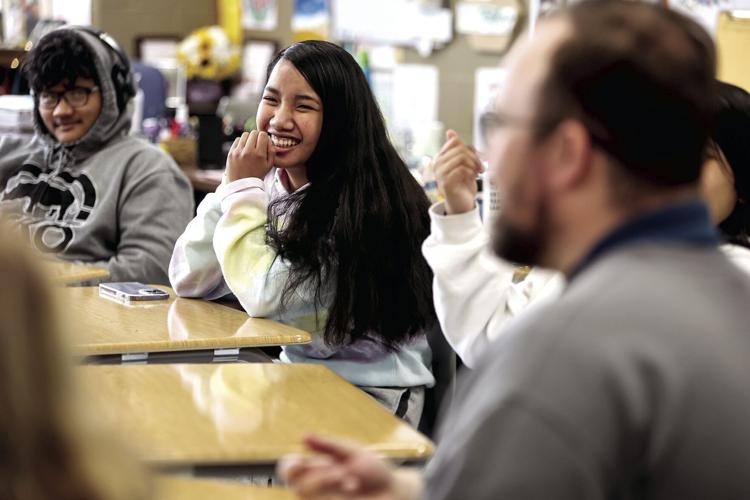
On a recent afternoon, Lorenzo, Meldon and other members of Hempstead’s Pacific Islander club laughed and chatted with the teachers who serve as their advisors, trying to plan a time to go bowling as a group.
English teacher and club advisor Theresa Cheever said about 30 students are involved in the club.
The group has hosted activities such as cookouts in the park and a basketball and volleyball tournament with Senior’s Pacific Islander club, and they are working on putting posters in classrooms across the school with Marshallese “words of the week.” Soon, they hope to plan a visit to the new Rivers to the Sea exhibit at Dubuque’s National Mississippi River Museum and Aquarium, which features a model Marshallese outrigger canoe.
“I think what we’ve noticed is that (the Marshallese students) just don’t always feel like they’re part of something, and we want to let them know that they are,” Cheever said.
Lorenzo and Meldon said they both feel welcome at Hempstead, but the language barrier can make it difficult to connect with English-speaking classmates. Jeik has been learning English since he was about 5 years old, but there are still “so many words I don’t know,” he said.
“I’d say every day is a challenge,” he said. “ … But when you hang out with these people (in the club), it helps you learn new things, and it also shows you what things you have to improve on.”
Language and culture
Language learning is a key component of programming for multiple area districts who have seen an influx of Hispanic students.
During the 2011-2012 school year, Darlington (Wis.) Community Schools had 76 Hispanic students, comprising just under 10% of the district’s population. By the 2021-2022 year, that figure had risen to 255, with Hispanic students making up almost 30% of Darlington’s enrollment.
The district employs seven English as a second language teachers, three support staff and a recently hired English as a second language administrative assistant, according to Darlington High School Principal Rich Moyer.
“Some (Hispanic students) haven’t been in school for a few years when they get to us … so it’s about building that confidence, finding out what their strengths are, and then we take them on and treat them like any other student,” he said.
The district connects with Hispanic families through family heritage nights and pairs incoming Spanish-speaking students with older learners who previously were in the same position to serve as mentors.
“I think (staff) have done a good job of celebrating the students’ diversity, yet making sure there’s this climate of inclusivity,” said Darlington Elementary/Middle School Principal Michael Flanagan.
Hispanic students made up just over 10% of the Galena, Ill., school district’s student population in the 2011-2012 school year. During the 2021-2022 academic year, it was about 15%, and over half were identified as English language learners, according to Superintendent Tim Vincent.
The district has three English as a second language teachers and, this school year, added two Spanish-speaking paraprofessionals. Also this year, the district’s FFA program launched a chapter for minority students as part of a national program called Minorities in Agriculture, Natural Resources and Related Sciences.
“We look at our growing Spanish-speaking population as a real positive to us. The more students we get, the more programs we can offer and the more resources we can give them,” Vincent said.
The district has a Bilingual Parent Advisory Council that meets with staff to discuss issues related to the Hispanic community and provide translation services as needed.
BPAC member Jacqueline Velazquez has four children in the district. Originally from Mexico, she has lived in Galena for almost eight years, and she and her family spoke little English when they arrived.
She said the Galena district gave her children the resources to be successful, but she initially struggled to get involved with their education. Until she learned English through classes at Galena Art and Recreation Center, she said, she felt like she lacked a voice.
Now, she helps translate for parents and connect them to district staff through BPAC in hopes of helping them avoid that helpless feeling.
“It is very important because usually some (Hispanic parents) are afraid,” she said. “They really, really need this help so they can feel more comfortable and have the conversations with their children’s teachers. They need more of a voice. This is a good step for our community.”
In Dubuque Community Schools, Horstman said district staff work hard to find interpreters, particularly during parent-teacher conferences, so children are not put in the position of having to communicate between teachers and families.
From interpreters and cultural competency training to increasing the diversity of mentors and staff, Horstman and Littleton both said they feel the district is moving in the right direction when it comes to meeting the needs of minority students.
However, they emphasized that work will be ongoing as the district’s demographics continue to diversify in the coming years.
“We’re not going to have it all done this year, but what I’m happy about is that all the stakeholders are at the table having the necessary conversations that, in turn, impact how students and families show up and how they learn,” Littleton said. “As long as we can keep students at the forefront of that work, we will continue to be successful.”


