
Sign up for the Slatest to get the most insightful analysis, criticism, and advice out there, delivered to your inbox daily.
Science writer Michaeleen Doucleff’s new book, Dopamine Kids: A Science-Based Plan to Rewire Your Child’s Brain and Take Back Your Family in the Age of Screens and Ultraprocessed Foods, is a wake-up call for the kind of parent who spent the last decade self-soothing with the mantra “everything in moderation.” Anti-screen, pro-whole-food parenting often gets tagged as alarmist—or now, god forbid, MAHA—and it’s hard to say straight out that screens and ultraprocessed foods are bad news for kids without seeming extremely judgmental. But Doucleff doesn’t seem to care about the optics or the politics. Screens and ultraprocessed foods are bad for kids and adults, she argues, and we should do something about it.

Just as with her previous book, Hunt, Gather, Parent, Doucleff writes as a mother trying to cope with a problem in her life, but also as an ultradisciplined researcher, willing to go the distance. In Doucleff’s view, screens and ultraprocessed foods are so powerful, and have such new effects on the brain and body, that they are quasi-alien technologies that render traditional parenting wisdom moot. (She terms these twin omnipresent temptations “dopamine magnets,” or “magnets” for short.) “In many ways, it feels like these dopamine magnets control our families. They determine how we spend our time and what we eat throughout the day. They toy with our emotions and determine our moods. They add stress to our children’s lives, stress to our relationships with our children, and stress to our bodies,” she writes. Reading Dopamine Kids, I imagined us all as apes leaping around the monolith at the beginning of 2001: A Space Odyssey, manipulated in ways we don’t understand, by a force we can see but can barely comprehend.
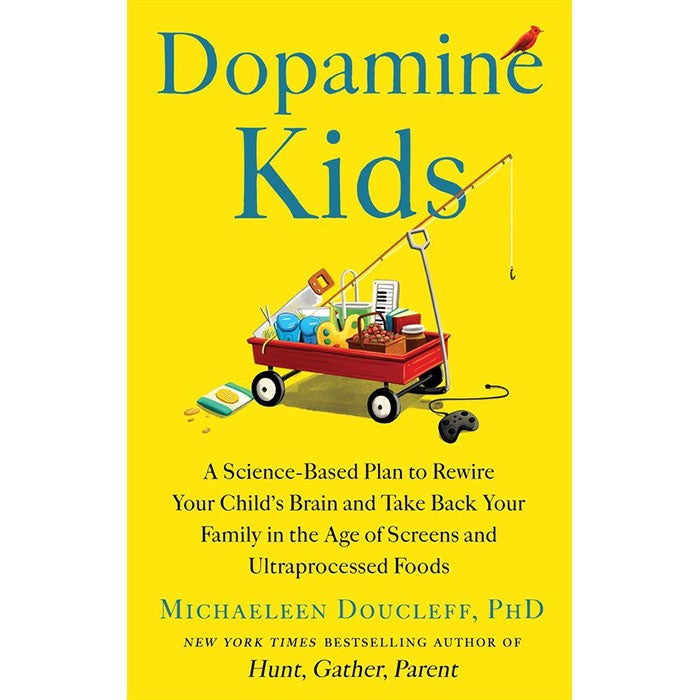
Dopamine Kids: A Science-Based Plan to Rewire Your Child’s Brain and Take Back Your Family in the Age of Screens and Ultraprocessed Foods
By Michaeleen Doucleff. Avid Reader Press/Simon & Schuster.
Slate receives a commission when you purchase items using the links on this page. Thank you for your support.
So too, according to her narrative, were Doucleff, her husband, and her 9-year-old daughter Rosy, before she started researching this book. (The idea that a science reporter wouldn’t have heard very much about the possible negative effects of these “magnets” until she hit ProQuest on a mission requires a bit of suspension of disbelief, but that’s OK.) Just as Hunt, Gather, Parent was born out of the travails of the toddler and preschool years, Dopamine Kids feels like (though it’s not specifically marketed as) a middle-childhood book, probably most useful to those parenting children between kindergarten and high school—the kids who can read, go outside solo to play in the neighborhood, and participate in family decisionmaking, but who aren’t yet squarely in the teenage “pulling away from your spying eyes” phase.
There are many stretches of the book that people who read too much about the evils of phones will recognize—the chapter on Natasha Dow Schüll and slot machines (check), the references to Cal Newport (check). The more interesting parts to the reader familiar with popular literature on screens and habit formation will be the stories about how, exactly, Doucleff tried to change her family’s habits—including the habits of the parents, who must also accept a life without nightly TV or desserts. Doucleff writes that the project was less about imposing her will, more about using Rosy’s own motivations to steer her in a new way. “Could I get her to want to practice piano or work on reading at night instead of streaming cartoons on Netflix?” she wondered. “Could I get her to pick up a book first thing in the morning instead of wanting to grab my phone? Could I motivate her to grab the carrots sitting on the counter instead of digging through the pantry in search of Oreos? Would she ever want to go play outside after dinner, voluntarily—no begging, no nagging, no power struggle needed but rather because she held a genuine desire to be outside?”
There are a lot of eye-roll moments in Dopamine Kids, as with the multiple times Doucleff, clearly not a fellow acolyte in the church of cinema, unfairly lumps “watching movies and TV”—also known as “consuming art,” if you’re discerning!—in with every other screen-based activity. She describes hating her past self for wanting her child to go to bed so she could watch Succession (a very human feeling), or daring to take some alone time to watch a movie by herself, then thinking better of it, slamming the laptop shut, and going on a walk with her child instead. (You were watching a movie on a laptop? That’s where your problem started.) And her “simple” suggestion of offering a child a bowl of chickpeas with salt on top as an afternoon snack, or mixing black beans in with a food they already like in order to get more fiber in their diet, had me laughing out loud, picturing my own 9-year-old’s reaction.
But I could recognize while reading that some of my eye-rolling was defensive. She’s probably right about refined white flour. She’s definitely right about how hard it will be to convince a kid to try piano or carpentry during the same timeslot when he usually plays Minecraft. And who among us hasn’t seen a child ignore beautiful strawberries and edamame beans as soon as the Veggie Straws appear? The book tries really hard—sometimes too hard; there are a ton of frameworks and lists—to suggest incremental shifts and ways that kids can be involved in habit transformation. I found the exercise of writing out a list of family values and discerning how different activities support, or don’t support, those values, to be quite useful. (“Appreciating cinema” was on my list.)
But the overwhelming feeling Dopamine Kids left me with was a sense of awe at the mental work signing on to the book’s program would require. And it’s not just the work of changing your home routines, depriving your own self of cake and movies, likely weathering your child’s desperate pleas for same, and spouting rehearsed lines about how fun it is to be outside or how good it feels to eat vegetables. In order to get with the program outlined in Dopamine Kids, a middle-of-the-line liberal reader who believes children are fundamentally good and will grow up fine no matter what you do, and who also believes that children have their own social world and we shouldn’t interfere with it too much, will also have to embrace a few key principles that very much go against their worldview.
First, if you buy what Dopamine Kids is saying, as I mostly do, you buy that these “magnets” have so much pull that old ideas about free will, moderation, and the gradual development of willpower no longer apply. Given the power of the magnets, “This is the world they are living in, and they should learn to navigate it” (a thing you hear a lot when it comes to screens and processed food) won’t fly. You will have to protect your children from themselves. Doucleff explains this with science—people who seem to have strong willpower, she writes, are actually just better at constructing environments that remove temptation, and that’s what we should do for our kids and ourselves, with screens and food. And while this makes sense, it goes against the common liberal belief that parents err when they try to overcontrol their kids’ experiences, and will end up with kids who binge on video games and Cheetos their first year in college. No, argues Doucleff; this is the time for us to be rigid.
The second worldview shift: You can’t trust a child’s pleasure. Do you believe that children will gravitate toward things that are good, and that we should encourage their interests instead of overengineering them? I generally do. But if you take the point of view outlined in Dopamine Kids, you see that kids may look like they “like” Minecraft or YouTube Shorts, but that’s wrong; in actuality, there is the right way of liking, and the wrong way of liking. If we let them do too much of the wrong things, that’s a dereliction of our duty, because it deprives them of developing better tastes that will result in better mental and physical health. Just as the 19th-century food reformers Helen Zoe Veit describes in her new history of picky eating advocated giving kids “plain” food lest their appetites, trained on the extreme pleasures of spice, sugar, and fat, would incline them toward alcohol, Doucleff suggests that consuming too much of these dopamine magnets will permanently warp kids’ ability to recognize real satisfaction in their lives—the kind that comes from activities like mastering an instrument, learning to sew, or in-person interaction with neighbors and family. The difference is those reformers back in the day were acting on dubious science (or none at all), and while there are many real-world uses for ultraprocessed food and social media, we can probably all agree that most American kids get too much of them. Doucleff isn’t a total extremist—she allows Rosy to eat ultraprocessed food in social situations, and suggests many ways to use magnet activities to promote more desirable habits, as when she requires Rosy to write an essay about the last movie she saw before she watches the next one (hey, not a bad idea)—but all this requires a certain level of vigilance and control.
That brings me to the third major mind shift the book represents. Dopamine Kids argues it’s our responsibility to engineer our home environment so that kids know what the right kind of pleasure feels like: growing vegetables in the garden, building a backyard shed, playing cards or board games together at night. (“Take back your family,” the book’s title enjoins.) This is an endeavor that is increasingly countercultural, and is far more natural to the conservative worldview, where the home is a fortress against a decadent outside world. Although the fact is not mentioned in the book, a New York Times profile reports that Doucleff’s child is homeschooled, a choice that would certainly make it way easier to keep kids away from magnets. (Schools, in my experience thus far, are chock-full of screens and processed food.) Doucleff told the Times that she’s far from MAHA, and she “wants the government to do more to protect children, but hopes that Dopamine Kids gives parents ‘agency’ in the face of structural failures. ‘I don’t have the privilege of waiting for regulation,’ she said. ‘I have a child I need to raise today.’ ” The book is not about what everyone can do, or even what RFK Jr. might do; it’s about what the reader can do. Time to get to work. You might have to clear your schedule first.
