

HEATED DEBATE On Islam, Immigration, and Israel: Shabbos Kestenbaum vs Cameraman
In the second half of this episode, our cameraman, armed with ChatGPT and a set of convictions he’d never been asked to defend, stepped out from behind the camera to debate our guest. What happened next is the most clarifying thing we’ve captured on film in a long time.
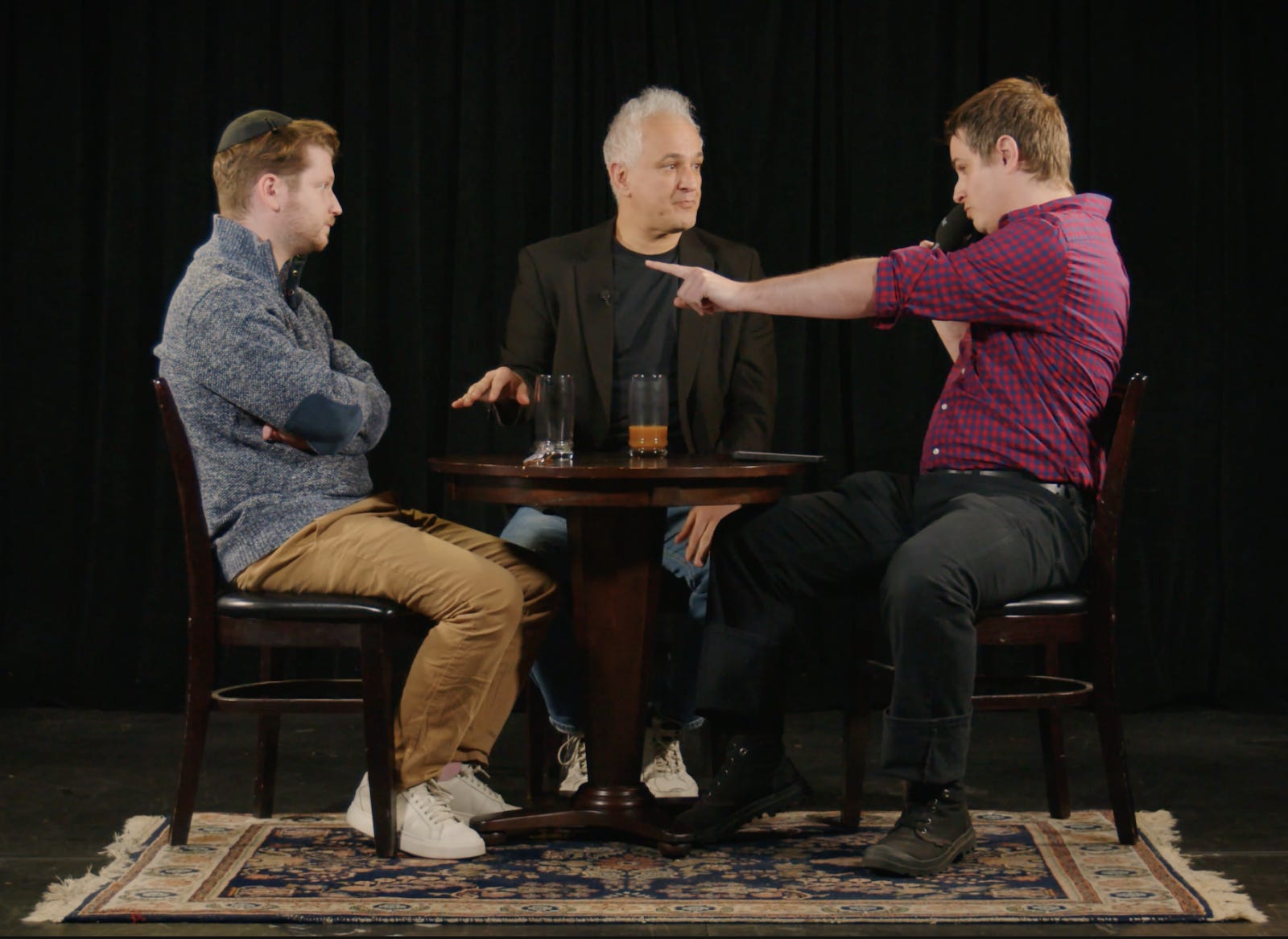
But first, the guest.
Shabbos Kestenbaum is a 26-year-old Orthodox Jewish Harvard graduate who sued his university for failing to protect Jewish students from antisemitic harassment and violence on campus. He testified before Congress. He spoke at the Republican National Convention. But before that, he voted for Bernie Sanders twice, marched with BLM, booed Hillary Clinton at the 2016 DNC—and then watched the left abandon Jewish Americans after October 7th, and switched sides. He came on my show to talk about all of it: Radical Islam, the demoralization of Gen Z, Jews as the canary in the coal mine, and more.
It was a wide-ranging conversation. We talked about whether Western Europe is in hospice; Shabbos, who is half-British, thinks London has fallen, and frankly, I think he’s correct. We talked about the distinction between Muslims and Islamists, a distinction on which I’ve challenged other guests and one that Shabbos draws carefully: Not all Muslims are Islamists, but all Islamists are Muslims, and the people beheading apostates and shooting up Hanukkah celebrations and driving trucks into Christmas markets belong to a specific subset that we need to be able to name. We talked about the conspiracy culture poisoning the right, how figures like Tucker Carlson, Nick Fuentes, and Candace Owens tell young men that the reason they can’t get a job or a girlfriend is something something the Jews, something something the billionaires, and they are making enormous amounts of money doing it. We talked about how this mirrors exactly what the far left has been doing for years, and how both versions destroy the same thing: The belief that you are responsible for your own life.
It was a solid interview. What happened next is what I haven’t been able to stop thinking about.
A week earlier, we’d had Raymond Ibrahim on the show. During that taping, our cameraman, a young man, got heated enough about what he was hearing that he interrupted the recording to challenge Raymond’s claims. So when Shabbos came on the following week, I decided to give the cameraman a proper seat at the table. No ambush, no gotcha…just an open invitation to make his case.
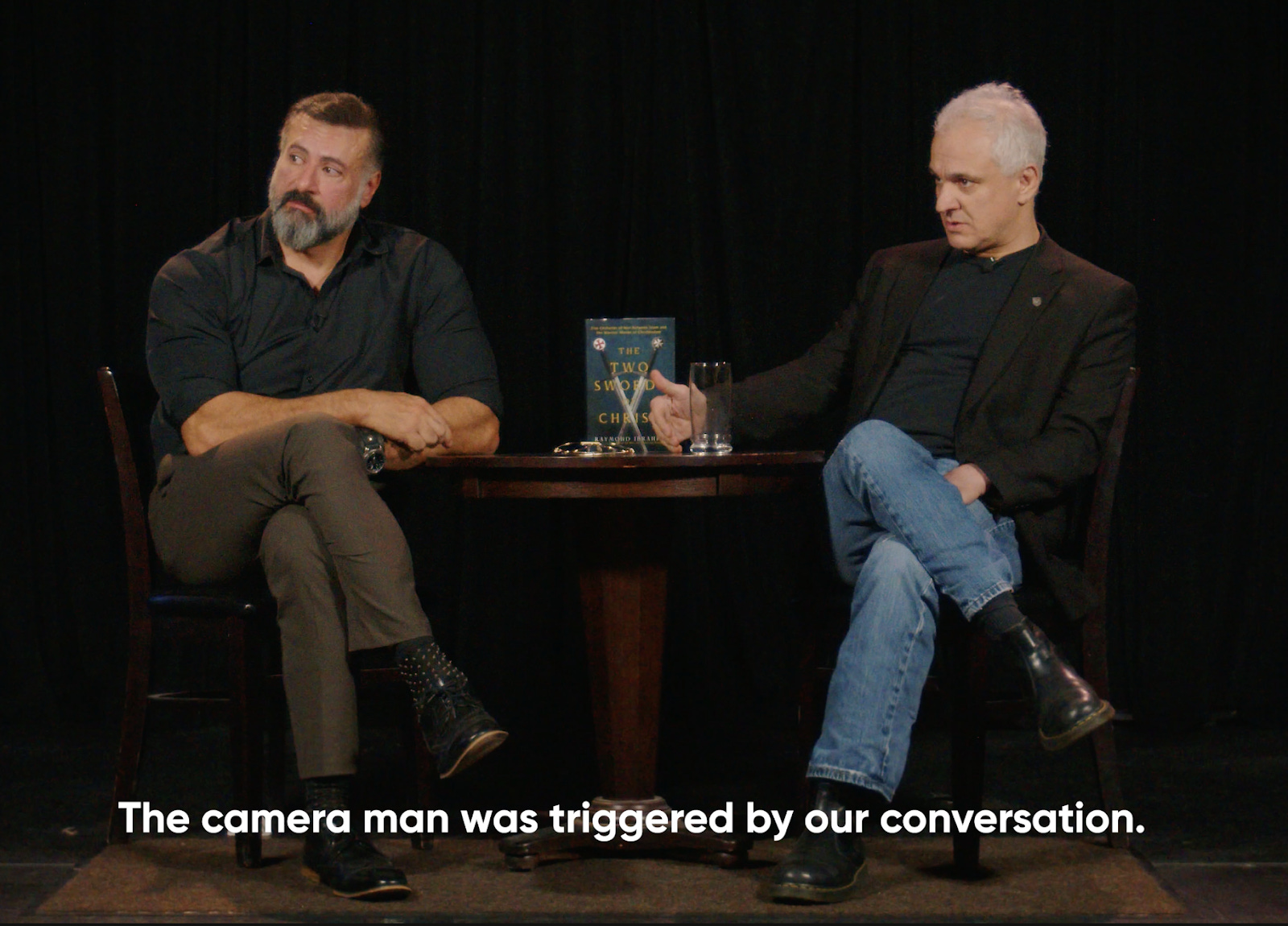
What followed was one of the most revealing exchanges we’ve had on the show.
The cameraman held positions that, in their raw form, were not insane. He believed in religious freedom. He believed in freedom of speech. He believed that the government shouldn’t discriminate against people based on their beliefs. He believed that immigrants shouldn’t be barred from the country based on what they think. These are not fringe positions. They come from a legitimate liberal tradition; a tradition I happen to share deep roots with as a lifelong advocate of free speech and cognitive liberty.
But he couldn’t defend any of them. Again, not because the positions are indefensible, but because nobody had ever helped him think through them seriously. He’d absorbed conclusions without ever learning the reasoning behind them. When Shabbos pushed him on edge cases: “Should someone who wants to marry a six-year-old be admitted? Because that’s an actual thing happening in Iraq right now,” he struggled. When I asked him what criteria should disqualify someone from immigrating to the United States, he could only come up with two: If they’ve committed a crime, or if there’s credible evidence they intend to commit one. That’s it. Nothing about values. Nothing about the social fabric. Nothing about what makes a society cohere.
I want to steelman what he was trying to say, because Shabbos didn’t, and I think someone should.
The cameraman’s core belief, as best I can reconstruct it, is something like this: America is defined by its freedoms, and the moment you start excluding people based on their beliefs—even repugnant beliefs—you’ve betrayed the very thing that makes America worth defending. In his words: “It’s un-American to say we shouldn’t allow people in who don’t like America, because I believe in freedom.”
There’s something admirable in that. It’s a coherent position and one that many thoughtful people have held. It’s essentially a radical commitment to the open society: The idea that the best answer to bad speech is more speech, and that the same principle should extend to immigration. You let everyone in, you let the marketplace of ideas sort it out, and you trust the system.
The problem is that this position, taken to its logical conclusion, is self-defeating. Karl Popper identified this decades ago as the paradox of tolerance: A society that is tolerant without limit will eventually be destroyed by the intolerant. If you extend unlimited freedom to people who explicitly aim to abolish that freedom—who state openly that they wish to replace liberal democracy with theocracy, who use the mechanisms of the open society to dismantle the open society—you haven’t defended liberalism. What you’ve actually done is provided the instruments of its destruction and called it a liberal principle.
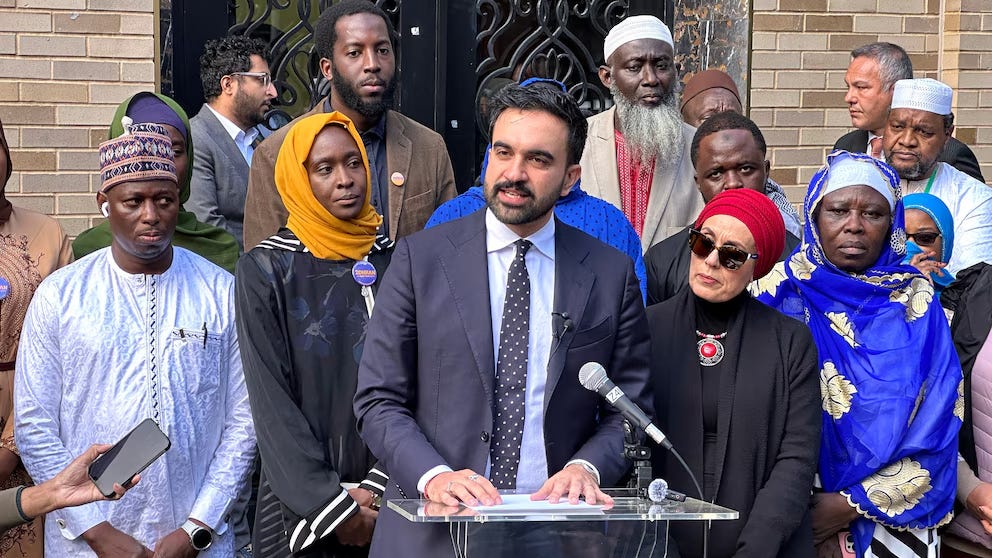
This is not a theoretical concern. Shabbos gave concrete examples: Dearborn, Michigan, where “Death to America” was chanted at a public event. Zohran Mamdani in New York. The Bondi Beach massacre. The grooming gangs. You don’t have to agree with every claim Shabbos made to acknowledge that the question of who gets in and what values they hold is not a bigoted question. It is, in fact, the foundational question of any self-governing society. Every liberal democracy in history has had to answer it.
The cameraman couldn’t see this because, I suspect, he’d been taught a flattened version of liberalism, one where all exclusion is bigotry and all standards (social, legal, relational) are arbitrary. And I don’t blame him for this. I blame the institutions that should have sharpened his thinking and instead gave him a catechism.
Because throughout the exchange, while struggling to articulate any of this, the cameraman kept pulling up ChatGPT to fact-check Shabbos’s claims in real time. He’d type a question: “Do Muslims commit a disproportionate amount of violent crimes in the US?” read the AI’s response aloud, and present it as if it settled the matter. When I asked him to put the phone down and engage with what Shabbos was actually saying, not what Shabbos was allegedly saying according to a language model that hedges everything, he couldn’t do it. Or wouldn’t.
What I watched wasn’t someone using a tool to augment his thinking. It was someone who had replaced his thinking with a tool. He could produce a fact-shaped response in seconds but couldn’t explain why it mattered, how it connected to his broader argument, or what he’d do if the next query returned a different answer. When Shabbos pressed: “If Muslims aren’t more susceptible to radical Islam, then who is?” the cameraman had no framework. He’d never had to build one. The machine had always done it for him.
This is one of the most underappreciated dangers of our moment. We’re producing people who can access information instantaneously but process it almost not at all. The cameraman wasn’t dumb. But he’d never been trained to stress-test his convictions, and now he has a device in his pocket that ensures he’ll never have to.
This is one of the great crimes of the university system: It has taken young people who have genuine moral intuitions—people who care about fairness, who oppose bigotry, who believe in human dignity—and instead of teaching them how to reason carefully about those commitments, how to stress-test their beliefs, how to encounter strong counterarguments and emerge with something more refined, it has handed them conclusions. As the old adage goes, it has taught them what to think, not how to think. It has replaced epistemology with ideology.
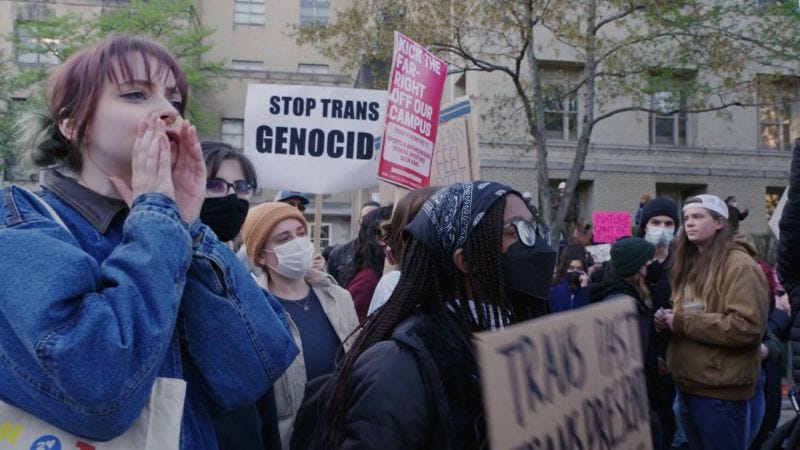
The cameraman is a product of that system. He walked into a conversation armed with principles he couldn’t defend, definitions he couldn’t articulate, and a phone full of AI-generated responses he couldn’t evaluate. The tragic thing is that he’s an archetypical representation of his generation. He is the new normal. He represents millions of young people who hold unshakable convictions about justice and freedom and equality and have absolutely no intellectual infrastructure supporting any of it.
Now, the format with Shabbos didn’t help matters. Shabbos is a skilled debater. When the cameraman stumbled, Shabbos pounced. He caught him in contradictions, pressed him on terms he couldn’t define, cornered him on the distinction between Islam and Islamism that the cameraman admitted he didn’t understand and then accused Shabbos of conflating. It was rhetorically devastating and almost entirely unproductive. And I take responsibility for not being able to steer the conversation in a more productive direction.
Part of being a considerate thinker is presenting the best version of your opponent’s argument, not the worst version of their delivery. People who are less informed than you will likely still have good points. Your job, if you’re serious about the exchange and about debate as a truth-seeking mechanism in a liberal society, is to help them make those points well and then address them. The cameraman’s position on the paradox of tolerance (whether a free society can survive if it extends unlimited openness to the intolerant) is one of the most important questions in political philosophy. It deserved real engagement. Instead, it got a cross-examination.
Shabbos was a guest on my show, and I’m grateful he came—I’m not interested in lambasting someone I’ve invited to have a conversation. His knowledge of antisemitism on campus, his personal experience at Harvard, his ability to rattle off specific names and specific incidents of Jewish students being assaulted, stalked, and having their civil rights formally violated as determined by the Department of Justice, all of that was powerful and important. The cameraman’s response to hearing about those assaults was revealing in its inadequacy: “Hate crimes are bad.” He said it multiple times, as if the sentence itself constituted an argument. When Shabbos pressed on why the Democratic Party refused to defund universities found complicit in civil rights violations against Jewish students the way Eisenhower threatened to defund schools that wouldn’t integrate, the way Obama threatened to defund universities that didn’t combat sexual assault, the cameraman immediately pivoted to Israel and Gaza. He couldn’t separate the two. And that conflation—Jewish student gets assaulted on an American campus, and the response is “well, what about Israel”—is itself a species of the bigotry the cameraman claimed to oppose.
But one of the most important ideas in the entire conversation was one Shabbos offered almost in passing: Jews are a canary in the coal mine. When a society starts going after its Jews—not criticizing Israeli foreign policy, but targeting Jewish people, beating Jewish students, chanting for intifada in American cities—it is almost never only about the Jews. Historically, antisemitism (Jew hatred) is the early warning system for civilizational collapse. It was true in Weimar Germany. It was true in the Soviet Union. The Jews get targeted first. They are never targeted last.
What Shabbos described on campus is not merely a Jewish problem. It’s an American problem. It means the institutions tasked with protecting individual rights have decided that some individuals are less worth protecting. Once that principle is in place, it will be applied to others. It always is.
Watch the episode. Not because anyone delivers a knockout blow, but because it’s a nearly perfect snapshot of where we are. Two people who both believe they’re defending freedom. One sharpened by adversity and serious education. One failed by institutions that should have done the same for him but chose to indoctrinate instead. The canary is singing. I hope someone is listening.
Peter


This is phenomenal Peter thank you!! I just having a "debate" with my 20 yr old son about the Epstein Files, billionaires, and the ruling class who buy off all the politicians who are all "liars" anyway. Although he was sent to a classical christian school where formal logic was taught starting in 6th grade, once he got into high school(and now university)and the consistency of the iphone things have gone off the rails a bit. He has big half formed ideas and a lot of "ideology" based on those half formed ideas (many of which he gets from his "feeds"). We have good debates and I appreciate this piece of advice Peter gives: "Part of being a considerate thinker is presenting the best version of your opponent’s argument, not the worst version of their delivery". This worked well for me today and I hope he picks it up too. This is the best gift we can give our kids... the gift of logic and reason.
We may be at the end of the age of reason. What many people don’t understand about LLMs is that they don’t spit out “truth”; they spit out a synthesis of what they have been fed. Garbage in, garbage out. The only real defense against this is being able to reason, something which appears to have fallen out of favor (to a degree few people are capable of understanding).
I hope that you keep exploring forbidden topics (as you’ve done for years, going back to your exposé on academic publishing). These are, indeed, dangerous times, and we desperately need more heterodox thinkers, not more sheeple.