1


Slauk Valeriy Petrovich's (b. 1947) fine etching art style: Inheriting Belarusian etching traditions, he subverted post-WWII somber linocut imagery into intriguing, unseen creature folklore, revitalizing Belarusian and Slavic myths. [Gemini Nano Banana 2]


1
100% Upvoted
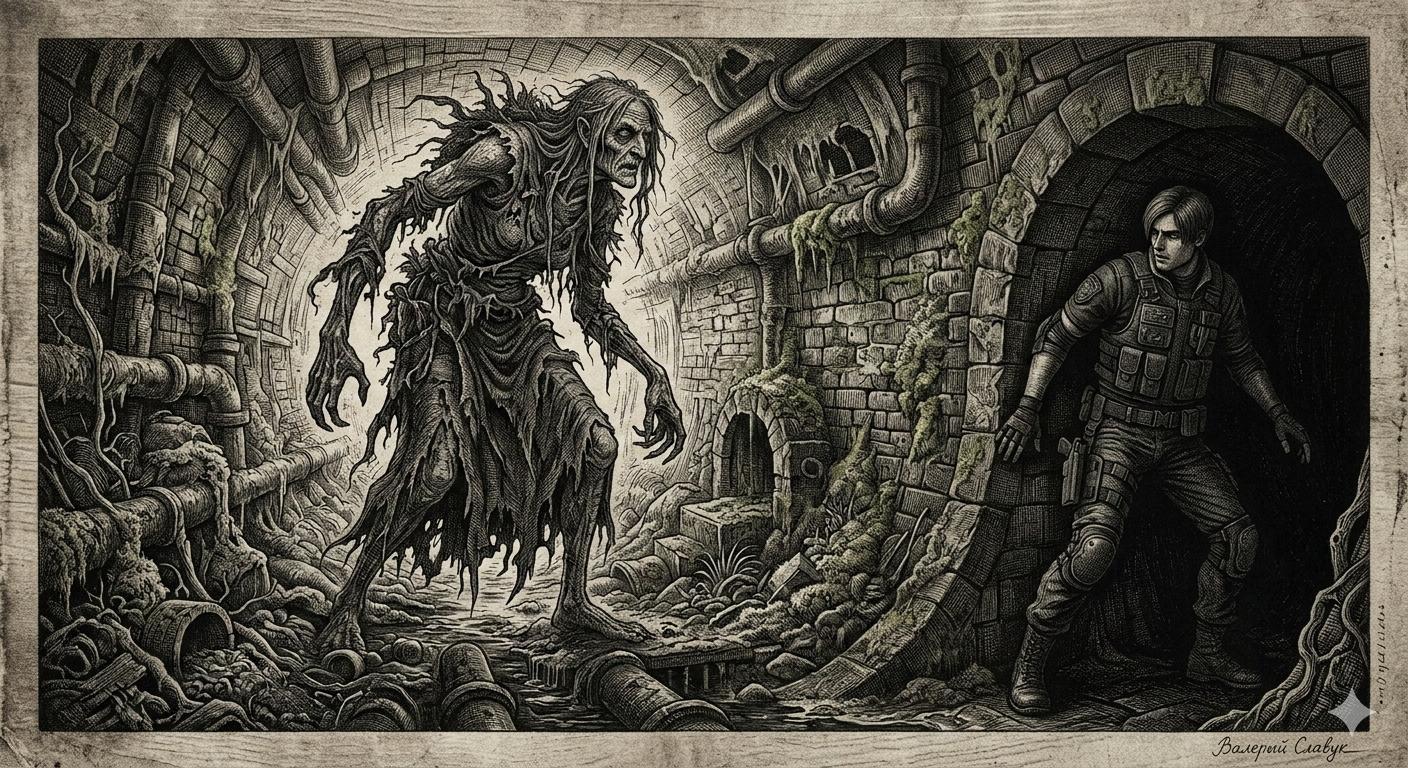
{Resident Evil Requiem: In the fetid sewer tunnels, Leon S. Kennedy presses into the shadows, evading a grotesque, towering female mutant whose gaunt visage and ragged form echo the legend of Baba Yaga} illustrated in Slauk Valeriy Petrovich's (Валерый Пятровіч Славук, b. 1947) fine etching style, intricate line-art used in his Belarusian children’s books and mythological illustrations: {
Slauk Valeriy Petrovich (Bel. Валерый Пятровіч Славук; Rus. Валерий Петрович Слаук; b. April 7, 1947, Kokhanovo, Tolochin district, Vitebsk region) studied from 1971 to 1977 at the Belarusian State Theater and Art Institute (now the Belarusian State Academy of Arts) under the eminent graphic artist Vasily Sharangovich (Васіль Шаранговіч, 1939–2021). Sharangovich belonged to the generation of Belarusian artists whose formation was indelibly shaped by the aftermath of the Great Patriotic War (1941–1945). The postwar Belarusian graphic school elevated printmaking—both relief and intaglio—through the dual imperatives of reproductive utility within Soviet publishing infrastructure and the expressive potential that the state fine-art hierarchy accorded easel graphics. In reclaiming intaglio as a vehicle for national artistic expression, the school drew upon a Belarusian engraving tradition rooted in the Grand Duchy of Lithuania era: the cartographic copperplate work of Tomasz Makowski (c. 1575–1630), the technically accomplished intaglio prints of Alexander Tarasevich (c. 1640–1727), and the liturgical engravings of Leonty Tarasevich (late 17th century). This lineage was carried into the twentieth century by figures such as the graphic artist Lazar Ran (1909–1989), whose practice bridged prewar engraving traditions and the postwar institutional school from which Sharangovich emerged as a defining figure. Sharangovich professed that "truths in art do not appear on their own—one discovers them in the course of work." His oeuvre centered on the Belarusian literary canon—Yanka Kupala, Yakub Kolas—and was distinguished by structural command of source texts, psychologically penetrating characterization, and harmoniously integrated book design. The intaglio series Memory of Fiery Villages exemplifies his rendering precision: seamless modulation from abstract tonal gradients to sculptural chiaroscuro within stylized, linocut-inflected compositions whose polished and roughened surfaces coexist in a single print. Having specialized in linocut through the 1970s and early 1980s, Sharangovich expanded his practice to embrace lithography and aquatint etching from the mid-1980s onward—a technical trajectory his student Slauk would closely parallel.
Slauk was inducted into the Belarusian Union of Artists in 1981, consolidating his professional identity as a book illustrator. His early works—illustrations for Walter Scott's Ivanhoe, Jurij Brězan's The Black Mill (1984), and various Belarusian folk-tale collections—were produced primarily from the late 1970s through the 1980s, published by major Belarusian houses including Yunatstva (Youth) and Mastatskaya Litaratura (Fiction Literature). In his Ivanhoe illustrations, Slauk employs meticulous intaglio etching combined with strong contours, aquatint gradients, and delicate color washes, producing narratively focal compositions that emphasize decorative legibility. This comparatively centralized, hierarchical approach would later yield to the decentralized, all-over compositional density and predominantly monochromatic palette of his mature mythological cycles.
In these formative works Slauk inherited Sharangovich's pastoral sensibility and sculptural approach to chiaroscuro—texturally rich, precisely etched renderings in which form emerges through deliberate modulation of light and shadow. Yet Slauk subverted this inherited pastoralism, redirecting it from his mentor's literary-historical gravity toward the mythic curiosities of unseen wilderness—the hidden life of forest, marsh, and threshold—drawn from the pre-Christian animistic substrata of Slavic (and specifically Belarusian) folk tradition and their literary refractions in classic Russian and Ukrainian prose, notably Nikolai Gogol's (1809–1852) supernatural tales such as Viy and Christmas Eve. His compositional logic drew on the deep cinematic shadows and spatially flattened, monumentally decorative woodcut narratives of Lynd Ward (1905–1985), the fairy-tale tableaux of Hermann Vogel (1854–1921), and the rhythmic tonal orchestration of Howard Pyle's (1853–1911) engraved illustrations—a convergence of influences that imbued his pages with an atmosphere of exquisite nightmare. The resulting synthesis offered believable perspective windows into otherworldly creatures' lives that nonetheless abide by the governing logic of nature—analogous, in narrative strategy, to how the animated film Toy Story (1995) constructs a plausible unseen world operating alongside the familiar one.
His pen-and-ink work from this period demonstrates exacting draftsmanship within a dense, organically detailed idiom. In Filipka the Son (The Boy and the Witch, 1985), illustrating the Belarusian folk tale of the witch Baba Yaga, Slauk rendered both human figures and an anthropomorphic cat in grotesque realism, merging the realist animal-fable characterization of John Tenniel (1820–1914) with the meticulous textural crosshatching and attentive dip-pen linework of Albert Robida (1848–1926) and the engraving-simulating pen technique of Franklin Booth (1874–1948). These compositions employ a harmonious horror vacui maximalism—dense, nature-bound pen-and-ink surfaces that anchor the fantastical firmly in the organic.
Slauk's experimentation with intaglio techniques began as early as the mid-1970s—still within his student years—and intensified from the mid-1980s onward as he increasingly adopted etching and aquatint to expand his tonal and textural vocabulary. Key intaglio works spanning this arc include Kupalle (Midsummer Night) Delusions (1976), Firewood (Rus. Древесина для костра, 1981), Competition (1988), Hollow (1989), and Mushroom Forest (1989). These prints draw on the densely populated, grotesque social panoramas of Hieronymus Bosch (c. 1450–1516) and Pieter Bruegel the Elder (c. 1525–1569)—their teeming, bizarre creature inventories and complex communal staging—while deploying varying tactile, texturally visible hatchings evocative of untouched forest ecosystems, akin to the organic density of Bernie Wrightson's (1948–2017) pen-and-ink work. The prints are staged theatrically, achieving high tonal contrast through dense graphic hatchwork rather than naturalistic directional modeling: ambient darkness envelops each composition, isolating figures within intimate pools of light whose source remains atmospherically undefined, forging environments severed from the vibrancy of settled life. In their occultist psychological charge, they recall Francisco Goya's (1746–1828) Osuna Witch paintings (1797–1798), where the nocturnal and the ritualistic merge into a single register of dread.
These late-1980s intaglio works marked Slauk's decisive transition from illustrating Belarusian and Slavic folk tales as narrative entertainment toward visualizing them as sustained, symbolic mythologies. From the 1990s through the 2000s, his focus shifted to expansive academic folklore cycles: illustrations for Jan Barshcheuski's The Nobleman Zavalnya, Uladzimir Karatkevich's Viasna ŭvosień (Spring in Autumn), the encyclopedic two-volume Belarusian Folklore, and the fairy-tale compendium Wonderful World. In these mature works, Slauk employed dense, finely crosshatched etchings to generate sculptural chiaroscuro—a technical mastery widely likened to the engraved surfaces of Albrecht Dürer (1471–1528) and Gustave Doré (1832–1883) and the etched tonal drawings of Rembrandt van Rijn (1606–1669), while atmospherically evoking the isolating, escapist dreamscapes of Harry Clarke's (1889–1931) monotone illustrations. The resulting imagery conveys dry, wood-grain-like, dust-laden textures across both environments and creatures, viscerally rendering a windswept, resonant wilderness. In this mature phase, Slauk fully adapted the postwar Belarusian intaglio tradition—with its stylized imagery of earthbound existence and undercurrents of psychological intensity—for the context of children's and youth literature, fusing documentary rigor with a whimsical "what if" imagination directed at the unknown and transmuting the postwar generation's undercurrents of collective trauma and cultural insularity into an intriguing animistic curiosity rooted in Belarusian myth.
Slauk Valeriy Petrovich served as professor of applied graphics at the Belarusian State Academy of Arts, and his easel and book graphics have repeatedly been the subject of art-historical research. His widely known illustrations—for The Widow's Son, Filipka the Son, Alyonka, Ivanhoe, The Black Mill, The Nobleman Zavalnya, Spring in Autumn, Wonderful World, Belarusian Folklore, and others—constitute a cohesive body of work in which the engraved line, across relief print, etching, aquatint, and lithography, serves as the vehicle for a uniquely Belarusian synthesis: the mythic imagination of folk tradition rendered with the technical rigor and psychological depth of the postwar Eastern European graphic school. Dubbed a Belarusian spiritual successor to Dürer, Slauk channeled the full expressive range of printmaking into the illumination of children's literature and national mythological cycles.
In sum, Slauk Valeriy Petrovich's overarching design framework synthesizes the tactile vernaculars of traditional printmaking—etching, aquatint, lithography, and relief printing (linocut/woodcut), alongside engraving-simulating pen-and-ink draftsmanship—to ground speculative otherworldly animistic curiosities within a weathered humanist realism governed by natural law. Technically, he defines both volumetric forms and outer contours through consistently meticulous, granular etching, deliberately avoiding direct, graphic linework that might break the illusion of realism. He employs this dense crosshatching to render the dry, wood-like decay and organic tangibility found in the engravings of Albrecht Dürer and the pen-and-ink work of Franklin Booth; his visible, tactile hatchwork materially enacts the organic complexity of the natural surfaces it depicts—bark, soil, fur, moss—so that technique and subject become mutually reinforcing. Chromatically, he relies primarily on high-contrast monochromatic chiaroscuro—echoing the enveloping, occult shadows of Francisco Goya—to carve spatial depth from surrounding darkness, though when color is used, delicate watercolor washes are introduced to complement the etched renderings with textural realism. Compositionally, Slauk organizes his subjects through theatrical horror vacui akin to Harry Clarke's densely layered, harmoniously unified illustrations, guiding the viewer's eye ethereally and sequentially through tightly framed, isolated wilderness environments. Narratively, he resolves the tension between the mundane and the mythical by subjecting grotesque, hidden beings to the physical laws of nature, achieving an intimate, earthy folklore illustration style that shares the animistic wonder of Arthur Rackham's (1867–1939) Golden Age fairy-tale work while surpassing it in graphic density and earthbound physicality.
}