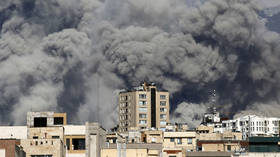
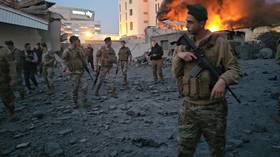
RT Arabic has evacuated its office in the Iranian capital, Tehran, after a nearby airstrike, the channel reported on Monday. There were no immediate reports of casualties among its staff.
Branch chief Hami Hamedi has shared several videos showing a building which he said had just been destroyed next to the RT office.
He said a gas leak, which can be heard in the footage, prompted his decision to instruct staff to urgently leave the premises.
A separate clip shows nearby buildings with windows shattered by the blast wave.
On Saturday, the US and Israel launched a joint military attack against Iran, aimed at killing the country’s leaders and replacing its government.
Russia has condemned the decision to use military force as an act of unprovoked aggression and called the targeted killing of the Islamic Republic’s supreme leader, Ayatollah Ali Khamenei, a political assassination that undermines basic principles of international relations.
RT launched its Arabic-language broadcast arm in 2007. The channel, also known as Rusiya Al-Yaum, is headquartered in Moscow and has regional offices in several Arab-speaking nations.
In 2023, RT Arabic’s branch in Gaza was destroyed amid the Israeli campaign targeting the militant movement Hamas, which resulted in devastation of large parts of the Palestinian enclave.

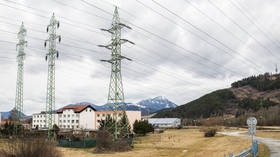
Slovakia will terminate an emergency electricity supply contract with Ukraine, state-owned energy operator SEPS has announced.
The move comes amid the continuing row between Kiev and Bratislava over the Soviet-era Druzhba pipeline, which carried crude from Russia to Slovakia and Hungary. The pipeline went offline in late January, with Kiev claiming it was damaged by Russian long-range strikes, which Moscow has denied. Slovakia and Hungary have echoed Russia’s stance, accusing Ukraine of deliberately disrupting the supply for political reasons and threatening retaliation.
Slovak Prime Minister Robert Fico ordered a halt to emergency electricity supplies from his country to Ukraine last week while threatening “further reciprocal steps” if oil supplies are not resumed. Announcing the halt, Fico reiterated that Ukraine’s actions were a “purely political decision aimed at blackmailing Slovakia.”
The contract with Ukrainian energy operator Ukrenego, which covers the emergency supply, is now set to be terminated, the director of SEPS, Martin Magath, told reporters on Wednesday after a government meeting. Over the past week, Ukraine reached out to Slovakia for an emergency electricity supply, but the request was turned down, he revealed.
Kiev has been increasingly reliant on electricity imports to stabilize its power grid, which has been battered by Russian strikes on Ukraine’s critical dual-use infrastructure. According to the Slovak authorities, Kiev received twice as much electricity from the country this January compared to the entire year of 2025.
Budapest has also mulled cutting emergency electricity supplies to Ukraine amid the Druzhba standoff. In late February, both Slovakia and Hungary announced that they would suspend diesel exports to Ukraine until the pipeline becomes operational again.
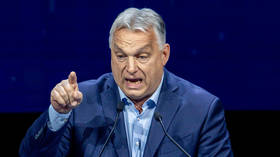
Additionally, Budapest has vetoed the EU’s proposed €90 billion ($106 billion) emergency loan for Ukraine and the latest package of anti-Russian sanctions. Until Kiev “returns to common sense and normality, we will not support any decision that is favorable to Ukraine,” Hungarian Prime Minister Viktor Orban has said.