1


Jim Fitzpatrick's (b. 1944) Western comic-infused Celtic-Nouveau visual style. He continues the Celtic-Irish revival legacy of Harry Clarke (1889–1931) by bringing the archaic Celtic visual vernaculars into comic illustrations and album covers.


1
100% Upvoted
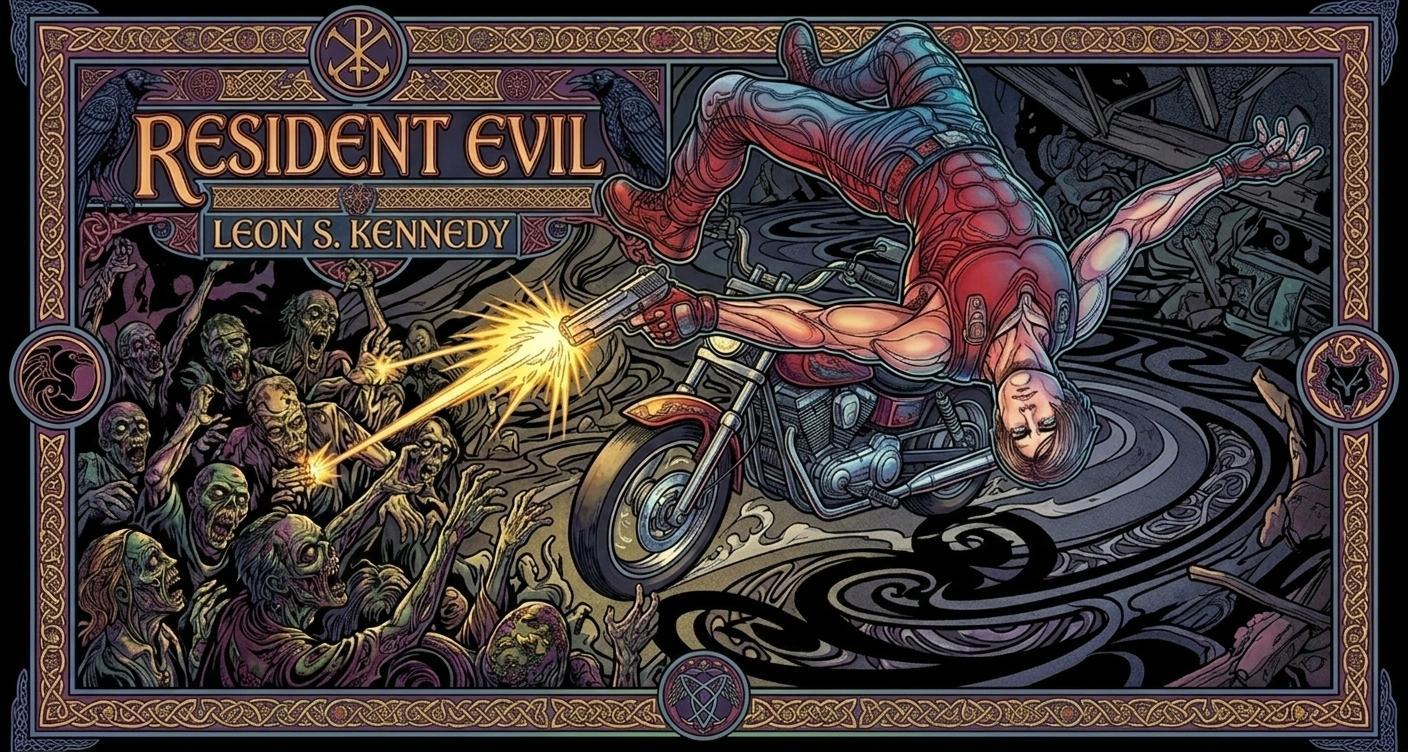
{Resident Evil: Leon S. Kennedy executes a mid-air body-flip off his bike, emptying his gun into the horde of zombies before the wheels even touch the asphalt} color-illustrated in Jim Fitzpatrick's Western comic-infused Celtic-Nouveau visual style: {
Born in Dublin in 1944 and educated at Franciscan College Gormanston, Jim Fitzpatrick emerged as a pioneering graphic artist who successfully bridged the decorative intricacies of the insular Celtic manuscript tradition with the bold, high-contrast aesthetics of modern pop and comic art. In a 1982 interview with RTÉ, Fitzpatrick detailed a conceptual framework informed by diverse visual lineages: he credited archived American Sunday comic supplements for his foundational drafting practice, while heavily aligning his stylistic pedigree with the ornate, semi-decadent linework of Harry Clarke (1889–1931) and Aubrey Beardsley (1872–1898), the compositional fluidity of Alphonse Mucha’s (1860–1939) Art Nouveau, and the flattened perspectives of Japanese Ukiyo-e woodblock prints. Crucially, his deep structural study of the Book of Kells throughout the 1970s informed his mature works, which modernized the manuscript’s decorative typography, interlaced symbolic ornamentation, and vibrant, elemental color palettes through highly idealized, graphic linework. Fitzpatrick viewed this synthesis as a vital vehicle for cultural transmission; he recognized the escapist, mythological power of folklore as directly analogous to modern superhero archetypes, leveraging this dynamic accessibility to engage younger audiences. Technically, his ideation process relied heavily on cultivating hypnagogic and hypnopompic states—the liminal, subconscious phases immediately preceding sleep and upon waking. While many designers utilize relaxed states for skeletal brainstorming, Fitzpatrick possessed the rare mnemonic discipline to capture and retain fully formed, complex visionary imagery from these fleeting moments, a methodology he famously cited as the genesis for intricately detailed masterworks like his Nuada of the Silver Arm illustration.
In 1968, Fitzpatrick entered a transformative era of political graphic design, most famously marked by his creation of the Viva Che! poster. Adapting Alberto Korda’s iconic "Guerrillero Heroico" photograph, Fitzpatrick utilized a high-contrast silkscreen technique to distill the portrait into stark black-and-white planes. He subsequently evolved this into the striking two-tone red and black composition that became a ubiquitous emblem of both the anti-Vietnam War movement and the global countercultural revolution. He applied a similar orthochromatic, monotone aesthetic to his tribute poster for Robert F. Kennedy. In both works, Fitzpatrick eschewed traditional halftones, instead constructing the portraits using fluid, curvilinear linework heavily inspired by the psychedelic pop aesthetics of late-1960s counterculture. While contemporaries largely restricted these undulating, liquid motifs to stylized typography, Fitzpatrick innovatively mapped them onto facial topography to render anatomical form. This period forced him to master the binary tension of positive and negative space—a bold, high-contrast graphic sensibility that would later serve as the structural foundation for the crisp, idealized linework of his signature "Celtic-Western" comic-art style.
Fitzpatrick’s commercial illustrations for the music industry, spanning the 1970s through the 2000s, served as a crucial testing ground that expanded the boundaries of this framework, allowing him to mythologize contemporary subjects. In 1973, his cover art for Thin Lizzy’s Vagabonds of the Western World successfully snuck the visual vernacular of Irish mythology into the world of hard rock, translating the three band members into highly stylized, dynamic comic-book archetypes imbued with vivid, heroic personalities. By 1980, his work on Thin Lizzy’s Chinatown cover showcased a significant evolution in his rendering capabilities: by creating an intricately designed Chinese dragon, he highlighted his masterful command of complex organic patterning, meticulously detailing full-body scales to achieve volumetric depth through tonal modulation—a stark contrast to his earlier flat, planar aesthetics. Decades later, his celebrated circa-2000 portraiture of Sinéad O'Connor proved his enduring capacity for capturing the essence of figural pop iconography. By rendering her iconic, unadorned likeness with minimalist, graphic precision, he evoked an aesthetic reminiscent of Andy Warhol’s (1928–1987) pop-art screenprintings, successfully bringing his 1960s silkscreen roots full circle to convey a profound sense of emotional purity.
This synthesis of historical and contemporary influences reached its absolute apex in 1978, when Fitzpatrick spearheaded a landmark visual revival of the Lebor Gabála Érenn (The Book of Invasions), the 11th-century manuscript chronicling the mythological origins of Ireland. This initiative debuted with The Book of Conquests, a lavishly illustrated volume that structurally mirrored the illuminated layouts, ornate typography, and intricate knotwork borders of ancient insular texts. Here, he achieved a groundbreaking synthesis of disparate traditions: seamlessly grafting the hyper-muscular, dynamic sculptural realism of American fantasy illustrator Frank Frazetta (1928–2010) onto the decadent, macabre elegance of Harry Clarke and the intensely detailed, flattened planar compositions of Aubrey Beardsley. Within these flattened planes, Fitzpatrick utilized a repetitive, ornamental approach to micro-detailing—subtly nudging traditional material textures toward rhythmic, tessellated geometric motifs and continuous zoomorphic interlacing that ornaments both surfaces and negative space, while maintaining narrative integrity. This intricate linework was subsequently modernized through his signature rendering technique, utilizing gradient-modulated airbrush color-blocking meticulously confined within continuous, cloisonné-like keylines. He expanded this monumental framework in 1981 with The Silver Arm, continuing the epic narrative of the Tuatha Dé Danann. This definitive high-fantasy visual lexicon not only dominated print but subsequently translated into immersive spatial design, as evidenced by his extensive, similarly styled environmental illustrations for Celtworld, an educational heritage theme park in County Waterford (1992–1997).
Simultaneously, Fitzpatrick demonstrated how effectively his framework could cross-pollinate with other genres. In the early 1980s—most notably through his 1983 collaboration on Michael Scott’s The Song of the Children of Lir—he stripped away his vibrant gradients to focus purely on stark, monochrome interior line art. Drawing heavily from the Gothic-inspired stained-glass methodologies of Harry Clarke, Fitzpatrick employed bold, continuous monolines—acting much like leaded cloisons—to firmly define planar shapes and establish scalar depth without traditional volumetric shading. A decade later, he proved the adaptability of his "Celtic-Western" style within international sci-fi circles by contributing to the 1993 tribute project Visions of Arzach (dedicated to French comic master Jean "Moebius" Giraud, 1938–2012). Creating a surreal, album-cover-style composition, Fitzpatrick seamlessly integrated Moebius’s titular character Arzach in flight against the ethereal visage of Morfís the Druid, perfectly framed by Fitzpatrick’s signature Celtic decorative ornamentation.
Ultimately, the publication of his 1985 retrospective anthology, Erinsaga, alongside his recent two-volume 2023–2024 portfolio, Ancient Ireland, Land of Legend, serves as a comprehensive testament to his fully matured conceptual framework. Directed by his deep ties to the hard rock music scene, Fitzpatrick successfully employed a "Celtic-Nouveau" visual lexicon to enrich the contextual narrative of contemporary youth culture. By integrating the ornate geometries of ancient Irish metalwork and the striking aesthetics of Harry Clarke’s Celtic-Irish revival—specifically Clarke’s lyrical figurative symbolism and "tenebristic luminism," where glowing, jewel-toned subjects emerge from stark, heavy black inks—Fitzpatrick shattered antiquated stereotypes of folklore, rendering these ancient myths vital and rebellious. Technically, his methodology relies on an Alphonse Mucha-inspired crispness and clarity; he employs a disciplined, uniform lineweight for both primary contours and micro-detailing. This mastery maintains a clean visual flow despite an overwhelming compositional density, echoing the sweeping, romantically intricate yet balanced line art of early comic pioneer Nell Brinkley (1886–1944). This foundation simultaneously channels the clean, calligraphic contouring of Japanese ukiyo-e alongside the hyper-elegant, stylized forms of Art Deco visionary Erté (Romain de Tirtoff, 1892–1990), all richly infused with the exacting figural detailing of Northern Renaissance master Albrecht Dürer (1471–1528) and the dramatic, symbolic lighting characteristics of Gustave Doré (1832–1883). This perfectionist, horror vacui approach to maximalist ornamentation—where high-effort filigree serves as both literal texture and contextual narrative framing—also shares profound structural DNA with the hyper-detailed, ligne claire aesthetics of modern comic illustrator Geofrey "Geof" Darrow (b. 1955). Structurally, Fitzpatrick’s character design is defined by a striking stylistic dichotomy: he consistently juxtaposes hyper-muscular Western comic realism—championed by defining sequential artists like Jack Kirby (1917–1994) and Hal Foster (1892–1982)—with the delicate, ethereal facial idealism of 19th-century Pre-Raphaelite painting. This exact fusion of classical romanticism and pulp exaggeration closely parallels the conceptual framework of Japanese manga artist Hirohiko Araki (b. 1960), who similarly revolutionized his medium by grafting the flamboyant elegance of Greco-Roman and Pre-Raphaelite art onto the hyper-masculine, gekiga-inspired anatomy of traditional 1980s manga. Finally, tying this intricate line art together is a color palette imbued with the rhythmic, subtly psychedelic qualities of Byzantine and Gothic stained glass, echoing the vibrating poster art of Rick Griffin (1944–1991), seamlessly integrated with the luminous, smooth gradients characteristic of traditional mokuhanga woodblock printing. When applied to flat comic planes, this approach generates an electric, high-chroma vibrancy; it simultaneously channels the subversive, countercultural energy of the underground comix that famously rebelled against the CCA (Comics Code Authority), while its slick, illuminated surfaces share an unexpected aesthetic kinship with the visionary concept art of Syd Mead (1933–2019). Through this unique alchemy, Fitzpatrick’s enduring legacy lies in his ability to elevate the escapist thrills of Western graphic illustration into the realm of timeless, high decorative art.
}