2


Mark Schultz's comic art style: combining his dual mastery as illustrator and author, a pre-CCA comic revival that fuses classical realism with authorial narrative pacing to capture epic moments with cinematic depth and impeccable timing. [Nano Banana 2]


2
100% Upvoted
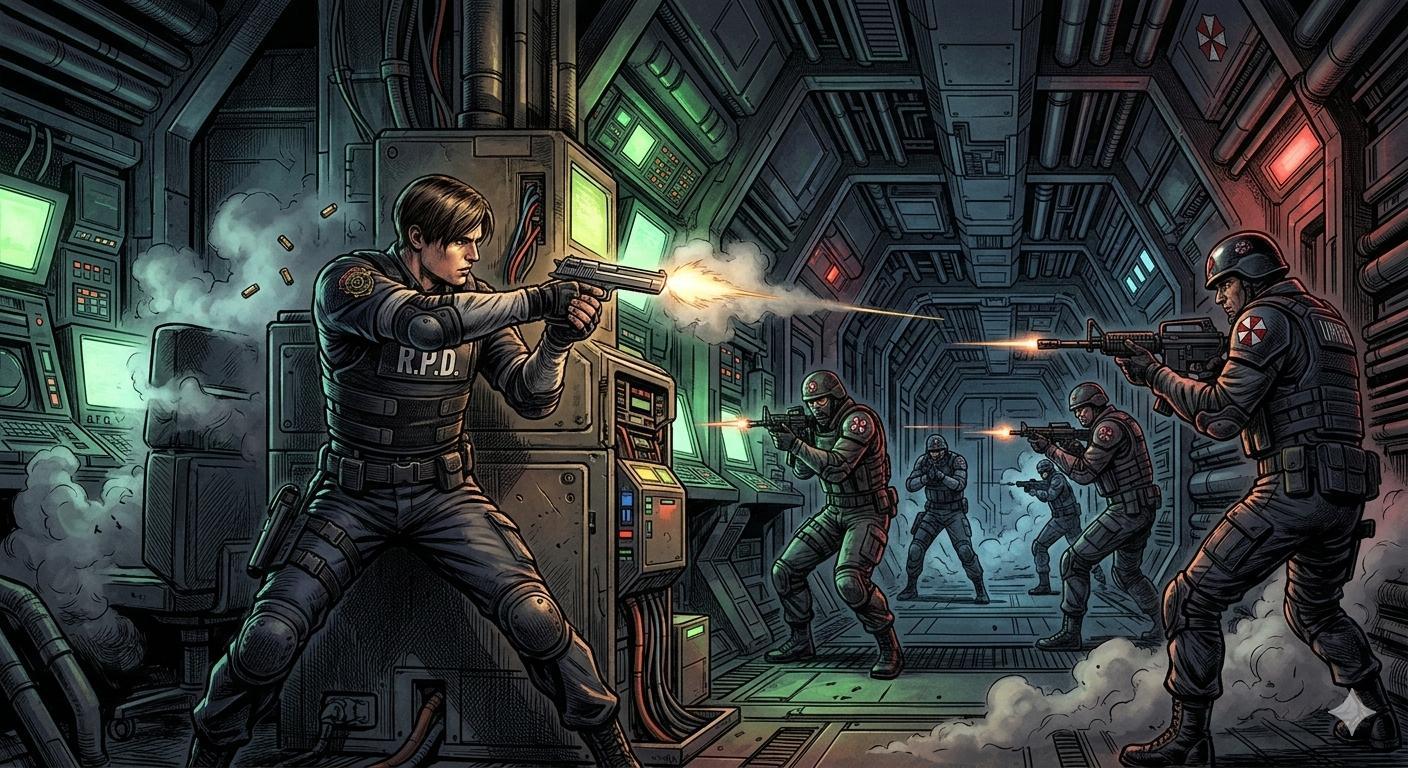
{Resident Evil: Leon S. Kennedy in a gun fight against Umbrella Corp’s armed agents in a dark futuristic tunnel} color-illustrated in Mark Schultz’s (b. 1955) signature comic pictorial style, which is a neo-classical synthesis of virtuosic Golden Age pen-and-ink draftsmanship and Burne Hogarth’s dynamic figure dynamics, utilized to capture epic cinematic depth that fuses rigorous scientific realism with visceral underground comix energy: {
Mark Schultz earned his Bachelor of Fine Arts in painting from Kutztown State College in 1977. In 1986, he debuted his Xenozoic short stories in Kitchen Sink Press's Death Rattle #8—a publisher sharing the uncensored, creator-owned underground comix ethos of Fantagraphics and Eclipse. Evolving into the seminal Xenozoic Tales (1987), Schultz's narrative synthesized pulp adventure with rigorous ecological science, akin to Richard Corben's (1940–2020) visceral, survivalist paleontological illustrations. Inspired by 1930s Tarzan films and Edgar Rice Burroughs's novels, Schultz internalized a romanticism favoring nature over industrialization—mirroring the perspectives of primatologist Jane Goodall (b. 1934) and paleontologist Philip J. Currie (b. 1949). He grounded his world-building in pulp philosophies: the tragic nobility of 1933's King Kong, Robert E. Howard’s (1906–1936) cynicism regarding civilization's fragility, and H.P. Lovecraft’s cosmic insignificance of humanity. Crucially, Schultz elevated these tropes by integrating the environmental philosophies of scientists like Loren Eiseley, Rachel Carson, Stephen Jay Gould, E.O. Wilson, and Sylvia Earle, framing his post-apocalyptic narrative through a highly literate lens on humanity's embeddedness in natural systems.
Visually, Xenozoic Tales established Schultz as a modern master of black-and-white sequential illustration, sharing the unapologetic density of fellow Death Rattle contributor Rand Holmes (1942–2002). Employing high-contrast chiaroscuro, intricate feathering, and expressive brushwork, Schultz crafted atmospheric depth recalling Brandywine School illustrators Howard Pyle (1853–1911) and N.C. Wyeth (1882–1945). His muscular figural dynamism and primal compositional energy reflected the virtuosic pulp-to-sequential legacy of Hal Foster (1892–1982), Frank Frazetta (1928–2010), Al Williamson (1931–2010), Wally Wood (1927–1981), and Roy Krenkel (1918–1983). Schultz’s page architecture relies on precise spatial clarity, translating the 3D geometry of biological and geological forms into robust, volumetric figures and environments that anchor highly kinetic action. This rigorous staging captures the immersive sweep of foundational epics from Homer's Odyssey to Tolkien's The Lord of the Rings and Lucas's Star Wars (1977). Furthermore, his sequential pacing evokes Akira Kurosawa’s (1910–1998) cinematic compositions, translating the director's atmospheric gravitas and dynamic spatial blocking into panel-to-panel rhythms charged with visceral energy.
In 1998, Schultz expanded into urban noir, scripting "Dr. Broca Von Bitelbaum" for Kitchen Sink’s The Spirit: The New Adventures #4, illustrated by David Lloyd (b. 1950). Operating within Will Eisner’s (1917–2005) theatrical vernacular, Schultz tailored his pacing to exploit Lloyd’s mastery of stark, structural chiaroscuro. Their collaboration highlighted a shared aesthetic philosophy: heavy spotting of blacks and the elimination of traditional holding lines. The resulting artwork utilizes color-enhanced chiaroscuro where shadows become materialized, volumetric design elements—akin to the sculptural lighting in Horst P. Horst’s (1906–1999) fine-art photography. Scripting for this stylized, expressionistic delivery refined Schultz’s architectural understanding of graphic storytelling, demonstrating how atmospheric dread and narrative tension can be driven entirely by manipulating negative space and heavy cinematic shadow.
In 1999, Schultz transitioned to mainstream franchise writing, succeeding Louise Simonson on DC Comics' Superman: The Man of Steel beginning with issue #87. Partnering primarily with penciller Doug Mahnke, Schultz navigated DC's collaborative "Triangle Era" publishing structure—a sharp contrast to his sole authorship of Xenozoic Tales. Though strictly writing, Schultz's draftsman background informed detailed compositional directions that shaped the final pages. Mahnke's muscle-bound anatomical penciling and dramatic chiaroscuro achieved emotional resonance through expressive postures, offering a distinct variation from Schultz's own kinetic, ephemeral action. Unlike the stark black-and-white of Xenozoic Tales, these Superman issues utilized DC's digital coloring pipeline, employing tonal modeling, soft gradients, and restrained palettes. Thematically, Schultz seamlessly extended his signature preoccupations with science fiction, ecological awareness, and the tension between technology and the natural order into the Superman mythos.
In 2002, Schultz shifted to classical book illustration for Wandering Star Books’ deluxe prose collection, Conan of Cimmeria: Volume One (1932–1933). Tasked with stripping away decades of pop-culture pastiche, he aimed to capture the pre-civilization barbarism, moral ambiguity, and existential grit of Robert E. Howard’s original texts. Recognizing that the Hyborian Age’s visceral realism stemmed from Howard's integration of historical and anthropological research, Schultz applied meticulous historical grounding to his armor, architectural, and environmental designs. Visually, this portfolio elevated Schultz’s aesthetic into the Golden Age pulp tradition, cementing him as a modern heir to J. Allen St. John (1872–1957) and Roy G. Krenkel. Broadening his technical repertoire beyond high-contrast ink, Schultz employed heavily textured tonal graphite and charcoal alongside traditional brush-and-ink plates. This tonal approach facilitated a softer, atmospheric chiaroscuro, significantly enhancing his figures' volumetric weight and his scenes' environmental density.
From 2005 to 2011, Flesk Publications issued the five-volume Mark Schultz: Various Drawings, exposing his foundational process: constructing figures from geometric volumes, developing dynamic compositions through iterative study, and maintaining anatomical rigor beneath gestural expressiveness. Schultz cited realist painter Thomas Eakins (1844–1916) as a key inspiration, sharing his commitment to anatomical study and a proto-photographic sensibility that grounds documentary realism in staged directional lighting and high-contrast tonal emphasis. These studies showcase Schultz's signature draftsmanship, reflecting William Stout's (b. 1949) blend of rigorous natural-history observation and uninhibited underground comix energy. The pervasive gestural dynamism also channels the teachings of Burne Hogarth (1911–1996), utilizing whole-body muscular tension, "S"-curve contrapposto, and exaggerated foreshortening to generate inner structural logic. Action-driven sketches reveal the influence of Tintoretto’s (1518/19–1594) fluid spatial dynamics, while monumental studies echo the declarative propaganda-era rhetoric, virtuosic ink density of Joseph Clement Coll (1881–1921), and commanding directness of James Montgomery Flagg (1877–1960). Furthermore, Schultz’s atmospheric chiaroscuro and Romantic sensibilities resonate with Francisco Goya's (1746–1828) Osuna cabinet paintings, deeply tying him to the classical sword-and-sorcery illustration tradition.
Concurrently, Schultz's affinity for classical illustration culminated in his November 2004 appointment as writer for the legendary syndicated Sunday strip Prince Valiant. Collaborating with master illustrators Gary Gianni (b. 1954) and later Thomas Yeates (b. 1955), he stepped into the narrative footprint of creator Hal Foster. Because the strip eschews word balloons for typeset captions, Schultz adapted to a highly specific, pageant-like pacing. As a narrative architect, his scripts demanded sweeping panoramic compositions and deep-focus staging, delivering an immersive Arthurian vision. A decade later, he reaffirmed his sword-and-sorcery mastery by contributing interior illustrations to the tabletop RPG Conan: Adventures in an Age Undreamed Of (2016). Translating his historically grounded, anatomically rigorous draftsmanship to gaming, Schultz provided a visceral, authentic standard for expansive world-building, perfectly aligning with his classical illustrative gravity.
Ultimately, Schultz’s conceptual design framework stands as a masterclass in neo-classical sequential illustration, synthesizing the visceral energy of pre-Comics Code Authority (CCA) pulp adventure with rigorous scientific and anatomical realism. While sharing a commitment to revitalizing pre-CCA traditions with contemporaries like Walter Simonson (b. 1946) and Mike Mignola (b. 1960), Schultz deliberately diverges from their stylized graphical abstractions. Rejecting simplified, production-driven shortcuts, he grounds his style in virtuosic pen-and-ink draftsmanship—characterized by texturally evocative crosshatching, structural chiaroscuro, and volumetric geometry. Nevertheless, he fuses this classical finesse with a modernist awareness of print-reproduction efficiency, utilizing heavy black spotting and crisp spatial clarity to ensure intricate rendering never muddies the printed page. He achieves an immersive, deep-focus cinematic staging reminiscent of epic Golden Age filmmaking and widescreen Westerns, where sweeping vistas are activated by high-tension, athletically dynamic figures. Through this seamless integration of classical technique, kinetic spatial flow, and atmospheric world-building, Schultz elevates genre illustration. His style thus defines a unique post-CCA synthesis: combining authorial narrative pacing with classical graphic realism to capture memorable epic moments with cinematic depth and impeccable timing.
}