


Dr. Eric Davis Said He Laid It All Out in His Interviews - So I Put It All Together. Here’s What I Found and Why The Convergence Should Terrify You.
I followed the technical threads from a Soviet propulsion manuscripts to over $1.2 billion in independently funded U.S. programs covering every subsystem Davis described.


I spent the last several weeks doing something I haven’t yet seen done in the UAP community with rigor: treating the entire public record of Dr. Eric W. Davis - every paper, every interview, every leaked memo, every congressional briefing - as an open-source intelligence corpus and subjecting it to the same forensic methodology I used during my years in security intelligence at Shell.
Then I did something else. I took the engineering specifications in the Černohajev manuscripts (119 pages of detailed propulsion system designs produced by my late father-in-law, Soviet aerospace engineer Valerijs Černohajev ) and followed every technical thread outward. MHD propulsion led to DARPA contracts. Fusion parameters led to ARPA-E programs and a $3 billion MIT spinoff. Superconductor-gravity specifications led to a DoD-funded physicist who disappeared. Material science requirements led to Stanford lab results and Navy patents. What I found was over $1.2 billion in independently funded programs that collectively address every subsystem of the integrated architecture that Černohajev described and that Davis’s Pentagon intelligence documents surveyed.
The results broke my analytical framework. Not because they disprove Davis. Because they corroborate him in ways that are almost impossible to explain away.
Every technical domain Davis identified in his Pentagon intelligence documents is now the subject of active, well-funded research. The magnetic field specifications converge within the same narrow engineering regime. The funding pattern is exactly what compartmentalized reverse-engineering would look like from the outside.
PART ONE: THE DAVIS DOSSIER and WHAT HE ACTUALLY SAID
He’s Not a Commentator. He’s a Pipeline.
The first thing I need you to understand about Eric Davis is what he is not. He is not a podcaster. He is not an enthusiast. He is not speculating.
Davis holds a Ph.D. in astrophysics from the University of Arizona. He holds Top Secret/SCI clearances with the Pentagon. He is a Fellow of the British Interplanetary Society, an Associate Fellow of AIAA, and a member of the Association of Former Intelligence Officers. He co-edited the AIAA’s 739-page Frontiers of Propulsion Science. He authored at least six of the 38 Defense Intelligence Reference Documents commissioned under the Pentagon’s $22 million AAWSAP program (DIA contract HHM402-08-C-0072) on topics including traversable wormholes, warp drives, vacuum energy extraction, and antigravity.
His career path reads like a institutional relay race: NIDS (Bigelow’s National Institute for Discovery Science, 1996–2002) → EarthTech International (Puthoff’s Institute for Advanced Studies) → BAASS/AAWSAP (the DIA’s UFO program) → The Aerospace Corporation (a federally funded defense R&D center, 2019–2024) → back to EarthTech and a research professorship at the University at Albany.
Davis is not outside looking in. He is the pipeline between private UAP research and classified government programs. He admits as much, describing the network managing these alleged programs as an “incestuous community,” a striking term from someone sitting at its exact center.
When Davis claims he has “exposed everything,” he’s not making idle boasts. He’s issuing a challenge. I accepted it.
The Wilson-Davis Memo
I cannot overstate the importance of this document. Fifteen pages of handwritten notes recording an alleged October 16, 2002 meeting between Davis and Vice Admiral Thomas Wilson (recently retired at the time Director of the Defense Intelligence Agency) outside the EG&G Special Projects building at McCarran International Airport in Las Vegas.
According to the memo, Wilson found a “special subset of unacknowledged/carve-out/waived programs” at an unnamed defense contractor, “an aerospace technology contractor with intelligence capabilities in their corporate portfolio … the best one of them.” When he demanded access, a three-person “watch committee” told him he wasn’t on the “bigot list” (a list of 400–800 workers, predominantly civilian scientists and engineers, with no recognizable White House or Congressional names on it). The program managers admitted to operating a reverse-engineering program with access to “an intact craft/UFO of unknown origin” that had “crashed years ago and been recovered.” They’d achieved “little or no success” due to agonizing isolation and lack of outside expertise.
When Wilson escalated, the Senior Review Group chairman threatened him personally: drop the inquiry or face loss of promotion, early retirement, and loss of stars.
The memo leaked in April 2019 from Edgar Mitchell’s estate. Rep. Mike Gallagher entered it into the Congressional Record on May 17, 2022. Admiral Wilson has categorically denied everything but the memo records both men agreeing that if word leaked, “both would deny it.”
Davis’s handling is textbook intelligence craft. For years, he offered only “no comment.” He confirmed the notes “leaked from Ed Mitchell’s estate” without confirming their content. By 2024, he was referring to “our meeting” and “my interview notes” on social media he’s confirming authorship while maintaining legal distance from the classified substance. I call this Glomar validation: authenticating a document while technically avoiding NDA violation.
The Boiling Frog: 25 Years of Calculated Escalation
As I mapped every major Davis public statement onto a timeline, a pattern emerged that is too precise to be accidental. This is not a man blurting things out. This is a graduated disclosure strategy best characterized as a “boiling frog” approach designed to acclimate the public, the scientific community, and Congress to progressively more explicit claims.
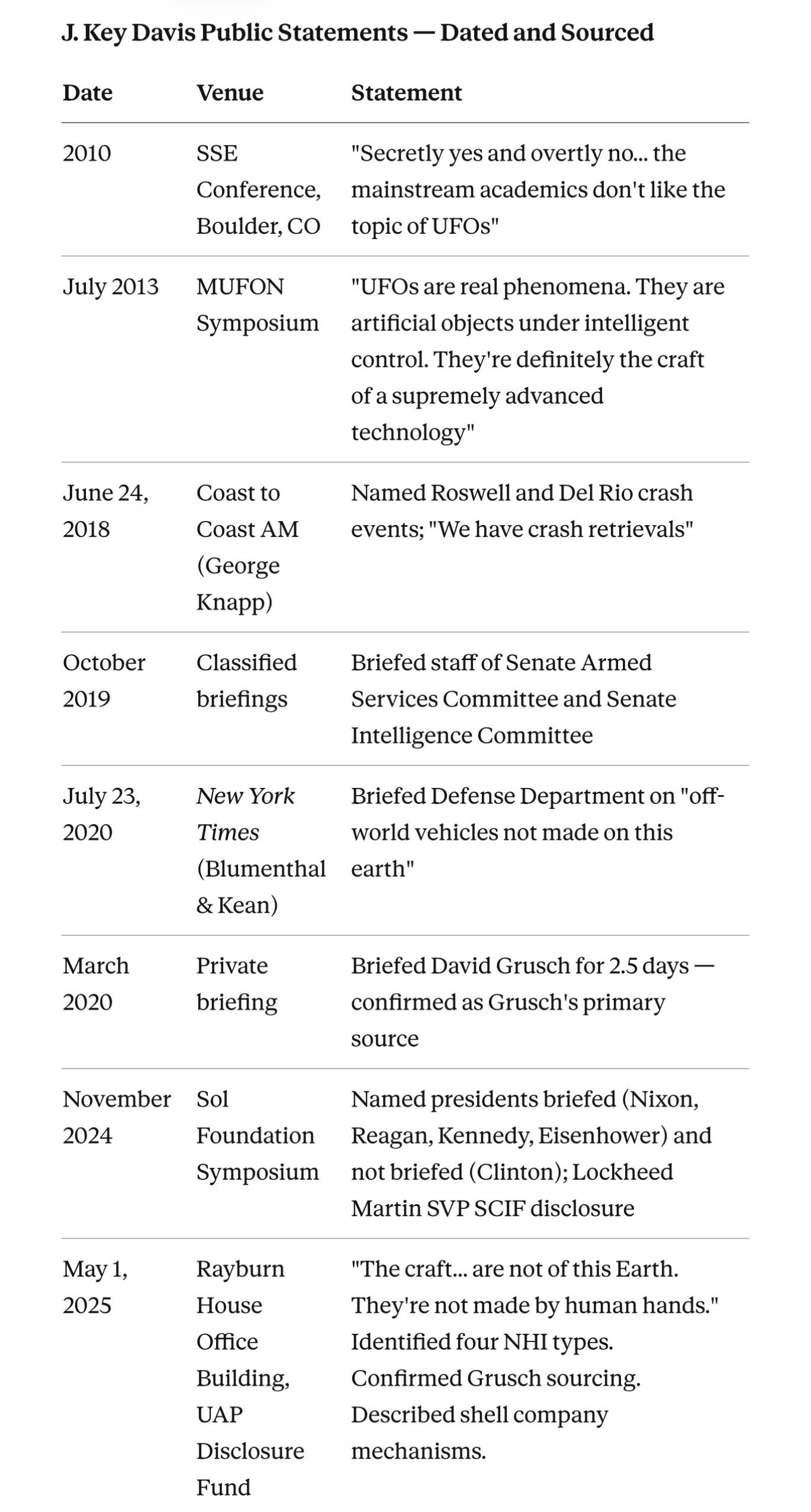
Phase I (1997–2017): Scientific foundation. Davis published in Foundations of Physics, General Relativity and Gravitation, JBIS, and AIAA venues. He authored DIRDs on wormholes, warp drives, and vacuum energy. Respectable physics. Frontier topics, but legitimate. Then, at the 2010 SSE Conference, when asked whether UFO properties had guided propulsion research, he let something slip: “Secretly yes and overtly no... the mainstream academics don’t like the topic of UFOs.” At MUFON in 2013: “UFOs are real phenomena. They are artificial objects under intelligent control. They’re definitely the craft of a supremely advanced technology.”
Phase II (2018–2019): Naming names. On Coast to Coast AM, June 24, 2018, Davis crossed a line: “If you’re going to throw your bets on Roswell, your bet’s really good. Del Rio, Texas, that was a 1950s case... the other ones I won’t bring up because those are still classified.” He added: “We have crash retrievals and they’ve been analyzed and unfortunately our laboratory diagnostic technologies and our materials sciences and the understanding of physics that we had were not advanced enough to be able to make heads or tails of what they had their hands on.” In October 2019, he gave classified briefings to staff of the Senate Armed Services Committee and the Senate Intelligence Committee.
Phase III (2020): “Off-world.” The New York Times, July 23, 2020: Davis said “he gave a classified briefing to a Defense Department agency as recently as March about retrievals from ‘off-world vehicles not made on this earth.’” He added: “We couldn’t make it ourselves.” First time an official of his caliber used explicitly non-human language in a paper of record. The goalpost moved from “unidentified” to “identified as not from here.”
Phase IV (2024–2025): The Rubicon. At the November 2024 Sol Foundation Symposium, Davis named specific presidents briefed on UAP programs - Nixon, Reagan, Kennedy, Eisenhower - and those not briefed: Clinton. He disclosed that a Lockheed Martin senior vice president told him inside a SCIF about direct involvement in a crash retrieval program for two decades.
Then came May 1, 2025. The Rayburn House Office Building. The UAP Disclosure Fund briefing. Davis abandoned every remaining ambiguity: “The craft that had been recovered are not of this Earth. They’re not made by human hands. They are not from this planet. They are not human. They are an alien technology.”
When a congressman asked him what kind of beings were associated with these craft, Davis identified four types of non-human entities: Grays, Nordics, Insectoids, and Reptilians.
He described in detail the shell company mechanisms used to hide programs from Congress.
And then he confirmed that he was David Grusch’s primary source. “I briefed them for two and a half days just the week before COVID struck. Dave took all my classified and proprietary information... the output of that was his classified whistleblower complaint to the ICIG.”
If Davis had said “Reptilians” in 2017, he would have been destroyed. By 2025, after years of “off-world” discourse, after Grusch’s congressional testimony, after the Schumer-Rounds UAP Disclosure Act, it was the next logical step. Calculated. Deliberate. Precisely timed.
The Grusch Pipeline and the Circularity Problem
I need to be honest about something that troubles me analytically, even as I find Davis’s technical claims corroborated.
The chain of influence is direct and documented: Davis → Grusch → Congressional alarm → the Schumer-Rounds UAP Disclosure Act. Davis briefed Grusch for two and a half days in March 2020. Grusch’s July 2023 congressional testimony — “a multi-decade UAP crash retrieval and reverse engineering program,” contractor-held technology, and non-human biologics tracks almost exactly with the Wilson-Davis memo’s narrative. Davis was one of approximately 40 witnesses in Grusch’s ICIG complaint, found “urgent and credible.”
But here’s the circularity concern I can’t ignore: through NIDS → AAWSAP/AATIP → UAPTF, the same small network has influenced successive generations of government officials with substantially the same narrative. The appearance of independent corroboration may instead reflect a single information stream refracted through multiple institutional prisms.
This is precisely why I turned to a source outside the network entirely.
PART TWO: THE ČERNOHAJEV KEY — INDEPENDENT CORROBORATION FROM A DEAD SOVIET ENGINEER
The circular sourcing problem within the Davis network is real. Puthoff confirms Davis. Davis sources Grusch. Grusch’s testimony tracks Davis’s narrative. Elizondo confirms the memo. The same people keep confirming each other.
But Valerijs Černohajev never met Eric Davis. He never met Hal Puthoff. He never heard of AAWSAP. He was a Soviet aerospace engineer who spent decades producing 119 pages of technical specifications for what he described as reverse-engineered UFO propulsion systems including specifications that include precise engineering parameters, material science requirements, and reactor designs.
He died without knowing that the physics he described would converge, parameter by parameter, with both the Pentagon’s intelligence surveys and active DARPA programs funded decades later.
The Černohajev manuscripts are not testimony. They are not opinions. They are engineering documents with numbers. And those numbers gave me something to search for; specific technical parameters I could trace through patent databases, DARPA solicitations, DOE awards, and peer-reviewed literature. Every thread I pulled led somewhere real.
I call this methodology the Černohajev Key.
How the Key Works
I triangulate three independent source streams:
The Davis Corpus: His six DIRDs, published papers, and public statements about crash retrieval technology
The Černohajev Manuscripts: 119 pages of engineering specifications for fusion-powered electromagnetic propulsion, produced independently between the 1980s and early 2000s as the investigative starting point
Verified Public Programs: DARPA, ARPA-E, DOE, Navy, and private-sector programs with documented budgets, published results, and no acknowledged connection to either Davis or Černohajev
When all three sources converge on the same technical parameters, when a Soviet engineer’s specifications lead me to DARPA programs and Navy patents that match a Pentagon intelligence survey, and none of these sources acknowledges the others, the correlation demands explanation. Not belief. Explanation.
Here’s what I found.
PART THREE: SIX CONVERGENCES THAT SHOULD TERRIFY YOU
CONVERGENCE 1: MHD Propulsion — They’re Building the Same Engine
Davis authored or commissioned DIRD #26 on magnetohydrodynamic air-breathing propulsion for AAWSAP, written by a Lockheed Martin engineer.
Černohajev’s Work No. 2 provides a complete MHD electric current generator design integrated with a fusion reactor — including specific reaction pathways (p + p → d + e⁻ + ν; d + d → ³He + p; ³He + ³He → ⁴He + 2p), operating pressures of 2000 atmospheres, particle densities of 10²⁴/m³, and an MHD conversion stage to power propulsion solenoids.
DARPA launched the PUMP program (Principles of Undersea Magnetohydrodynamic Pumps), solicitation HR001123S0044, in May 2023 (a 42-month program managed by Dr. Susan Swithenbank) targeting 20 Tesla magnetic fields using REBCO superconducting magnets. Prime contractor HRL Laboratories (owned by Boeing and GM) demonstrated proof-of-concept at roughly 70% efficiency in April 2025. General Atomics provides the superconducting magnets. Tokamak Energy joined in October 2025 with magnets generating up to 24 Tesla.
A Soviet engineer. A Pentagon intelligence document. A DARPA program. Three independent sources converging on the same propulsion architecture. None references either of the others.
CONVERGENCE 2: The 16.65 Tesla Problem
This is the single data point that keeps me awake at night.
Černohajev specified B(max) = 16.65 Tesla as the magnetic field strength required for his propulsion solenoid system, derived from what he called the maximum magnetic induction value of the Sun. He specified a 32-solenoid array configuration.
When he wrote this, 16.65 Tesla was effectively unreachable for any practical application. It was an engineering fantasy.
Then, on September 5, 2021, Commonwealth Fusion Systems and MIT’s Plasma Science and Fusion Center demonstrated a world-record 20 Tesla magnetic field with a large-scale high-temperature superconducting magnet; a breakthrough that made DARPA’s PUMP program possible.
DARPA’s program explicitly cites the 20 Tesla REBCO breakthrough as the enabling technology. Tokamak Energy’s latest magnets reach 24 Tesla. The DOE validated CFS’s full-scale production magnets in September 2025, awarding them $8 million in the largest Milestone program award to date. CFS has raised nearly $3 billion.
Černohajev’s 16.65 Tesla and DARPA’s 20 Tesla are not identical values. But they occupy the same narrow engineering regime; a regime that was science fiction when the manuscripts were written and is now demonstrated reality. The convergence is not on “strong magnets” generically. It is on a specific magnetic field intensity range required for a specific propulsion architecture that both sources describe.
CONVERGENCE 3: The Fusion Reactor — Same Power Plant, Different Blueprints
Davis authored or commissioned three fusion-related DIRDs including inertial electrostatic confinement fusion (DIRD #1), advanced nuclear propulsion (DIRD #2), and aneutronic fusion propulsion (DIRD #30). Collectively, these survey every compact fusion approach relevant to a mobile power source for electromagnetic propulsion.
Černohajev provides detailed engineering specifications for a thermonuclear synthesis reactor using the Cl + ⁶Li → 2⁴He reaction, with a cross-section of σmax = 0.026 barn and energy release of 22.4 MeV. The manuscripts include multiple deuterium injection points, magnetic field containment zones, inertial plasma containment, and dual power extraction via MHD generator plus synchronized turbine.
ARPA-E’s BETHE program (Breakthroughs Enabling THermonuclear-fusion Energy), announced November 2019, awarded $32 million across 15–16 projects to develop commercially viable compact fusion concepts. CFS is building SPARC with plans for first plasma in 2026 and grid-connected power in the early 2030s. Even the Navy got involved with Salvatore Pais’s abandoned Plasma Compression Fusion Device patent (US10322827B2, filed 2018, assigned to Secretary of the Navy) explicitly referenced Lockheed Martin Skunk Works’ Compact Fusion Reactor.
The convergence isn’t on fusion in general. It’s specifically on compact, mobile-scale fusion as enabling technology for electromagnetic propulsion; precisely the integrated architecture both Černohajev and Davis describe.
CONVERGENCE 4: The Physicist Who Disappeared
This one disturbs me the most.
Davis’s DIRD #14 (”The Role of Superconductors in Gravity Research,” available at the DIA FOIA Electronic Reading Room) extensively covers the work of Dr. Ning Li, a Chinese-American physicist at the University of Alabama in Huntsville. Between 1991 and 1993, Li and colleague Douglas Torr published papers in Physical Review D (Vol. 43, 1991), Physical Review B (Vol. 46, 1992), and Foundations of Physics Letters (Vol. 6, 1993) proposing that rapidly rotating ions in high-temperature superconductors could generate gravitomagnetic fields producing repulsive gravitational force.
Li left UAH in 1999 to found AC Gravity LLC, which received a $448,970 DoD grant in 2001 to continue antigravity research. The grant period ended in 2002. No results were ever made public. After a 2003 MITRE Corporation conference, Li vanished from public view completely. Her son confirmed in 2023 that she continued working for DoD until a 2014 accident caused permanent brain damage. She died in 2021.
Now look at what Černohajev independently specified: a hull design combining layered diamagnetic materials (silicon, germanium) with ferromagnetic materials (Si₃Fe, Si₃N₄), 678,000 solenoids across 678 square meters of surface area, with electromagnetic field flow between layers. His own annotation: “THIS IS VERY DIFFICULT TO ACHIEVE. THIS IS 22ND CENTURY TECHNOLOGY LEVEL.”
Both sources describe architectures designed to produce gravitational effects through electromagnetic means. Li’s research was funded by DoD, then classified. Pais’s Navy patents describe nearly identical mechanisms. Davis’s DIRD surveyed the domain. And here’s the geographic convergence that sends chills down my spine: Li worked in Huntsville. Travis Taylor (later the UAPTF Chief Scientist) was at UAH simultaneously in the 1990s. Davis himself was stationed at The Aerospace Corporation’s Huntsville office from 2019 to 2024. Jay Stratton (UAPTF Director) and Taylor both moved to Radiance Technologies, a small employee-owned defense contractor in Huntsville, within three weeks of each other in spring 2022. Radiance’s president has publicly expressed willingness to take reverse-engineering contracts.
The research didn’t stop. It went dark. And everyone involved ended up in the same city.
CONVERGENCE 5: Materials That Don’t Play by Our Rules
Davis’s DIRD #23 covered metamaterials for aerospace applications. He has repeatedly stated that recovered materials exhibit properties suggesting engineering at scales not achievable by known terrestrial processes.
Černohajev’s manuscripts specify hull materials engineered at the atomic level, specifying manganese boride with specific Curie points, chemically amorphous semiconductors (SiOx, Si₃N₄), germanium selected for corrosion resistance based on atomic mass ratios. These are metamaterials before the term existed.
Stanford’s Garry Nolan, who was contacted by the CIA to analyze alleged UAP materials, published the first peer-reviewed UAP materials methodology paper with Jacques Vallée in Progress in Aerospace Sciences (Nolan et al., Vol. 128, 2022, DOI: 10.1016/j.paerosci.2021.100907). Using nanoSIMS analysis, he found that Ubatuba (Brazil, 1957) magnesium samples showed roughly 30% deviation from terrestrial isotope ratios. Of twelve UAP material samples analyzed, two were “not playing by our rules.” One alleged magnesium sample turned out to be almost entirely high-purity silicon; extraordinary for any era.
Nolan’s conclusion: “If you find a metal where the isotope ratios are changed far beyond what is normally found in nature, then that material has likely been engineered.”
Černohajev describes materials requiring atomic-level engineering. Nolan finds materials with anomalous compositions suggesting deliberate engineering for unknown purposes. Davis’s DIRD surveyed the same domain. Karl Nell, an Army colonel who served as UAPTF Liaison and later publicly stated at the Sol Foundation that non-human intelligence on Earth is a “non-zero” certainty, founded a venture-backed metamaterials startup called StarDustX in January 2023, immediately after leaving his government UAP role.
Four independent directions. Same question. Same material science territory.
CONVERGENCE 6: Spacetime Metric Engineering — The Physics Is No Longer Theoretical
Davis’s most mainstream scientific contributions are his published papers on traversable wormholes, the Alcubierre warp metric, and vacuum energy extraction. His 2004 AFRL Teleportation Physics Study recommended $7.5 million for further research. At the 2010 SSE Conference, he connected these domains explicitly: “There are aspects of anti-gravity, the properties of negative vacuum energy, that would create a repulsive force that allows something to levitate up. And UFOs do exhibit that.”
Černohajev’s “Gravitational-Charge Dualism” proposes that gravitational and electromagnetic fields are fundamentally coupled, with specific mathematics for field manipulation through solenoid arrays creating “spatially-accelerating flows” and “directly-accelerating flows for UFO.”
Pais’s Navy patents, US10144532B2 (inertial mass reduction), US10135366B2 (electromagnetic field generator), US10322827B2 (plasma compression fusion), describe using high-energy electromagnetic fields to create “local polarized vacuum” and reduce inertial mass. NAWCAD spent $508,000 from 2016–2019 testing the concept. The Pais Effect “could not be proven” but the Navy’s Chief Technology Officer personally intervened to ensure the patents were granted, telling the USPTO examiner the technology was of strategic importance.
NASA’s Eagleworks Laboratory tested the Alcubierre metric at Johnson Space Center from 2010–2015.
Different formalism. Same physical outcome: electromagnetic manipulation of gravitational effects for propulsion. And every institution that matters is investigating it.
PART FOUR: THE DISAGGREGATED MACHINE
Here is the finding that changes everything.
The Černohajev manuscripts describe an integrated system in a single craft that combines:
Fusion reactor (Cl + ⁶Li or D+D) as the power source
MHD generator for energy conversion
Solenoid array (678,000 units, 16.65 Tesla) for electromagnetic propulsion
Layered diamagnetic-ferromagnetic hull for field interaction
Gravitational-electromagnetic coupling as the propulsive mechanism
Atomic-level engineered materials as structural requirements
No single U.S. program combines all six elements. But the collective portfolio of documented, funded programs addresses every subsystem separately:
SubsystemU.S. ProgramInvestmentStatusCompact fusionARPA-E BETHE + CFS SPARC$32M public + ~$3B privateActive; 20T magnets achievedMHD propulsionDARPA PUMPMulti-million, 42 monthsActive; 70% efficiency demonstratedHigh-field solenoidsCFS / Tokamak Energy HTSIncluded above20–24 Tesla demonstratedSuperconductor-gravityNing Li / AC Gravity DoD grant$449K (results classified)Dark since 2003Spacetime engineeringPais patents / NAWCAD HEEMFG$508K”Could not be proven”Advanced metamaterialsTTSA ADAM / StarDustX / Nolan labVariousActive
Total documented funding across these domains: over $1.2 billion.
I need you to sit with this. A Soviet engineer who never met anyone in the American disclosure network produced an integrated engineering blueprint. The Pentagon commissioned intelligence surveys of each individual subsystem. And the U.S. government is now funding, openly and at scale, every single piece of that machine, separately, under different program offices, at different agencies, with different classification levels.
If you are reverse-engineering a recovered craft that integrates all six subsystems, but your institutional structure prevents any single program from acknowledging the integrated purpose, this is exactly what it would look like. The research is real. The physics is advancing. The integration is what’s classified.
PART FIVE: WHAT I’M NOT CLAIMING AND WHAT I AM
I am not claiming that crash retrievals have occurred. I am not claiming that Černohajev had access to recovered technology (though the precision of his specifications raises that question). I am not claiming that the disaggregated funding is deliberately concealing an integrated program. Correlation is not causation.
But I am claiming the following, and I will defend every word:
Davis has placed a structurally complete narrative in the public record. When his entire 25-year corpus is synthesized, it describes the what (crash retrievals exist), the who (defense contractors, specific oversight bodies), the how(shell companies, waived SAPs, bigot lists), the why it’s hidden (constitutional oversight failure), and the what they found(specific non-human biological types). What he has not exposed is verifiable proof in terms of program names, contractor identities, material specifications, physical evidence. He has given the public a detailed map with the place names removed.
The Černohajev manuscripts provide an independent technical framework that converges with Davis’s claims at the engineering parameter level. The 16.65 Tesla specification alone, written when that field strength was unreachable and now demonstrated by CFS, represents a data point that demands serious analytical attention.
Documented U.S. programs collectively fund every subsystem of the architecture both describe. This is verifiable. The DARPA contracts are public. The CFS milestones are validated by DOE. The ARPA-E awards are on the record. The Pais patents are in the USPTO database. The Ning Li grant is documented. None of these programs acknowledges connection to the others. None acknowledges connection to UAP.
The question is no longer whether the physics is plausible. CFS has built the magnets. DARPA is building the MHD drive. ARPA-E is funding the fusion reactors. The Navy filed the spacetime engineering patents. Every piece of the machine is either demonstrated or under active development.
The question Congress should be asking and the question I am asking, publicly, right now is: Who is integrating these subsystems, and under what authority?
If the answer is “nobody,” if these parallel programs are genuinely independent and no integration exists, then the Černohajev manuscripts represent the most remarkable case of convergent engineering intuition in modern aerospace history, and a Soviet engineer independently derived the engineering specifications for a machine the United States is accidentally building piece by piece.
If the answer is something else, then Eric Davis has indeed “exposed everything.”
And my father-in-law gave us the key to see it.
Gene Sticco is a former Shell Global Security Executive, intelligence officer, USAF veteran, and co-founder of the Černohajev Archive and Research Institute (CARI). The Černohajev manuscripts, “Engineering Infinity: Earth’s First Interstellar Blueprint” are available for scientific review and institutional analysis through ASIRP.
All program details, funding figures, and technical parameters cited in this article are drawn from published government documents, patent filings, peer-reviewed papers, and official program announcements. Source documentation is maintained by ASIRP and available upon request.
If you found this analysis valuable, please share it. The institutional walls I’m describing are designed to prevent exactly this kind of cross-domain synthesis. Every share is a crack in the compartmentalization.
Subscribe to ASIRP Dispatch for continuing forensic intelligence analysis of the UAP disclosure ecosystem.
APPENDIX: SOURCE REFERENCE AND INVESTIGATIVE INDEX
This appendix is provided so that congressional staff, inspectors general, journalists, and independent researchers can verify every claim in this article and pursue further investigation. Every item below is drawn from publicly available records.
A. DARPA PUMP Program
Program: Principles of Undersea Magnetohydrodynamic Pumps (PUMP)
Solicitation: HR001123S0044 (Broad Agency Announcement)
Proposers Day: DARPA-SN-23-57 (May 9, 2023)
BAA Issued: May 30, 2023; proposals due July 31, 2023
Issuing Office: Defense Sciences Office (DSO), DARPA
Program Manager: Dr. Susan Swithenbank
Duration: 42 months (Phase Ia: 12 months; Phase Ib: 12 months option; Phase II: 18 months option)
Prime Contractor: HRL Laboratories, LLC (Malibu, CA) — jointly owned by Boeing and General Motors
Subcontractors: General Atomics (HTS magnet design/build); University of Illinois (electrochemical and corrosion modeling); Tokamak Energy (joined October 2025, magnets up to 24 Tesla)
Principal Investigator: Jason Graetz (HRL Laboratories)
Key Result: Proof-of-concept demonstrated April 2, 2025 — ~70% efficiency, 95% bubble reduction, 5+ year projected lifespan, no corrosive O₂/Cl₂ generation
Target: 90% efficiency at 20 Tesla magnetic field strength
DARPA Program Page: https://www.darpa.mil/research/programs/principles-of-undersea-magnetohydrodynamic-pumps
BAA Document: Available at https://research-authority.tau.ac.il/sites/resauth.tau.ac.il/files/DARPA_PUMP_HR001123S0044.pdf
B. Salvatore Pais Navy Patents (All Assigned to Secretary of the Navy)
US10144532B2: “Craft using an inertial mass reduction device” — Filed April 28, 2016; Granted December 4, 2018. Status: Expired (maintenance fee non-payment)
US10135366B2: “Electromagnetic field generator and method to generate an electromagnetic field” — Filed December 19, 2017; Granted November 20, 2018. Status: Expired
US10322827B2: “Plasma compression fusion device” — Filed September 13, 2018; Granted June 18, 2019. Status: Abandoned
US20190295733A1: “Room temperature superconductor” — Filed application only. Status: Abandoned
NAWCAD HEEMFG Testing: Naval Air Warfare Center Aircraft Division spent $508,000 testing High Energy Electromagnetic Field Generator concepts, October 2016–September 2019. Conclusion: “Pais Effect could not be proven”
Inventor Career Path: Salvatore Cezar Pais — NAWCAD → Navy Strategic Systems Programs (June 2019) → U.S. Space Force (2021)
Patent Review: Invention evaluation board staffed by PhDs in quantum physics, electrical and aerospace engineering reviewed before approval. Navy CTO personally intervened with USPTO to ensure grant.
All patents searchable: https://patents.google.com (search inventor: Salvatore Cezar Pais)
C. AAWSAP/AATIP Program and Defense Intelligence Reference Documents (DIRDs)
Contract: HHM402-08-C-0072 (solicitation HHM402-08-R-0211)
Agency: Defense Intelligence Agency, Defense Warning Office
Contractor: Bigelow Aerospace Advanced Space Studies (BAASS)
Funding: ~$22 million across FY2008–2012 (Senate-directed appropriation via Harry Reid, Ted Stevens, Daniel Inouye)
Program Manager: Dr. James T. Lacatski (DIA)
Output: 38 DIRDs transmitted to Congress (list released by DIA January 9, 2018; 37 of 38 released via FOIA March 25, 2022)
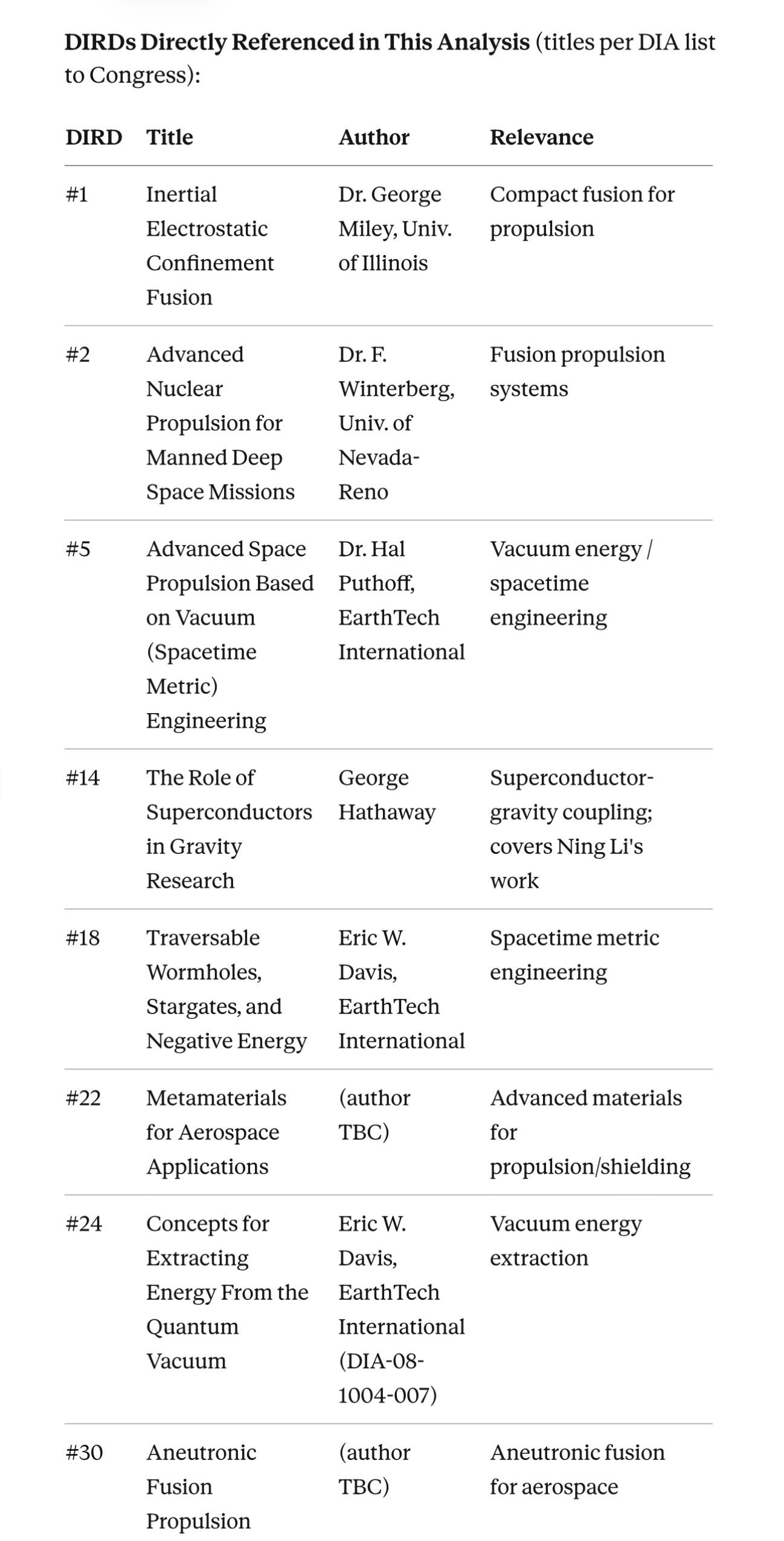
DIA FOIA Electronic Reading Room (37 released DIRDs available for download): https://www.dia.mil/FOIA/FOIA-Electronic-Reading-Room/
Davis’s Six DIRDs (listed on EarthTech International website with DIA document numbers): DIA-08-1011-001, DIA-08-1004-001, DIA-08-1004-007, and three others
FAS.org Archive of DIA-Congress Letter: https://irp.fas.org/dia/aatip-list.pdf
D. Commonwealth Fusion Systems / REBCO Superconducting Magnets
Company: Commonwealth Fusion Systems (CFS), Devens, Massachusetts
Founded: 2018 (MIT Plasma Science and Fusion Center spinoff)
Total Capital Raised: Nearly $3 billion
Key Achievement: World-record 20 Tesla large-scale HTS magnet, demonstrated September 5, 2021 at MIT PSFC
Magnet: REBCO (rare-earth barium copper oxide) high-temperature superconducting tape, no-insulation design, 20,000 lbs, 267 km of tape
DOE Milestone Validation: September 30, 2025 — full-scale toroidal field (TF) magnet validated by independent DOE panel; $8 million Milestone award (largest in program)
Next Milestone: SPARC first plasma targeted 2026; ARC power plant grid-connected early 2030s
DOE Energy Secretary Visit: Chris Wright visited CFS Devens HQ, September 2025
Peer-reviewed confirmation: Detailed results published in multiple papers; validated by DOE magnet experts from national labs
CFS Website: https://cfs.energy
E. Ning Li / AC Gravity LLC / Superconductor-Gravity Research
Researcher: Dr. Ning Li (January 14, 1943 – July 27, 2021), Chinese-American physicist
Institutional Affiliation: Center for Space Plasma and Aeronomic Research (CSPAR), University of Alabama in Huntsville
Key Publications:
Li, N. & Torr, D.G. “Effects of a gravitomagnetic field on pure superconductors,” Physical Review D, Vol. 43(2), pp. 457–459 (January 15, 1991)
Li, N. & Torr, D.G. “Gravitational effects on the magnetic attenuation of superconductors,” Physical Review B, Vol. 46(9), pp. 5489–5495 (September 1, 1992)
Li, N. & Torr, D.G. “Gravito-electric coupling via superconductivity,” Foundations of Physics Letters, Vol. 6(4), pp. 371–383 (August 1, 1993)
Li, N. et al. “Static Test for a Gravitational Force Coupled to Type II YBCO Superconductors,” Physica C, Vol. 281(2–3), pp. 260–267 (1997)
Company: AC Gravity LLC, founded 1999, Huntsville, Alabama
DoD Grant: $448,970 (2001); grant period ended 2002; results never made public
Security Clearance: Top Secret (obtained after founding AC Gravity)
Disappearance: No public papers or appearances after 2003 MITRE Corporation conference
Confirmed Activity: Continued working for DoD until 2014 accident caused permanent brain damage (confirmed by son George Men, 2023)
Death: July 27, 2021
DIA Assessment: A 2010 DIA report critiqued Li-Torr models, noting predicted external effects were ~20 orders of magnitude smaller than claimed
FOIA Request Filed: MuckRock FOIA for AC Gravity grant documents — https://www.muckrock.com/foi/united-states-of-america-10/department-of-defense-grant-for-ac-gravity-llc-2001-department-of-defense-under-secretary-of-defense-for-intelligence-and-security-135082/
Investigative Question for Congress: What were the results of AC Gravity’s $448,970 DoD-funded antigravity research? Under what authority were the results classified? Where did the research continue after 2002?
F. ARPA-E BETHE Fusion Program
Program: Breakthroughs Enabling THermonuclear-fusion Energy (BETHE)
Announced: November 7, 2019
Awards Announced: 2020 — $32 million across 15 projects
Agency: Advanced Research Projects Agency–Energy (ARPA-E), U.S. Department of Energy
Program Director: Dr. Ahmed Diallo
Builds On: ARPA-E’s ALPHA program (Accelerating Low-Cost Plasma Heating and Assembly)
Three Research Categories: (1) Concept Development; (2) Component Technology Development; (3) Capability Teams
Notable Project: WHAM (Wisconsin High-field Axisymmetric Mirror) at Univ. of Wisconsin-Madison
Press Release: https://arpa-e.energy.gov/news-and-media/press-releases/department-energy-announces-32-million-lower-cost-fusion-concepts
G. Nolan/Vallée UAP Materials Analysis
Peer-Reviewed Paper: Nolan, G.P., Vallée, J.F., Jiang, S., & Lemke, L.G. “Improved instrumental techniques, including isotopic analysis, applicable to the characterization of unusual materials with potential relevance to aerospace forensics,” Progress in Aerospace Sciences, Vol. 128, pp. 100788 (2022). DOI: 10.1016/j.paerosci.2021.100907
Instruments Used: NanoSIMS 50L (Cameca, Stanford Shared NanoSIMS Facility); MIBI (Multiplexed Ion Beam Imaging)
Key Findings: Ubatuba magnesium samples ~30% deviation from terrestrial isotope ratios; one sample of alleged magnesium proved to be near-pure silicon; Council Bluffs material consistent with non-industrial carbon steel
Nolan Quote: “If you find a metal where the isotope ratios are changed far beyond what is normally found in nature, then that material has likely been engineered.”
Searchable at: https://www.sciencedirect.com/science/article/abs/pii/S0376042121000907
H. The Huntsville Nexus — Personnel and Institutional Convergence
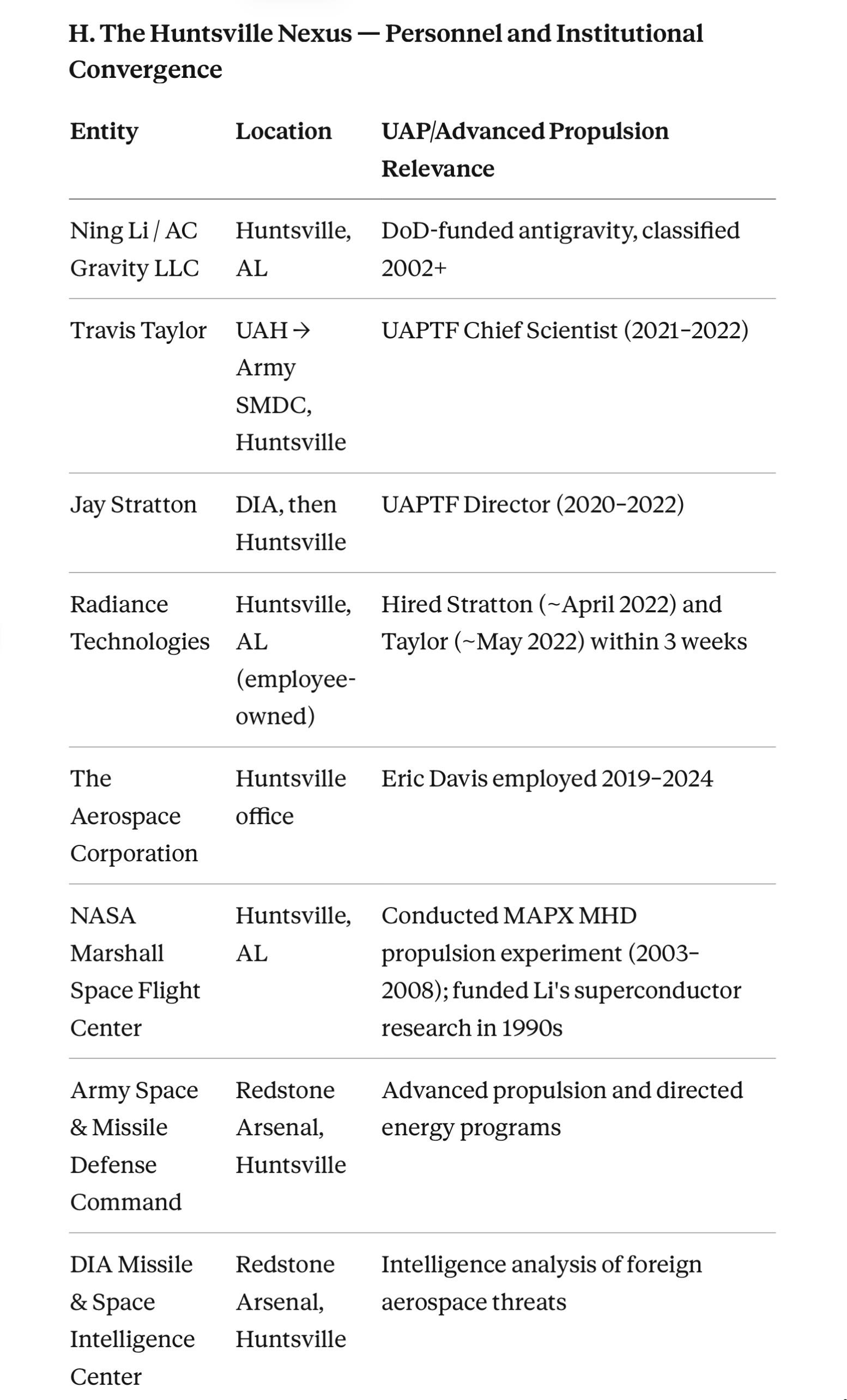
Investigative Question for Congress: Why did the UAPTF Director and Chief Scientist both move to the same small, employee-owned Huntsville defense contractor within three weeks of each other? What contracts does Radiance Technologies hold related to advanced propulsion or UAP-adjacent technology?
I. The Wilson-Davis Memo
Date of Alleged Meeting: October 16, 2002
Location: Outside EG&G Special Projects building, McCarran International Airport, Las Vegas, NV
Participants: Dr. Eric W. Davis and Vice Admiral Thomas R. Wilson, USN (Ret.), former Director, DIA
Length: 15 pages handwritten notes
Leaked: April 2019, from estate of Dr. Edgar Mitchell (d. February 4, 2016)
Congressional Record Entry: Rep. Mike Gallagher, May 17, 2022, House Intelligence Committee hearing on UAPs
Wilson Denial: Categorical — “pure fiction” (multiple statements 2008–2024)
Davis Authentication: Confirmed notes “leaked from Ed Mitchell’s estate” (November 2019, New York Post); referred to “our meeting” and “my interview notes” (September 2024, Facebook)
Elizondo Statement: “The memo is legit. Confirmed to me by someone who was there” (2024)
Oke Shannon Partial Confirmation: “What was said about him in these notes is accurate” (to journalist Billy Cox)
J. Key Davis Public Statements — Dated and Sourced
K. FOIA Requests and Investigative Actions Recommended
DARPA PUMP integration: Request all documents connecting DARPA PUMP program (HR001123S0044) to any classified propulsion programs or UAP-related research
AC Gravity results: Request complete grant documentation and final report for AC Gravity LLC DoD grant ($448,970, 2001) — determine classifying authority
Ning Li continued work: Request all DoD contracts or employment records for Ning Li from 2002–2014
Pais HEEMFG test results: Request complete NAWCAD test reports for High Energy Electromagnetic Field Generator experiments (FY2017–FY2019, $508,000)
DIRD #14 classified annex: Determine whether the released version of “Role of Superconductors in Gravity Research” was redacted or if classified annexes exist
Radiance Technologies contracts: Request listing of all Radiance Technologies contracts related to advanced propulsion, electromagnetic systems, or UAP-adjacent research since 2020
CFS/DARPA connection: Determine whether CFS REBCO magnet technology has been evaluated for propulsion applications beyond fusion energy containment
Integration authority: Identify any SAP, USAP, or waived program with oversight of multiple advanced propulsion subsystem programs across DOE, DARPA, and Navy
This appendix will be updated as additional documentation is identified. Corrections, additions, and independent verification are welcomed at ASIRP.

Gene, this is truly outstanding work!
Thank you for highlighting HRL. The GM connection is important and people are missing the significance.