


Transit workers’ union worried Halifax micro-transit plan could cannibalize bus routes
Council voted unanimously on Tuesday to approve the micro-transit plan

Halifax’s micro-transit plan, including its pilot project in Lucasville, may have received a green light from council but the local transit worker’s union wants them to pump the brakes.
Patricio Garcia, the president of Amalgamated Transit Union (ATU) Local 508, which represents HRM’s transit workers, says he’s worried micro-transit won’t have the impact council’s looking for.
Council voted unanimously Tuesday to approve the plan.
“The problem I have is that micro-transit, as has been proven in various other ATU properties, is it’s unsuccessful and costs the city more in the long run,” Garcia told The Chronicle Herald, citing an ATU study that examined micro-transit in the United States.
The stated goal of HRM’s micro-transit plan is not to remove traditional transit routes. Instead, micro-transit — an on-demand service using mid-sized vehicles like vans to meet local passenger needs — would be used to bridge transit service gaps in HRM.
“My fear is, and it was mentioned to me when they first took a look at micro-transit, they mentioned Route 65 (Caldwell / Caldwell Express) would be the first route looked at to eventually be changed into the micro-transit model,” said Garcia. “What happens to Route 83 or the 88, the 61, the 68, some of your lower-ridership routes?”
Garcia said he’s worried these routes could be cannibalized by the micro-transit plan while increasing the cost per rider.
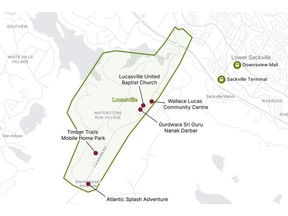
Initially, as outlined in a report prepared by staff, the plan would be to trial micro-transit in Lucasville as a proof-of-concept pilot before expanding to other underserved communities like Fall River, Cow Bay and Eastern Passage, Sambro West and Sambro East.
The plan is then to evaluate gaps and opportunities for micro-transit in urban and suburban areas, which is where Garcia’s worries stem from.
“Micro-transit for access to cultural and historic sites, off-peak service in low-density employment centres, and flexible service to replace conventional routes with low ridership will be evaluated and extended as resources allow,” reads the report.
Garcia said council should be focusing on meeting expectations for existing transit services.
“They are not looking at the actual problem they have, which is that transit worked when I started in 2007 but doesn’t work now. It doesn’t serve the citizens of this city well.”
Giving micro-transit a chance
Coun. John Young (Hammonds Plains – Upper Hammonds Plains – Lucasville – Middle and Upper Sackville) said council needs to see the results of the pilot project in Lucasville, which is in his district, to better inform their decisions.
- Advertisement 1Story continues below


Not exploring micro-transit because of cost or the needs of other services is an excuse, he said.
“To me, that’s another reason for not servicing a community for years. Lucasville is 199 years old. It’s a historic Black community that’s without service, and has been without service, for that amount of years. My thing is if it’s about money, look for another funding project,” said Young.
“It’s a pilot project. If you don’t do it at all, it results in nothing (happening) and something has to be done, especially in that community.”
Lucasville was chosen for the pilot because of its lack of public transit, its proximity to transit hubs at Downsview Mall and the Sackville Terminal and cost effectiveness. Depending on if council chooses to run the service through a vendor or in-house, the cost ranges between $1.7 million and $2.3 million.
If successful, the model used in Lucasville could be scaled to other communities across HRM.
“This could be a blueprint for other communities who are facing the same situation, which is a lack of transit and trying to hook up to it in some ways,” said Young, adding that it could open other doors for Lucasville.
“Micro-transit is an opportunity to see the viability of having transit in the community. If it works, and the pilot is successful, the opportunity to add Access-a-Bus to the community would do really well.”
The pilot is being considered for next year’s budget.
- Advertisement 2Story continues below


