
I finally spotted them in a windowless room below deck, the uncategorizable celebrities who had persuaded dozens of people like me to set sail in the Caribbean just to be in their presence. I had never had a desire to go on a cruise, but this one I couldn’t miss. The room—a conference space that wouldn’t have been out of place in a suburban Hampton Inn—was packed to the gills, with cruisers waiting patiently for signatures and chats from a series of characters they knew well. Their names might not mean that much to you: Queen Sandra. Courtney and Todd, aka Toddney. Troy Robertson, aka Troyzan. But to us, they were everything. Despite a step-and-repeat available for selfies, photos were happening everywhere, in corners, in crowds, in the hallway. There were multiple iterations of “I can’t believe I’m meeting you!” There were hugs and at least a few tears. We were in the presence of gods.

A few years ago, I would have had no business here. When Survivor—the reality competition series that outwitted, outplayed, outlasted them all—first aired on May 31, 2000, I was 24 years old and did not own a television. But I was in the minority. Almost immediately, it was a phenomenon. Some 57.3 million people watched the first season finale. Forty-nine seasons have followed, filmed across the world: in the desiccated Australian Outback, in the humid and cruel Amazon, in the punishing jungles of Nicaragua and Guatemala. Island locations like Vanuatu and Micronesia brought beautiful beaches, but also downpours that left players with pruned feet and hands for days. Toenails fell off. Sunburns and insect bites festered. Fights over camp—the structures, the supplies, the coconuts—helped viewers decide who was good and bad, up and down. You could play an almost completely unphysical game, like the “Queen” Sandra Diaz-Twine—the one right in front of us on this ship—and still be a two-time Sole Survivor, the $1 million winner of it all. Or you could physically maneuver your way to the end, like Season 10 winner Tom Westman, a firefighter in my own Brooklyn neighborhood, who sadly was not here. However you did it, you had to survive for 39 days in the elements and stay sharp.
A good chunk of the hundred-odd people with me for this Survivor gathering at sea had spent the past 25 years following every in and out of this show. I was an interloper by comparison. I’d spent the better part of 2024 watching every Survivor, from the first season in Borneo to Fiji (and Fiji, and Fiji, since the show shoots there exclusively these days). In that time, being a Survivor obsessive had become a small to medium part of my identity, depending on the day. I fell in love with some players and abhorred others. I forgot hundreds of them. I developed strong feelings about the show before it entered the more recent, shorter arcs of the “new era,” post-Season 40. I went from having a mild crush on host Jeff Probst to respecting him to being annoyed by him. I didn’t watch anything else, and I wanted to talk about Survivor all the time. Often, I did.
And now here I was, confronted with these people in real life, appropriately trapped with them on the ocean. One especially daunting celebrity—at least to me—soon appeared. Even if you missed that first season of Survivor, even if you weren’t alive during that season, you probably heard at some point of the inaugural Sole Survivor, Richard Hatch, who shocked viewers with his perpetual nudity and his villainous reputation. While the show had been conceived as a social experiment with some physical challenges thrown in, Hatch showed practically out of the gate that you could triumph without being the biggest or baddest—you just had to be calculating. He made for great TV, and his triumph over runner-up Kelly Wiglesworth created a villain-vs.-hero dynamic that has infused Survivor ever since. To my genuine surprise, he now ambled about in the crowd, towering over all of us. (He is so tall!) Hatch hadn’t been in the promotional materials, perhaps for good reason: His second go at Survivor ended in a cloud of controversy that was only intensified when he was convicted of tax evasion. Later, when I spoke with him, it was a slightly out-of-body experience. I braced for confrontation. He put me at ease and was bracingly candid. I asked: How has Survivor affected your life? “Really negatively, for the most part,” he answered, deadpan. It wasn’t the last thing he told me.
Hatch will not appear on the show’s landmark Season 50 when it finally debuts on Wednesday, although he would have been happy to return. But the new season will surely be driven by a tension that has captivated one of pop culture’s most dedicated fan bases.
Early in its run, Survivor began to cast its first All-Stars seasons of returning players: fan favorites, villains, baddies, souls whose dreams had been crushed, cruelly, too early in their seasons. (In fact, the first All-Stars cast arrived with Season 8, when Hatch played for the second time.) These seasons didn’t just bring the promise of second chances. They reunited viewers with the most memorable players and rebuilt those bonds too. Even as Survivor evolved over the next two decades—as casting for archetypes (the farm boy, the mom, the martyr, the nerd, and, yes, the racist or homophobe) gave way to the casting of lifelong fans who have studied gameplay strategy for 20 years—the periodic reunion episodes kept watchers grounded in the old. With Season 50, the formula will be truly tested, as players of the very old school will go up against some of those players who started as fans and arrived on the show not to test out a new form of television, not only to win a million bucks to buy their mom a house, but to prove to themselves that they could do it. It may well be nothing less than a reckoning with the soul of the show.
On this ship, I was having a reckoning of my own. I was all in on Survivor, but I had kept a certain distance from the more ardent corners of the fandom and cast myself as an observer of the proceedings here. By the time I left, I understood better why Survivor endures than I ever could have bingeing season after season. If a trip to Fiji changes you, I had no idea what this one would do to me.
The Mariner of the Seas is not one of Royal Caribbean’s newer, flashier vessels. It’s part of an older fleet, the Voyager class, built in 2003, a workhorse that can hold about 3,000 passengers and runs a budget-friendly route from Galveston and New Orleans through the Western Caribbean. But this ship has recently been amped up—it was refurbished in 2023—fitted with giant waterslides, an escape room, and a hibachi restaurant. It’s great for families and friend groups, as well as maybe lovers who want to hook up in a compact stateroom. As I found out in late July, it is definitely perfect for a mini-convention of a hundred-odd Survivor fans who were willing to pay a premium to nerd out on their favorite show.
I had brought along with me my 13-year-old daughter, who one night had said to me, “We should go on a cruise sometime.” She had no idea I’d booked the Survivor voyage. She’s not a fan of the show, so the two of us had different objectives. Hers was to ditch me as soon as possible and get to the ship’s Teen Club, where she could connect with kids she’d found on TikTok and stay out until 1 a.m., the ship’s curfew. I was there for the “Postgame Cruise: 2nd Edition,” a boutique bundle of special programming with former Survivor players featuring ship-based games, Q&As, and that frenzied meet and greet. (“Postgame 1st Edition” had been devoted to the show’s CBS sibling Big Brother.)
There was very little precommunication about what would happen on this cruise. To the extent there was, it occurred via a Facebook group. There were posts announcing a door-decorating challenge and urging us to bring outfits for a look-alike contest. I missed both—I’m barely on Facebook. Fortunately, as I discovered soon enough, I was in the minority with this problem. The Survivor crowd is still very much on Facebook, and they were ready to participate.
To be clear, I cannot claim I’m not one of these people. I’ve evangelized friends into joining the cult. I have logged into chat groups and apps devoted to breaking down the gameplay. I have Survivor merch. I’ve considered auditioning. But let’s be real: I am never going to audition for Survivor, let alone be cast in it. I needed to stop acting like an exception as a Survivor fan and accept that I’m just part of this—a massive global community that I may have nothing else in common with besides this one reality TV show that’s been airing for 26 years. I needed to join.
Young adults who’ve been fans from the beginning have since sprouted grays and guts during the time they’ve been watching Survivor; kids who started watching in 2000 have passed the age requirement to apply to play. These are the OGs, the steadfast, tried-and-true fans who have seen the show evolve slowly, over years and years. Then there are the ones like me: the pandemic watcher, the expert binge-watcher, who had a crash course in 40-plus seasons and came out at the end with the fervor of the converted. Having missed the opportunity to discuss the show as it aired live, we doubled down and preached about it to all who would listen.
As part of this, I have a futile habit of asking Survivor fans to name their favorite season. This is futile because, unless the seasons are all extremely fresh in your mind, you can barely remember where and when things happened, who was on what, or when it aired. And with many fan favorites playing the game three, four, or even five times, it can be tough to recall, say, just which Boston Rob season was your favorite. Most players—including those who were strong enough to make it to final tribal council before coming in second—slip into the recesses of our memory. Even winners of less-memorable seasons can fade away fast.
Still, I ask, always in the hopes that someone will say their favorite season is my favorite season: Season 37: David vs. Goliath, aka the Mike White season, which was filmed in Fiji and aired in 2018. Three of the season’s players, including White Lotus creator White and my favorite player of all time, will appear on Season 50.
A few hours after setting sail on our cruise, my daughter having run off as promised, I had my chance. As I waited at the elevator bay to rise up seven decks to the Ellington Lounge, a space that had a kind of Star Trek command-bay vibe with a panoramic view of the sea, I noticed that three women waiting with me had cruise lanyards like mine. I should have clocked their outfits—they were dressed as their favorite players for the contest—but it turns out many Survivor costumes look a lot like what people would wear on a cruise anyway.
I popped the question to the multigenerational crew, but after a bit too much awkward hmm-ing, I gave up and switched gears, asking where they were from. All three: Kentucky. They were family. I told them of my love for their state: the bourbon trail, the horses, the Hot Browns, the TV show Justified. They were appreciative of my love. Then, one asked where I was from.
“Brooklyn.”
“Oh, I’m sorry,” she said. (For the duration of the cruise, I made sure to highlight my more palatable Midwestern roots to everyone I talked to. I became “Hillary, originally from Cincinnati.”)
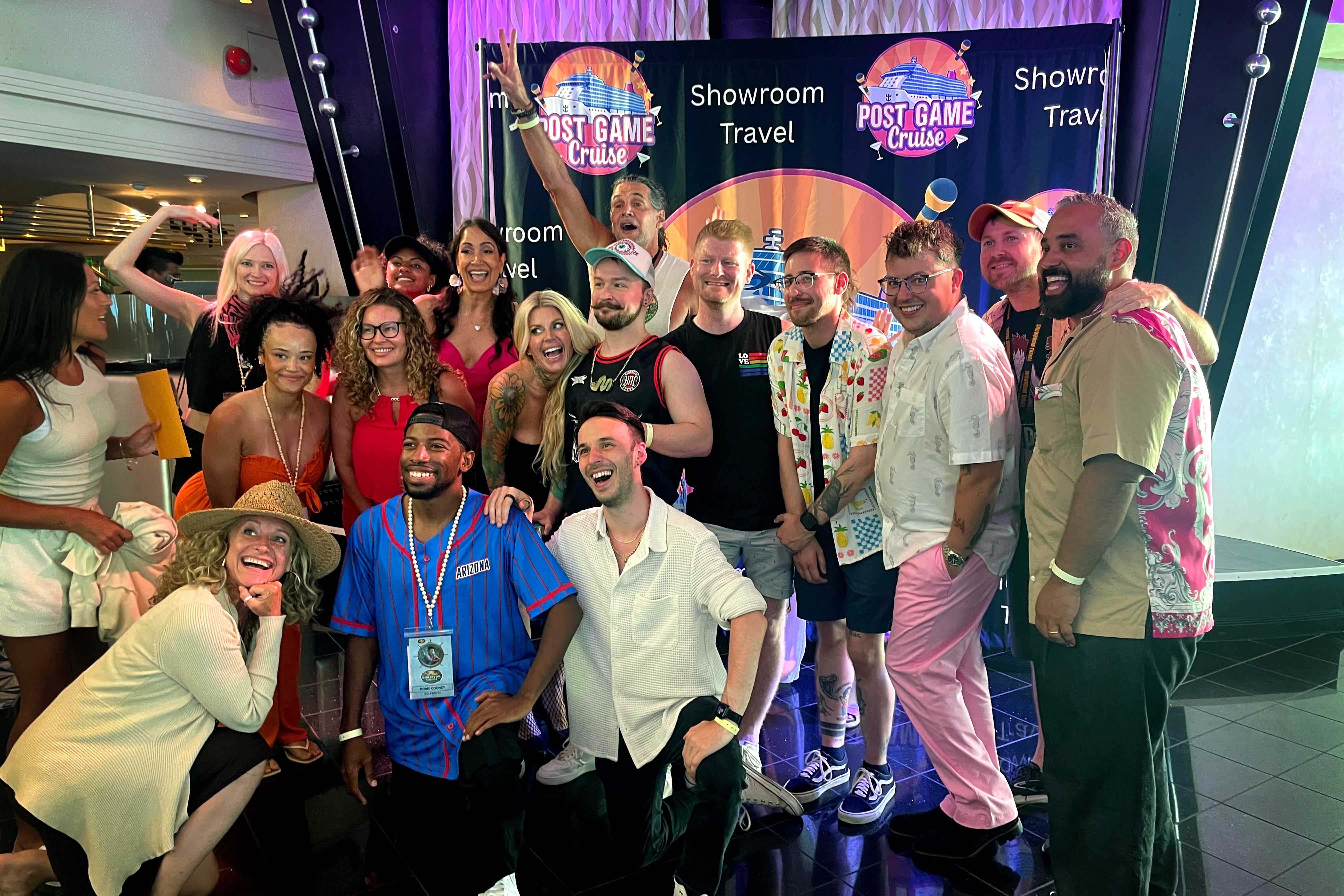
We eventually arrived upstairs to a splendor of Survivor look-alikes. I was surprised that so many were highly recognizable: There were two easily spotted Carolyns, likenesses of Carolyn Wiger, eccentric and delightful Season 44 finalist and erstwhile Traitors star. There was an excellent “Coach” (in real life, Benjamin Wade), the three-time never-winning player known as the “Dragon Slayer” for his signature warrior stance. (He’ll return for Season 50.) There was another instantly recognizable three-time player, Jerri Manthey (clad in cowboy hat and halter top), which was great because the actual Jerri Manthey was on the cruise. And, naturally, there were some Boston Robs, representing with baseball hats and attitude, but none quite as cute as the original. One brave soul came as Shambo, a single-season player from 2009 whose mullet is seared into the memory of every fan. “Eye of the Tiger” blared in the background as Jerome Cooney (aka “Rome” from Season 47) called up each look-alike to dazzle us with their wordless impressions.
The Survivor contingent reflected the universal appeal of the show itself. Although it took a certain would-be “woke” turn after 2020, instituting some important changes (a more diverse cast) and some misguided ones (too much feelings talk), Survivor has maintained ratings numbers strong enough that we can conclude that the viewership crosses political, social, and even international lines. I met a gaggle of gay male fans who love Season 15 (China) winner Todd Herzog—many of them paid homage with their costumes, donning his signature headwrap and red shirt. “He’s an icon!” one told me. (Todd, with his China season-mate and bestie Courtney Yates, was also one of the 14 former players we could hang with as part of our cruise package.) I met teachers from West Virginia, a marketing executive from New Jersey, a professor of public health from Indiana, a wellness consultant from Maryland. I met two best friends who live in different states but had met up specially for the cruise. (“I get to see my best friend, and my husband has to parent solo!” one trilled.) Other cruisers came from Minnesota, Pennsylvania, and even Australia. The only overtly political conversation I had was about the governor of West Virginia. I did not hear great things.
There weren’t too many kids among us, but one of them won the look-alike contest, which was adjudicated by applause: 10-year-old Deric, on the cruise with his mom and grandma, who was dressed as three-time player and one-time winner Jeremy Collins. (Why Jeremy? “His faces. And how competitive he is,” Deric told me.) Jeremy was actually supposed to be on the cruise, but rumor had it he’d had to drop out due to conflicts with his appearance on The Traitors, the current post-Survivor holy grail of opportunities to keep your celebrity status, and chance at big bucks, alive.
It was clear even from a glance around that the “Postgame Cruise” drew not just fans but families and friend groups and best friends who had bonded, or strengthened their bonds, over Survivor. It’s funny, because the life lessons to extract from the show aren’t really what we want our kids to learn, and the qualities that make winning players aren’t those we look for in friends: lie, deceive, betray, do anything you must to win. Nice guys don’t always finish last, but they only very occasionally win. (I’m thinking about you, Season 13 Sole Survivor Yul Kwon!) I find it hard to root for the Jonny Fairplays of the world; Jonny was an Eddie Haskell type who famously lied and said his grandmother had died to get sympathy on Season 7. But the villains’ darkness makes the virtuous, the socially adept, and the resourceful shine and gives us all plenty to deconstruct at our watch parties and in our group chats. As challenges come down almost to good vs. evil, we find earnest connection over players’ manipulation and cravenness, thinking we may all be better people than them and possibly wishing we were not.
Could I win Survivor? This is the question that bonds all of us, whether or not we say it out loud.
Later, after that ecstatic first meet and greet, I settled into a wood-paneled conference room, which had an added benefit: quiet. Across from me, surreally, was the surprise cruiser himself: Richard Hatch.
The head of the “Postgame Cruise” told me later he’d kept him out of the promotional materials deliberately, unsure whether he’d be a draw or a put-off. With this crowd, there was no question: He was a draw.
“I always get a warm welcome,” Hatch told me. “People either love me or love to hate me, but the reason they do is because they recognize how I played the game and what I’ve done for the game. The game is still being played the way I played it, and people appreciate that. And then, of course, when they meet me, they’re human, and I’m human, and it’s all good. These kinds of things—when I get invited to do them—they’re great.”
When Hatch says “these kinds of things,” boy, are there a lot of them. Despite the Survivor players on the cruise being on wildly different seasons, some had met before. If you’re a popular enough player, you can just about make a career off your appearances: You might, like cruiser and Season 32 winner Michele Fitzgerald, end up on MTV’s The Challenge or, even better, The Traitors. You might, like Sole Survivor and legend Parvati Shallow, write a memoir that is in large part about how playing Survivor has changed your life or, like Rob Cesternino, run a very successful podcast network devoted to reality TV, including, of course, Survivor. You can cruise or be a special guest at watch parties for an appearance fee. You can show up at charity events, often also for a fee, and feel good about yourself. You can charge for Cameo videos. (I got one of Parvati for my 50th birthday encouraging me to audition for the show.)
Each opportunity is potentially remunerative, if sometimes marginally so. It’s also reinforcing: You, as a former Survivor player, are a famous person. People you do not know love you. They want to tell you they love you. They want to make you dinner, and send you emails, and tell you that this one thing you did or said that you don’t even really remember changed their life. They want to explain to your face why you should have won. And they let you process and reprocess what was likely the hardest thing you’ve ever done in your life: exist with a bunch of strangers, in front of a bunch of cameras, in the wild for a few weeks without showers, real food, or shelter, while also completing ridiculous physical challenges in punishing heat and chilling rain.
Villain or not, Hatch had been around since the beginning, and so he has been on the circuit the longest. And he was ready to dish. He was especially withering about how Survivor has evolved as host Jeff Probst, who had also become my occasional show enemy, garnered more power as an executive producer.
“He doesn’t get the game,” he said. “So every change that he made that took the game out of the players’ hands and made it random”—as in certain player advantages, like extra votes and immunity idols—“undermine what Survivor is. And every time he stepped in and made an extra speech, that was less time for the participants who were new to get known by the viewers, which is how the viewers connect. It’s why the show succeeds, because you understand who the people are, and you wonder what would you do, and you think about yourself, and why did she do that, and why would he do that? Those kinds of things.
“So, forgetting any of the awful things that Probst has done to me personally, he’s also affected the game negatively. I think it’s gotten better, so I’ll give them credit. They’ve stopped some of the crap,” Hatch said.
Indeed, Probst, while the heart and soul of Survivor, has never been a contestant. Nor does he really participate in the extensive Survivor economy that’s evolved to keep fan favorites rooted in fame. At a Q&A on the cruise, one former player noted, with a guffaw, that Probst had no experience actually playing the game of Survivor, the implication being that while he has hosted and designed and produced the game for 50 seasons, he really has no idea what it’s like to actually survive. Later, at my sit-down dinner with some other cruisers, one mentioned that he’d been told there’d be another big surprise, à la Hatch, during the cruise. “I think Probst is coming! He’s gonna arrive on that helipad!” he said. I almost spit out my food. There was no way Jeff Probst was joining our little three-and-a-half-day cruise on an old ship docking for one day in the tourist trap of Cozumel, Mexico. We were small time, even if it was big time for us.
As much as I loved gossiping with Hatch—and I too dropped my lingering reservations about him as he walked me through his post-Survivor legal sagas and told me about his uncompensated side hustle mentoring wannabe players—I found it harder to crack other former players.
I asked them, in so many words: Surely, fans are annoying? Nope: They love the fans! Aren’t some of these post-Survivor events kind of ridiculous? No! They’re fun—especially this cruise. Jerri Manthey told me it was her favorite. “I’m always amazed that people still care, and I’m even more amazed that people remember me,” she said, totally earnestly. (She gave me her phone number. So did Hatch and numerous other players: “Just text me if you have more questions!”)
Wasn’t it tiresome reliving their 15 minutes of fame over and over again? Absolutely not. Former player Stephen Fishbach, who was not on the cruise but whose recent novel Escape! is about a Survivor-style reality show, later explained it to me for a piece I wrote about his book: “You’re hanging out with all the other reality players, and all you’re talking about is how you should have won your season or how they should have won their season or what a legend they are or what a legend you are. You get to keep that glow alive while in your normal life.”
I kept thinking someone, somewhere along my cruise journey, would roll their eyes, but … nope. The instinct to roll my own left me. My challenge morphed from being one of understanding the craven opportunism of the broader Survivor economy, the sycophantic nature of fandom, to learning how to belong myself. Here I was, a fan of the show, on a ship with dozens of other fans. Where else could I find that magic I had for a few minutes with Richard Hatch? Turns out it was back at the Ellington Lounge.
The afternoon of our last day at sea, there was a scavenger hunt for us Survivor folks, organized by player Todd Herzog, who took it upon himself to step in and design activities where official organizers had not. I arrived at the Ellington Lounge a bit after the scheduled meeting time, not realizing that the hunt would take place across the entire ship. Most cruisers were already running around in teams, searching for buoys and statues and random pieces of artwork spread throughout the ship. Luckily for me, Carolyn Wiger and Lauren Harpe—both of Season 44—hadn’t yet set out to scavenge. Carolyn grabbed me by the arm, and off we ran.
If you are at all familiar with Carolyn from Survivor or Traitors, you know she’s unpredictable, enthusiastic, and all over the place, an absolutely lovable wild card who is always exactly who she is. She pulled me along to the ship’s top deck as we hunted for various items to take selfies with as proof of our discovery. A statue of a basketball player. A lifesaving inner tube. A specific hole on the mini-golf course. I have proof of it all on my phone: unposed, squished-eyed smiles and hysteria, bona fide laughter, hair blowing all over. We were sweating and hyperventilating and surely annoying the general population of cruisers, even if some were delighted by the sight of Carolyn.
The whole thing was a hoot: an escape into a game, a challenge we wanted to try and crush. We lost by a landslide. I immediately texted and Slacked anyone I knew who would care.
The hunt concluded with a closing ceremony back at the bar. There was palpable anticipation in the air. The ceremony had a point: Each of the 14 Survivor players on board would present a small gift—a custom Funko Pop crafted in their likeness—to the fan they’d most connected to on the cruise. When I found out this was happening, I felt extremely grateful to not be at all part of this contest. I was back to being a writer. So many fans in the room had connected with their heroes; what if the connection was stronger with someone else? What if they didn’t feel the same way about you that you did about them? A person next to me was really hoping to be called out, and was shit-talking someone else who was probably hoping too. The feel-good gameplay that had infused our other challenges had disappeared. This was as cutthroat as any tribal council on Survivor. Who would win?
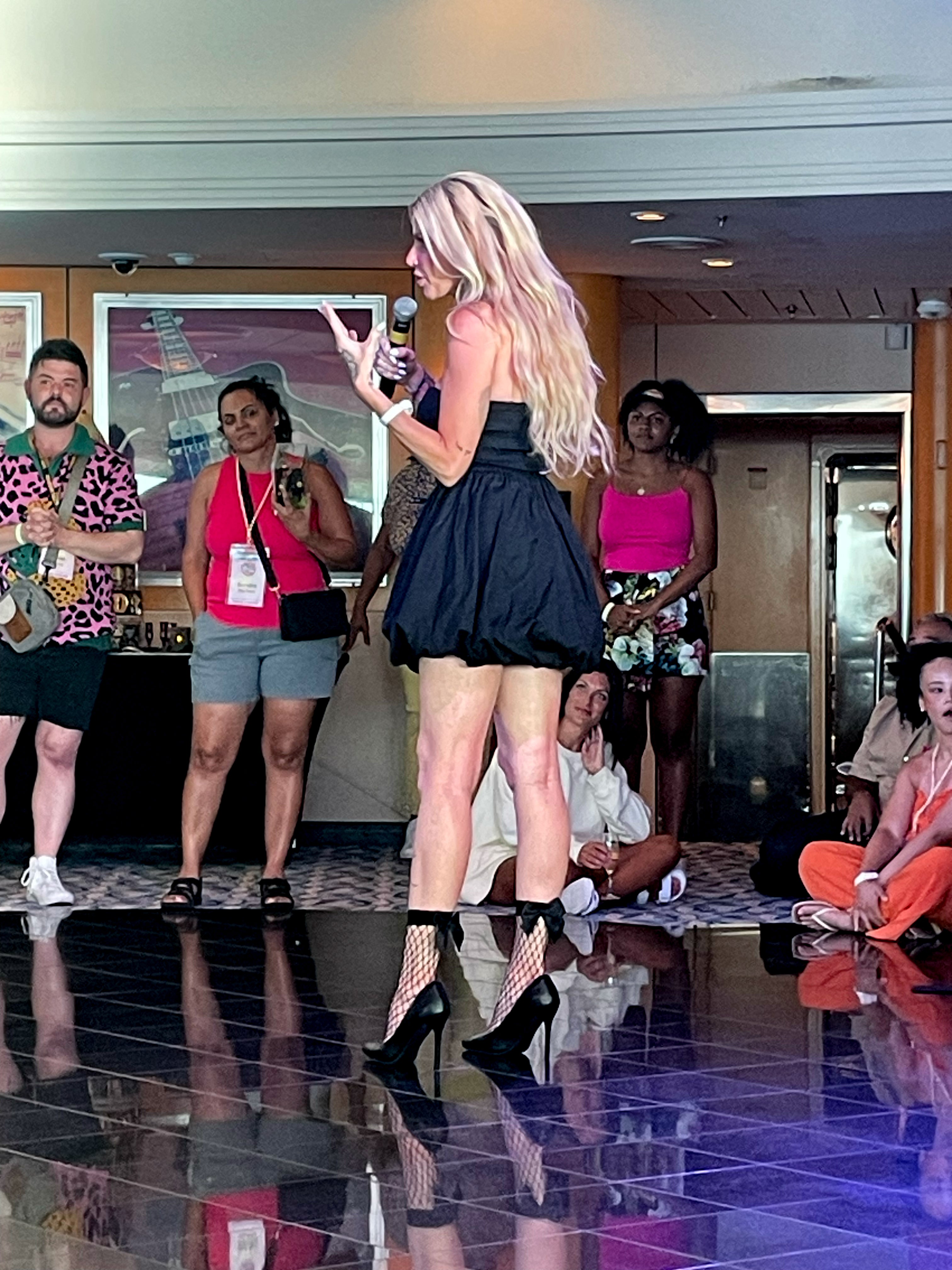
One by one, the players stepped onto a small stage to call out their winners. In most cases, the reason for the deep connection was fairly opaque to us watchers beyond “I loved that talk we had.” But then Carolyn took the stage. Teetering on her stilettos, she looked at a family of four right in front of her and was all but quivering.
She was speaking to Jaime, her husband Cory, and their kids Zander (11) and Daxtyn (14). They’d found Survivor during COVID. It was fun to watch together, but they took it deeper and used conflicts and questionable decisions made by players to learn about being good people. “I think it’s just being a parent, and it really just prompted or provoked a lot of great discussions and learning opportunities for us as a family to talk to each other about ‘Well, what would you do?’ ” Jaime told me after the cruise, when I caught up with the whole family on Zoom. “Have you ever been in an experience, had an experience like that?”
Carolyn—one of the most beloved players of the new school, if not the most beloved—called the family beautiful. (I had to agree.) She cited Jaime and Cory’s open-mindedness and how unique both kids are. She bestowed her award on Zander. Daxtyn got one from Hatch, who had sat with the family at dinner and talked with them for hours. “He’s such a smart guy,” Jaime said. “We just had such a great conversation. And it wasn’t like a Survivor player talking with us about the Survivor game the whole time—it was whatever. It was just human beings, a restaurant, anywhere, having just cool conversation about human behavior, psychology. He was telling us about his dogs.”
“And philosophy,” Daxtyn chimed in. “I can’t believe I was into that conversation that much. I was constantly just like, ‘Ohhh.’ ” Cory said it was the most talkative that he’d seen his daughter in a long time.
“I got teary-eyed when Richard gave his speech about Daxtyn,” Jaime said. “And also Carolyn when she shared about meeting the family.” If it had been allowed, Zander would have gotten a second one. “Todd was like, ‘I would’ve given mine to you, but Carolyn got you first.’ ”
Once the event wrapped, we went for our last meal. While the players rotated tables, we’d had regular tablemates for the other nights. But this evening, I was seated with a new group: a mom and daughter from Australia who’d managed to plan a U.S. trip around this cruise—not the easiest task, with the cruise leaving from Galveston, Texas—and Todd Herzog and his husband, Jess. We talked about Salt Lake City (where they live); Melbourne (where the mom and daughter live); all the places we hope to travel. I got to discuss my love of Australian TV and movies. We talked about Todd’s toy business (he’d made those Funko Pops). I asked Jess all about the mountains around Utah, where I hope to visit one day. He invited me to come. I vowed to invite everyone to my 50th birthday party. It got deeper and lighter and was the kind of night I’d been missing for one reason or another. We clicked. I’d joined in.
“Reality competition” has come of age along with Survivor—the Outstanding Reality Competition Program Emmy, which the series has incidentally never won, was added to the awards in 2003—but the enduring power of a franchise like this comes in the satellite economy of fandom and former players, the very people I was with on this cruise. And I couldn’t cast a side eye any longer: These connections were real. Some tactics on Survivor might make you question the world and people around you, but these communities are enough to turn you into a true believer in the joy of simply experiencing new things with new people. When the Season 50 opening credits first roll this week, it’s going to hit a little different. I still think they cast too many players from the “new era”—12 of the 24 hail from Seasons 41 to 49—but I had to agree with Hatch: The latest seasons have been a little better.
When my daughter and I ran into Todd and Jess, along with Courtney and her husband, Daniel, the next day at the Houston airport, we hung out for hours waiting for our flights. Royal Caribbean had told us to book our travel in the late afternoon or evening, to ensure we’d have plenty of time to disembark and get back to the city, but we didn’t need that time at all. My daughter was obsessed with Courtney, who hasn’t aged a day since her Survivor run and still has the platinum hair, waifish figure, and dry wit that made her so famous as a two-time player. She yapped; we listened and laughed. We took loads of selfies. We did our best to kill the time for each other. At this point, we weren’t even players and fans—we were just ex-cruisers, bored at the airport. We were going back home. We’d survived.
