


Work expected to start in early 2026 on Canada's new missile defence radar
The system is expected to be initially operational by 2029, a Department of National Defence spokesperson said.

The federal government will begin clearing land in Ontario early next year for a new multi-billion-dollar radar system that is supposed to detect incoming missiles over the Arctic.
The transmission site for the first Over-the-Horizon Radar (A-OTHR) will be built north of the city of Kawartha Lakes on 163 hectares of land acquired by the Department of National Defence. The system’s receiving site will be located on 288 hectares of agricultural land in Clearview Township, near Wasaga Beach.
The other locations for a second radar installation have yet to be determined.

“The Department of National Defence continues to assess siting options for the remaining transmit and permanent receive sites for the installation of the full A-OTHR capability,” Department of National Defence spokesperson Kened Sadiku noted in an email to the Ottawa Citizen
Trees on the two properties will be cut down in the first several months of 2026, followed by more extensive clearing of the land. The radar system is expected to be initially operational by 2029, according to Sadiku.
Prime Minister Mark Carney announced on March 18 that Canada would purchase the new radar system from Australia, with the British firm BAE providing the technology.
DND had already spent around $30 million with an Ottawa company to successfully create A-OTHR technology, but the Liberal government decided to instead go with the Australian system.
DND originally estimated the cost of the over-the-horizon radar would be under $1 billion. In 2024, it estimated it could be as much as $3 billion. Carney’s announcement put the cost at $6 billion, but there was no explanation for the significant increase.
Canada and Australia signed a partnership agreement on June 20 for the development of the Canadian A-OTHR capability. Stage one of the A-OTHR program will provide an initial capability by the end of 2029. “Dates for full operational capability will become clearer as the A-OTHR program progresses through Definition/Implementation,” Sadiku noted.


Over-the-horizon radar has the ability to conduct surveillance at far greater ranges than regular radar technology as it extends the distance of its capabilities by bouncing signals off the ionosphere, a layer of Earth’s atmosphere that reflects radio waves. It’s estimated that the minimum range for the radar will be 500 kilometres, while the maximum range could be more than 3,000 kilometres. The system would be able to track aircraft, missiles and surface ships.
Australia’s military currently has the Jindalee Operational Radar Network, an over-the-horizon system that can monitor air and sea movements up to 3,000 kilometres. In 2018, the Australian government announced it would spend more than $1 billion upgrading the system and BAE Australia was hired for that project.
- Advertisement 2Story continues below


Canada’s A-OTHR system is seen by the federal government as a key component of its North American Aerospace Defence Command (NORAD) modernization plan and is expected to provide advanced early warning and enable faster detection of threats. In 2023, then prime minister Justin Trudeau highlighted Canada’s original decision to move ahead with the over-the-horizon radar during a visit to Ottawa by U.S. President Joe Biden.
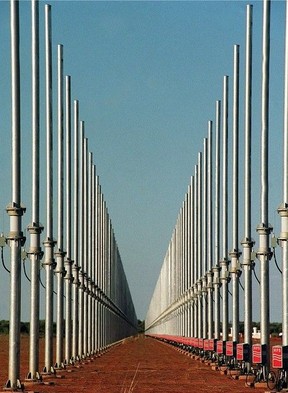
The Australian deal has been heralded as a significant win for that country’s defence industry, but has sparked criticism from officials with D-TA Systems of Ottawa.
D-TA Systems was established in 2007 and has been involved in defence projects in the U.S., Canada and other NATO nations as well as Japan. The firm has been working on over-the-horizon radar since 2011 for various DND and U.S. military projects.
“It was a slap in the face,” Dipak Roy, chairman of D-TA Systems, said after Carney’s announcement of the Australian deal. “We seem to have a problem in this country buying our own, made-in-Canada solutions. It’s a lack of national pride.”
Australian media outlets have pointed to the Canadian project as the largest defence export deal in that country’s history. Defence Minister Richard Marles told the Australian Broadcasting Corp. that the contract would significantly boost the country’s defence firms.
David Pugliese is an award-winning journalist covering Canadian Forces and military issues in Canada. To support his work, including exclusive content for subscribers only, sign up here: ottawacitizen.com/subscribe

Postmedia is committed to maintaining a lively but civil forum for discussion. Please keep comments relevant and respectful. Comments may take up to an hour to appear on the site. You will receive an email if there is a reply to your comment, an update to a thread you follow or if a user you follow comments. Visit our Community Guidelines for more information.
Conversation
All Comments