
Upwork After the Crash: Cash Cow on Sale - or Platform in Decline?
Despite record cash flow and high margins, the freelancer platform is being treated like an AI loser. Here's why the re-rating could come sooner than expected.


Due to popular demand, I am offering my stock analyses in both English and German (DE). If you would prefer to read this article in German, click here. If you would like to receive the German articles by email in the future, you can change the settings (notifications) in your Substack account here.
Almost exactly three months ago, I published my initial investment story on Upwork, the world’s leading freelance platform. The article is now available without a paywall:

The timing of this article seemed to be quite good. It was published when UPWK 0.15%↑ shares had just begun to recover at a price of $18, and by January 26, 2026, they had risen to nearly $23 - an increase of around 30% since I bought them in November.
Then, the Q4/2025 figures were published. The market drastically repriced the stock. As a result, Upwork crashed below $13 - a 35% drawdown since the beginning of the year.
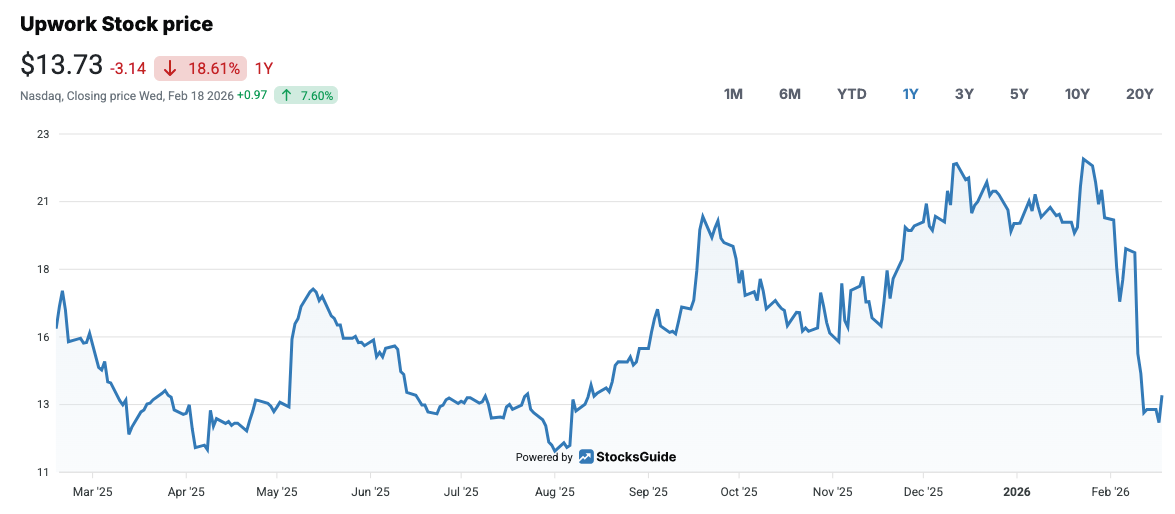
Even though Upwork had a remarkably strong year in 2025 in terms of operations, so why did this crash occur?
Because the stock market evaluates not the past, but the next two to three quarters. And that is precisely where, after Q4, some somewhat opaque figures need to be assessed: the customer base is weakening, the enterprise business is undergoing restructuring, and Q1 guidance suggests a decline in business compared to Q4 – albeit with very high profitability at the same time.
Q4/2025 in figures
In Q4 of 2025, Upwork generated $198.4 million in revenue, a 4% year-over-year increase. For the full year, revenue was $787.8 million, a 2% increase over the previous year.
Gross services volume (GSV) increased slightly as well. In Q4, GSV amounted to $1.02 billion, up 3% year-over-year. For the full year of 2025, Upwork reported a GSV of $4.03 billion. This signals that, after a period of weakness, volume is slowly returning to growth, representing an increase of 1% in 2025.
Profitability and cash flow development remain particularly impressive. Upwork now not only delivers “adjusted” results, but also generates noticeable real cash. In the fourth quarter, the company achieved adjusted EBITDA of $52.9 million, corresponding to a margin of 27%. For the full year of 2025, adjusted EBITDA totaled $225.6 million, corresponding to a margin of 29%. Free cash flow was $57.3 million in the fourth quarter and $223.1 million for the full year. This was 60% more than the previous year, representing a remarkable FCF margin of 28%.
At the segment level, however, the picture is mixed. The Marketplace business with smaller customers continued to grow, generating $171.4 million in revenue in the fourth quarter, a 5% year-over-year increase. The Enterprise segment, on the other hand, remained under pressure due to the transition to the “Lifted” platform (more on that later) and generated $27.1 million in revenue for the same period, a 3% decline. For the full year of 2025, Marketplace revenue increased to $682.9 million (a 3% increase), while Enterprise revenue decreased 2% year-over-year to $104.9 million.
Overall, this sounds like a solid result. However, the market has latched onto one figure that is extremely important psychologically in a platform model such as Upwork’s: the number of active customers.
The problem: Active customers are falling – and Upwork is accepting it
The company reported 785,000 active customers at the end of the year, down from 832,000 the previous year. This represents a significant decline of 6%. This type of metric immediately causes many investors to extrapolate downward. This better explains the price slump after the figures than any margin.
It’s important to know that: Upwork emphasizes that this decline is due not only to weak demand but also to a deliberate portfolio streamlining. CFO Erica Gessert attributes weak customer development in the fourth quarter to a decrease in “low-value, high-volume contracts.” In other words, there were fewer small contracts, which may bring in many customers, but they do not necessarily deliver quality or recurring revenue. This sounds reasonable to me. Because at the same time, GSV per active customer increased to $5,129 (a 7% YoY increase) in Q4, and average contract volume rose 10% YoY.
It’s a classic trade-off: You accept fewer customers if they are “better.” The stock market usually loves this. However, this is only the case as long as the customer base does not erode significantly.
That’s why a particularly important sentence in the earnings call from CFO Erica Gessert, which many investors probably overlooked, stands out:

