1


Mark Hearld's (b. 1974) collage art style: drawing on the traditions of British decorative modernism—lithography, linocut, tapestry design—to create compositions in which forms are distilled through graphic silhouettes and enriched by crafty mark-making.


1
100% Upvoted
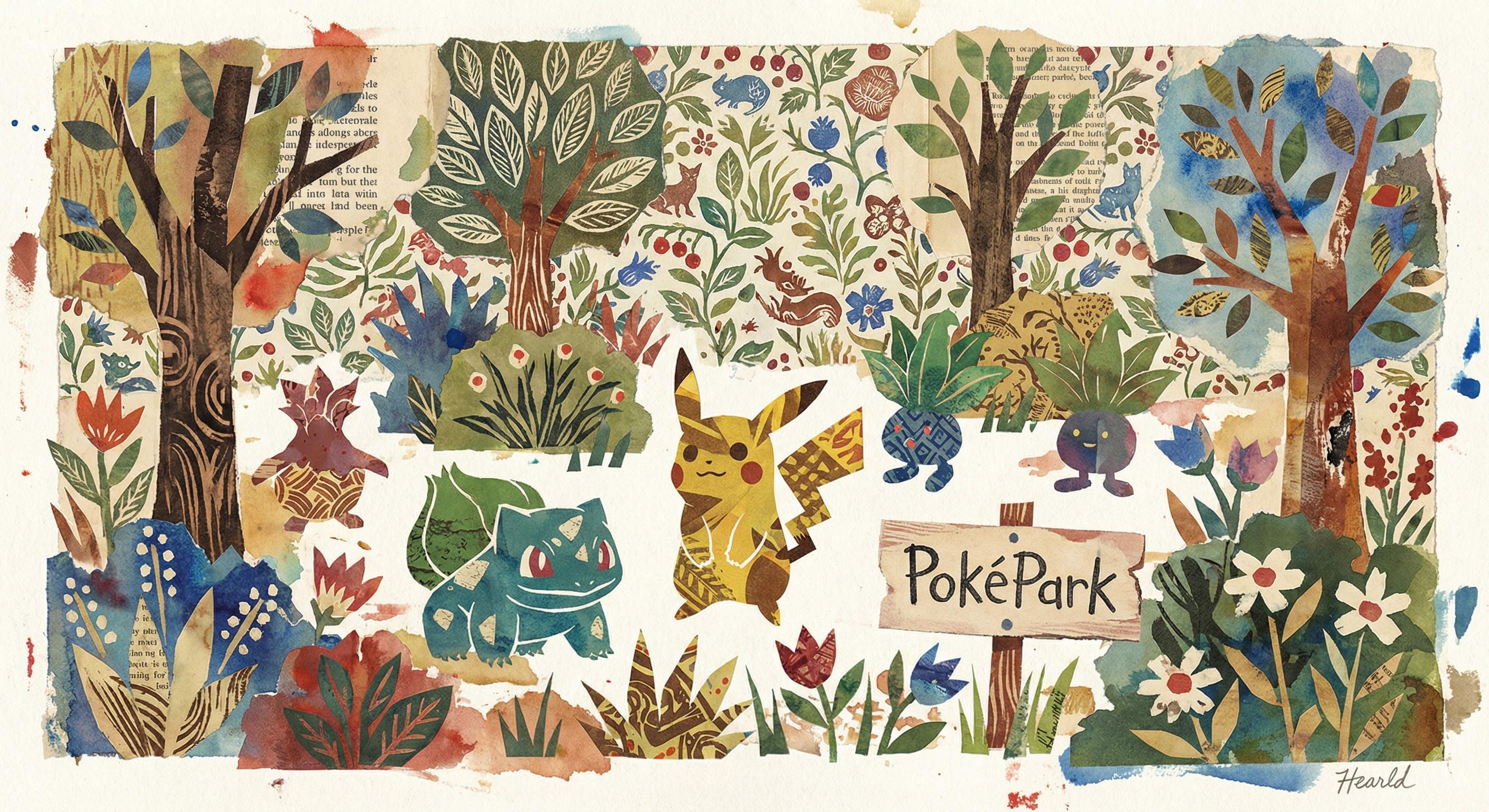
{PokéPark — a magical realm where Pikachu journeys through themed zones to restore harmony among Pokémon}, illustrated in Mark Hearld’s (b. 1974) signature collage art style, which draws on the traditions of British decorative modernism—lithography, linocut, tapestry design—to construct a composition that synthesizes decorative aesthetics with illustrative intent, in which natural forms are simultaneously distilled into graphic silhouettes and enriched by accidental mark-making: {
Mark Hearld's artistic practice represents a synthesis of mid-century British Neo-Romanticism, the post-war English printmaking and design tradition, and an instinctive engagement with English folk and popular art. Working across collage, lithography, linocut, watercolour, gouache, ceramics, and textile design, he carries forward the conviction — central to the mid-twentieth-century artist-designer tradition — that fine art and applied design are inseparable pursuits. His most distinctive contribution is a collage-driven illustrative method that integrates found and fabricated materials into densely patterned, compositionally unified images of British flora and fauna, achieving a decorative richness grounded in direct observation.
Born in York in 1974, Hearld's early environment in North Yorkshire provided the visual vocabulary — hen runs, pigeon lofts, foxes, hedgerow plants — that would become the recurring subject matter of his mature work. He studied illustration at the Glasgow School of Art (1994–1997), where an emphasis on expressive drawing and conceptual freedom shaped his gestural, instinctive approach to mark-making. He then pursued an MA in Natural History Illustration at the Royal College of Art, which grounded his expressive tendencies in scientific observation and taxonomic precision. This dual formation — the spontaneous and the disciplined — remains the generative tension at the core of his practice.
Hearld situates his work within a lineage of British artist-designers who treated printmaking, pattern, and the decorative arts with the seriousness of fine art. His most immediate forebears are Edward Bawden (1903–1989) and Eric Ravilious (1903–1942) — both associated with the Great Bardfield circle — as well as Enid Marx (1902–1998) and Peggy Angus (1904–1993), whose work in pattern, textile, and print exemplified the integration of decorative purpose with graphic invention. From the broader Neo-Romantic movement, he draws on John Piper (1903–1992), Graham Sutherland (1903–1980), and Keith Vaughan (1912–1977), particularly their capacity to charge observed landscape with subjective intensity. He also threads a historical line through the collage and mixed-media experiments of Julian Trevelyan (1910–1988) to the Cubist papiers collés of Pablo Picasso (1881–1973) and Georges Braque (1882–1963), tracing the formal precedent for integrating found materials into pictorial composition. In the applied arts, he shares with William Morris (1834–1896) a commitment to nature-derived colour, rhythmic density, and compositional balance, while diverging from Morris's all-over ornamental distribution by maintaining a clear focal hierarchy — an illustrative clarity of emphasis that recalls the lithographic economy of Barnett Freedman (1901–1958).
Hearld's primary medium is collage, which he has characterised with deliberate understatement as "cutting something out and sticking it down." In practice, the method is considerably more exacting. He layers torn and cut papers—vintage ephemera, hand-painted sheets, patterned stock, printed offcuts—alongside drawn and painted marks in watercolour and gouache, constructing densely inhabited compositions centred on the flora and fauna of the British countryside. Unlike much contemporary collage, which tends toward disjunctive fragmentation or ironic recontextualisation, Hearld integrates his materials with a control that approaches the intentionality of painting. He eschews the arbitrary accumulation of visual noise; instead, found and accidental textures are organised into a cohesive decorative unity where complexity serves a strict semantic purpose. Every element is calibrated to serve a dual function, descriptive and ornamental: a scrap of printed paper reads simultaneously as found texture and as the dappled flank of a hare; pattern becomes plumage. In this framework, decoration is never merely filler, but information. Organic variations register as envisioned intent rather than opportunistic experiment. The result suggests a kind of invented folk art—exuberant and materially abundant, yet formally deliberate. Impressionistic mark-making—vigorous, gestural, sometimes deliberately rough—is embedded within this decorative surface, lending each composition the spontaneous energy of direct observation while preserving the material tactility and visible handwork of craft practice.
The compositional structure of these works draws on the visual grammar of medieval and early-modern tapestry, particularly the millefleurs and verdure traditions. From tapestry, Hearld adopts the suppression of recessional depth, the side-by-side arrangement of motifs across a compressed pictorial field, and the integration of decorative pattern with descriptive content. Foreground and background merge into a single richly patterned surface in which botanical, ornithological, and landscape elements coexist with near-equal visual weight — much as figures and foliage do in a millefleurs tapestry. However, unlike the dispersed ornamental logic of traditional tapestry, Hearld maintains a focal hierarchy derived from illustration: depth is implied through relative scale, tonal contrast, and colour weight, ensuring that key descriptive elements — the posture of a bird, the alertness of a hare — remain legible focal points within the decorative profusion.
The formal logic underlying Hearld's apparent spontaneity is rooted in early British Modernism. He cites John Piper's Abstraction on the Beach (c. 1934–1936) as a seminal influence—a work from the period when Piper, stimulated by the European avant-garde and the critical discourse of journals such as Cahiers d'Art, pivoted from topographical landscape toward an abstraction informed by Braque, Jean Arp (1886–1966), and Henri Matisse (1869–1954). Piper drew on the South Coast of England both as a source of form—the shapes of sails, buoys, hulls, and lighthouses—and as a site for collecting physical materials to incorporate into his compositions. For Hearld, this work demonstrated that descriptive and psychological evocation need not depend on perspectival realism: abstracted, distilled visual forms can retain and even concentrate the essential character of their subjects. He applies this principle by reducing complex natural forms to essential silhouettes that function simultaneously as description and as design—containing richly textured surfaces within sharply defined contours. This reliance on the decorative silhouette parallels the papercut art of his contemporary Rob Ryan (b. 1962), though Hearld uses the outline not as a negative space, but as a vessel for painterly texture.
Technically, Hearld extends the subtractive logic of the linocut across his mixed-media practice. In linocut, the carved block isolates areas of flat tone by removing surrounding material; Hearld transposes this principle to collage, using sharp, reductive silhouettes — cut or torn — to frame and contain pre-painted, textured, or found surfaces. The effect is that tonal modelling is achieved not through continuous gradation but through discrete zones of pattern, hatching, or stippling. Each bounded shape reads as an aperture onto its own interior graphic register — as though the silhouette were a window revealing a distinct patterned world beneath. The descriptive and the decorative become structurally inseparable: the silhouette defines the form; the enclosed surface provides its texture, colour, and material character. He combines linocut and lithography with ancillary techniques such as gel printing and letterpress, achieving a bold, planar clarity that recalls the Curwen Studio tradition of autographic colour lithography and the printmaking of Bawden and Piper, while retaining the exuberant, slightly unruly energy of direct handwork.
Hearld has applied this collage-illustrative framework across a range of commissions and publications. His illustrations for Nicola Davies's Outside Your Window: A First Book of Nature (2012) demonstrate the method's adaptability to children's book illustration, where decorative richness is held in balance with narrative legibility and visual simplicity. In July 2024, he was commissioned by the Dovecot Studios in Edinburgh — a tapestry workshop founded in 1912 with a distinguished history of artist-designer collaborations — to produce work drawing on 16th-century verdure tapestries, a project that brought his long-standing compositional engagement with tapestry's visual grammar into direct dialogue with the woven medium itself. His monograph Raucous Invention: The Joy of Making (2025), featuring over four hundred illustrations with a foreword by the art historian Alan Powers (b. 1955), presents the fullest account of his practice to date. Powers's remark that "this art is imperfect in the best way… the sound of singing and laughter is in the air" identifies a quality that resists purely formal analysis: the sense that Hearld's work, for all its art-historical awareness and technical deliberation, is animated by an instinctive, celebratory engagement with its subjects.
Across all media, Hearld's work unites the decorative ambitions of the applied arts with the descriptive attentiveness of the natural-history illustration tradition, producing images that are at once visually sumptuous and botanically or ornithologically specific — stylised, yet never merely symbolic. He shares with his mid-century forebears a commitment to pattern, print, and the integration of art into the fabric of everyday life, but his sensibility is distinctly his own: less preservationist than revivalist, more improvisatory, and charged with a directness of material pleasure. He does not reproduce mid-century traditions so much as reinterpret them through the accumulated visual culture of found materials, the physical immediacy of collage, and what appears to be an irreducible delight in the natural world.
}