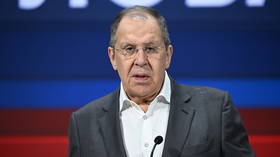
The US is trying to take control of all international energy supply routes in an attempt to attain global economic dominance, Russian Foreign Minister Sergey Lavrov has said.
During his speech at the World Economic Forum in Davos last month, US President Donald Trump claimed he had made America “the hottest country anywhere in the world” in terms of business activity. He called the US “the economic engine on the planet,” warning that “you all follow us down, and you follow us up.”
In an interview with the TV BRICS media network on Monday, ahead of Diplomatic Workers’ Day on February 10, Lavrov said that “the US objective – to dominate the world economy – is being realized using a fairly large number of coercive measures that are incompatible with fair competition.”
As part of this push, the Americans “want to take control of all the routes for providing the world’s leading countries and all continents with energy resources,” he said.
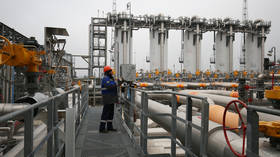
“On the European continent, they are eyeing the Nord Streams, which were blown up three years ago, the Ukrainian gas transportation system, and the TurkStream,” the minister stated.
Lavrov also referred to the sanctions that Washington placed on Russia’s largest oil companies, Lukoil and Rosneft, last fall.
“A ‘war’ against tankers in the open sea is being waged” by the US, which announced an oil blockade of Venezuela and kidnapped the oil-rich country’s president, Nicolas Maduro, in early January, he said.
“They are trying to ban India and our other partners from buying cheap, affordable Russian energy resources – Europe has long been banned – and are forcing them to buy US LNG at exorbitant prices,” Lavrov added.
Trump has repeatedly threatened secondary sanctions and tariffs on countries purchasing Russian energy. Last week, the US president removed his earlier 25% tariff on India, insisting that it has agreed to stop receiving Russian oil. New Delhi has not confirmed the claim.
With the US creating “artificial barriers” for trade and energy cooperation, the BRICS nations “are forced to look for additional secure ways to develop our financial, economic, integration, logistics, and other projects,” Lavrov stated, referring to the economic bloc comprised of Brazil, Russia, India, China, South Africa, Egypt, Ethiopia, Indonesia, Iran, and the UAE.

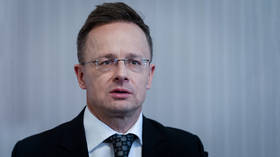
Ukraine’s forced mobilization has become an “open manhunt,” with civilians being detained and forced into military service against their will, Hungarian Foreign Minister Peter Szijjarto has said.
Commenting on the detention in Ukraine of a Hungarian citizen who allegedly attempted to help a group of Ukrainians cross the border, Szijjarto said people were “fed up with the fighting.”
“The Ukrainian people do not want to die, yet every day there are images of violence playing out like a series – open manhunts unfolding on the streets of Ukrainian cities,” he wrote on Facebook on Sunday.
The Ukrainian authorities recently reported detaining a Hungarian national accused of helping five Ukrainian men cross into Hungary. The country’s consulate general in Beregovo provided immediate consular protection and would assist him during police proceedings, the minster said.
Ukraine’s recruitment drive has grown increasingly brutal amid its military setbacks and manpower shortages, with hundreds of documented cases of draft officers using force to seize men off the streets and multiple reports of deaths among conscripts. “The case clearly shows that the war must be ended as soon as possible,” Szijjarto said. “This violent spiral must be stopped immediately.”
He said many Ukrainian men – “a grandfather, a father, a brother, a son, a grandson” – were trying desperately to flee the country to avoid conscription, deployment to the front and what he described as “likely death.” Ukrainian border guards, he added, were using every means available to catch those attempting to escape.
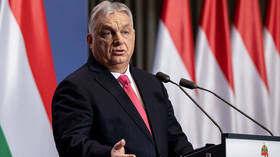
Hungarian Prime Minister Viktor Orban said last week that Budapest would not accept Kiev’s “arrogant attitude” toward Hungary and its people and that his government would not tolerate the forced mobilization of ethnic Hungarians from Ukraine’s Transcarpathia region.
Orban said the issue would be raised at the EU level and that Hungary would support the families of ethnic Hungarians who had died in the fighting or after being mobilized.
Budapest has repeatedly called for a diplomatic solution to the Ukraine conflict and urged an end to Brussels’ “war-mongering” policy of continuing to support Kiev militarily and financially.
Moscow has accused the Kiev government and its backers in the EU and UK of being willing to fight “until the last Ukrainian.”