

2001: A Space Odyssey, Nietzsche, and the Nuclear Weapons-UFO Connection
Part Two of a Series

2001: A Space Odyssey was co-created between 1964/65 and 1968 by filmmaker Stanley Kubrick and science fiction author Arthur C Clarke. Most of the content and meaning in 2001 relies on imagery. There is little dialog. While Kubrick’s film closely follows Clarke’s narrative, it departs in style and method; it emphasizes visual symbolism and ambiguity where Clarke’s novel offers explanation. For example, in Clarke’s book, the Monolith is explicitly an object created by an off-planet intelligence. In the film, although this is implied, Kubrick leaves the meaning of the Monolith to the interpretation of the viewer. This is the second installment in my series reading the film through the lens of recent events.

Nietzsche and the Announcement of a New Form of Religion
The beginning of the film is disorienting unless we recognize two deliberate cultural references.
First, Kurbrick chose Richard Strauss’s orchestral score, Also sprach Zarathustra, which is a musical interpretation of the philosopher Friedrich Nietzsche’s short book about a new religiosity/philosophy of the Übermensch, or the transformed and evolved human being (according to Nietzsche). Nietzsche’s text is both a prophecy and a diagnosis: the old metaphysical guarantees of meaning no longer hold, and humanity stands in a transitional condition. “Man is something that shall be overcome,” Zarathustra announces.
For those unfamiliar with Nietzsche’s work, the name Zarathustra is taken from the ancient religion Zoroastrianism (which is still a practiced religion), which Nietzsche believed predates Judaism and thus Christianity (there are academic arguments that question this assumption, just fyi). Nietzsche uses the Greek form of the name of the prophet Zarathustra, and not the Latinized form—Zoroaster, to convey this historical placement. He is reviving this prophet to announce the overturning of the old order (founded on moral dualism, i.e., good vs. evil, and what he views as a Good God vs. an Evil God). Yet, he is also using aphoristic, religious language, and a religious framework (Zoroastrianism) to convey this cultural and historical shift.
Nietzsche calls out a two thousand year span. Its been two thousand years, Nietzsche says, and it is high time for a new form of religion. The reference to the year 2001, then, if we are reading Kubrick as a Nietzschean (which he seems to be!) is very symbolic, as we are in the first year, year one, of this new order.
All of this is to suggest that Kubrick is making these references intentionally. The strange opening scene of the film is more than two minutes of extended darkness, which is hard for today’s students and viewers to endure. I recently staged a showing of the movie for my students, and I saw the confusion on their faces as they watched this scene. Could this darkness represent the dark before creation, as depicted in several creation myths, including The Book of Genesis? Given that the next scene opens to the famous cut of the proto-humans around the watering hole, I think so. A new interpretation of creation and evolution is on the horizon, and this is further illustrated by the images of the horizon—the moon-earth-sun alignments.
My latest rewatching of the film was eye-opening. It brought me back to my own work. When, years ago, I puzzled over the strange research for my book American Cosmic, I came to a recognition that Nietzsche had predicted a new form of something other than secular, Darwinian evolution. To open my book, I quoted Nietzsche’s proverbial question, posed in The Antichrist, to frame the issue: “Two thousand years have come and gone, and not a single new god!” I thought that the answer to Nietzsche’s question/observation was best stated by David Bowie’s statement, “The Internet is an alien life form.” Therefore, this new religion or order posited humanity as technologically transformed by non-human intelligence.
Kubrick never states these themes explicitly, but in my mind the film images and music together suggests this reading.
The Monolith and Evolution Through Encounters
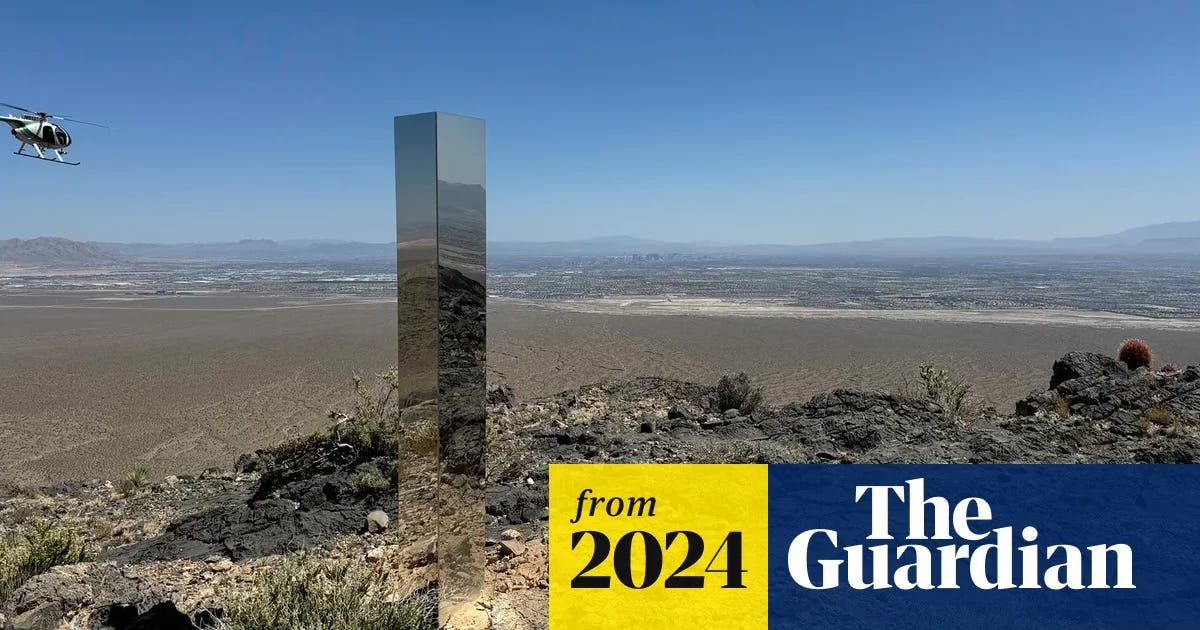
In the opening scenes of the proto-humans at the water hole, the Monolith appears. One of the proto-humans touches it and soon discovers that a bone can function as both tool and weapon. The proto-humans, which had been depicted as being food for a cheetah and being friendly with the tapirs which whom they shared a branch for food, now are shown eating the meat of animals (the tapirs?) they now killed with their new weapon. They’ve moved up the food chain. In the famous edit, the bone thrown into the sky becomes an orbiting satellite.
The assumption, here, is evolution. But the film suggests a form of evolution that is not Darwinian in the ordinary sense. Natural selection is gradual, but what happens with the Monolith is something completely different. As the movie progresses, it becomes apparent that in each scene where a human being touches the Monolith, a technological development occurs that propels them into a new world and cosmos. The Monolith acts as an external agent that intervenes, accelerates, and directs development. Evolution is curated by the Monolith. The character, Dr. Heywood Floyd, a scientist and government official, states that the Monolith is apparently an artifact, “deliberately buried.” It indicates off-planet intelligence.
In this way the Monolith occupies the narrative place once held by the sacred. It functions like the gods, or God: it upgrades the human condition.
Bowman’s Transformation, Nuclear Weapons and the ET Connection
Clarke’s novel 2001: A Space Odyssey differs from Kubrick’s movie. In Clarke’s story, when the astronaut Bowman returns to Earth as the Star Child, he neutralizes nuclear weapons orbiting the planet. Humanity is saved from immediate self-destruction. I find this theme in the movie fascinating, as both Clarke and Kubrick were writing so long ago, yet, considering UFO research of thirty or more years, they got this connection right: there is a link between off-planet intelligence and nuclear weapons.
As we’ve learned from the research of Robert Hastings and others, it appears that UFOs are not only interested in nuclear power sites, but they seem to be invested in having us not utilize these weapons. You see this in the research of ufologists who use historical and factual research methods, and you see this in experiencer narratives. For example, in the narratives of the school children of the 1994, Ruwa, Zimbabwe school sighting, some of the children said that the non-humans told them that there was a danger in technology. Other experiencers, as described by Dr. John Mack, relate that non-human intelligences showed them images of a nuclear conflagration and warned them to spread the word or face some serious consequences (presumably nuclear war).
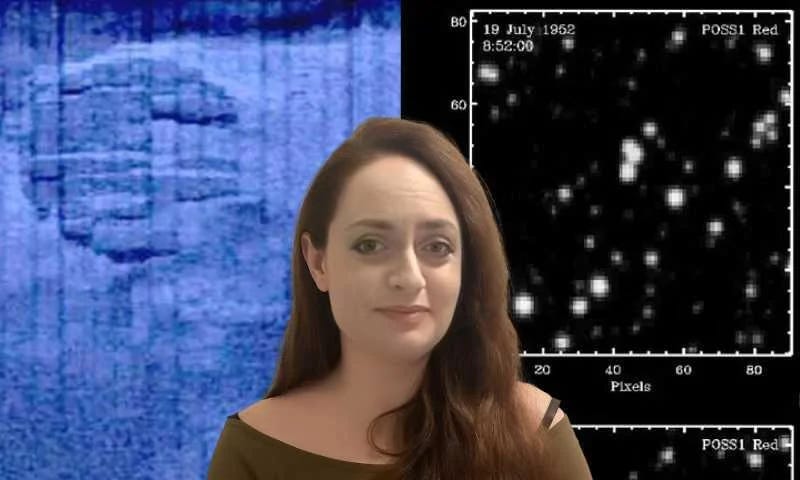
Just recently my colleague, astronomer Beatriz Villarroel, in work associated with the VASCO project, examined thousands of brief, star-like transients (a source of light that appears temporarily and then disappears or changes quickly) visible on mid-twentieth-century photographic plates from the Palomar Sky Survey. She identified their appearance around particular historical events. In a study published in Scientific Reports, the team reported that such transients were statistically more likely to occur within a day of above-ground nuclear weapons tests, and that days with transients also tended to show slightly elevated numbers of independent UAP (UFO) reports. The authors are careful to frame interpretation cautiously, proposing possibilities that range from poorly understood atmospheric or instrumental effects to more speculative reflections from objects in near-Earth space, while emphasizing that correlation does not by itself establish causation.
In 2023, at the first conference of Dr. Garry Nolan and Dr. Peter Skafish’s Sol Foundation, Beatriz presented some of her initial findings. I was sitting between former U.S. Navy F/A-18 Super Hornet pilot Ryan Graves and pilot and space researcher Dr. Iya Whiteley. Toward the end of her presentation, Beatriz identified one of the UFO sightings that had been recorded during a cluster of transients: the famous 1952 Washington, DC flap. I remember being kind of shocked (is that even possible these days?) and looking to my left and right. Judging by the faces of my associates, they looked shocked too. But I could be wrong.
The Unpublished Research
In 2018, I was still figuring out how to present the research I had accumulated in my journeys through the UFO communities I had found myself within. These were populated by the usual suspects--the scientists of the Invisible College, new scientists like Garry, but also the invisibles who I still cannot name (some have been revealed, and some have not). There was information that I didn’t understand at the time, and therefore never published. Now, by watching events unfold (like information about alleged crash retrieval programs) and seeing treasures like 2001: A Space Odyssey, and rereading the science fiction of Arthur C. Clarke, I’m connecting the dots.

I first watched 2001 around 20 years ago. Then I watched last year after reading your interpretations of the movie and the YouTube videos you provided as evidence. The interpretations you provided rang absolutely true.
Last year as I was re watching 2001, I was also getting a little confused with the 2 minutes of black screen at the beginning of the movie. But then it hit me: of course, Kubrick is making a point here. He’s showing us the monolith. During those 2 minutes, you’re looking at the monolith. The screen is the monolith, and you (the observer) are the monkey.
I have taken a month's paid sub so that I can share this with you and your readers:
https://youtu.be/9fWFY09impI
It speaks directly to all you've said about 2001: A Space Odyssey (and countless other topics you've touched on.
FWIW, I'll be discussing these and relate topics in depth with Jesse Michels for his "American Alchemy" channel at the end of the month