


SUBSCRIBE TO OUR FREE NEWSLETTER
Daily news & progressive opinion—funded by the people, not the corporations—delivered straight to your inbox.
5
#000000
#FFFFFF
To donate by check, phone, or other method, see our More Ways to Give page.

President Donald Trump on Monday declared that the Republican Party should “nationalize the voting” in the US and take away individual states’ power to administer their elections.
While speaking with Dan Bongino, a former FBI deputy director and current podcaster, Trump rehashed the false allegations he’s made in the past about Democrats only winning elections through the help of undocumented immigrants.
“These people were brought to our country to vote, and they vote illegally!” Trump falsely claimed. “Amazing that the Republicans aren’t tougher on it. The Republicans should say... ‘We should take over the voting in at least... 15 places.’ The Republicans ought to nationalize the voting.”

Trump then continued to rehash his lies about winning the 2020 election that he lost to former President Joe Biden.
“We have states that are so crooked, and they’re counting votes, we have states that I won that show I didn’t win!” he said. “Now, you’re going to see something in Georgia, where they were able to get with a court order the ballots, you’re going to see some interesting things come out. But, you know, the 2020 election, I won that election by so much. And everybody knows it!”
In fact, Trump lost the 2020 election to Biden at both the national level and in the state of Georgia, which has a Republican governor, a Republican secretary of state, and a Republican-run Legislature.
Last week, the FBI executed a search warrant at Georgia’s Fulton County election hub and hauled out boxes of ballots as part of an investigation related to the 2020 election.
Some Trump critics reacted to his latest outburst about “nationalizing” the vote by noting how incredibly unlikely the president would be to succeed in such an endeavor.
“Neither Trump nor the GOP in Congress have this power, and the only way they do this is if we decline to stand up for our rights,” wrote Ezra Levin, co-executive director of Indivisible, in a social media post. “He’s had a string of electoral defeats and rightfully fears the midterms. His outbursts are real threats, but they come from weakness. Tough shit, he’s going down. No Kings.”
MS NOW contributor Philip Bump also expressed skepticism about Trump’s scheme, which conflicts with Article I of the US Constitution.
“Trump doesn’t have the power to federalize elections, which obviously doesn’t mean it’s OK that he’s saying things like this,” he wrote. “The stuff about ginning up bullshit in Atlanta—we’ll see.”
Political strategist Murshed Zaheed likewise advised his social media followers to “take a deep breath” before panicking over Trump’s plans.
“Trump cannot change election/voting rules with [executive orders],” he wrote. “Of course they are going to try crazy stuff—but this is desperate attempt to gin up fear.”
Other critics, however, said that Trump’s remarks needed to be taken as a direct threat to democratic governance.
“He’s saying the quiet part out loud,” said Sen. Ed Markey (D-Mass.). “Trump and MAGA Republicans can’t win with their unpopular policies at the ballot box, so they want to steal the 2026 election.”
Dartmouth political scientist Brendan Nyhan expressed even greater alarm.
“The last time he started talking like this, his allies minimized the risks and we ended up with January 6,” he warned, referring to the deadly riots carried out by Trump supporters on the US Capitol that sent lawmakers running for their lives. “This time we must take him literally and seriously. These comments are a five-alarm fire for democracy. In a functioning republic, he would be impeached and removed from office today.”
Trump’s comments come as Republicans in Congress push a bill that would enable massive voter purges, impose photo ID requirements, and ban ranked-choice voting, universal mail-in ballots, and the acceptance of mailed ballots that arrive after Election Day.
Dear Common Dreams reader, The U.S. is on a fast track to authoritarianism like nothing I've ever seen. Meanwhile, corporate news outlets are utterly capitulating to Trump, twisting their coverage to avoid drawing his ire while lining up to stuff cash in his pockets. That's why I believe that Common Dreams is doing the best and most consequential reporting that we've ever done. Our small but mighty team is a progressive reporting powerhouse, covering the news every day that the corporate media never will. Our mission has always been simple: To inform. To inspire. And to ignite change for the common good. Now here's the key piece that I want all our readers to understand: None of this would be possible without your financial support. That's not just some fundraising cliche. It's the absolute and literal truth. We don't accept corporate advertising and never will. We don't have a paywall because we don't think people should be blocked from critical news based on their ability to pay. Everything we do is funded by the donations of readers like you. Will you donate now to help power the nonprofit, independent reporting of Common Dreams? Thank you for being a vital member of our community. Together, we can keep independent journalism alive when it’s needed most. - Craig Brown, Co-founder |
|

President Donald Trump on Monday declared that the Republican Party should “nationalize the voting” in the US and take away individual states’ power to administer their elections.
While speaking with Dan Bongino, a former FBI deputy director and current podcaster, Trump rehashed the false allegations he’s made in the past about Democrats only winning elections through the help of undocumented immigrants.
“These people were brought to our country to vote, and they vote illegally!” Trump falsely claimed. “Amazing that the Republicans aren’t tougher on it. The Republicans should say... ‘We should take over the voting in at least... 15 places.’ The Republicans ought to nationalize the voting.”
Trump: "These people were brought to our country to vote, and they vote illegally. The Republicans should say, we should take over the voting in at least 15 places. The Republicans ought to nationalize the voting. We have states that I won that show I didn't win. You're gonna see… pic.twitter.com/H5hT3OvtLE
— Aaron Rupar (@atrupar) February 2, 2026
Trump then continued to rehash his lies about winning the 2020 election that he lost to former President Joe Biden.
“We have states that are so crooked, and they’re counting votes, we have states that I won that show I didn’t win!” he said. “Now, you’re going to see something in Georgia, where they were able to get with a court order the ballots, you’re going to see some interesting things come out. But, you know, the 2020 election, I won that election by so much. And everybody knows it!”
In fact, Trump lost the 2020 election to Biden at both the national level and in the state of Georgia, which has a Republican governor, a Republican secretary of state, and a Republican-run Legislature.
Last week, the FBI executed a search warrant at Georgia’s Fulton County election hub and hauled out boxes of ballots as part of an investigation related to the 2020 election.
Some Trump critics reacted to his latest outburst about “nationalizing” the vote by noting how incredibly unlikely the president would be to succeed in such an endeavor.
“Neither Trump nor the GOP in Congress have this power, and the only way they do this is if we decline to stand up for our rights,” wrote Ezra Levin, co-executive director of Indivisible, in a social media post. “He’s had a string of electoral defeats and rightfully fears the midterms. His outbursts are real threats, but they come from weakness. Tough shit, he’s going down. No Kings.”
MS NOW contributor Philip Bump also expressed skepticism about Trump’s scheme, which conflicts with Article I of the US Constitution.
“Trump doesn’t have the power to federalize elections, which obviously doesn’t mean it’s OK that he’s saying things like this,” he wrote. “The stuff about ginning up bullshit in Atlanta—we’ll see.”
Political strategist Murshed Zaheed likewise advised his social media followers to “take a deep breath” before panicking over Trump’s plans.
“Trump cannot change election/voting rules with [executive orders],” he wrote. “Of course they are going to try crazy stuff—but this is desperate attempt to gin up fear.”
Other critics, however, said that Trump’s remarks needed to be taken as a direct threat to democratic governance.
“He’s saying the quiet part out loud,” said Sen. Ed Markey (D-Mass.). “Trump and MAGA Republicans can’t win with their unpopular policies at the ballot box, so they want to steal the 2026 election.”
Dartmouth political scientist Brendan Nyhan expressed even greater alarm.
“The last time he started talking like this, his allies minimized the risks and we ended up with January 6,” he warned, referring to the deadly riots carried out by Trump supporters on the US Capitol that sent lawmakers running for their lives. “This time we must take him literally and seriously. These comments are a five-alarm fire for democracy. In a functioning republic, he would be impeached and removed from office today.”
Trump’s comments come as Republicans in Congress push a bill that would enable massive voter purges, impose photo ID requirements, and ban ranked-choice voting, universal mail-in ballots, and the acceptance of mailed ballots that arrive after Election Day.
President Donald Trump on Monday declared that the Republican Party should “nationalize the voting” in the US and take away individual states’ power to administer their elections.
While speaking with Dan Bongino, a former FBI deputy director and current podcaster, Trump rehashed the false allegations he’s made in the past about Democrats only winning elections through the help of undocumented immigrants.
“These people were brought to our country to vote, and they vote illegally!” Trump falsely claimed. “Amazing that the Republicans aren’t tougher on it. The Republicans should say... ‘We should take over the voting in at least... 15 places.’ The Republicans ought to nationalize the voting.”
Trump: "These people were brought to our country to vote, and they vote illegally. The Republicans should say, we should take over the voting in at least 15 places. The Republicans ought to nationalize the voting. We have states that I won that show I didn't win. You're gonna see… pic.twitter.com/H5hT3OvtLE
— Aaron Rupar (@atrupar) February 2, 2026
Trump then continued to rehash his lies about winning the 2020 election that he lost to former President Joe Biden.
“We have states that are so crooked, and they’re counting votes, we have states that I won that show I didn’t win!” he said. “Now, you’re going to see something in Georgia, where they were able to get with a court order the ballots, you’re going to see some interesting things come out. But, you know, the 2020 election, I won that election by so much. And everybody knows it!”
In fact, Trump lost the 2020 election to Biden at both the national level and in the state of Georgia, which has a Republican governor, a Republican secretary of state, and a Republican-run Legislature.
Last week, the FBI executed a search warrant at Georgia’s Fulton County election hub and hauled out boxes of ballots as part of an investigation related to the 2020 election.
Some Trump critics reacted to his latest outburst about “nationalizing” the vote by noting how incredibly unlikely the president would be to succeed in such an endeavor.
“Neither Trump nor the GOP in Congress have this power, and the only way they do this is if we decline to stand up for our rights,” wrote Ezra Levin, co-executive director of Indivisible, in a social media post. “He’s had a string of electoral defeats and rightfully fears the midterms. His outbursts are real threats, but they come from weakness. Tough shit, he’s going down. No Kings.”
MS NOW contributor Philip Bump also expressed skepticism about Trump’s scheme, which conflicts with Article I of the US Constitution.
“Trump doesn’t have the power to federalize elections, which obviously doesn’t mean it’s OK that he’s saying things like this,” he wrote. “The stuff about ginning up bullshit in Atlanta—we’ll see.”
Political strategist Murshed Zaheed likewise advised his social media followers to “take a deep breath” before panicking over Trump’s plans.
“Trump cannot change election/voting rules with [executive orders],” he wrote. “Of course they are going to try crazy stuff—but this is desperate attempt to gin up fear.”
Other critics, however, said that Trump’s remarks needed to be taken as a direct threat to democratic governance.
“He’s saying the quiet part out loud,” said Sen. Ed Markey (D-Mass.). “Trump and MAGA Republicans can’t win with their unpopular policies at the ballot box, so they want to steal the 2026 election.”
Dartmouth political scientist Brendan Nyhan expressed even greater alarm.
“The last time he started talking like this, his allies minimized the risks and we ended up with January 6,” he warned, referring to the deadly riots carried out by Trump supporters on the US Capitol that sent lawmakers running for their lives. “This time we must take him literally and seriously. These comments are a five-alarm fire for democracy. In a functioning republic, he would be impeached and removed from office today.”
Trump’s comments come as Republicans in Congress push a bill that would enable massive voter purges, impose photo ID requirements, and ban ranked-choice voting, universal mail-in ballots, and the acceptance of mailed ballots that arrive after Election Day.

After a US Border Patrol Agent shot two Venezuelan immigrants in Portland, Oregon in January, the Department of Homeland Security claimed that the two victims were "vicious Tren de Aragua gang members" who "weaponized their vehicle" against federal agents, who had no choice but to open fire in self-defense.
However, court records obtained by the Guardian reveal that a Department of Justice prosecutor subsequently told a judge the government was "not suggesting" that one of the victims, Luis Niño-Moncada, was a gang member.
The Guardian also obtained an FBI affidavit contradicting DHS claims about the second victim, Yorlenys Zambrano-Contreras, being "involved" in a shooting in Portland last year, when in reality she was a "reported victim of sexual assault and robbery."
Attorneys representing Niño-Moncada and Zambrano-Contreras, who both survived the shooting and were subsequently hospitalized, told the Guardian that neither of them have any prior criminal convictions.
Legal experts who spoke with the Guardian about the shooting said it appeared that DHS was waging a "smear campaign" against the victims.
Sergio Perez, a civil rights lawyer and former US prosecutor, noted in an interview that prosecutors filed criminal charges against Niño-Moncada and Zambrano-Contreras just two days after they were shot, even before it had obtained crucial video evidence of the incident.
"This government needs to go back to the practice of slow and thorough investigations," he told the Guardian, "rather than what we consistently see in immigration enforcement activities—which is a rush to smear individuals."
Carley Palmer, a former federal prosecutor, told the Guardian that the court records obtained by the paper don't show DOJ presenting any of the usual evidence that prosecutors use to establish defendants' alleged gang membership.
"What’s interesting about the filings is that you don’t see evidence of gang association," said Palmer. "It just feels like a dirtying up of the defendant."
DHS in recent months has made a number of claims about people who have been shot or killed by federal immigration officers that have not held up to scrutiny.
Most recently, Homeland Security Secretary Kristi Noem claimed that slain Minneapolis intensive care nurse Alex Pretti was a "domestic terrorist" intent on inflicting "maximum damage" on federal agents, when video clearly showed that Pretti was swarmed by multiple federal agents and was disarmed before two agents opened fire and killed him.
Noem also openly lied about the circumstances and actions that resulted in the shooting death of Renee Nicole Good by a federal agent weeks earlier.
In November, federal prosecutors abruptly dropped charges against Marimar Martinez, a woman who was shot multiple times by a US Border Patrol agent in October in Chicago’s Brighton Park neighborhood.
In the indictment filed against Martinez, prosecutors said that the Border Patrol agent who shot her had been acting in self-defense, and that he had only opened fire after Martinez’s car collided with his vehicle.
However, uncovered text messages showed the Border Patrol agent apparently bragging about shooting Martinez, as he boasted that he “fired five rounds and she had seven holes” in a message sent to fellow agents.
An attorney representing Martinez also claimed that he had seen body camera footage that directly undermined DHS claims about how the shooting unfolded.
No explanation was provided for why charges against Martinez were dropped.

Haitian refugees living in the United States with temporary protected status were given a reprieve Monday night when a federal judge blocked an order by the Trump administration to strip them of their TPS—an effort that many feared would lead to an immediate intensification of efforts to target such communities with the same heavy-handed tactics seen by federal agents in Minnesota, Maine, and elsewhere.
US District Judge Ana Reyes in Washington granted a request to pause the TPS termination for Haitians while a lawsuit challenging the order issued by Secretary of Homeland Security Kristi Noem in November proceeds.
The termination of TPS for Haitian nationals was set for Tuesday, but Reyes's 83-page order stated that it "shall be null, void, and of no legal effect."
Rose-Thamar Joseph, the operations director of the Haitian Support Center in Springfield, Ohio—which has a large Haitian community that has been the target of racist and xenophobic attacks from President Donald Trump, Vice President JD Vance, and their allies—said the judge's ruling means "we can breathe for a little bit."
The residents of Springfield and surrounding areas have been anxious that their community would be the next target for Trump's aggressive deportation tactics. The legal challenge to the termination of TPS for Haitians alleges that the secretary acted with "animus," as evidenced by repeated public remarks from Noem and other administration officials.
Reyes, in her ruling, determined that the suit stands a good chance of winning on the merits, writing: “The mismatch between what the secretary said in the termination and what the evidence shows confirms that the termination of Haiti’s TPS designation was not the product of reasoned decision-making, but of a preordained outcome justified by pretextual reasons."
Jerome Bazard, a member of the First Haitian Evangelical Church of Springfield, told NPR that life in Haiti remains too dangerous for many in his community to return.
"They can't go to Haiti because it's not safe," Bazard said. "Without the TPS, they can't work. And if they can't work, they can't eat, they can't pay bills. You're killing the people."
The sense of relief was felt beyond Ohio, as people from Haiti living with TPS status live in communities across the US.
Tessa Petit, executive director of the Florida Immigrant Coalition and a native of Haiti, said the ruling is a welcome development for the approximately 330,000-350,000 people living in the country with TPS, which allows them to work and pay taxes. In her ruling, Reyes noted that Haitians with TPS generate $5.2 billion annually in tax revenue.
"For Haitian TPS holders and their families, this decision provides immediate relief from the fear of family separation, job loss, and forced return to life-threatening conditions in Haiti," said Petit, "where political instability, gang violence, and humanitarian collapse remain acute. No one should be deported into crisis, and today’s ruling affirms that the law cannot be twisted to justify cruelty.”
“Today’s ruling is a victory for the roughly 350,000 Haitian TPS holders whose status was set to expire tomorrow,” said Sen. Ed Markey (D-Mass). “By providing a safe haven to those who cannot return home safely, TPS embodies the American promise as a land of freedom and refuge. Haitian TPS holders are deeply rooted in our Massachusetts communities—from Mattapan to Brockton. They are our friends, our family members, our neighbors, our colleagues. I will keep fighting to protect the Haitian community.”
Aaron Reichlin-Melnick, senior fellow at the American Immigration Council, said that even though Monday's ruling is sure to be appealed by the Trump administration, it arrives as a "huge" win.
With the order, he said, "350,000 people can breathe a sigh of relief and go to work or school tomorrow without suddenly having been rendered 'illegal' and forced to either go back into danger or risk being rounded up by ICE agents on the street."

With only five Palestinians in need of medical evacuation from Gaza permitted to leave through the Rafah crossing after it reopened on Monday, health authorities in the exclave warned that the restrictions Israel is continuing to impose at the crossing could ultimately kill thousands of Palestinians who have been waiting for years for treatment as Israeli attacks have decimated Gaza's health system.
Zaher al-Wahidi, a spokesperson for the Gaza Health Ministry, told Al Jazeera Tuesday that although the crossing has reopened—a step that has been hailed as progress under the "ceasefire" agreement reached in October—the intense screening process Palestinians are subjected to by Israeli authorities at the entry point is "too complex."
About 20,000 patients in Gaza are awaiting medical evacuation, including about 440 people whose cases are critical and need immediate treatment.
Egyptian officials had said before the crossing reopened that 50 people were expected to cross from Gaza into Egypt per day, but al-Wahidi said that if the rate of crossing on Monday continues, "we would need years to evacuate all of these patients, by which time all of them could lose their lives while waiting for an opportunity to leave."
Al Jazeera reported that people hoping to leave Gaza must register their names with Egyptian authorities, who send the names to Israel's Shin Bet for approval. Palestinians then enter a checkpoint run by the Palestinian Authority and European Union representatives before Israeli officers use facial recognition software to identify those who are leaving.
Reporting for the outlet, Nour Odeh said the crossing process has been "humiliating" for Palestinians and exemplifies the "absolute control" Israel demands over the lives of people in Gaza.
"There were strip searches and interrogations, but now there are even more extreme elements. We’re hearing about people being blindfolded, having their hands tied, and being interrogated," said Odeh. "When we talk about security screening, and a person needing urgent medical care, that person is basically being denied medical attention."
Ambulances waited for hours on Monday on the Egyptian side of the border, ready to take patients to 150 hospitals across Egypt that have agreed to treat patients from Gaza, before five people were finally able to cross after sunset.
The process, said al-Wahidi, "will not allow us to evacuate patients and provide medical services to them to give them a chance at life."
About 30,000 Palestinians have also requested to return to Gaza, having fled the exclave after Israel began bombarding civilian infrastructure and imposing a total blockade on humanitarian aid in October 2023—retaliating against Gaza's population of more than 2 million people, about half of whom are children, for a Hamas-led attack on southern Israel.
But only about a dozen people were permitted to reenter Gaza on Monday, falling far short of the daily target of 50.
The Associated Press reported that Palestinians arrived at the border crossing with luggage that they were told they could not bring into Gaza.
“They didn’t let us cross with anything,” Rotana Al-Regeb told the AP after returning to Khan Younis. “They emptied everything before letting us through. We were only allowed to take the clothes on our backs and one bag per person.”
Another woman told Tareq Abu Azzoum of Al Jazeera that she was "blindfolded and interrogated by the Israeli military on her way back to Gaza," and other said "they were intercepted by Israeli-backed militias" who demanded information about armed groups in Gaza.
For people who have waited months or years to return to Gaza, Abu Azzoum said, "the Rafah crossing has been a humiliating process instead of a day marking a beautiful reunion with family."
Palestinian political analyst Muhammad Shehada of the European Council on Foreign Relations said the process "means in practice that Israel has made the Rafah border crossing a one-way ticket. If you decide to go to Gaza, they tell you, 'Okay, you will be caged there permanently. Forget about being able to leave ever again.' If you decide to leave you will have to settle with the concept of being banished and exiled again, permanently, because the queue is so formidably long."
Palestinian analyst @muhammadshehad2 explains the restrictions that Israel has imposed at Rafah Crossing are so harsh that it would take approximately 10 years for all 150,000 Palestinians in Egypt to return to Gaza, and similarly long for the tens of thousands of patients and… https://t.co/FBy1TCAW3L pic.twitter.com/WwBA7rs4xC
— Drop Site (@DropSiteNews) February 2, 2026
On Tuesday, a World Health Organization (WHO) team arrived at a Palestinian Red Crescent hospital in Khan Younis to take about 16 patients with chronic conditions or injuries sustained in Israeli attacks to the Rafah crossing. The Red Crescent had previously been told 45 people would be able to cross on Tuesday.
Al Jazeera reported that health authorities in Gaza are being forced to choose which sick and wounded patients will be permitted to get treatment first.
“We know that patients have died basically waiting for evacuation," WHO spokesperson Christian Lindmeier said, "and that’s something which is horrible when you know just a few miles or kilometers outside that border help is available."

Law enforcement authorities in France on Tuesday executed a raid on the offices of the social media company X, owned by the world's wealthiest person, Elon Musk, backed by allegations of unlawful "abuse of algorithms and fraudulent data extraction" by company executives.
The mid-morning operation by the nation's federal cybercrime unit, Unité Nationale Cyber, also involves the EU police agency Europol as part of an investigation opened in January 2025 into whether the platform's algorithm had been used to illegally interfere in French politics.
According to Le Monde:
French prosecutors also said they had summoned X owner Elon Musk for a voluntary interview in April as part of the investigation. "Summons for voluntary interviews on April 20, 2026, in Paris have been sent to Mr. Elon Musk and Ms. Linda Yaccarino, in their capacity as de facto and de jure managers of the X platform at the time of the events," it said. Yaccarino resigned as CEO of X in July last year, after two years at the company's helm.
The investigation was opened following two complaints in January 2025 and then broadened after additional reports criticized the AI chatbot Grok for its role in disseminating Holocaust denials and sexual deepfakes, the prosecutor's office said in a statement. One of the complaints came from Eric Bothorel, an MP from President Emmanuel Macron's Renaissance party, who complained of "reduced diversity of voices and options" and Musk's "personal interventions" in the platform's management since he took it over.
The statement by the Paris prosecutor's office said, “At this stage, the conduct of this investigation is part of a constructive approach, with the aim of ultimately ensuring that the X platform complies with French laws, insofar as it operates on national territory."

As the Hennepin County medical examiner on Monday classified Alex Pretti's death as a homicide, US Homeland Security Secretary Kristi Noem said members of her department who are on the ground in Minnesota will be issued body-worn cameras—a development that came amid a congressional funding fight and was met with mixed reactions.
President Donald Trump and Noem this year have sent thousands of Department of Homeland Security (DHS) agents to the Twin Cities, where they have fatally shot Pretti and Renee Good, both US citizens acting as legal observers. Noem announced on social media Monday that she met with the heads of Customs and Border Protection (CBP) and Immigration and Customs Enforcement (ICE).
"Effective immediately we are deploying body cameras to every officer in the field in Minneapolis. As funding is available, the body camera program will be expanded nationwide. We will rapidly acquire and deploy body cameras to DHS law enforcement across the country. The most transparent administration in American history," the department chief wrote, also thanking the president.
Noem's revealed the move as Congress was in the process of reopening the government after a weekend shutdown. The package would give federal lawmakers until mid-February to sort out a battle over DHS funding. Democrats have fought for policies to rein in the department since ICE officer Jonathan Ross killed Good last month, and demands have mounted since Border Patrol agent Jesus Ochoa and Customs and Border Protection officer Raymundo Gutierrez killed Pretti.
Responding to the secretary on social media, House Appropriations Committee Ranking Member Rosa DeLauro (D-Conn.) said, "The funding is there, and every officer operating in our communities should be wearing a body camera."
"However, this alone won't be enough for Homeland Security to regain public trust or to ensure full transparency and accountability. Secretary Noem must be removed from office," DeLauro added. There have been growing calls to impeach her.
Pointing to extra money that ICE got in the budget package that congressional Republicans and Trump forced through last summer, Rep. Pramila Jayapal (D-Wash.) said: "You got $75 billion in the Big Bad Betrayal bill. You've got funding 'available' right now. And... release the Pretti bodycam footage NOW."
Congressman Don Beyer (D-Va.) also took to social media to call for releasing the bodycam footage from the Pretti shooting and stressed that funding is already available:
As the Associated Press reported:
Homeland Security has said that at least four Customs and Border Protection officers on the scene when Pretti was shot were wearing body cameras. The body camera footage from Pretti's shooting has not been made public.
The department has not responded to repeated questions about whether any of the ICE officers on the scene of the killing of Renee Good earlier in January were wearing the cameras.
Bystander footage of the Minneapolis shootings has circulated widely and fueled global demands for ending Trump's "Operation Metro Surge" in Minnesota as well as arresting and prosecuting the agents who shot and killed both legal observers.
Some Americans and a growing number of Democratic lawmakers are also calling to abolish ICE. Author Chantal James declared Monday: "We didn't say bodycams on ICE. Their murders are already on video. We said no more ICE."
Critics of the administration cast doubt on whether adding more bodycams to the mix will reduce violence by DHS. Campaign for New York Health executive director Melanie D'Arrigo said that immigration agents "murdered two people on video since the beginning of the year, and the Trump administration still lied about what happened and tried to justify it. I don't think cameras are the solution."
Todd Schulte, president of FWD.us, a a policy organization focused on harmful criminal justice and immigration systems, shared an image emphasizing that "surveillance is not accounability" and a fact sheet about body cameras his group put out last month.
"In the wake of the killing of Michael Brown in 2013, policymakers and police departments held up body-worn cameras as the path forward. Editorial boards joined the chorus," the fact sheet states. "Over a decade later, with 80% of large police departments in the US now having acquired body-worn cameras, it's safe to say body-worn cameras have not delivered on their lofty promise."
"The evidence that body-worn cameras reduce use of force is mixed, at best," and "footage ≠ transparency or accountability," the document details. Additionally, "contrary to their stated purpose, body-worn cameras are actually thriving as tools to surveil and prosecute civilians."
Body cameras are surveillance camerasBody cameras are surveillance camerasBody cameras are surveillance camerasBody cameras are surveillance camerasBody cameras are surveillance camerasBody cameras are surveillance cameras
— Evan Greer (@evangreer.bsky.social) February 2, 2026 at 7:03 PM
After a masked federal immigration agent told a legal observer in Maine that she was being put in a database for purported "domestic terrorists," independent journalist Ken Klippenstein reported last week that federal agencies are using multiple watchlists to track and categorize US citizens—especially activists, protesters, and other critics of law enforcement.

A county medical examiner's office in Minnesota on Monday ruled the death of Alex Pretti, the 37-year-old nurse fatally shot last month by Trump administration immigration enforcers in Minneapolis, a homicide.
The Hennepin County medical examiner said that Pretti's cause of death was homicide by multiple gunshot wounds. Homicide is a medical description that does not imply criminal wrongdoing; the Trump administration said last week that it has launched a civil rights probe into the January 24 incident in which agents shot Pretti seconds after disarming him of a legally carried handgun.
On Sunday, ProPublica revealed that US Border Patrol agent Jesus Ochoa and Customs and Border Protection (CBP) officer Raymundo Gutierrez shot Pretti, who was reportedly known to federal officials after a previous encounter in which immigration enforcers allegedly broke his rib.
A physician who rushed to the scene of the shooting and tried to save Pretti's life said in a sworn statement that agents denied the victim medical care and instead "appeared to be counting his bullet wounds."
As they did with Renee Good, the 37-year-old mother and poet who was also shot dead by a US Immigration and Customs Enforcement (ICE) agent in Minneapolis last month, President Donald rTrump and some of his senior officials attempted to smear Pretti as a “domestic terrorist”—a move consistent with the administration’s designation of left-wing activism as terrorism.
Last week, US District Court Judge Katherine Menendez—an appointee of former President Joe Biden—rejected a bid by state and local officials in Minnesota to halt Operation Metro Surge, the Trump administration's name for the ongoing anti-immigrant blitz in the Twin Cities.
This, even as Menendez acknowledged that the operation "has had, and will likely continue to have, profound and even heartbreaking, consequences," and that “there is evidence that ICE and CBP agents have engaged in racial profiling, excessive use of force, and other harmful actions."
Immigrant advocates renewed calls to end ICE and the Trump administration's broader anti-immigrant crackdown in the wake of the Minnesota medical examiner's homicide determination.
Author Chantal James took aim at Homeland Security Secretary Kristi Noem's Monday announcement that every officer with her department deployed to Minneapolis will be equipped with a body-worn camera.
"We didn't say bodycams on ICE," she wrote on Bluesky. "Their murders are already on video. We said no more ICE."
Congresswoman Ilhan Omar (D-Minn.), whose district includes Minneapolis, said on Bluesky: "Abolish ICE. There’s no reforming it. There’s no compromise. There’s only one way to rein in ICE’s terror campaign. Abolish it."

While President Donald Trump's administration on Monday again made its commitment to planet-wrecking fossil fuels clear, a Republican-appointed judge in Washington, DC dealt yet another blow to the Department of the Interior's attacks on offshore wind power.
US District Judge Royce Lamberth, an appointee of former President Ronald Reagan, issued a preliminary injunction allowing the developer of the Sunrise Wind project off New York to resume construction during the court battle over the department's legally dubious move to block this and four other wind farms along the East Coast under the guise of national security concerns.
Lamberth previously issued a similar ruling for Revolution Wind off Rhode Island—which, like Sunrise, is a project of the Danish company Ørsted. Other judges did so for Empire Wind off New York, Coastal Virginia Offshore Wind off Virginia, and Vineyard Wind off Massachusetts, meaning Monday's decision was the fifth defeat for the administration.
Ørsted said in a Monday statement that the Sunrise "will resume construction work as soon as possible, with safety as the top priority, to deliver affordable, reliable power to the State of New York." The company also pledged to "determine how it may be possible to work with the US administration to achieve an expeditious and durable resolution."
Welcoming Lamberth's decision as "a big win for New York workers, families, and our future," Democratic Gov. Kathy Hochul stressed that "it puts union workers back on the job, keeps billions in private investment in New York, and delivers the clean, reliable power our grid needs, especially as extreme weather becomes more frequent."
Despite the series of defeats, the Big Oil-backed Trump administration intends to keep fighting the projects. As E&E News reported:
White House spokesperson Taylor Rogers reiterated in a response Monday that Trump has been clear that "wind energy is the scam of the century."
"The Trump administration has paused the construction of all large-scale offshore wind projects because our number one priority is to put America First and protect the national security of the American people," Rogers said. "The administration looks forward to ultimate victory on the issue."
The Interior Department said it had no comment at this time due to pending litigation.
Still, advocates for wind energy and other efforts to address the fossil fuel-driven climate emergency are celebrating the courts' consistent rejections of the Trump administration's "abrupt attempt to halt construction on these fully permitted projects," as Hillary Bright, executive director of the pro-wind group Turn Forward, put it Monday.
"Taken together, these five offshore wind projects represent nearly 6 gigawatts of new electricity now under construction along the East Coast, enough power to serve 2.5 million American homes and businesses," she noted. "At a time when electricity demand is rising rapidly and grid reliability is under increasing strain, these projects represent critically needed utility-scale power sources that are making progress toward completion."
"We hope the consistent outcomes in court bode well for the completion of these projects," Bright said. "Energy experts and grid operators alike recognize that offshore wind is a critical reliability resource for densely populated coastal regions, particularly during periods of high demand. Delaying or obstructing these projects only increases the risk of higher costs and greater instability for ratepayers."
"After five rulings and five clear outcomes, it is time to move past litigation-driven uncertainty and allow these projects to finish the job they were approved to do," she argued. "Offshore wind strengthens American energy security, supports domestic manufacturing and construction jobs, and delivers reliable power where it is needed most. We need to leverage this resource, not hold it back."
Sierra Club senior adviser Nancy Pyne similarly said that "the unilateral court victories are evidence of what we've known all along—Donald Trump has it out for offshore wind, but we aren't giving up without a fight. Communities deserve a cleaner, cheaper, healthier future, and offshore wind will help us get there."
"Despite the roadblocks Donald Trump has tried to throw up in an effort to bolster dirty fossil fuels, offshore wind will prevail," she predicted. "We will continue to call for responsible and equitable offshore wind from coast to coast, as we fight for an affordable and reliable clean energy future for all."
Allyson Samuell, a Sierra Club senior campaign representative in the state, highlighted that beyond the climate benefits of the project, "we are glad to see Sunrise Wind's 800 workers, made up largely of local New Yorkers, get back to work."
"Once constructed, Sunrise Wind will supply 600,000 local homes with affordable, reliable, renewable energy—this power is super needed and especially important during extreme cold snaps and winter storms like Storm Fern," Samuell said in the wake of the dangerous weather. "Here in New York, South Fork has proven offshore wind works, now is the time to see Sunrise, and Empire Wind, come online too."

A reportedly withdrawn proposal from the US government contractor behind the "Alligator Alcatraz" concentration camp for immigrants in Floridawe to secure a seven-year monopoly on new trucking in the Gaza Strip was blasted Monday by critics accusing President Donald Trump of genocide profiteering.
The Guardian reported in December that Gothams LLC submitted a plan to the White House that would have guaranteed the monopoly and 300% profits from a contract to provide trucking and logistics for Trump's so-called Board of Peace in the obliterated Palestinian exclave.
The Austin-based company was previously known for being a leading recipient of no-bid contracts in Texas and for securing a $33 million deal to help run the South Florida Detention Facility, better known as Alligator Alcatraz, where detainees and human rights groups have described abuses including torture, inadequate and maggot-infested food, inability to bathe, flooding, and denial of religious practice.
Although Gothams LLC founder Michael Michelsen told the Guardian that he had withdrawn the Gaza proposal due to security concerns, critics contend that the story shows how Trump's Board of Peace is, as Center for International Policy vice president for government affairs Dylan Williams put it, "a vehicle for massive exploitation and corruption."
"Trump’s family and associates are poised to make billions at the expense of US taxpayers and Palestinian rights and lives," Williams said.
Ken Fairfax, who served as US ambassador to Kazakhstan during the Obama administration, said Monday on Bluesky, "As Trump continues to spread chaos, the constant graft by him and his buddies remains the only entirely predictable aspect of his rule."
"A built-in 300% minimum profit margin plus a guarantee of an absolute monopoly on all trucking for seven years," Fairfax added. "All for Trump's cronies."
my god, forget 19th-century colonialism, this is 17th-century colonialism. it's hard to shock me these days but "using genocide and the resulting famine to secure a royal colonial monopoly on trucking" is really somethingwww.theguardian.com/world/2026/f...
[image or embed]
— Henry Snow (@henrysnow.bsky.social) February 2, 2026 at 9:45 AM
US weapons-makers made billions of dollars arming Israel's genocidal war on Gaza, and sources told the Guardian that US contractors are now vying for a share of the estimated $70 billion Gaza reconstruction action.
“Everybody and their brother is trying to get a piece of this,” said one contractor familiar with the process. “People are treating this like another Iraq or Afghanistan. And they’re trying to get, you know, rich off of it.”
One year ago, Trump said that the United States would "take over" and "own" Gaza, which the president vowed to transform into the "Riviera of the Middle East." He later walked back his remarks, even as plans for US domination of the strip circulated.
Private equity billionaire and Trump son-in-law Jared Kushner recently unveiled plans for a "New Gaza" replete with offshore fossil fuel production, luxury apartments, and industrial parks.
"It could be a hope, it could be a destination, have a lot of industry and really be a place that the people there can thrive, have great employment," Kushner said last month as Israeli forces continued their assault on Gaza that has left more than 250,000 Palestinians dead, maimed, or missing since October 2023.
While Gothams LLC may have withdrawn its proposal for the trucking contract, Chris Vaneks, a partner at the company, is still involved in the project, according to records reviewed by the Guardian. A Gothams spokesperson told the newspaper that Vanek “has not had any discussions regarding financing, investment, or returns, and any suggestion otherwise would be inaccurate."
Addressing Gothams' initial proposal, Charles Tiefer, an expert on federal contracting law who was a member of the Commission on Wartime Contracting in Iraq and Afghanistan, told the Guardian on Monday that “there’s never been a US government contract that had triple returns on capital, not in 200 years."
“Having spent three years looking at contracts in Iraq and Afghanistan," he added, "this looks like highway robbery.”

Teachers slipping to work under cover of darkness. The windows of a school building papered over to stop onlookers from peering in. Classrooms more than half-empty in an eerie echo of the pandemic five years ago.
These are just a few of the scenes that have been reported out of Minnesota schools in recent days amid President Donald Trump's "Operation Metro Surge," which has flooded Minneapolis, St. Paul, and surrounding towns with immigration agents who school officials say have left the area feeling like an occupation zone.
As the Twin Cities have reeled from agents' fatal shootings of Renee Nicole Good and Alex Pretti, agents with agents with US Immigration and Customs Enforcement (ICE) and Customs and Border Protection (CBP)—including Border Patrol—have been documented detaining, harassing, and in some cases brutalizing students, including US citizens and others with legal status.
The Trump administration has reversed the Biden-era guidance that forbade immigration raids at "sensitive" locations, including schools, churches, and hospitals.
According to the New York Times, "School officials in the Twin Cities say federal agents have appeared at bus stops, and showed up at people’s homes at times when they are coming and going from school."
Some school districts across the state have moved to an e-learning option to accommodate the growing number of students who are too afraid to come to school for fear of being taken by agents.
Minneapolis School Board Chair Collin Beachy told Fox 9 Minneapolis-St. Paul that 6,500 students in the district of around 29,000 had opted to learn remotely on the first day it was offered, which was the Monday after agents were recorded handcuffing staff members at Roosevelt High School before blasting students with chemical irritants.
At one Minneapolis charter school profiled on Monday by the Los Angeles Times, which was left unnamed due to fear of reprisal from the Trump administration, fewer than half of the 800 students, who are nearly all Black or Latino, now report for class in person. Three other charter schools have shut down in-person learning entirely.
For those who still attend in person, the LA Times observes that "Signs of a fearful new normal are all over the school." According to the paper:
Green craft paper covers the bottom of many first-floor windows so outsiders can’t peer in. A notice taped outside one door says unauthorized entry is prohibited: “This includes all federal law enforcement personnel and activities unless authorized by lawful written direction from appropriate school officials or a valid court order.”
"Three students have been detained—and later released—in recent weeks," the LA Times said of the school its reporters visited. "Two others were followed into the school parking lot and questioned about their immigration status. Several have parents who were deported or who self-deported. Latino staff said they have also been stopped and questioned about their legal status."
One student, 16-year-old Alondra, who was born in the US and is a citizen, told the paper that she and her friend had been detained shortly after school while going to purchase medication for her grandmother.
A car swerved in front of her as she entered the parking lot, and four men in ski masks got out with guns drawn. After she was forced to stop abruptly, another car full of agents rear-ended her vehicle. She said agents began attempting to break into her window and tried to blame her for the accident.
Despite showing her identification, Alondra and her friend were handcuffed and taken to a detention facility for hours. Her feet were shackled together, and she was left in a holding facility alone.
“I asked at least five times if I could let my guardian know what was happening, because I was underage, but they never let me,” she said. She and her friend were both released without paperwork about the incident. At the time of the report, she had still been unable to locate her car.
The school has undertaken protocols to protect students from raids that are "more typical of active shooter emergencies," the LA Times said:
Staff coordinate throughout the day with a neighborhood watch group to determine whether ICE agents are nearby. When they are, classroom doors are locked and hallways emptied until staff announce “all clear.” ...
If agents were to enter the building without a judicial warrant, the school would go into a full lockdown, turning off lights, staying silent and moving out of sight.
The school's executive director, identified only as Noelle, told the paper: "Our families feel hunted."
That anxiety has spread beyond the Twin Cities and into the surrounding suburbs, especially at schools with large nonwhite populations.
In the suburb of Fridley, which the New York Times visited for a report published Saturday, school administrators now escort more than two dozen staff, many of whom are international teachers, to school before sunrise each morning.
In nearby Columbia Heights, "more than two dozen parents and four students have been detained by federal agents, including a 5-year-old boy on his way home from school who was detained with his father."
That boy, Liam Conejo Ramos, was released from custody this weekend by a federal judge and returned to school in Minneapolis after being shipped to a family detention facility in Dilley, Texas, where he became extremely ill. Since then, a measles outbreak has been reported at the facility.
In Fridley, school officials are constantly on high alert, fearing that a similar fate could befall their own students.
The school's superintendent, Brenda Lewis, spends the dismissal period circling the neighborhood, looking for agents.
Last week, she and other educators spoke at a news conference denouncing the terror that ICE had inflicted upon her students and community.
"The fundamental right to go to school and the basic principle of human dignity has been ripped away from our children, our staff, and our families,” Lewis said. “None of this is partisan. This is about children—predominantly children of color—being treated as less than human.”
Since she spoke at the conference, she said masked agents have tailed her car on multiple occasions, and that on Wednesday, they came closer to the school campus than usual. Three other members of the Fridley school board said they saw agents parked outside their homes, and another also says they were followed.
"It is my responsibility to ensure that our students and staff and families are safe, and if that means [agents are] going to target me instead of them, then that's what we need to do, and then they can leave our families alone," she told Bring Me the News on Friday. "But at the end of the day, are they trying to intimidate me to stop? Yes. Will I stop? No."

At a campaign event over the weekend, Democratic US Senate candidate Graham Platner repeated a message that's been central to his campaign since it launched last August: that his goal of serving in the Senate is about "movement politics" more than attaining a position of power for himself.
“If we win this race, with this kind of politics and building this kind of organizational capacity,” Platner told the crowd that had packed into the AmVets hall in Yarmouth, Maine on Saturday, “then we get to point to this and show them it works. We get to inspire others in other states. We get to show them that you can win Senate seats with a working-class movement.”
On Monday, new fundraising numbers released by the progressive candidate's campaign on social media showed that Maine voters are responding to Platner's call to help build people-powered movement.
In the fourth quarter of 2025, the veteran and oyster farmer's campaign brought in $3.2 million from people who donated less than $200—about three times the amount collected by Platner's top competitor in the Democratic primary, Gov. Janet Mills, and Sen. Susan Collins (R-Maine) combined.
Mills brought in $822,000 in the fourth quarter while the longtime Republican senator reported $230,000 in donations.
Teachers had the most common occupation among Platner's small-dollar donors, according to the campaign.
Platner released the fundraising data soon after announcing the "207 Tour"—a statewide tour currently scheduled to go until at least May with stops in the southern coastal town of York, Fort Kent on the Canadian border, and tiny inland towns like Liberty and Appleton.
Collins has not faced Mainers at a town hall in over two decades, Platner has noted.
"I don't know how we've reached a time when Mainers cannot count on politicians to show up in their communities and openly and honestly answer questions. Our campaign is doing things differently because I'd actually like to hear from you," said Platner last week. "Wherever you are, I'll see you there."
Beyond small-dollar fundraising, the Platner campaign is aiming to mobilize a grassroots army of volunteers across the state and that’s what the slate of town halls in dozens of communities is designed to help build.
The 207 Tour so far appears to offer more proof that Platner's campaign platform—which demands a Medicare for All system to replace for-profit health insurance, a repeal of Citizens United to "ban billionaires buying elections," and a billionaire minimum tax—is resonating with Maine voters.
He spoke to 500 people in Yarmouth, a town of 9,000 people. That same day, 100 people crowded into a venue in South Paris (population: 2,000), and 85 people joined him Sunday at a town hall in Isleboro, a town of fewer than 600 people which is accessible only by ferry.
In Liberty, Platner was greeted with a standing ovation on Sunday.
"Remember back when the national media said our campaign was dead?" he said on social media, referring to stories that broke just as Mills entered the Democratic primary race in October, pertaining to a tattoo that resembled a Nazi symbol—which had never before raised alarm and which Platner subsequently had covered up—and old Reddit posts he had written that he said no longer reflected his worldview.
The controversies did not slow his momentum, with voters at his campaign events responding positively to Platner's candid comments about how his views have changed throughout his life.
Organizer and attorney Aaron Regunberg said Sunday that Democratic consultants and pundits who wrote off Platner last fall "shouldn’t be allowed to keep being so wrong all the time and still have jobs."
In overall fundraising in the last quarter of 2025, Platner outpaced both of his rivals, reporting $4.6 million in total donations. He has $3.7 million in cash on hand.
Mills reported $2.7 million for the period and has $1.3 million in available cash after the fourth quarter, and Collins raised $2.2 million and has $8 million in cash on hand.
A number of recent polls have also shown Platner favored to win in the primary and general election.
In recent weeks, Platner has taken Collins to task for supporting a funding bill for the Department of Homeland Security even as President Donald Trump's mass deportation campaign came to Maine and swept up numerous people who had not committed any crimes—and for taking credit when Homeland Security Secretary Kristi Noem said US Immigration and Customs Enforcement agents were ending "enhanced" operations in the state.
In Yarmouth, Platner acknowledged he has built a reputation as a bit of a "bomb-throwing populist" with some of his campaign rhetoric—"and I am," he promised.
But he also said he does not want to go to Washington, DC just to "get in fights with people" with whom he disagrees—but to push for policies that his growing "movement" is demanding by working with anyone he can.
"When we're talking about policy that impacts people's lives and livelihoods," he said, "things don't happen just because you're holding grudge against somebody."
"The point is to go down there and pass things and build power," said Platner. "Sometimes it's not going to work, but that's also why we need to build that secondary power—the movement power—to impose [our power] at those times when relationships won't work."

The Trump administration on Monday took the first step toward holding controversial oil and gas lease sales in the Coastal Plane of the Arctic National Wildlife Refuge.
The Bureau of Land Management announced on Monday that it was seeking nominations for which parts of ANWR's Coastal Plane should be offered up to fossil fuel companies for potential drilling, fulfilling a mandate passed by the US Senate in late 2025. However, the move goes against the wishes of Indigenous people who consider the plane sacred as well as conservationists, scientists, and many members of the American public who value US public lands for their beauty and wildlife.
“People have worked together for decades to defend the Arctic Refuge, because this unique landscape is too special to be sacrificed to the oil industry for profit," Earthjustice managing attorney Erik Grafe said in a statement. "Tripling down on oil development in the Arctic takes us in exactly the wrong direction in our existential fight to curb climate change and protect these critically important public lands."
The sales would continue US President Donald Trump's push to increase oil and gas production, including in Alaska, ramping up an agenda that has dominated both of his terms. The Senate's action in 2025 followed an October decision by the Department of the Interior (DOI) to open the Coastal Plane to drilling, overriding Biden-era protections. The DOI, led by pro-fossil fuel Doug Burgum, also reversed Biden administration protections for Alaska's Western Arctic.
"The Arctic Refuge is no place for drilling."
"The Trump administration spent 2025 waging an all-out assault on public lands in Alaska’s Arctic, while ignoring the voices of Indigenous communities that hold these lands sacred and jeopardizing the survival of Arctic wildlife," Grafe said. "We’ve already taken steps to challenge Interior’s overall leasing plan for the Arctic Refuge in court, and we’re prepared to continue the fight as this lease sale process grinds on.”
The Trump administration's plan for the Arctic faces wide opposition—public comments on nominations for portions of the Western Arctic to lease featured tens of thousands of calls for protection rather than exploitation.
However, opponents of the plan also noted it may not be as popular with the industry as Trump hopes. Lease sales in ANWR in 2021 and 2024 received little interest from oil and gas companies, with the latter not receiving a single bid.
“The Trump administration is hung up on oil and gas leasing in the Arctic Refuge because they cannot admit that the original Trump leasing plan—established following the 2017 Tax Act—was a complete and utter failure,” said Kristen Moreland, executive director of the Gwich’in Steering Committee, in a statement.
The Alaska Wilderness League appealed to the industry itself, noting that the area has some of the highest production costs on the continent while being an increasingly difficult place to work due to extreme weather and other changes caused by the climate crisis, an uncertain regulatory environment, competition from cheaper forms of renewable energy, and the fact that many Americans do not support drilling in the Arctic.
“Serious companies don’t gamble their future on the most remote, expensive, and controversial oil on Earth from one of the most unparalleled ecosystems left on this planet,” said league executive director Kristen Miller. “If companies are still looking to drill the Arctic Refuge in 2026, it’s a sign that they can’t read the writing on the wall: Smart money has already walked away.”
But whatever the decision of the oil and gas industry, Indigenous communities and their allies are determined to fight for the land that is home to polar bears, millions of birds, and the Porcupine caribou herd.
“We condemn these actions, and encourage officials in the Trump administration—and our representatives in the Alaska delegation—to acknowledge and accept what we as Gwich’in know, and what the majority of the American people agree on: The Arctic Refuge is no place for drilling," Moreland continued. "It deserves to be protected and preserved for the wildlife that depend on it, and for all our futures.”

Doubling down on a ruling from late last year, a federal judge on Monday once again rejected an effort by the Trump administration to block congressional lawmakers from accessing federal immigration detention facilities.
In the ruling, US District Judge Jia Cobb granted a temporary restraining order sought by Democratic members of the House of Representatives to overturn the US Department of Homeland Security's (DHS) policy of requiring lawmakers to give a week's notice before being granted access to US Immigration and Customs Enforcement (ICE) detention facilities.
Cobb had already overturned this DHS policy in a December ruling, arguing that it "was likely contrary to the terms of a limitations rider attached to" the department's annual appropriated funds.
However, Homeland Security Secretary Kristi Noem in January reimplemented the one-week notice policy and argued that it was now being implemented with separate funds provided to DHS through the 2025 One Big Beautiful Bill Act, which did not contain the language used in the earlier limitations rider.
Cobb rejected this argument and found that "at least some of these resources that either have been or will be used to promulgate and enforce the notice policy have already been funded and paid for with... restricted annual appropriations funds," including "contracts or agreements that predate" the passage of the One Big Beautiful Bill Act.
According to legal journalist Chris Geidner, the effect of Cobb's ruling will be that congressional oversight visits to ICE facilities will now be "allowed on request."
Rep. Joe Neguse (D-Colo.), the lead plaintiff in the case, hailed Cobb's ruling and vowed to keep putting pressure on the Trump administration to comply with the law.
"The Court’s decision today to grant a temporary restraining order against ICE’s unlawful effort to obstruct congressional oversight is a victory for the American people," said Neguse. "We will keep fighting to ensure the rule of law prevails."

Public health experts and immigrant advocates sounded the alarm Sunday over a measles outbreak at a US Immigration and Customs Enforcement internment center in Texas where roughly 1,200 people, including over 400 children, are being held.
Texas officials confirmed Saturday that two detainees at the Dilley Immigration Processing Center, located about 75 miles (120 km) southwest of San Antonio, are infected with measles.
"Medical staff is continuing to monitor the detainees' conditions and will take appropriate and active steps to prevent further infection," the US Department of Homeland Security (DHS) said in a statement. "All detainees are being provided with proper medical care."
DHS spokesperson Tricia McLaughlin said Sunday that ICE "immediately took steps to quarantine and control further spread and infection, ceasing all movement within the facility and quarantining all individuals suspected of making contact with the infected."
Responding to the development, Dr. Lee Rogers of UT Health San Antonio wrote in a letter to Texas state health officials that the Dilley outbreak "will become an epidemic if we don't act immediately" by establishing "a single public health incident command center."
"Viruses are not political," Rogers stressed. "They do not care about one's immigration status. Measles will spread if we allow uncertainty and delay to substitute for reasoned public health action."
Dr. Benjamin Mateus took aim at the Trump administration's wider policy of "criminalizing immigrant families and confining children in camps," which he called a form of "colonial policy" from which disease is the "predictable outcome."
Measles is a highly contagious viral disease that can kill or cause serious complications, particularly among unvaccinated people. The United States declared measles eliminated in 2000, but declining vaccination fueled by misinformation has driven a resurgence in the disease, and public health experts warn that the US is close to following Canada, which lost its elimination status late last year.
Many experts blame this deadly and preventable setback on the vaccine-averse policies and practices of the Trump administration, particularly at the Department of Health and Human Services, led by vaccine conspiracy theorist Robert F. Kennedy Jr.
US measles cases this year already exceed the total for the whole of 2023 and 2024 combined, and it is only January. Yikes.
[image or embed]
— Dr. Lucky Tran (@luckytran.com) January 29, 2026 at 12:29 PM
Critics also slammed ICE's recent halt on payments to third-party providers of detainee healthcare services.
Immigrant advocates had previously warned of a potential measles outbreak at the Dilley lockup. Neha Desai, an attorney at the Oakland, California-based National Center of Youth Law, told CBS News that authorities could use the outbreak as a pretext for preventing lawyers and lawmakers from inspecting the facility.
"We are deeply concerned for the physical and the mental health of every family detained at Dilley," Desai said. "It is important to remember that no family needs to be detained—this is a choice that the administration is making."
Run by ICE and private prison profiteer CoreCivic, the Dilley Immigration Processing Center has been plagued by reports of poor health and hygiene conditions. The facility is accused of providing inadequate medical care for children.
Detainees—who include people legally seeking asylum in the US—report prison-like conditions and say they've been served moldy food infested with worms and forced to drink putrid water. Some have described the facility as "truly a living hell."
The internment center has made headlines not only for its harsh conditions, but also for its high-profile detainees, including Liam Conejo Ramos, a 5-year-old abducted by ICE agents in Minneapolis last month and held along with his father at the facility before a judge ordered their release last week. The child's health deteriorated while he was at Dilley.
On Sunday, the League of United Latin American Citizens (LULAC)—the nation's oldest Latino civil rights organization—held a protest outside the Dilley lockup, demanding its closure.
"Migrant detention centers in America are a moral failure,” LULAC national president Roman Palomares said in a statement. "When a nation that calls itself a beacon of freedom detains children behind razor wire, separates families from their communities, and holds them in isolated conditions, we have crossed a dangerous line."

In the wake of immigration agents' killings of three US citizens within a matter of weeks, the Department of Homeland Security is quietly moving forward with a plan to expand its capacity for mass detention by using a military contract to create what Pablo Manríquez, the author of the immigration news site Migrant Insider calls "a nationwide 'ghost network' of concentration camps."
On Sunday, Manríquez reported that "a massive Navy contract vehicle, once valued at $10 billion, has ballooned to a staggering $55 billion ceiling to expedite President Donald Trump’s 'mass deportation' agenda."
It is the expansion of a contract first reported on in October by CNN, which found that DHS was "funneling $10 billion through the Navy to help facilitate the construction of a sprawling network of migrant detention centers across the US in an arrangement aimed at getting the centers built faster, according to sources and federal contracting documents."
The report describes the money as being allocated for "new detention centers," which "are likely to be primarily soft-sided tents and may or may not be built on existing Navy installations, according to the sources familiar with the initiative. DHS has often leaned on soft-sided facilities to manage influxes of migrants."
According to a source familiar with the project, "the goal is for the facilities to house as many as 10,000 people each, and are expected to be built in Louisiana, Georgia, Pennsylvania, Indiana, Utah, and Kansas."
Now Manríquez reports that the project has just gotten much bigger after a Navy grant was repurposed weeks ago. It was authorized through the Worldwide Expeditionary Multiple Award Contract (WEXMAC), a flexible purchasing system that the government uses to quickly move military equipment to dangerous and remote parts of the world.
The contract states that the money is being repurposed for "TITUS," an abbreviation for "Territorial Integrity of the United States." While it's not unusual for Navy contracts to be used for expenditures aimed at protecting the nation, Manríquez warned that such a staggering movement of funds for domestic detention points to something ominous.
“This $45 billion increase, published just weeks ago, converts the US into a ‘geographic region’ for expeditionary military-style detention,” he wrote. "It signals a massive, long-term escalation in the government’s capacity to pay for detention and deportation logistics. In the world of federal contracting, it is the difference between a temporary surge and a permanent infrastructure."
He says the use of the military funding mechanism is meant to disburse funds quickly, without the typical bidding war among contractors, which would typically create a period of public scrutiny. Using the Navy contract means that new projects can be created with “task orders,” which can be turned around almost immediately, when “specific dates and locations are identified” by DHS.
"It means the infrastructure is currently a 'ghost' network that can be materialized anywhere in the US the moment a site is picked," Manríquez wrote.
Amid its push to deport 1 million people each year, the White House has said it needs to dramatically increase the scale of its detention apparatus to add more beds for those who are arrested. But Manríquez said documents suggest "this isn't just about bed space; it’s about the rapid deployment of self-contained cities."
In addition to tent cities capable of housing thousands, contract line items include facilities meant for sustained living—including closed tents likely for medical treatment and industrial-sized grills for food preparation.
They also include expenditures on "Force Protection" equipment, like earth-filled defensive barriers, 8-foot-high CONEX box walls, and “Weather Resistant” guard shacks.
Eric Feigl-Ding, an epidemiologist and health economist, said the contract's provision of materials meant to deal with medical needs and death was "extra chilling." According to the report, "services extend to 'Medical Waste Management,' with specific protocols for biohazard incinerators."
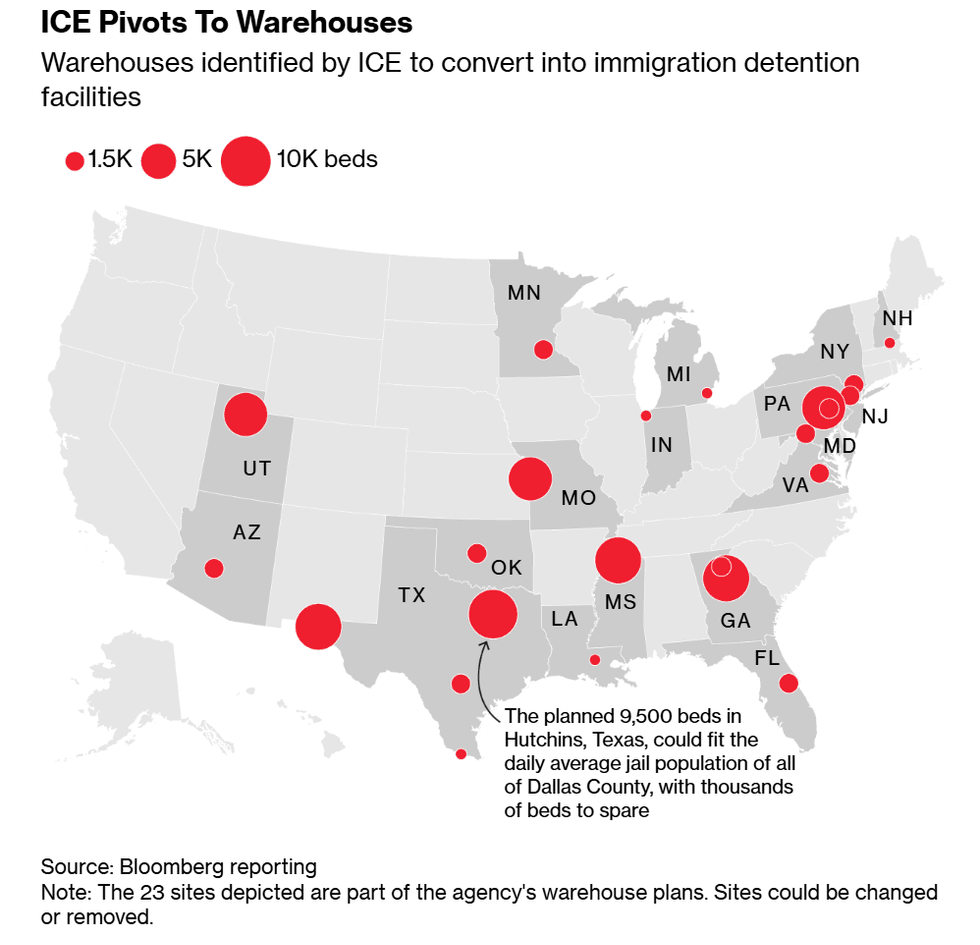 Graphic from Bloomberg
The new reporting from Migrant Insider comes on the heels of a report last week from Bloomberg that US Immigration and Customs Enforcement (ICE) has used some of the $45 billion to purchase warehouses in nearly two dozen remote communities, each meant to house thousands of detainees, which it said "could be the largest expansion of such detention capacity in US history."
The plans have been met with backlash from locals, even in the largely Republican-leaning areas where they are being constructed:
This month, demonstrators protested warehouse conversions in New Hampshire, Utah, Texas and Georgia after the Washington Post published an earlier version of the conversion plan.
In mid-January, a planned tour for contractors of a potential warehouse site in San Antonio was canceled after protesters showed up the same day, according to a person familiar with the scheduled visit.
In Salt Lake City, the Ritchie Group, a local family business that owns the warehouse ICE identified as a future “mega center” jail, said it had “no plans to sell or lease the property in question to the federal government” after protesters showed up at their offices to pressure them.
On January 20, Sen. Chris Van Hollen (D-Md.) joined hundreds of protesters outside a warehouse in Hagerstown, Maryland, that was set to be converted into a facility that will hold 1,500 people.
The senator called the construction of it and other detention facilities "one of the most obscene, one of the most inhumane, one of the most illegal operations being carried out by this Trump administration."
Reports of a new influx of funding from the Navy come as Democrats in Congress face pressure to block tens of billions in new funding for DHS and ICE during budget negotiations.
"If Congress does nothing, DHS will continue to thrive," Manríquez said. "With three more years pre-funded, plus a US Navy as a benefactor, Secretary Kristi Noem—or any potential successor—has the legal and financial runway to keep the business of creating ICE concentration camps overnight in American communities running long after any news cycle fades."

Congresswoman Yassamin Ansari on Sunday called for the impeachment of US Attorney General Pam Bondi after the Department of Justice published dozens of unredacted nude photos of young women or teenagers as part of its legally required release of files related to deceased sex offender Jeffrey Epstein.
The DOJ released the final batch of documents on Friday, well beyond the December 19 deadline established by the Epstein Files Transparency Act. Although President Donald Trump signed the law, his ties to the late billionaire and heavy redactions of previously released records have fueled concerns about the process.
While reviewing the more than 3 million pages published last week, New York Times journalists found "nearly 40 unredacted images" of "nude bodies and the faces of the people portrayed," the newspaper reported. "The people in the photos appeared to be young, although it was unclear whether they were minors. Some of the images seemed to show Mr. Epstein's private island, including a beach. Others were taken in bedrooms and other private spaces."
The paper continued:
The Times notified the Justice Department on Saturday of nude images that journalists had encountered and flagged more of them on Sunday. A spokeswoman said that the department was "working around the clock to address any victim concerns, additional redactions of personally identifiable information, as well as any files that require further redactions under the act, to include images of a sexual nature."
"Once proper redactions have been made, any responsive documents will repopulate online," the spokeswoman said.
Officials have largely removed or redacted the images that the Times flagged for them. The images appeared to show at least seven different people, although the Times did not seek to identify them.
Flagging the report on social media late Sunday, Ansari (D-Ariz.) declared that "this is an indefensible and horrifying disregard for the victims by Trump's US Department of Justice. They are still withholding the full Epstein Files, and rich and powerful men continue to evade accountability for their heinous crimes. Attorney General Pam Bondi should be impeached."
Even before the nude photos were discovered, progressive Congresswoman Alexandria Ocasio-Cortez (D-NY) similarly called for Bondi's impeachment on Friday, pointing to not only her DOJ's handling of the Epstein files, but also its efforts to force Minnesota to turn over voter data and the arrest of journalists, including former CNN anchor Don Lemon.
Since Friday, survivors of Epstein's abuse have also slammed the DOJ, with 18 of them saying in a joint statement that the latest release "is being sold as transparency, but what it actually does is expose survivors. Once again, survivors are having their names and identifying information exposed, while the men who abused us remain hidden and protected. That is outrageous."
“As survivors, we should never be the ones named, scrutinized, and retraumatized while Epstein's enablers continue to benefit from secrecy. This is a betrayal of the very people this process is supposed to serve," they continued. "This is not over. We will not stop until the truth is fully revealed and every perpetrator is finally held accountable."
CNN reported Monday that lawyers Brittany Henderson and Brad Edwards requested "immediate judicial intervention" by US Judges Richard Berman and Paul Engelmayer to address at least "thousands of redaction failures on behalf of nearly 100 individual survivors whose lives have been turned upside down by DOJ's latest release."
"There is no conceivable degree of institutional incompetence sufficient to explain the scale, consistency, and persistence of the failures that occurred—particularly where the sole task ordered by the court and repeatedly emphasized by DOJ was simple: Redact known victim names before publication," the attorneys wrote.
While the DOJ didn't reply to the outlet's request for comment, Henderson said in a statement to CNN that "with every second that passes, additional harm is being caused to these women. They are scared, they are devastated, and they are begging for our government to protect them from further harm."

A whistleblower last year filed a complaint against US Director of National Intelligence Tulsi Gabbard whose contents are so sensitive that the complaint itself has reportedly been locked in a safe.
The Wall Street Journal reported on Monday that the complaint was filed in May, and it set off "a continuing, behind-the-scenes struggle about how to assess and handle it, with the whistleblower’s lawyer accusing Gabbard of stonewalling the complaint."
The Journal's sources say that the complaint is so classified that no one in the US Congress has even laid eyes on it, as disclosure of its contents could cause "grave damage to national security."
A letter written by Andrew Bakaj, the whistleblower's attorney, to Gabbard in November accused her office of trying to block the complaint from reaching members of Congress by failing to provide guidance about how it should be handled while minimizing national security risks.
Gabbard's office told the Journal that it is working to get the issue resolved but that it is taking time because of the sensitive nature of the complaint, which it dismissed as "baseless and politically motivated."
However, Bakaj told the Journal that he doesn't believe Gabbard's office is making a good-faith effort to disclose the complaint to Congress.
“From my experience, it is confounding for [Gabbard’s office] to take weeks—let alone eight months—to transmit a disclosure to Congress,” he said.
The Journal was not able to verify the contents of the complaint against Gabbard, and Bakaj told the paper that its contents are so highly classified that he has not been allowed to view it.
Whistleblower Aid, the nonprofit legal organization where Bakaj serves as chief legal counsel, called on Monday for Congress to open an investigation into Gabbard "for hiding high-level intelligence... for nearly eight months," as well as for "her attempts to bury a whistleblower disclosure about her own actions," as required by US law.
National security attorney Mark Zaid, who co-founded Whistleblower Aid, praised the organization's work in representing the whistleblower and declared in a social media post that Gabbard and her office "have a lot of explaining to do."

Cuba's Ministry of Foreign Affairs on Monday said the country is open to expanding "bilateral cooperation" with the US, following President Donald Trump's comments that the White House is "going to make a deal with Cuba"—but diplomatic officials emphasized that they vehemently reject Trump's recent accusations that they harbor terrorists and pose an "unusual and extraordinary threat" to the US.
"Cuba categorically declares that it does not harbor, support, finance, or permit terrorist or extremist organizations," said the ministry.
The statement was released days after the White House issued an executive order to address what it called threats that Cuba poses to the US, threatening to impose new tariffs on countries that sell oil to Cuba.
Trump's invasion of Venezuela—which had been the top energy supplier to Cuba—and his push to take control of the South American country's oil has left Cuba's economy struggling with a virtual energy blockade and rolling blackouts. The US has also been pressuring Mexico to stop supplying energy to the island nation, prompting fears of a potential humanitarian crisis.
White House Deputy Chief of Staff Stephen Miller said last month that the US has the right to take over any country if doing so furthers its interests, and said the Trump administration should "secure our interests unapologetically in our hemisphere."
In the executive order last week, the president made sweeping accusations against Cuba, claiming that it provides support for countries including Russia and China—though the Trump administration has also sought improved relations with Russian President Vladimir Putin and Chinese President Xi Jinping—and offering no evidence for the allegation that it also supports Hamas and Hezbollah.
The Cuban storytelling platform Belly of the Beast called the accusation "laughable, if it weren't so serious," and spoke to some of the hundreds of Palestinian medical students who are studying to be doctors at the Latin American School of Medicine and other institutions.
"The vast majority of Palestinians in Cuba are medical students," said Ihab Masri, who is studying there alongside students from about 100 other countries. "Trump is a person who says he stopped 10 or 12 wars... a person who not only justifies but also denies the genocide in Gaza that they commit and have committed. You can't trust someone like that."
In his attempt to block oil shipments to Cuba, Donald Trump now claims the country is a safe haven for Hamas and Hezbollah, without presenting any evidence. Cubans say it’s complete nonsense. The real story? Hundreds of Palestinian students training to be doctors in Havana. pic.twitter.com/3X24dhF6mN
— Belly of the Beast (@bellybeastcuba) February 1, 2026
Trump's executive order also accused Cuba of spreading "its communist ideas, policies, and practices around the Western Hemisphere, threatening the foreign policy of the United States."
The Ministry of Foreign Affairs on Monday emphasized that "Cuba does not host foreign military or intelligence bases and rejects the characterization that it is a threat to the security of the United States. Nor has it supported any hostile activity against that country, nor will it allow its territory to be used against another nation."
The US has maintained a trade embargo on Cuba for more than six decades and has had hostile relations with the country since the communist revolution gave rise to the late President Fidel Castro and overthrew authoritarian leader Fulgencio Batista, who was backed by the US.
US Rep. Jesús "Chuy" García (D-Ill.) warned that Trump's "latest economic assault against the island is designed to cause a humanitarian collapse, deepening our collective punishment of the Cuban people and forcing more migration."
"Cuba poses no threat to the United States, but that’s not the point. Trump is manufacturing an excuse for cruelty and regime change," added the congressman, while Rep. Rashida Tlaib (D-Mich.) denounced Trump's executive order as "pure cruelty" that could "kill countless innocent Cubans."
Cuban President Miguel Diaz-Canel said last week that Trump's threat against countries that continue to supply energy "reveals the fascist, criminal, and genocidal nature of a clique that has hijacked the interests of the American people for purely personal ends."
On Monday, the global organization Progressive International joined Cuban officials in denouncing Trump's executive order as a "cruel and criminal act of economic warfare that will bring nothing but starvation, deprivation, and despair to [Cuba's] people."
"With this new executive order, the logic of siege has reached its apotheosis: Sanction not only Cuba but every nation that dares show solidarity, effectively demanding that sovereign states choose between the interests of their own people and the dictates of an empire," said the Cabinet of Progressive International.
The group called on the international community to "coordinate diplomatic resistance, demand that governments refuse to enforce secondary tariffs, and amplify Cuban voices against this assault on international law, human dignity, and basic human rights."
"History will judge those who saw this moment and turned away. Cuba stood with oppressed peoples globally—from defeating apartheid in South Africa to sending doctors to the frontlines of epidemics—and now it is our time to act with audacity, moral courage, and collective force," said Progressive International."
"Stand with the Cuban people now," the group added. "Stand against this siege, this economic assault, this unfolding humanitarian disaster; join together in the provision of key supplies to the island, from medicine to food to fuel for its people; and stand for the right of all nations to self-determination and human dignity, or be complicit in its destruction."

The descendants of former President John F. Kennedy are denouncing President Donald Trump's order to shutter the Kennedy Center and calling bullshit on his reasons for doing so.
On Sunday, Trump abruptly announced on Truth Social that beginning on July 4, the performing arts center in Washington, DC, which he recently renamed after himself, would shut down for two years for “Construction, Revitalization, and Complete Rebuilding.”
Trump said the decision was based on input from a group of "many Highly Respected experts," who said the center was "tired, broken, and dilapidated" and needed to be shut down for a facelift.
However, the family of the center's namesake said it has more to do with the recent pullout of talent in protest after it became the "Trump-Kennedy Center" last year and the president began asserting control over its programming, which included the world premiere of a hagiographic documentary about his wife, First Lady Melania Trump, this weekend.
In a post on social media, JFK's niece, Maria Shriver, gave what she said was a "translation" of Trump's comments about the center's sudden closure.
She suggested the president meant to say: "It has been brought to my attention that due to the name change (but nobody's telling me it's due to the name change), but it's been brought to my attention that entertainers are canceling left and right, and I have determined that since the name change no one wants to perform there any longer."
Speaking as Trump, she continued: "I've determined that due to this change in schedule, it's best for me to close this center down and rebuild a new center that will bear my name, which will surely get everybody to stop talking about the fact that everybody's canceling... right?"
Among those who have pulled out of planned performances at the center are the Washington National Opera, Lincoln composer Philip Glass, the Broadway show Hamilton, the actress and producer Issa Rae, and several others—many of whom directly cited Trump's takeover as their reason.
Kennedy's grandson, Jack Schlossberg, who is running for Congress as a Democrat in New York, was even more direct in his condemnation.
"Trump can take the Kennedy Center for himself. He can change the name, shut the doors, and demolish the building. He can try to kill JFK," he wrote. "But JFK is kept alive by us now rising up to remove Donald Trump, bring him to justice, and restore the freedoms generations fought for."

The mayor of Portland, Oregon demanded that federal immigration enforcement officials leave his city after they were seen lobbing tear gas and flash bang grenades at demonstrators.
As reported by The Oregonian on Sunday, Portland Mayor Keith Wilson reacted with outrage after seeing federal agents deploying tear gas and firing rubber bullets at thousands of protesters who on Saturday marched to a US Immigration and Customs Enforcement (ICE) facility in the city's South Waterfront neighborhood.
Wilson called the agents' attacks on protesters a vast overreaction to a "peaceful daytime protest, where the vast majority of those present violated no laws, made no threat, and posed no danger to federal forces" stationed at the facility.
“To those who continue to work for ICE: Resign. To those who control this facility: Leave,” Wilson said. "Through your use of violence and the trampling of the Constitution, you have lost all legitimacy and replaced it with shame."
The mayor also heaped scorn on federal agents for employing such tactics when several children were present in the crowd.
"To those who continue to make these sickening decisions, go home, look in a mirror, and ask yourselves why you have gassed children," he said. "Ask yourselves why you continue to work for an agency responsible for murders on American streets. No one is forcing you to lie to yourself, even as your bosses continue to lie to the American people."
Erin Hoover Barnett, a former Oregonian reporter who attended the demonstration, told the paper that she saw "what looked like two guys with rocket launchers" who started dousing the crowd with tear gas on Saturday.
"To be among parents frantically trying to tend to little children in strollers," she said, "people using motorized carts trying to navigate as the rest of us staggered in retreat, unsure of how to get to safety, was terrifying."
A Portland protester identified only as Robin gave an account similar to Barnett's during an interview with local news station KPTV.
"About eight or 10 of them came out with guns whatever kind of guns they have and flash bombed just started throwing them at the crowd just exploding everywhere," said Robin. "It was like a war zone. It felt like we were under attack. I definitely got hit. I had to run around the corner and pour a bunch of water on my face."
One local protester identified only as Celeste told local news station KOIN 6 that she was out on the streets because she wanted to "fight tyranny."
"What’s happening in our streets with ICE is ridiculous," said Celeste. "It’s illegal. It’s got to be stopped. And no one’s going to stop it. Except we the people. We’ve got a tyrant in the White House, and no one will stop him but us.”

Progressive critics of Senate Minority Chuck Schumer had fresh reasons to speak out Sunday after the powerful New York Democrat said that "one of many of [his] jobs" in the US Senate was to fight for ongoing taxpayer-funded military and financial assistance to the Israeli government, a position that has been the focus of growing protest among rank-and-file party members and the public at large in the face of Israel's brutal genocide against the Palestinian people of Gaza.
“I have many jobs as [Senate] leader... and one is to fight for aid to Israel — all the aid that Israel needs," Schumer said at a gathering of Jewish leaders and community members in New York on Sunday.
"I will continue to fight for it.," Schumer continued. "We delivered more security assistance to Israel, our ally, than ever, ever before."
According to Jacob Kornbluh, who provided footage of the remarks while reporting for The Forward, Schumer told the audience that his support for Jewish security funding will only continue growing under his leadership, calling it his “baby.”
Schumer:
“I have many jobs as leader.. and one is to fight for aid to Israel — all the aid that Israel needs. I will continue to fight for it.
“We delivered more security assistance to Israel, our ally, under my leadership than ever, ever before. We will keep doing that.” pic.twitter.com/qXMONmyiYj
— Jacob N. Kornbluh (@jacobkornbluh) February 1, 2026
"As long as I’m in the Senate," Schumer said, "this program will continue to grow from strength to strength, and we won’t let anyone attack it or undo it."
Meanwhile, in Gaza over the weekend and despite claims that a cease fire remains in effect, bombings by Israel in Gaza killed and wounded dozens of people, including women, children, and police officers.
“We found my three little nieces in the street. They say ‘ceasefire’ and all. What did those children do? What did we do?” Samer al-Atbash, an uncle of the three children killed in Gaza City, told Reuters.
Critics of Schumer's leadership took his comments Sunday as yet more confirmation that his relentless and unquestioning support for Israel—despite the genocide in Gaza, the enormous drop in public support for US support of the Israeli government's policies—as a sign that he remains far out of step with the general public and party membership, especially younger Democrats.
"A reminder that he vast majority of Democratic voters don’t agree with this—either this being his job description or aid to Israel itself—which is why Schumer should not be leader of the Democrats in the Senate," said journalist Mehdi Hasan.
"No, that is not your job," declared Saikat Chakrabarti, a Bay Area progressive running for a seat in the US House in California in this year's primary.
"Seventy-five percent of Democratic voters oppose sending Israel more military aid, as do 66% of independents and 60% of Americans overall," noted Dylan Williams, vice president for government affairs at the Center for International Policy, in response to the clip. "Schumer may use his position as Leader to push for more aid to Israel, but he should not misunderstand that to be part of the job Democrats entrusted to him."
Progressive organizer Aaron Regunberg, in a social media response, listed "jobs a Senate Democratic Leader should have," which include: "Fight Trump/fascism; Help Democrats win back power; Pass policy to help working people," compared to "jobs a Senate Democratic Leader shouldn’t have: Fight for all the aid that Israel needs."
"That’s just not the job," Regunberg said. "Schumer needs to resign."

After Border Patrol agent Jesus Ochoa and Customs and Border Protection officer Raymundo Gutierrez were identified Sunday as the two masked federal officers who shot and killed ICU nurse Alex Pretti in Minneapolis on Jan. 24, immediate calls for their arrest and prosecution went out alongside demands for the heavy-handed operations ordered by the Trump administration to come to an immediate end.
ProPublica named Ochoa and Gutierrez, both from Texas but deployed for operations in Minnesota prior to the shooting, based on government documents the nonprofit news outlet obtained.
According to ProPublica:
Both men were assigned to Operation Metro Surge, an immigration enforcement dragnet launched in December that sent scores of armed and masked agents across the city.
CBP, which employs both men, has so far refused to release their names and has disclosed few other facts about the deadly incident, which came days after a different immigration agent shot and killed another Minneapolis protester, a 37-year-old mother of three named Renee Good.
Protests erupted in Minneapolis and nationwide following the homicides of Good and Pretti, both captured on video from various angles by bystanders for all the world to see. Sunday's reporting notes that both Ochoa and Gutierrez were seasoned officers with the Border Patrol, joining the agency in 2018 and 2014 respectively.
"The two CBP federal agents who murdered Alex Pretti have been on the job for 11 and 7 years, respectively," said Melanie D'Arrigo, executive director of the New York Health Campaign, in response to the reporting. "It’s not a lack of training issue, it’s a culture of violence and lawlessness issue. If you’re still voting to fund this, you’re condoning it."
Many lawmakers have argued that the killings of Pretti and Good—as well as the near-endless list of violence, intimidation, unconstitutional searches, and unlawful behavior of immigration enforcement officers under the direction of Homeland Security Secretary Kristi Noem—are attributable to a wave of new recruits and inadequate training. But critics have said that the argument provides a smokescreen for the Trump administration, which has encouraged such tactics as a matter of policy.
"ICE has much more than a training problem—it has a culture problem," said Rep. Pramila Jayapal (D-Wash.) during a news interview on Sunday. "The lack of accountability for their violence and lawless actions corrupts the entire agency, and our communities are forced to pay the consequences."
ICE has much more than a training problem – it has a culture problem.
The lack of accountability for their violence and lawless actions corrupts the entire agency, and our communities are forced to pay the consequences. pic.twitter.com/hO0eMQ04uh
— Pramila Jayapal (@PramilaJayapal) February 1, 2026
Social justice activists like Lance Cooper were among those demanding, now that the identities are known, for the arrest and prosecution of the two agents named in the reporting.
"These killers are being protected by the US government," said Lance, "and we must continue to demand their arrest and prosecution."
State and local law enforcement in Minnesota been allowed to participate in the investigation following Pretti's shooting, and both agents were quickly taken away from the scene and then out of the state.
While the Trump administration has withheld the names of the agents from public disclosure, the editors at ProPublica said in a note that the public has an overriding interest in learning more about the masked men behind the killing of Pretti.
"The policy of shielding officers’ identities, particularly after a public shooting, is a stark departure from standard law enforcement protocols, according to lawmakers, state attorneys general and former federal officials," the outlet stated. "Such secrecy, in our view, deprives the public of the most fundamental tool for accountability."


