

💵Meta's Manus Acquisition: A New Playbook for Chinese-Founded AI Startups
Build with Chinese engineers, target global markets, secure global VC funding, establish legal presence outside China, and when the time comes, execute a clean exit.

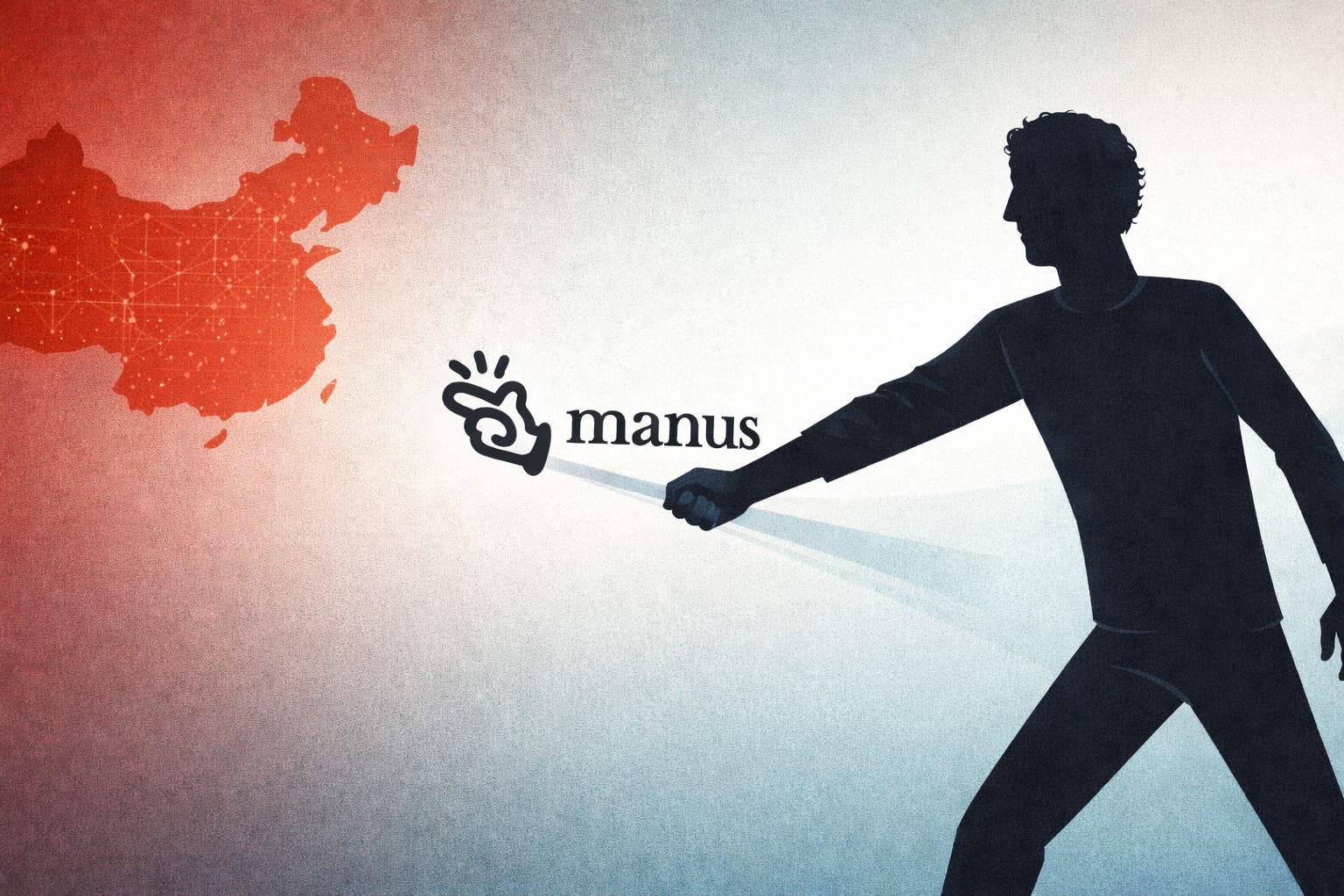
Six months ago, Manus was being called a deserter (‘逃兵’). When the company relocated to Singapore in mid-2025, shuttered all its China-focused operations, laid off 80 mainland employees, and went dark on Chinese social media, the backlash was brutal. Chinese netizens and media tore into them for abandoning their home market.

Yet that move proved to be the key that unlocked what came next. This week, Meta acquired Manus for over $2 billion—the company’s third-largest acquisition after WhatsApp and Scale AI. The deal was struck in reportedly around 10 days. The 100-person Manus team will join Meta, with Xiao Hong, CEO of Manus who goes by Red, reporting directly to Meta COO Javier Olivan.

This isn’t just another normal acquisition story. It’s a blueprint for how a new generation of Chinese entrepreneurs can build world-class AI products, win over global capital and tech companies, and execute a clean exit. It’s also a microscope through which we can observe the latest dynamics of U.S.-China AI competition, where talent and technology flows across borders even as geopolitical walls rise higher.
The Team Behind Manus
When Manus launched publicly with beta access earlier this year, it immediately stood apart from the chatbot crowd. Instead of just responding to commands, Manus was designed as a true AI agent. Give it a goal like “analyze competitors and create a business report,” and it would deliver—browsing the web, analyzing data, generating code, planning travel, building prototypes, writing reports, all with minimal human direction. The waitlist exploded to millions of users. Of course, success also breeds skepticism as critics (including me) dismissed Manus as “just a wrapper for Anthropic’s Claude.”

The results spoke for themselves. On GAIA, a benchmark designed to measure real-world problem-solving, Manus reportedly outperformed even OpenAI’s Deep Research across multiple complexity levels. Today, on the Remote Labor Index (RLI) benchmark created by Scale AI to measure how well AI agents handle complex, real-world remote jobs, Manus is state-of-the-art. The agent has processed more than 147 trillion tokens and powered the creation of over 80 million virtual computers, Manus said.
One month after launch in April 2025, Benchmark Capital led a $75 million Series A at a $500 million valuation, with Tencent, ZhenFund, and HongShan Capital joining the round. By December 2025, just nine months after launch, Manus AI announced it had hit $100 million in annual recurring revenue (ARR).
Chetan Puttagunta, the Benchmark General Parker who led the funding round, didn’t mince words when describing Manus’s team. He called them “one of the greatest technical teams in the world,” “brilliance, resilience, grit, vision, execution, and kindness.”
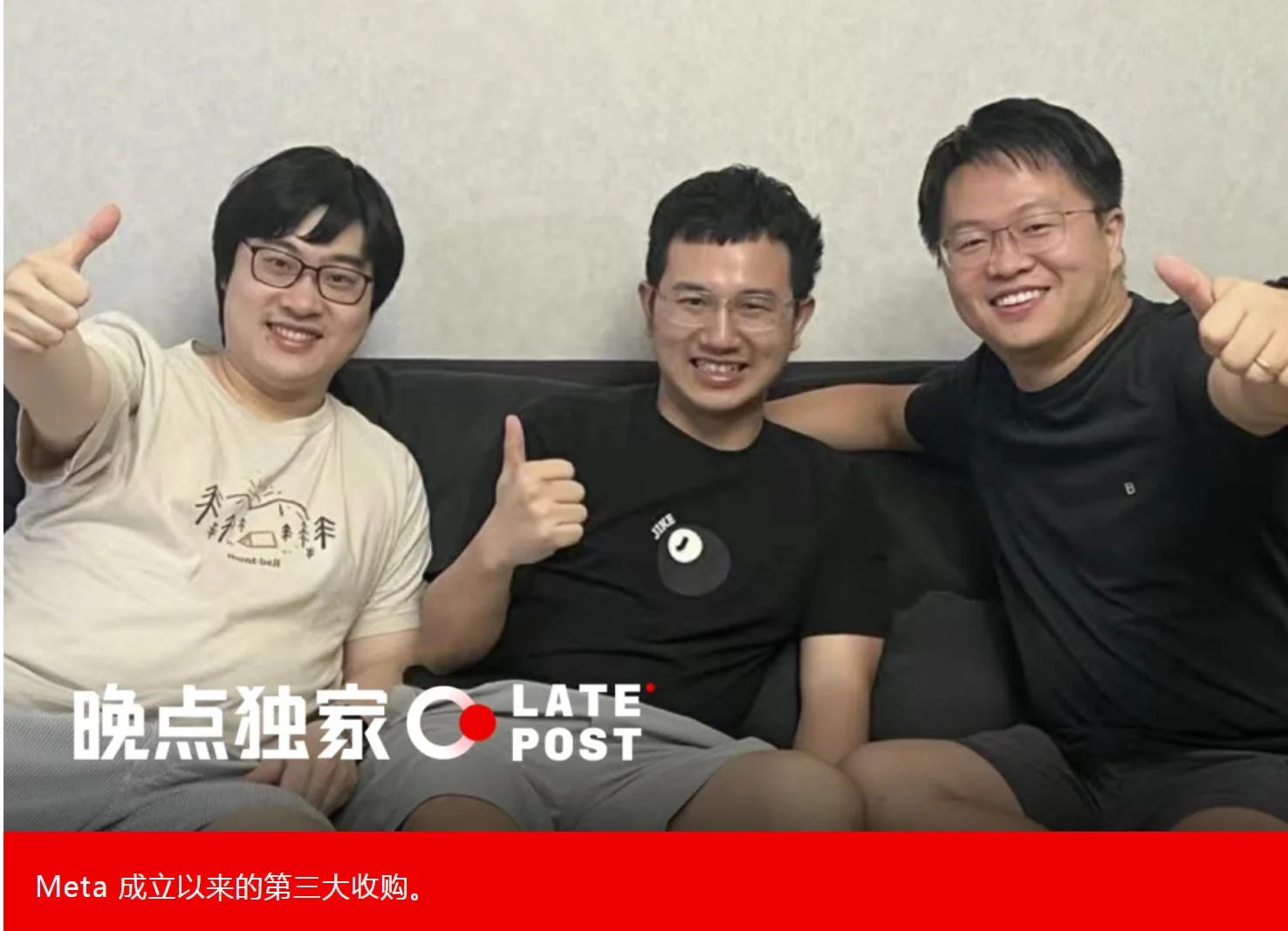
Look at the founding team. Xiao Hong isn’t a rookie. His first startup, launched in 2016 just a year after graduation, built creator tools for WeChat, where users can create content easily. That venture nearly failed him, and he was about to give up the company entirely before he accidentally won a hackathon. There he met Liu Yuan, a general partner at ZhenFund who became his mentor and close friend. Over the next decade, Liu and ZhenFund backed Xiao through every funding round, and brought in two critical partners for Manus: Peak Ji and Zhang Tao (Hidecloud).
Peak Ji Yichao, the CTO, is something of a prodigy. Son of a Peking University physics professor dad and a serial entrepreneur mom, Ji made his name a decade ago as a high school student creating Mammoth 5, which once became the most downloaded third-party iPhone browser in China, and Magi, a knowledge search engine. Zhang Tao, the CPO, brought 15 years of product experience across multiple top-tier tech companies.
(I highly recommend the interview below between Peak Ji and Benita Zhang)

In 2022, Xiao founded his second startup, Butterfly Effect, which launched Monica—a Chrome extension that uses LLMs to help users translate, summarize, and write. That experience building Monica directly paved the way for Manus.
Why Meta Bought Manus
The talent acquisition angle is crucial to understanding this deal. If you look at recent major acquisitions in Silicon Valley—Google acquiring Noam Shazeer through the Character.AI deal, the Windsurf acquisition for its executive team, Microsoft buying Inflection—they’re all fundamentally acqui-hires. These companies are paying billions to acquire teams that know how to build models and AI products. Meta’s earlier acquisition of Scale AI for over $10 billion followed the same playbook, bringing Alexandr Wang in to lead its AI efforts.
The second strategic driver is Meta desperately needs a powerful AI agent that can thread through its entire ecosystem of social media products—Facebook, Instagram, WhatsApp, and Messenger. Manus can also serve as a complementary entry as Silicon Valley tech giants are building standalone AI products like Google’s Gemini and Microsoft’s Copilot. In announcing the acquisition, Meta indicated plans to operate and sell Manus and integrate it into its suite of social media products.
The $2 billion price tag might sound high for a company founded three years ago with a product that’s only nine months old. But in the context of Meta’s other AI acquisitions and the team quality, it’s not actually crazy. In October, Meta raised its 2025 capital expenditure outlook to about $70 billion.


The China Exit Playbook
This acquisition represents a complete cut-tie from China. Meta spokesman Andy Stone made it explicit: there will be no continuing Chinese ownership interests in Manus after the transaction, and the startup will discontinue all services and operations in China.
This is fundamentally different from the last generation of Chinese tech companies. ByteDance created separate products for different markets (Douyin and TikTok) while keeping roots in China. Pinduoduo followed a similar model. Shein maintains a huge operational base in China while selling globally, though it now faces mounting scrutiny from U.S. and other regulators.
Manus and its parent company Butterfly Effect, by contrast, have been actively distancing themselves from state-linked capital. For example, when rumors surfaced that a state-run fund from Wuhan—the city where Butterfly Effect was founded—had invested in the company, Xiao directly rebutted it in a WeChat group and asked people to help clarify.
The regulatory landscape leaves little room for ambiguity. U.S. capital is barred from investing in Chinese firms developing AI, semiconductors, and quantum technologies. Top-tier chips from Nvidia and AMD cannot be sold to mainland China. Frontier model access such as Anthropic’s Claude is prohibited for Chinese companies. Given these constraints, a Chinese AI application startup targeting global markets and seeking international capital has limited paths forward.
Former Google CEO Eric Schmidt pointed out in a public forum that Chinese startups literally cannot get the money to keep up in the AI race, lacking access to the depth of the U.S. capital markets needed for large-scale model training.
The valuation gap is huge. China’s homegrown AI startups, despite their remarkable technical progress, are dramatically undervalued. Moonshot AI, developer of the frontier LLM Kimi, just raised $500 million at a $4.3 billion valuation. Zhipu AI and MiniMax, China’s other two top LLM startups preparing to go public in early 2026, are targeting valuations between $6.5 and $7 billion. Meanwhile, OpenAI is in talks to raise up to $100 billion at a potential valuation of $830 billion, meaning China’s No.1 LLM startup is worth less than 1% of America’s top player.
We’re living in an era of choosing sides. The Chinese regulator clearly isn’t happy about this deal. The Wall Street Journal reported that Beijing officials were surprised and displeased by Meta’s acquisition, viewing Manus as a showcase of China’s AI capabilities. They worry the sale gives the U.S. access to technology developed by Chinese engineers and creates a template for other Chinese startups to follow.
Manus’s acquisition is one of the biggest AI stories of 2025, and certainly one of the most significant in China’s tech ecosystem. The new generation of Chinese entrepreneurs is targeting globalization from day one. Their products, their marketing, their entire orientation is toward global users. They’re leveraging China’s massive pool of talented engineers and product managers—people who’ve been battle-tested in China’s cutthroat, fast-paced internet competition.
The playbook is clear now: build with Chinese engineers, target global markets, secure global VC funding, establish legal presence outside China like Singapore, and when the time comes, execute a clean exit.
It’s an exciting time for ambitious Chinese entrepreneurs dreaming of building products that reach billions of global users, and for the investors who bet on them chasing massive returns. But the story has its casualties. For the 80 mainland engineers laid off when Manus relocated to Singapore, watching their former company sell for $2 billion must sting with a bitterness. And for the tens of millions of Chinese users whose access to Manus was abruptly shut down, there’s only an empty space where a product once lived, and the uncertain wait for a domestic replacement that may not match in the near term.

Great analysis. Manus exit shows that China shedding works, or rather, the only way to get to the finish line.