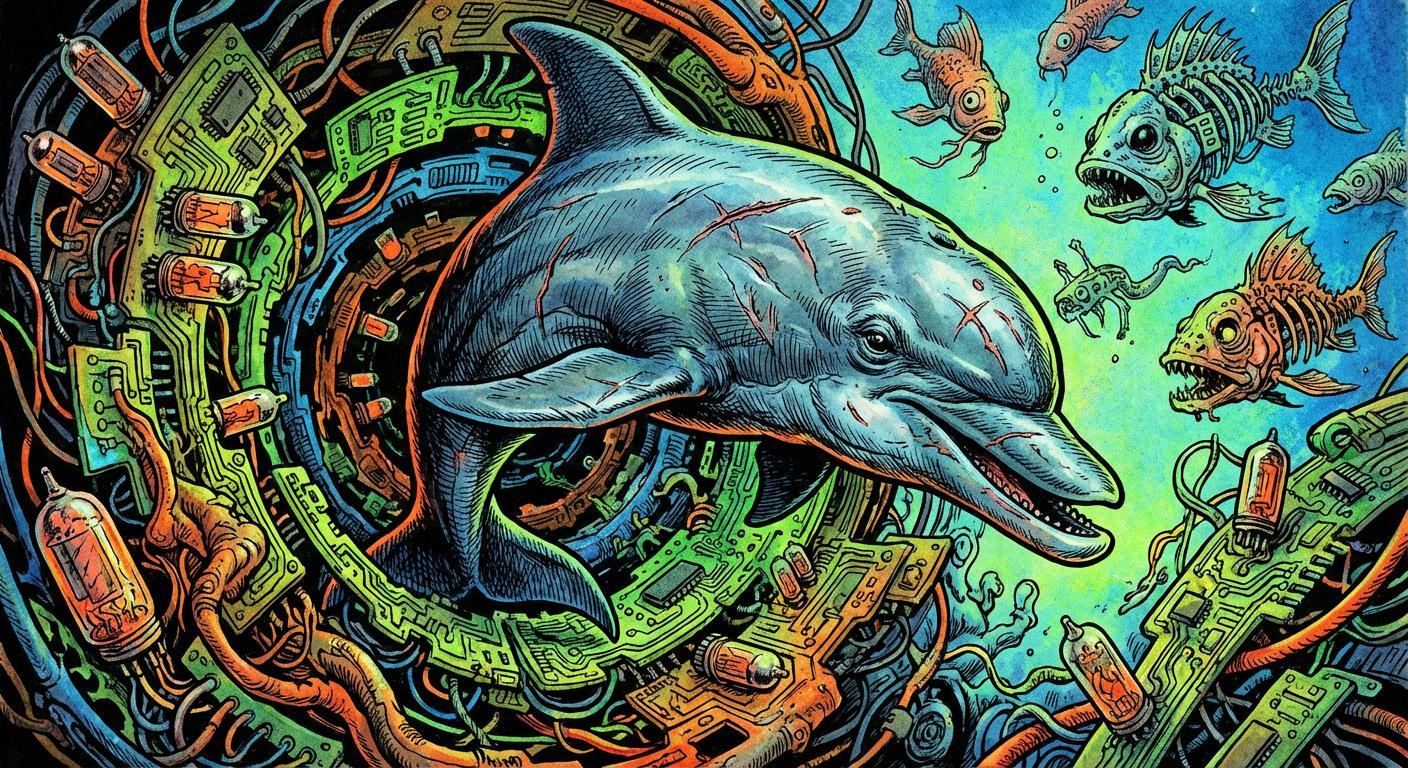
{Ecco the Dolphin navigating the Vortex computer circuit stages}, illustrated in William Stout's (b. 1949) signature subversive underground graphic illustration–inspired fine pictorial style (no speech bubbles, no text, no dialogue boxes, no comic panels, no lettering, no captions): {
William Stout's art style is profoundly shaped by his early aspiration to become a doctor, alongside lifelong passions for paleontology and paleobotany. Despite a childhood marked by poverty, he earned a full scholarship to the Chouinard Art Institute (later CalArts) on the strength of exceptional academic aptitude. His mature work masterfully fuses scientific rigor with artistic vision—continuing the tradition of paleoart pioneers Charles R. Knight (1874–1953) and Rudolph Zallinger (1919–1995)—while evoking a distinctive emotional register: eerie spookiness, escapist wonder, and meditative serenity. His landscapes share an atmospheric kinship with the plein-air traditions of Southern California painting, and he employs a flexible stylistic range—oscillating between tight realism and loose impressionism—to create emotional resonance that entertains as it educates.
Stout launched his professional career in 1968 with a cover for the inaugural issue of the occult pulp magazine Coven 13, signaling an immediate affinity for the macabre. In 1971, he apprenticed under Russ Manning (1929–1981) on the Tarzan of the Apes newspaper illustration series, absorbing Manning's anatomically rigorous draftsmanship rooted in the Alex Raymond (1909–1956) tradition. The following year, he joined Harvey Kurtzman (1924–1993) and Will Elder (1921–2008) on Little Annie Fanny, learning Kurtzman's irreverent timing and Elder's lush, obsessively detailed rendering. Concurrently, from approximately 1971 through the late 1970s, Stout immersed himself in the countercultural illustration movement, contributing to publications through Rip Off Press, Last Gasp, and Apex Novelties alongside peers including R. Crumb (b. 1943), Robert Williams (b. 1943), S. Clay Wilson (1941–2021), Gilbert Shelton (b. 1940), and Greg Irons (1947–1984). During this same period, he was recruited by "Dub" Taylor and associates at the infamous TMOQ (Trade Mark of Quality) bootleg label to illustrate album covers for unauthorized recordings of The Rolling Stones, Led Zeppelin, Bob Dylan, The Who, and Pink Floyd. These covers became canvases for Stout's countercultural sensibility: cartoonish anatomical exuberance rendered with crowquill precision, infused with a satirical, anti-corporate edge. His kinetic "pop-pulp" palette—saturated primaries and lurid Day-Glo accents suited to low-cost offset printing—evoked both the psychedelic poster art of Rick Griffin and Victor Moscoso and the garish hot-rod culture of Ed "Big Daddy" Roth. Narratively, these covers trafficked in chaotic concert scenarios, backstage debauchery, and surreal vignettes populated by grotesque human-animal hybrids and Boschian body-horror mutations—synthesizing the anatomical grotesquerie of Basil Wolverton with the lurid pulp energy of EC Comics. This bootleg oeuvre established Stout as a visual provocateur bridging lowbrow monster art and high-energy rock-and-roll mythology.
In 1981, Stout published The Dinosaurs: A Fantastic New View of a Lost Era, a landmark work that crystallized the "Dinosaur Renaissance" for a popular audience. Deeply inspired by the giant creatures in King Kong (1933) and the primeval forces of Fantasia (1940), Stout developed a highly dramatic approach to paleoart that rejected the sluggish, swamp-bound dinosaurs of mid-century illustration. This book—and its successor The New Dinosaurs (2000)—distilled emerging paleontological science into visually arresting, action-sticker-like compositions stylistically aligned with death-metal aesthetics. Stout fused the biological rigor of Gregory S. Paul's (b. 1954) skeletal reconstructions with Alphonse Mucha's (1860–1939) Art Nouveau framework: compressed spatiality, sinuous "whiplash" visual flow, and rhythmic stylized color. Rather than presenting encyclopedic species portraits, he organized dinosaur data with fresh speculation about sociality, warfare, and anatomy to create resonant narrative scenes. Atmospheric environmental context functions as implicit decorative framing through ornamental, modernist-aware, dense compositions. Through skeletal postures, Stout viscerally conveys a famished-yet-energetically struggling state—making the work akin to an extreme, hard-rock-inspired elaboration of Eleanor Kish's (1924–2014) atmospheric prehistoric landscapes. Where contemporaries like John Sibbick (b. 1949) sought photographic neutrality, Stout applied the ink-stained dynamism of EC Comics—particularly Wally Wood (1927–1981) and Al Williamson (1931–2010)—the atmospheric menace of Bernie Wrightson (1948–2017), the primitivist barbarism of Barry Windsor-Smith (b. 1949), and the primal heroic monumentality of Frank Frazetta (1928–2010) to the Mesozoic era. His dinosaurs are characterized by "shrink-wrapped" muscularity and vascular tension, reenvisioning staid museum-exhibit depictions into an electric life struggle that implicitly juxtaposes modern convenience against the feral, adrenaline-fueled daily existence of prehistoric creatures. This approach influenced the broader cultural reimagining of dinosaurs, contributing to the visual zeitgeist that informed works such as Michael Crichton's Jurassic Park (1990).
Parallel to his paleoart, Stout built a prolific career in film production design. Beginning with the rugged "sword and sorcery" aesthetic of Conan the Barbarian (1982), through the punk-rock horror of The Return of the Living Dead (1985), to the dark fantasy of Pan's Labyrinth (2006), Stout has served as storyboard artist, concept designer, or production designer on over thirty feature films. His concept visualization bridges comic art and cinema, heavily informed by the hyper-volumetric style of underground comix legend Richard Corben (1940–2020). Stout adopts Corben's "sculptural spherism," treating figures as dense, tangible masses rather than flat outlines. He employs theatrical, high-key lighting to create precise chiaroscuro—alternating between hard-edged, posterized shadow blocks and smooth airbrush-quality gradients. His compositions range from tight, tension-building perspectives to wide-angle dynamic action. This technique lends his storyboard and concept art a tactile, pseudo-3D solidity, enabling directors and cinematographers to visualize weight, texture, and environmental lighting long before cameras roll.
In 1997, Stout reportedly collaborated with Moebius (Jean Giraud, 1938–2012) on a short story featuring the iconic wordless warrior Arzach. For this project, Stout departed from his characteristically visceral aesthetic, instead adapting the meditative visual language of Moebius's Franco-Belgian tradition: compositional stillness over kinetic action, expansive negative space, precise linework, and delicate cross-hatching rendering texture through accumulation. The palette—muted ochres, dusty sienna, and pale atmospheric blues—evokes the vast, sun-bleached deserts of Moebius's original stories, achieved through soft gradients dissolving hard edges into luminous haze. This contribution demonstrates Stout's capacity for contemplative restraint, channeling Moebius's ability to generate narrative gravity through silence rather than explicit action.
In 2007, Stout created murals for the San Diego Natural History Museum's "Fossil Mysteries" exhibition. Drawing upon the otherworldly prehistoric landscapes of Thomas Moran (1837–1926), Stout developed a subtly psychedelic, jewel-toned palette suggestive of deep mineral crusts: cool shadowed depths—umbers, oxidized greens, bruised violets—punctuated by sudden washed-out flashes of sulfuric ochre and glacial blue. Dramatized low-angle views and black shadows evoke a megalophobic sense of looming dread, recalling the work of John Gurche (b. 1951) and Doug Henderson (b. 1949). These texturally smoky temperature contrasts render the ancient earth simultaneously alien and seductive—exemplified in speculative paintings like Mosasaur and Loons, which reimagines a prehistoric Antarctic marine scene.
In Legends of the Blues (2013), William Stout applied his signature 'Underground Comix' virtuosity to music history, creating a series of portraits that function less as cartoons and more as mythic archetypes. Moving beyond the neurotic fragility often found in R. Crumb’s blues illustrations, Stout adopts a heroic vernacular: he utilizes a 'woodcut-inspired' inking style—characterized by heavy, confident perimeter lines and dense, structural cross-hatching—to evoke the texture of vintage 'Race Records' advertisements and Victorian packaging. These linear foundations are illuminated by a vibrant, polychromatic watercolor palette that rejects sepia-toned nostalgia in favor of electric urgency. The result is a collection of stylized visual biographies that blend the collectibility of bubblegum trading cards with the compositional dignity of Art Nouveau, visually canonizing figures like Robert Johnson and Ma Rainey with a distinct 'poster-like' immediacy.
Across five decades, William Stout has forged a singular aesthetic that treats every subject—human, animal, or prehistoric beast—as a "character actor" imbued with behavioral specificity and visual charisma. His synthesis of Zallinger's anatomical realism, Manning's linear rigor, Kurtzman's satirical wit, underground comix provocation, EC Comics dynamism, and Corben's sculptural volume constitutes the foundational DNA of an artist who moves fluidly between scientific illustration, countercultural commentary, cinematic production design, and gallery-scale muralism. Whether depicting a shrink-wrapped tyrannosaur mid-hunt or a silent warrior traversing an alien desert, Stout's work consistently transforms factual observation into mythic spectacle—educational storytelling that entertains, provokes, and endures.


The 90s called, they want Photo #4 back (actually #1 as well)
{Ecco the Dolphin navigating the Vortex computer circuit stages}, illustrated in William Stout's (b. 1949) signature subversive underground graphic illustration–inspired fine pictorial style (no speech bubbles, no text, no dialogue boxes, no comic panels, no lettering, no captions): {
William Stout's art style is profoundly shaped by his early aspiration to become a doctor, alongside lifelong passions for paleontology and paleobotany. Despite a childhood marked by poverty, he earned a full scholarship to the Chouinard Art Institute (later CalArts) on the strength of exceptional academic aptitude. His mature work masterfully fuses scientific rigor with artistic vision—continuing the tradition of paleoart pioneers Charles R. Knight (1874–1953) and Rudolph Zallinger (1919–1995)—while evoking a distinctive emotional register: eerie spookiness, escapist wonder, and meditative serenity. His landscapes share an atmospheric kinship with the plein-air traditions of Southern California painting, and he employs a flexible stylistic range—oscillating between tight realism and loose impressionism—to create emotional resonance that entertains as it educates.
Stout launched his professional career in 1968 with a cover for the inaugural issue of the occult pulp magazine Coven 13, signaling an immediate affinity for the macabre. In 1971, he apprenticed under Russ Manning (1929–1981) on the Tarzan of the Apes newspaper illustration series, absorbing Manning's anatomically rigorous draftsmanship rooted in the Alex Raymond (1909–1956) tradition. The following year, he joined Harvey Kurtzman (1924–1993) and Will Elder (1921–2008) on Little Annie Fanny, learning Kurtzman's irreverent timing and Elder's lush, obsessively detailed rendering. Concurrently, from approximately 1971 through the late 1970s, Stout immersed himself in the countercultural illustration movement, contributing to publications through Rip Off Press, Last Gasp, and Apex Novelties alongside peers including R. Crumb (b. 1943), Robert Williams (b. 1943), S. Clay Wilson (1941–2021), Gilbert Shelton (b. 1940), and Greg Irons (1947–1984). During this same period, he was recruited by "Dub" Taylor and associates at the infamous TMOQ (Trade Mark of Quality) bootleg label to illustrate album covers for unauthorized recordings of The Rolling Stones, Led Zeppelin, Bob Dylan, The Who, and Pink Floyd. These covers became canvases for Stout's countercultural sensibility: cartoonish anatomical exuberance rendered with crowquill precision, infused with a satirical, anti-corporate edge. His kinetic "pop-pulp" palette—saturated primaries and lurid Day-Glo accents suited to low-cost offset printing—evoked both the psychedelic poster art of Rick Griffin and Victor Moscoso and the garish hot-rod culture of Ed "Big Daddy" Roth. Narratively, these covers trafficked in chaotic concert scenarios, backstage debauchery, and surreal vignettes populated by grotesque human-animal hybrids and Boschian body-horror mutations—synthesizing the anatomical grotesquerie of Basil Wolverton with the lurid pulp energy of EC Comics. This bootleg oeuvre established Stout as a visual provocateur bridging lowbrow monster art and high-energy rock-and-roll mythology.
In 1981, Stout published The Dinosaurs: A Fantastic New View of a Lost Era, a landmark work that crystallized the "Dinosaur Renaissance" for a popular audience. Deeply inspired by the giant creatures in King Kong (1933) and the primeval forces of Fantasia (1940), Stout developed a highly dramatic approach to paleoart that rejected the sluggish, swamp-bound dinosaurs of mid-century illustration. This book—and its successor The New Dinosaurs (2000)—distilled emerging paleontological science into visually arresting, action-sticker-like compositions stylistically aligned with death-metal aesthetics. Stout fused the biological rigor of Gregory S. Paul's (b. 1954) skeletal reconstructions with Alphonse Mucha's (1860–1939) Art Nouveau framework: compressed spatiality, sinuous "whiplash" visual flow, and rhythmic stylized color. Rather than presenting encyclopedic species portraits, he organized dinosaur data with fresh speculation about sociality, warfare, and anatomy to create resonant narrative scenes. Atmospheric environmental context functions as implicit decorative framing through ornamental, modernist-aware, dense compositions. Through skeletal postures, Stout viscerally conveys a famished-yet-energetically struggling state—making the work akin to an extreme, hard-rock-inspired elaboration of Eleanor Kish's (1924–2014) atmospheric prehistoric landscapes. Where contemporaries like John Sibbick (b. 1949) sought photographic neutrality, Stout applied the ink-stained dynamism of EC Comics—particularly Wally Wood (1927–1981) and Al Williamson (1931–2010)—the atmospheric menace of Bernie Wrightson (1948–2017), the primitivist barbarism of Barry Windsor-Smith (b. 1949), and the primal heroic monumentality of Frank Frazetta (1928–2010) to the Mesozoic era. His dinosaurs are characterized by "shrink-wrapped" muscularity and vascular tension, reenvisioning staid museum-exhibit depictions into an electric life struggle that implicitly juxtaposes modern convenience against the feral, adrenaline-fueled daily existence of prehistoric creatures. This approach influenced the broader cultural reimagining of dinosaurs, contributing to the visual zeitgeist that informed works such as Michael Crichton's Jurassic Park (1990).
Parallel to his paleoart, Stout built a prolific career in film production design. Beginning with the rugged "sword and sorcery" aesthetic of Conan the Barbarian (1982), through the punk-rock horror of The Return of the Living Dead (1985), to the dark fantasy of Pan's Labyrinth (2006), Stout has served as storyboard artist, concept designer, or production designer on over thirty feature films. His concept visualization bridges comic art and cinema, heavily informed by the hyper-volumetric style of underground comix legend Richard Corben (1940–2020). Stout adopts Corben's "sculptural spherism," treating figures as dense, tangible masses rather than flat outlines. He employs theatrical, high-key lighting to create precise chiaroscuro—alternating between hard-edged, posterized shadow blocks and smooth airbrush-quality gradients. His compositions range from tight, tension-building perspectives to wide-angle dynamic action. This technique lends his storyboard and concept art a tactile, pseudo-3D solidity, enabling directors and cinematographers to visualize weight, texture, and environmental lighting long before cameras roll.
In 1997, Stout reportedly collaborated with Moebius (Jean Giraud, 1938–2012) on a short story featuring the iconic wordless warrior Arzach. For this project, Stout departed from his characteristically visceral aesthetic, instead adapting the meditative visual language of Moebius's Franco-Belgian tradition: compositional stillness over kinetic action, expansive negative space, precise linework, and delicate cross-hatching rendering texture through accumulation. The palette—muted ochres, dusty sienna, and pale atmospheric blues—evokes the vast, sun-bleached deserts of Moebius's original stories, achieved through soft gradients dissolving hard edges into luminous haze. This contribution demonstrates Stout's capacity for contemplative restraint, channeling Moebius's ability to generate narrative gravity through silence rather than explicit action.
In 2007, Stout created murals for the San Diego Natural History Museum's "Fossil Mysteries" exhibition. Drawing upon the otherworldly prehistoric landscapes of Thomas Moran (1837–1926), Stout developed a subtly psychedelic, jewel-toned palette suggestive of deep mineral crusts: cool shadowed depths—umbers, oxidized greens, bruised violets—punctuated by sudden washed-out flashes of sulfuric ochre and glacial blue. Dramatized low-angle views and black shadows evoke a megalophobic sense of looming dread, recalling the work of John Gurche (b. 1951) and Doug Henderson (b. 1949). These texturally smoky temperature contrasts render the ancient earth simultaneously alien and seductive—exemplified in speculative paintings like Mosasaur and Loons, which reimagines a prehistoric Antarctic marine scene.
In Legends of the Blues (2013), William Stout applied his signature 'Underground Comix' virtuosity to music history, creating a series of portraits that function less as cartoons and more as mythic archetypes. Moving beyond the neurotic fragility often found in R. Crumb’s blues illustrations, Stout adopts a heroic vernacular: he utilizes a 'woodcut-inspired' inking style—characterized by heavy, confident perimeter lines and dense, structural cross-hatching—to evoke the texture of vintage 'Race Records' advertisements and Victorian packaging. These linear foundations are illuminated by a vibrant, polychromatic watercolor palette that rejects sepia-toned nostalgia in favor of electric urgency. The result is a collection of stylized visual biographies that blend the collectibility of bubblegum trading cards with the compositional dignity of Art Nouveau, visually canonizing figures like Robert Johnson and Ma Rainey with a distinct 'poster-like' immediacy.
Across five decades, William Stout has forged a singular aesthetic that treats every subject—human, animal, or prehistoric beast—as a "character actor" imbued with behavioral specificity and visual charisma. His synthesis of Zallinger's anatomical realism, Manning's linear rigor, Kurtzman's satirical wit, underground comix provocation, EC Comics dynamism, and Corben's sculptural volume constitutes the foundational DNA of an artist who moves fluidly between scientific illustration, countercultural commentary, cinematic production design, and gallery-scale muralism. Whether depicting a shrink-wrapped tyrannosaur mid-hunt or a silent warrior traversing an alien desert, Stout's work consistently transforms factual observation into mythic spectacle—educational storytelling that entertains, provokes, and endures.
}