




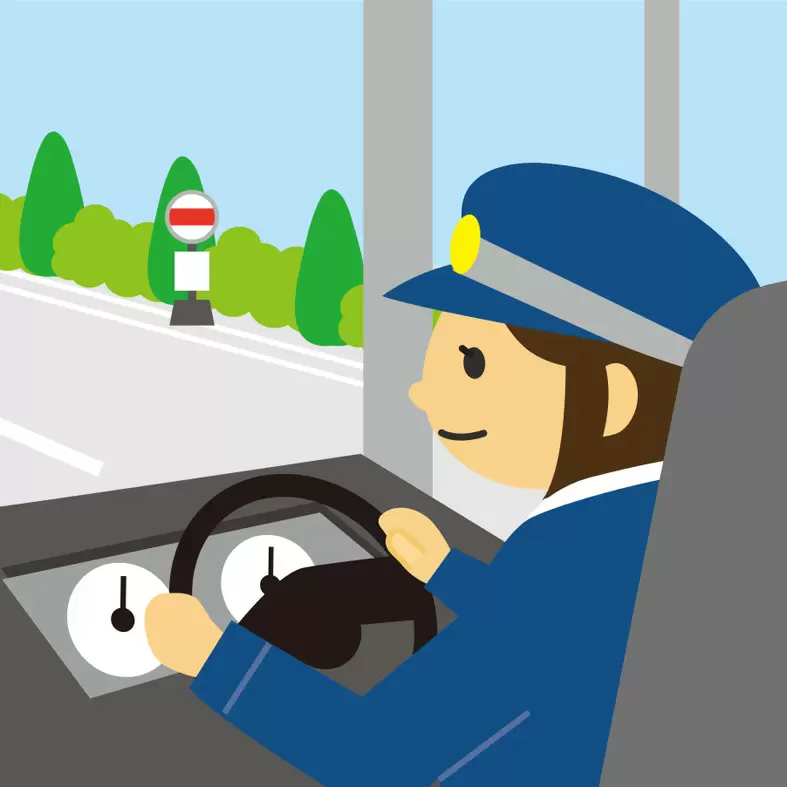
Drivers operate route buses that run from stop to stop on time, sightseeing buses that take travelers to their destinations, and shuttle buses used to take students to and from school. The number of female drivers is increasing.
Perfect For …
A person who is good at driving a car. A person who is serious and patient. A person with a strong sense of responsibility.
Job Details
Meaningful work that safely delivers many people to their destinations
The job of a bus driver is to carry a large number of passengers on a large or medium-sized bus to their destination. Bus work can be divided into three types depending on the passengers they carry. Route buses, which carry an unspecified number of passengers together around the bus stops, are called "shared-ride buses. Sightseeing buses that carry groups of passengers, such as on tour or school social studies visits, are "chartered buses. And "special buses," such as school buses that transport students to and from specific schools, are called "special buses. Charter buses are required to operate on a daily basis according to a set schedule because they serve as transportation for residents. Charter buses are used for sightseeing routes on excursions and school trips to help make the trip more memorable. Specified buses include those that operate at fixed times, such as school or company shuttle buses, and those that shuttle passengers to and from hotels and shopping malls between facilities and train stations throughout the day. All of them require a high level of driving skill supported by experience. In addition, the slightest defect in the vehicle body or slight error by the driver can lead to a major accident. Pre- and post-operation inspections and maintenance are indispensable, and the driver must be alert throughout the entire trip. The driver cannot leave his or her seat for personal reasons, and must be aware that passengers may suddenly become ill or that there may be trouble between passengers. Despite these hardships, it is a socially meaningful job in that "safe transportation is for the benefit of others.
Key Points !
A Large Motor Vehicle Class 2 Driver's License is required to drive a large bus.
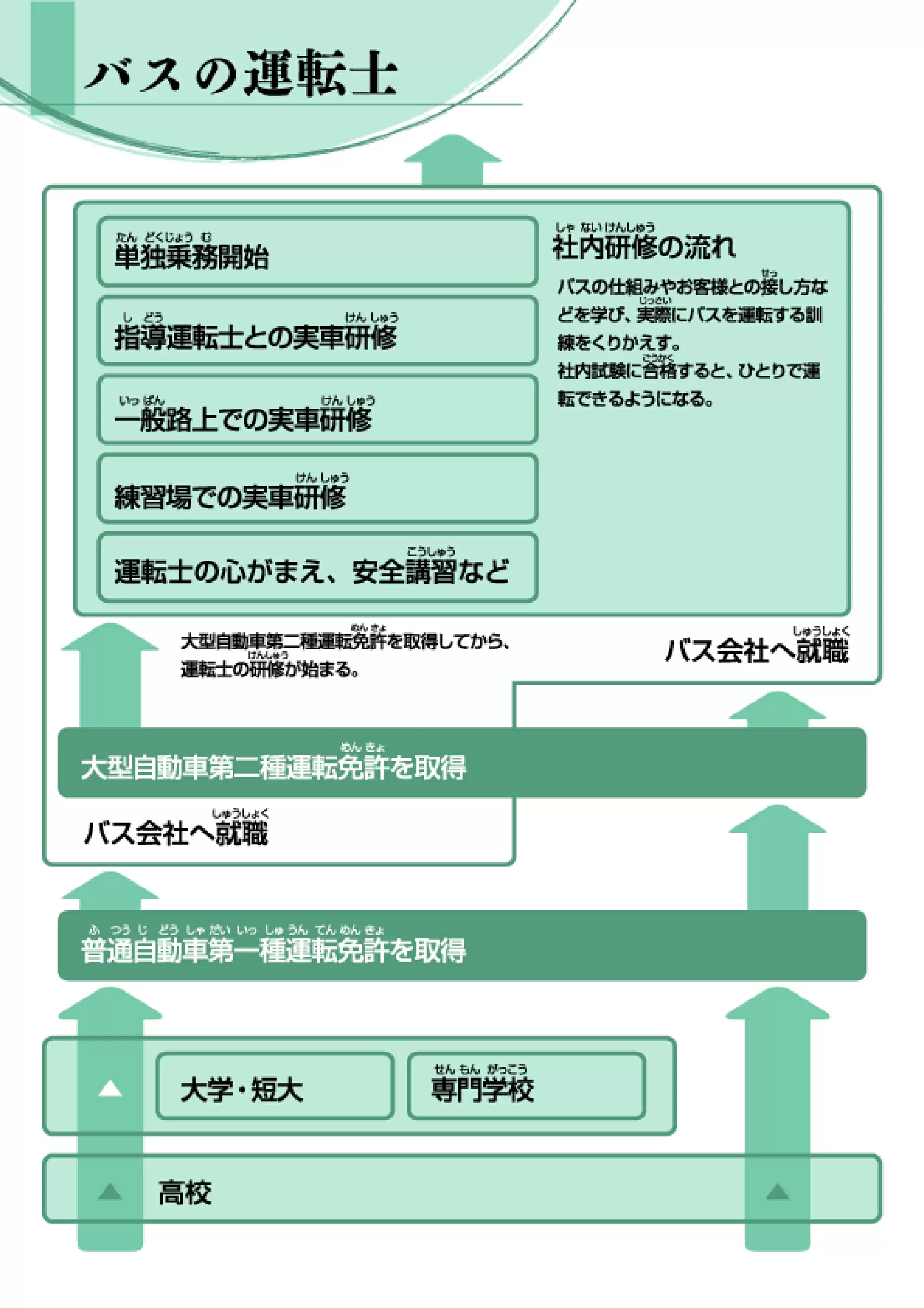
There are two types of "motor vehicle driver's licenses" required to operate a motor vehicle: Class I and Class II. The Class I driver's license is for driving for general purposes. A Class II license is required to drive a passenger-carrying vehicle, except in special circumstances. Furthermore, to drive a large bus carrying 30 or more passengers requires a license to drive a large motor vehicle, so a "large motor vehicle second-class driver's license" is required. However, a second-class license cannot be obtained until at least three years have passed since the first-class license was obtained. Therefore, if you have decided to work for a bus company, you should obtain a regular vehicle Class 1 driver's license before starting work. Some companies will pay for the cost of obtaining a large-sized vehicle Class 2 driver's license. If you obtain a Class 1 license three years before you start working, you can obtain a Class 2 license as soon as you start working for the company, which is a fast track. Once a driver has obtained a Type 2 license, he or she can improve his or her driving skills through in-house training and drills, aiming to become able to drive a bus by himself or herself. At companies that offer both route buses and sightseeing buses, employees often begin by driving route buses, which are the basis of their work, and then move on to sightseeing buses after passing an in-house test.
A second driver's license may not be required for shuttle bus drivers.
The motor vehicle driver's license required for a shuttle bus driver depends on the size of the bus to be driven, the number of passengers, and the manner in which the bus is operated. The most common automobile used for pick-up and drop-off is a small bus called a "microbus. Microbuses with a capacity of 11 to 29 passengers are classified as medium-sized vehicles with a vehicle weight of 8 tons; a regular vehicle license obtained after 2017 allows driving of vehicles under 3.5 tons, so microbuses cannot be driven. A medium-sized vehicle driver's license is required. There is also a larger microbus that seats three adults and 50 toddlers for kindergarten pickups and drop-offs. This one requires a large-size automobile driver's license. Also, since it transports guests, it would seem that a second-class license would be required, but this is not the case. When a hotel or kindergarten uses a private bus to provide transportation as a service, it does not require a Class II license because it is not passenger transportation for which a fare is charged. Employees with a type 1 license appropriate for the size of the bus can operate it. However, if a bus company operates a company vehicle as a courtesy bus, a Type II license is required.
In the Future
The number of female bus drivers is increasing every year.
Buses are indispensable transportation for people who cannot drive, such as the elderly, for shopping and hospital visits, and for children and students going to and from school. Yet, bus drivers are always in short supply. According to data from 2019, there are 1,867 female bus drivers in Japan, up from 186 in 1995, a tenfold increase over the past 25 years. Nevertheless, in terms of the gender ratio, they account for only 1.8 percent. However, customers have commented that they feel safer than male drivers in terms of customer service. In response, bus companies seem to be actively hiring female drivers. If bus companies can make their workplaces more comfortable for women by providing changing rooms, shower rooms, and other facilities for women, the number of women seeking employment is likely to increase.
Job Facts
Income.
It depends on the company you work for and the number of buses you are in charge of. The average annual salary is 4.04 million yen.
Vacation?
It depends on the company and the buses they operate. Bus routes are generally open 24/7, so drivers take turns taking a day off. Approximately one or two days a week. Charter buses are operated regardless of days of the week and national holidays, so drivers' days off are irregular. They take about 6 to 7 days off per month. Shuttle buses also operate approximately one to two days a week.
Where do you work?
Privately owned bus companies that own route buses and charter buses, and bus companies operated by local public entities (prefectures, cities, wards, towns, and villages). Companies, hotels, schools, kindergartens, etc. that own shuttle buses.
Your Future Path
It's a chart that shows at a glance the main routes to get a job as a bus driver!