




government official
A person who works for the well-being of the people by belonging to a national institution, such as the National Assembly, a court, or a ministry.
Perfect For …
People who want to work for the country and its people. People who want to change social systems and laws for the better.
Job Details
Tackling various issues to make the country a better place for its citizens to live.
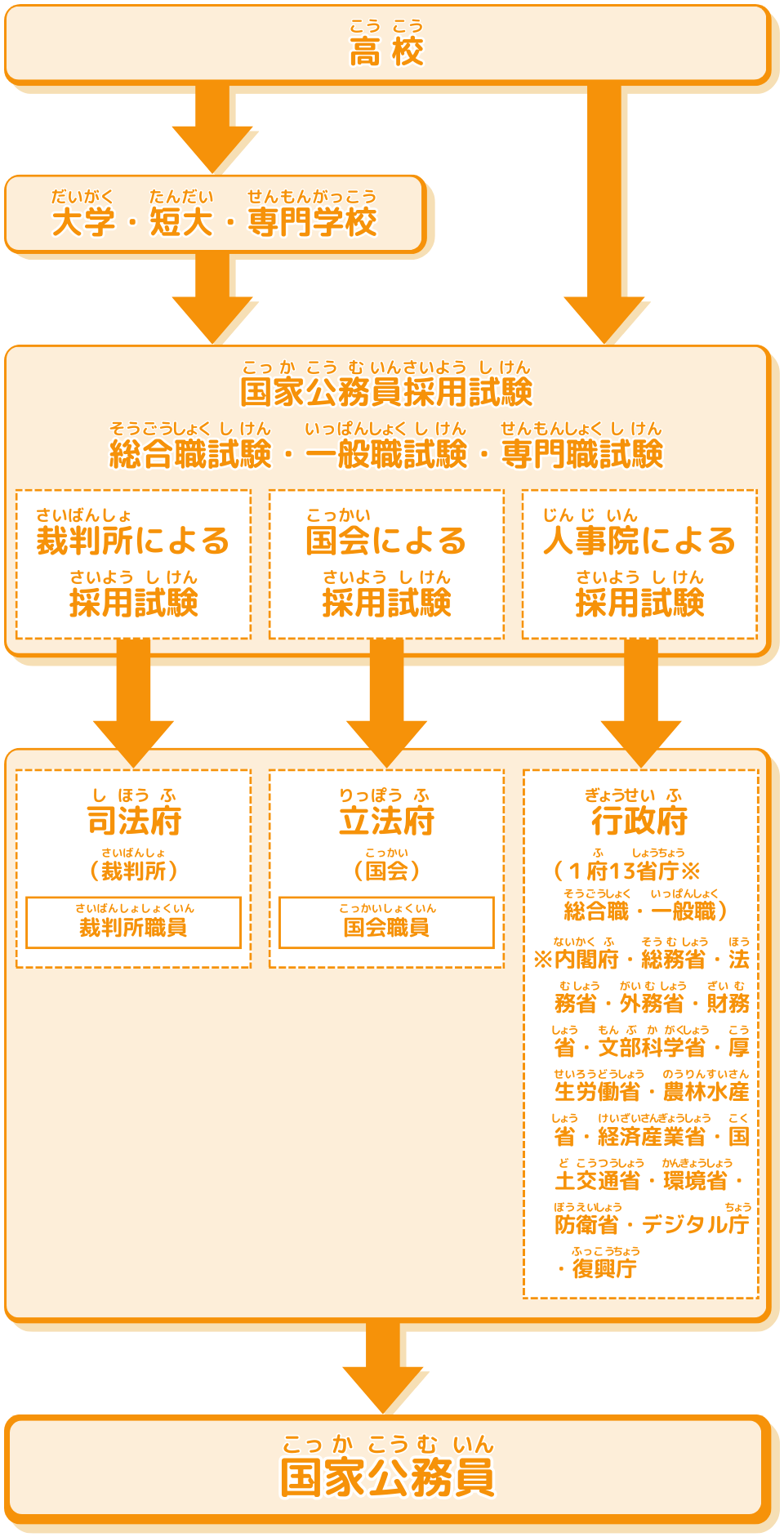
Civil servants are employees who work for public agencies such as government offices. Employees working for local government agencies such as prefectural and municipal governments are called "local public officers. Officials working for national organizations such as the Diet, courts, and ministries and agencies are called "national public officers. The Diet is the body that makes and changes laws, and is also called the "legislature. The jobs of officials who work in the Diet include secretariat staff who help manage the proceedings and some employees of the National Diet Library who help formulate policies. The courts are the institutions that adjudicate disputes according to the law, and are also called the "judicial branch. Court officials' jobs include court clerks, who help administer court proceedings, and family court investigators, who are in charge of investigating juvenile cases. Ministries and agencies are administrative agencies that promote policies and provide services based on laws, and are also called the "executive branch." As of 2023, the country's administrative agencies are divided into 13 ministries and agencies: Cabinet Office, Ministry of Internal Affairs and Communications, Ministry of Justice, Ministry of Foreign Affairs, Ministry of Finance, Ministry of Education, Culture, Sports, Science and Technology, Ministry of Health, Labor and Welfare, Ministry of Agriculture, Forestry and Fisheries, Ministry of Economy, Trade and Industry, Ministry of Land, Infrastructure, Transport and Tourism, Ministry of the Environment, Ministry of Defense, Digital Agency, and Reconstruction Agency. The ministry is divided into 13 ministries in 1 prefecture. Each ministry and agency specializes in a particular field. For example, the Ministry of Education, Culture, Sports, Science and Technology is responsible for developing school education, science and technology, sports, and culture. Officials create plans for this purpose, conduct surveys, etc., and work to realize the plans. If you are an official in charge of education, you are thinking about ways to improve learning methods so that studying at school becomes more enjoyable, or about ways to increase the number of teachers who can give easy-to-understand lessons. Employees of other ministries and agencies are also involved in creating rules and systems to make life easier for the people, such as disease prevention and work styles (Ministry of Health, Labor and Welfare), the national budget (Ministry of Finance), how to deal with foreign countries (Ministry of Foreign Affairs), and the country's peace and security (Ministry of Defense). It is a job with a lot of responsibility that affects the future of the country, but it must be worthwhile for that reason.
Here is the point
Pass the recruitment exam of a national agency and become a national civil servant.
To work as a national public officer, one must pass the recruitment examinations conducted by the legislative branch, the judicial branch, and the executive branch, respectively. In the case of the executive branch, however, employment does not depend solely on passing a recruitment examination administered collectively by the National Personnel Authority, which belongs to the Cabinet. Recruitment is determined by interviews conducted by each ministry and agency. Therefore, candidates for the executive branch visit the ministries and agencies of their choice to hear explanations of their work and to express their thoughts and ambitions. This is a major difference between the legislative and judicial branch examinations. On the other hand, all recruitment examinations are divided into "career-track" and "general" positions with different job roles and job descriptions, and some agencies also have "professional" examinations. Comprehensive positions are those that formulate policies. General positions are for administrative work related to policy implementation, etc. Specialists are professionals who do specific jobs, such as prison guards, tax officials, air traffic controllers, and coast guard officers. Each employment examination is divided into "high school degree level" and "college degree level" depending on the difficulty of the questions. In most cases, educational background is not required, so even if you have not graduated from a university, you can take the "college graduate degree" exam. However, the exam for "graduate school graduates" can only be taken by those who have completed or are scheduled to complete graduate school. There is also an age limit for eligibility, and in most cases, the upper age limit is in the early 20s for the high school equivalency exam and around 30 for the university equivalency exam. In addition, there is a rule that people who do not have Japanese nationality or who have served time in prison for a crime cannot take the examination.
The Prime Minister and the Self-Defense Forces are also national public servants.
National public officers can be broadly divided into "general positions" and "special positions. General positions here do not refer to clerical work, but to "all officials other than those in special positions. Special positions can be divided into those in charge of political affairs (Prime Minister, Ministers of State, Vice Ministers, etc.), those in charge of legislative and judicial affairs (Diet members, judges, court officials), and those engaged in special work (Ministry of Defense officials, including Self Defense Officials, Imperial Household Agency officials, etc.). While the National Public Service Law, a set of rules and regulations, applies to general positions, the National Public Service Law basically does not apply to special positions. However, laws (Diet Officials Law, Self-Defense Forces Law, etc.) are established for each position with regard to salary and service.
In the Future
The philosophy of national officials who serve the people remains the same.
In the future, the rapidly developing AI (artificial intelligence) is expected to take over the administrative tasks of national public servants. In fact, the Ministry of Agriculture, Forestry, and Fisheries (MAFF) is using the interactive AI "Chat GPT" for some tasks. However, the tasks handled by national public servants are not all about making rational decisions quickly, which is AI's forte. The role of national public officers is to provide various services for the people and work for the public interest. To decide on laws, make rulings on laws, and implement laws, it is necessary to do so with the feelings and thoughts of the people in mind. No matter how much AI advances in the future, the work of national public servants will not disappear, and the philosophy of national public servants to "serve the people" will not change.
Job Facts
Income.
It varies depending on the ministry and position for which the person was hired. The average monthly salary is approximately 410,000 yen.
Vacation?
Weekly holidays; three consecutive days of summer vacation between July and September, and year-end and New Year vacations from December 29 to January 3 of the following year are fixed by law.
Where do you work?
National Diet building, courts, the headquarters and main offices of prefectural ministries and agencies, as well as destination agencies located in the provinces. For career-track positions, many are transferred to other parts of Japan.
Your Future Path
It's a chart that shows at a glance the main routes to a job in the National Service!