1


Children's book illustration style of Roberto Innocenti (b. 1940): Immersive, cinematic wide-angle view of culturally grounded documentary realism with architectural precision, narrative-driven chiaroscuro, and focal atmosphere. [Gemini Nano Banana Pro]


1
100% Upvoted
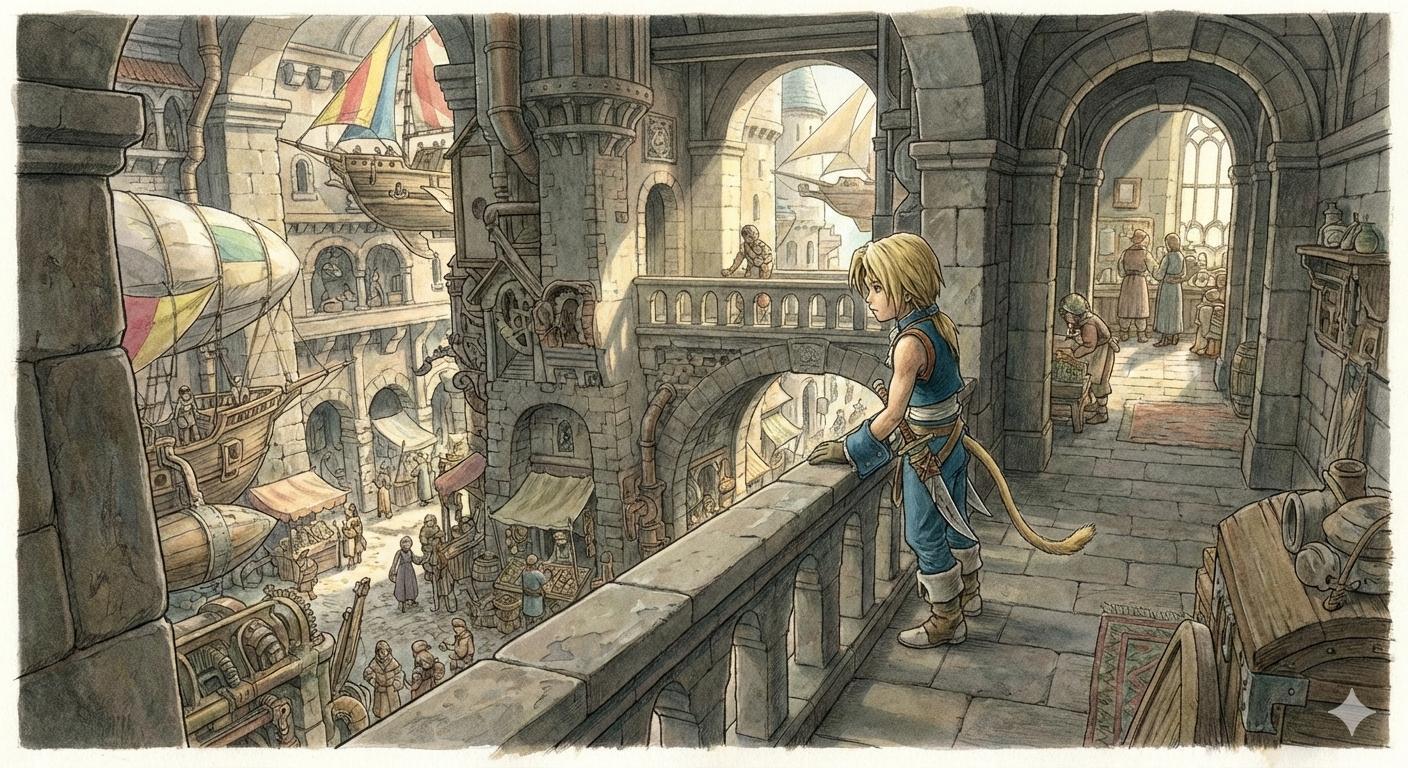
{Final Fantasy IX: Zidane in Lindblum Castle} illustrated in the narrative realism children's book illustration style of Roberto Innocenti (born 1940): {
Roberto Innocenti (b. 1940, Bagno a Ripoli, near Florence) is a self-taught Italian artist whose distinctive visual language was forged outside traditional art academies. His early career as a steel foundry worker (1953–1958) instilled a disciplined appreciation for mechanics and material structure—sensibilities that would later manifest in his exacting architectural renderings. Subsequent work at an animation studio in Rome and as a graphic designer for film posters and newspapers in Florence cultivated both technical precision and an intuitive grasp of visual narrative pacing. Since transitioning to book illustration in 1970, Innocenti has earned international recognition for synthesizing the mathematically precise, sculptural spatial staging of the Italian Renaissance with the documentary rigor of nineteenth-century academic realism—all inflected by dramatic vantage points that act as emphatic samplings of a greater cultural gravity. His signature aesthetic is characterized by immersive—at times panoramic—viewpoints that situate figures within densely realized cultural and environmental contexts; architecturally precise compositions rendered in watercolor and colored pencil—a technique informed by the luminosity of Italian fresco and tempera traditions as well as the graphic clarity of twentieth-century poster art—where exacting delicacy is grounded by a heavy, cinematic chiaroscuro that simultaneously defines spatial depth and establishes emotional gravity, all governed by strict lighting logic; and the use of dramatic foreshortening and visual foreshadowing to imbue static images with narrative tension and temporal implication. This synthesis positions him among the most formally rigorous illustrators of the late twentieth and early twenty-first centuries.
Innocenti's illustrative approach rests on several interrelated principles that recur throughout his oeuvre and develop in sophistication over time: chiaroscuro realism governed by logical, internally consistent light sources; perspectival precision derived from Renaissance spatial systems; documentary verisimilitude achieved through exhaustive historical research; dense cultural and environmental contextualization that rewards prolonged visual exploration; and a graphic-tonal foundation producing illustrations that retain structural integrity even in grayscale. His rendering technique combines finely layered transparent watercolor washes with precise pencil work—crosshatching in shadow areas, meticulous delineation of architectural ornament, textile patterns, and period-accurate objects. This method ensures that chromatic richness rests upon a robust underlying tonal architecture.
Innocenti's early style, spanning roughly 1974 to 1980, was defined by a productive tension between graphic flatness and volumetric realism—a tension he would later resolve through atmospheric modulation. In his collaboration with Pietro Di Donato, La luna nelle baracche (1974), Innocenti established his foundational framework: a colorless chiaroscuro realism with woodcut-like precision and layered spatial depth. The stark tonal contrasts and structural clarity demonstrated here—heavy black shadows, sharply delineated forms—would serve as the armature for his subsequent narrative illustrations, revealing his command of dramatic lighting even at this early stage. The educational trilogy authored by Seymour Reit—All Kinds of Ships (1978), All Kinds of Trains (1978), and All Kinds of Planes (1980)—reveals a disciplined technical illustration aesthetic distinct from Innocenti's later narrative works. Here, he employs a rigorous, localized, colored chiaroscuro characterized by high-contrast shading applied uniformly across subjects. When viewed in close inspection, individual elements—the metallic texture of a locomotive, the riveted geometry of an aircraft fuselage—appear fully volumetric, displaying structural mastery over mechanical form. However, because this lighting intensity remains consistent across entire compositions without atmospheric recession or environmental diffusion, the macro-level visual field retains a graphic flatness. This approach functions as encyclopedic cataloging: the precise tonal definition of each vehicle takes precedence over spatial depth or atmospheric mood. The series also demonstrates Innocenti's emerging capacity to organize dense technical information into aesthetically coherent arrangements—a compositional skill that would prove essential in his later, narratively populated townscapes.
During the transitional period of 1983 to 1985, Innocenti began adapting his technical precision to serve emotional and atmospheric ends, moving from encyclopedic description toward expressive characterization. In his adaptation of Charles Perrault's Cinderella (1983, published by Creative Education, Mankato, Minnesota), Innocenti recontextualized the narrative within the Roaring Twenties, demonstrating his capacity for period-specific immersion. He adopted a heavier, darker chiaroscuro reminiscent of the stippled engraving style of Lynd Ward (1905–1985). By employing high-contrast shading and intimate, focused perspectives, Innocenti moved decisively away from the uniform lighting of his technical books toward a dramatic, moody aesthetic that grounded folklore in tangible historical reality. This work represents a pivotal transition: chiaroscuro moves beyond structural description toward expressive characterization, with lighting functioning as a narrative agent rather than merely a rendering convention. His collaboration with author Christophe Gallaz on Rose Blanche (1985, with English text by Ian McEwan) marked Innocenti's emergence as a major international figure. Set during World War II, the book applies his documentary precision to morally weighty subject matter. The deliberately muted palette, carefully researched period details, and restrained emotional register demonstrated that his technical virtuosity could serve profound narrative purposes—grounding the horror of historical events in quotidian, tangible reality. Here, Innocenti's characteristic accumulation of verifiable detail takes on ethical weight: the specificity of period costumes, military insignia, and architectural textures refuses abstraction, insisting that atrocity occurred in real, inhabited spaces.
Innocenti's illustrated edition of Carlo Collodi's The Adventures of Pinocchio—first published in 1988 and subsequently revised and expanded in 2005—represents the fullest realization of his signature approach, integrating the specialized graphic mastery of earlier works into a unified visual language. The visual language of Pinocchio functions as a conduit between two major Italian artistic traditions: Innocenti employs the perspectival rigor of Florentine vedute—echoing the Quattrocento spatial constructions of Piero della Francesca (c. 1415–1492)—to establish deep staging with distinct foreground, middle-ground, and background action, while overlaying this architectural precision with the lighting sensibilities of the Macchiaioli movement (Tuscan Realism), specifically the macchia technique associated with Silvestro Lega (1826–1895), which employs patches of light and color as structural elements defining form. This synthesis is further inflected by compositional strategies paralleling Italian Neorealist cinema—particularly Luchino Visconti's period reconstructions—including aerial establishing shots, Dutch angles for psychological tension, and deep staging with simultaneous action across spatial planes. Innocenti deploys dramatic perspectival systems—frequently three-point perspective—to create vertiginous depth with subtle "fish-eye" or wide-angle lens effect in his psychologically charged depictions of nineteenth-century Tuscan townscapes. Streets plunge precipitously into the picture plane; rooftops recede at acute angles; interiors open through multiple doorways into successive spatial zones. Unlike Tintoretto's theatrical arrangements designed to capture a singular kairos (decisive moment), Innocenti disperses narrative attention across labyrinthine urban environments populated not only by main characters but by townsfolk, animals, and everyday vignettes. This density recalls the narrative scope of Pieter Bruegel the Elder (c. 1525–1569), inviting the viewer to adopt the role of a witness discovering simultaneous micro-narratives—a neo-realist approach that honors the quotidian texture of the depicted era
Innocenti's chiaroscuro in Pinocchio exemplifies what might be termed motivated expressionism: naturalistic in appearance but strategically heightened for emotional effect. His high-contrast, pristine lighting recalls the theatrical tenebrism of Caravaggio (1571–1610), yet remains governed by strict naturalistic logic—directional sunlight, candlelight, overcast diffusion—while being editorially manipulated for dramatic emphasis. Shadows pool in morally ambiguous spaces; shafts of light isolate moments of revelation or hope, achieving Caravaggesque intensity without sacrificing environmental coherence. Through finely layered transparent washes and precise crosshatching, Innocenti achieves trompe-l'œil verisimilitude. The accumulation of verifiable historical detail—architectural ornament, textile patterns, period-accurate objects, weathered surfaces—produces an immersive environment that grounds the narrative in tangible social reality. Each illustration rewards sustained exploration as new details emerge from densely layered compositions.
Having consolidated this mature visual language in Pinocchio, Innocenti subsequently demonstrated its adaptability across diverse cultural settings and narrative registers. In A Christmas Carol (1990), he transposed his signature style to Charles Dickens's Victorian London, applying the same perspectival complexity he had brought to Tuscan townscapes while embracing a distinctly British architectural vocabulary. A seasonal atmosphere of intimate warmth pervades domestic interiors, counterbalancing the labyrinthine London streets where Innocenti captures the idiosyncratic dynamism of public and private life. The symmetrical façades and refined proportions of Georgian townhouses give way to the denser, more ornate character of Victorian terraces, while polished bourgeois interiors contrast sharply with the squalor of London's poorer quarters. The work demonstrates Innocenti's capacity to transpose his Italianate spatial logic and documentary rigor to foreign architectural traditions while maintaining the atmospheric coherence characteristic of his finest illustrations.
In subsequent projects, Innocenti continued to modulate his approach according to narrative demands, expanding his chromatic and compositional range while preserving his foundational commitment to documentary realism and spatial precision. In L'Isola del Tesoro (Treasure Island; 2001), illustrating Robert Louis Stevenson's adventure classic, Innocenti shifts away from the oppressive chiaroscuro of his urban works toward a vivid, saturated color palette. He employs consistent tonal gradients and dramatic, panoramic staging to create trompe-l'œil realism and a sense of scalar depth akin to mural painting—an approach suited to the novel's expansive maritime settings. In The Last Resort (2002), written by J. Patrick Lewis, Innocenti amplifies the cinematic tension of his narrative realism through compositions defined by symbolic atmosphere and foreshadowing—recalling the surreal complexity with saturated chiaroscuro of Hieronymus Bosch (1450–1516). By employing distant, omniscient viewpoints, narrative-driven lighting, and a modernist graphic awareness of kinetic visual tension and emotive color, he transforms each illustration into a striking, movie-poster-like tableau that functions as a suspended cinematic still rich with implied narrative. In Erika's Story (2003), written by Ruth Vander Zee, Innocenti returned to Holocaust subject matter, repurposing his signature structural mastery to cinematically depict the oppressive scale of Holocaust-era railway infrastructure and grim urban environments. He employs a rigorous chromatic dualism as a narrative device: while the contemporary frame story is rendered in naturalistic color, the historical flashback plunges into a photorealistic, high-contrast grayscale. This elimination of color does not merely signify somber horror; it evokes the visual language of archival footage, lending the composition a haunting, documentary veracity that emphasizes the weight of historical memory.
Across five decades of sustained practice, Innocenti has maintained his foundational commitment to architecturally precise, historically researched compositions while demonstrating remarkable adaptability across cultural settings—from Tuscan piazzas to Victorian London, sunlit Caribbean shores to Holocaust deportation trains. His synthesis of Italian Renaissance spatial logic, Macchiaioli tonality, and Neorealist cinematic staging constitutes a singular achievement in contemporary illustration, distinguished equally by formal rigor and ethical engagement with historical subject matter.
}