


The Possessive Nature of the Beast
and how the concept of private property is natural, emergent and ends up dividing mankind

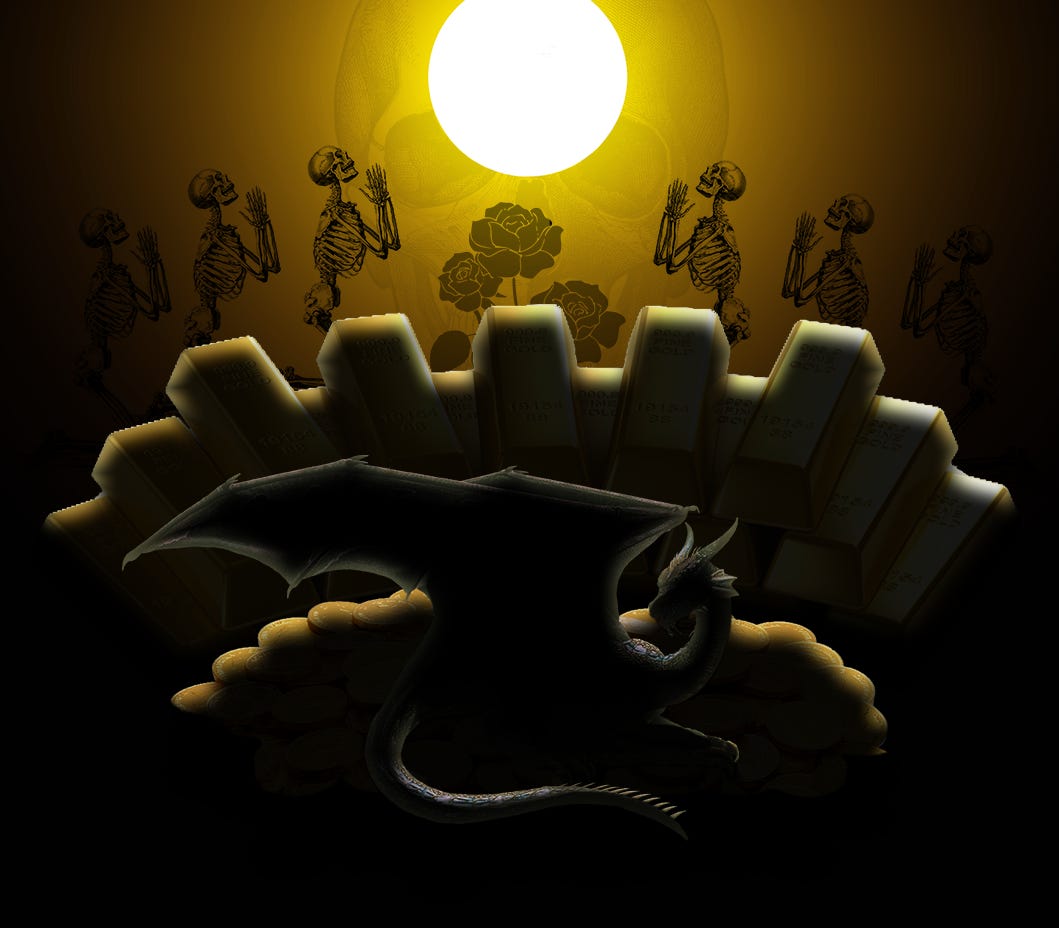
[ THE BLIND ARROGANCE ]
It is a common assertion to make – both on the Left and the Right – that the concept of private property is unique and exclusive to humans. The Left tries to argue this point to make the case that private property is as a concept wholly artificial and has no root in anything tangible and real. Their goal is to label it as an obsolete, oppressive social construct and to abolish it.
On the other hand, the Right – and the religious Right in particular - is desperate to elevate man above other beasts as much as possible in order to glorify him, and thus tries to argue that he is essentially unique through concepts such as private property.
In other words, it's still the same pattern – the ideologues already have their envisioned end-goals, that being the abolishment of private property on one hand, and the absolute a priori supremacy of man over all other lifeforms on the other. Whatever they encounter along the way gets simply used as a means to an end.
The Left will brazenly argue that man is no better than other beasts, because doing so allows them to strip the current system of its legitimacy and to slowly dismantle it, hoping to abolish property at the end of the process. While the Right will similarly do anything and resort to any level of delusion and fantasy to reinforce and fortify the system already in place.
Just as kings and emperors justified their rule through a divine right, so too does man in general justify his often cruel hegemony over animals as a divinely ordained state of affairs. The monarch was asserted to be essentially different from his subjects, and man is asserted to be essentially, irreconcilably different from animals. Not by the virtue of having more of some traits – such as intellect – but in the same sense that a horse is superior to a tree. The latter has no nervous system, no ability to think and feel, no agency, intellect or sense of self – while the former clearly has some measure of all of those qualities.
Regardless... as I am not here today to preach about the plight of nonhuman beasts... my point is that despite their vast differences, the Left and the Right have one thing in common – the belief that private property is a uniquely human concept. And I want to argue that this is nothing but pure ideology divorced from observations of the real world... before drawing certain parallels between man and lesser animals, and using them to make a key point about communism, socialism, fascism, and other similar totalitarian ideologies in the latter part of this essay.

[ THE POSSESSIVE BEAST ]
All private property begins with an individual selfishly asserting that there is something in the world, which belongs exclusively to him. In other words, there are two essential prerequisites for private property to emerge as a concept – an exclusive sense of self as an individual distinct and separate from other living beings, and the notion that this individual may lay an exclusive claim to an object inside or outside of himself (which is naturally rooted in violence as the core method of enforcement).
I am creating a distinction here between consciousness or self-awareness and private property – rather than asserting that a conscious being is inherently self-owning by definition – chiefly because a living being can conceivably exist, who sees itself as an individual, but who simultaneously cannot claim even its own material body as an exclusive inviolable property, let alone external objects. There are, in fact, human beings, who exhibit such traits – they are incapable of asserting their own boundaries and saying no to others trying to take advantage of them. Young children in particular are quite notorious for this and very vulnerable as a result.
This could easily be the overarching state of affairs for a fundamentally collectivist species – essentially, the perfect biological communists. An individual sense of self is still necessary for a being to operate effectively in the world, because if it quite literally cannot tell itself apart from others, it will struggle to navigate and resolve even the most basic situations. Ego is required for higher organisms to function and to maintain themselves. Exclusive ownership of external objects or even of their own bodies is not – at least not necessarily, depending on the species in question. Or, more specifically, depending on how collectivist or individualist it is by its nature.
It is here that we get to the subject of self-evaluation. I could rephrase my initial statement as follows:
"There are two essential prerequisites for private property to emerge as a concept – an exclusive sense of self as an individual distinct and separate from other living beings, and the subjective notion that one's individual needs take precedence over those of others."
That is to say, private property is a function of an individual, who prefers himself over other individuals and acts first and foremost in his own interest. It is thus that exclusive claims to external objects (aside from one's own body) are made. It is the result of natural scarcity combined with a sense of individuality combined with preferring one's self over others.
None of this is to be taken for granted. There are collectivist species, where the individual does not register himself as the most important thing. In fact, there are situations among individualist species – such as when raising offspring – where individuals temporarily suspend their selfish tendencies and put others above themselves in the hierarchy of importance.
In other words, an individual does not always evaluate himself as the most important of all. Therefore, individuality alone is not enough to produce the notion of private property. Individuals, who see themselves as less important than their collective cannot truly claim private property, because anything they could possibly own would be surrendered in a heartbeat to the "greater good". That is – without exaggeration - the end goal, which communists want for mankind.
With all of that said, however... all the common, more intelligent higher animals that one may think of – canines, felines, equines, vulpines, but also various avians, for example, among many others – are ultimately selfish individuals. Clearly they possess a sense of self, as they are able to distinguish between themselves and others, and do readily discriminate and act in their own interest. And even more importantly... they also readily lay claims to objects and to individuals outside of themselves. A stallion is deeply possessive of his mares and territory, and will fight to maintain exclusive control over them. Dogs – at least the functional breeds not ruined by dysgenics - also claim objects and territories as their own and will act hostile towards those trying to infringe.
In essence – to put it in the most simple of terms – an animal cannot possibly be territorial without having some primitive concept of private property. And the same is true for other aspects of life. An animal cannot form harems without the notion of possessing the other animals. It cannot possibly fight over an object with another animal without laying a claim to it in its mind, without seeing the object as belonging to it .
If there is any degree of scarcity – which is a given in the real world – and if a living organism perceives itself as an individual, which is more valuable than others, the concept of private property invariably emerges, however rudimentary it may be. That is the bottom line, now and forever.
In fact, one may simplify this even further. Private property can be described as exclusive possession. If a living being is simultaneously capable of possessing an object external to itself, and of forcefully excluding others from possessing it, it is recognizing and practicing a form of private property, even if a very basic one. Squirrels and hamsters hoarding nuts and grains are demonstrating some primitive understanding of property, because they are gathering objects in the natural world and storing them away in their exclusive private dens, which they defend from intruders. Hamsters in particular are notoriously vicious about this.
To deny this reality is at best dishonest and at worst lunacy. The communists have no leg to stand on here – these animals are selfish and exclusive by their very biological essence, just like humans. Private property isn't an invention, it's an emergent natural phenomenon, the same as ego itself.
Similarly, the traditionalists also have nothing of substance to support their doctrine of divinely determined human exceptionalism – the difference between the human beast and the nonhuman beast is clearly one of shades and degrees, not one of essence. Man's concept of private property is much more advanced and developed, but it still stems from the exact same root. It's a branch of the same tree, just located much higher up the trunk.
Now, with all of that said... what would one make of this reality?

[ THE MEANING AND VALUE ]
I am certain that many – if they were to read these paragraphs, that is – would immediately accuse me of trying to suggest that man ought to respect the property rights of other animals. So allow me to open this section by explicitly rejecting that notion.
Humans cannot respect the private property of other animals in an equal manner not because we're different a species and somehow holier than them and chosen by the Divine, but because – as I have previously stated – our understanding of private property itself isn't equal. Theirs is basic and rudimentary, ours is advanced and complex with entire legal systems built around it, all of them far beyond the comprehension of lesser beasts.
Let us look at felines (as well as vulpines), for example. They – clearly, self-evidently – don't really have a concept of "yours", only an understanding of "mine". A cat sees property as follows: "If I like it, then it's mine." That is, quite literally, the extent of it. They are possessive and capable of considering something to belong to them exclusively, but – due to not being a social species – they can't really conceive of something truly, rightfully belonging to others.
The interesting and relevant aspect, however, is that there also exist humans, who have a very feline conception of property. Many petty or not-so-petty criminals operate in precisely this way. They are, without an exaggeration, primitives akin to lower species, feeling entitled to anything that tickles their fancy, and being incapable of recognizing and respecting the ownership rights of others.
Canines – as well as equines – represent yet another interesting archetype and a clear parallel. They, being a deeply social primitive species, are all about power dynamics and hierarchies. Private property, in their eyes, works as follows: "If I like it and I am of a superior rank in the hierarchy, then it's mine. If I am of a lower rank, and my superior wants it, then it belongs to him. My options are either to attain a higher rank, or to beg and suck up to him, hoping to get scraps."
This is indeed more complex than the notion of felines and other species, but the notion of "rights" is still missing. The only factor is power and status. The only "right" is might, period. That's how dogs and wolves and horses and other species operate. Yet it still serves as a window into the human condition as well, because large amounts of humans have historically viewed private property in precisely this manner and continue to do so to this very day. The idea of genuine natural, universal rights based on logic and morality, rather than on things like status and power, is a historically recent one, which came with the advent of liberalism. Traditional feudalism was very much rooted in those canine-esque tendencies. Much more complex and advanced still, certainly, but ultimately adjacent nevertheless.
(Although do be careful to not make the wrongful assumption of a totally linear historical development – there have been clear ups and downs in this over the course of history.)
And all of this slowly brings me to a very important point, which organically arises from what I am saying. To repeat myself using different words, we know – even from millennia of experience – that we cannot play equals with lesser species, whose ideas of private property are much more primitive than ours. This is because while we can choose to respect their property, they are physically incapable of respecting ours, unless they are a social species like canines and we directly become their masters. But then, ironically, their property isn't truly respected anyway, because due to how they function they are ready to surrender anything to the master, meaning the object in question is as much "theirs", as the land they worked on was medieval peasant's.
However – and that's the actual crux of the matter I've been trying to get at – these parallels I am drawing are not accidental, because the same pattern of inequality exists internally among mankind as well. Simply, put there are different "branches" of humanity even within a single race or population, which do not have the same understanding of private property. Perhaps the most quintessential example of all are, once again, communists. Arguing with mature adults - especially middle aged and older - who are real, fervent, devoted communists is like arguing with a dog or a cat. It's utterly pointless. They are akin to a subspecies, wired differently on a biological level. No matter what you say, they are incapable of seeing the question of property your way. And this does include all manner of socialists, fascists, and adherents of various adjacent ideologies.
One cannot liken them to cats, because they're not individualists and they – in fact - hate individualism. One may not even liken them to dogs and wolves, because in truth, they despise traditional hierarchies and power dynamics. The idea of a king and a vassal disgusts them and enrages them. The only rightful hierarchy they recognize is the collective – usually the state – versus the individual, because at heart they truly are bugmen. Hive creatures like ants, bees, termites, wasps and others.
They can conceive of an individual, but only as a constituent part of a greater collective – a state or a community. To them, an individual exists the same way an individual engine part exists – a piston, a camshaft, a valve, even a single bolt. A discreet component, yes, but nevertheless inseparable from the greater whole in practice and utterly meaningless without it. The individual is not whole by himself, only representing a part, which is given purpose, meaning and "life" by the superstructure it belongs to.
One is distinct from the others, but nevertheless just a cog in the grand machine, and obligated – under all circumstances – to work in harmony with it, never to rebel, not even for a second. And it is thus that their idea of private property reveals itself, because if an individual is truly this subordinate to the collective, then it's strictly impossible for him to exclusively own something vis-a-vis the collective. There is no "private property", only – as communists like to say – "personal property", which one is allowed to possess by the grace of the collective, but which ultimately isn't exclusive and may be taken away at any moment for any reason.
Because, after all, if one is but a part of a greater organism, it makes no sense to withhold anything from it. How could the lungs or the liver or the eyes possess anything to the exclusion of the rest of the body? Only a cancerous growth could possibly do that. And that's precisely how these bugmen – whether they call themselves fascists or communists or European progressives – perceive the matter of property. To them, the only real property is collective property, with one subsection of it being personal property, which is just a portion of the collective property, which individuals are allowed to use for their personal needs. It is thus, that the hive-creatures implicitly understand the matter.
And my point is that this isn't just culture and ideology. Those two things are downstream from biological essence. They are fundamentally different people, who are predisposed to view concepts like property in different ways, as is the case for other species.
There are those of us, for whom the individual is the king. Just as God is singular, indivisible and all else derives from Him, so too is the individual the point of origin, from which all rights, morals and social structures derive. We are the children of liberalism and this is how our essence is expressed in the real world. We are Faustian people, who perceive existence in a "man against the world" kind of way. But there are also those, for whom the individual is akin to a single cell in a body – disposable, replaceable, and ultimately meaningless on its own.
It is from this fundamental difference that the divergent notions of property invariably arise, and the gap cannot truly be bridged without altering the nature of the beast itself. Thus, all is clear – private property as we understand it is indeed an emergent concept, but so are the other interpretations. In the end, it's just evolutionary biology at work - mechanisms of managing scarce resources and structuring societies.
Yes, the ideologues, who like to claim that private property is artificial and uniquely human, are wrong, but that does nothing to alleviate the evolutionary stress on a species, in which multiple mutually incompatible strains have arisen.
The question is... does the individualist strain actually stand a chance in the long-run, or is it destined to be outcompeted by the bugmen sooner or later?

