


Underappreciated Gems: Knights and Merchants
originally a raw diamond, this obscure piece of art has since been lovingly polished by people, to whom I am deeply grateful

I - Introduction
Knights and Merchants... one of the games that defined my childhood. And I would struggle to explain to you just how true those words are, just how obsessed with it I was and how it made me feel. But I think I can see one way, in which the point can be made with reasonable elegance and with at least some semblance of brevity, even if only by my standards.
Due to various circumstances, I was never able to get my hands on the full version of this game in my actual childhood years. It was only somewhere in my mid teens, I believe, that I finally got to buy it – after many years of playing other things and not thinking about it, that is. But back then, when I was so very passionate about it, all I had to play was the shareware version, which quite literally only contains the one tutorial mission. And yet... and yet, indeed.
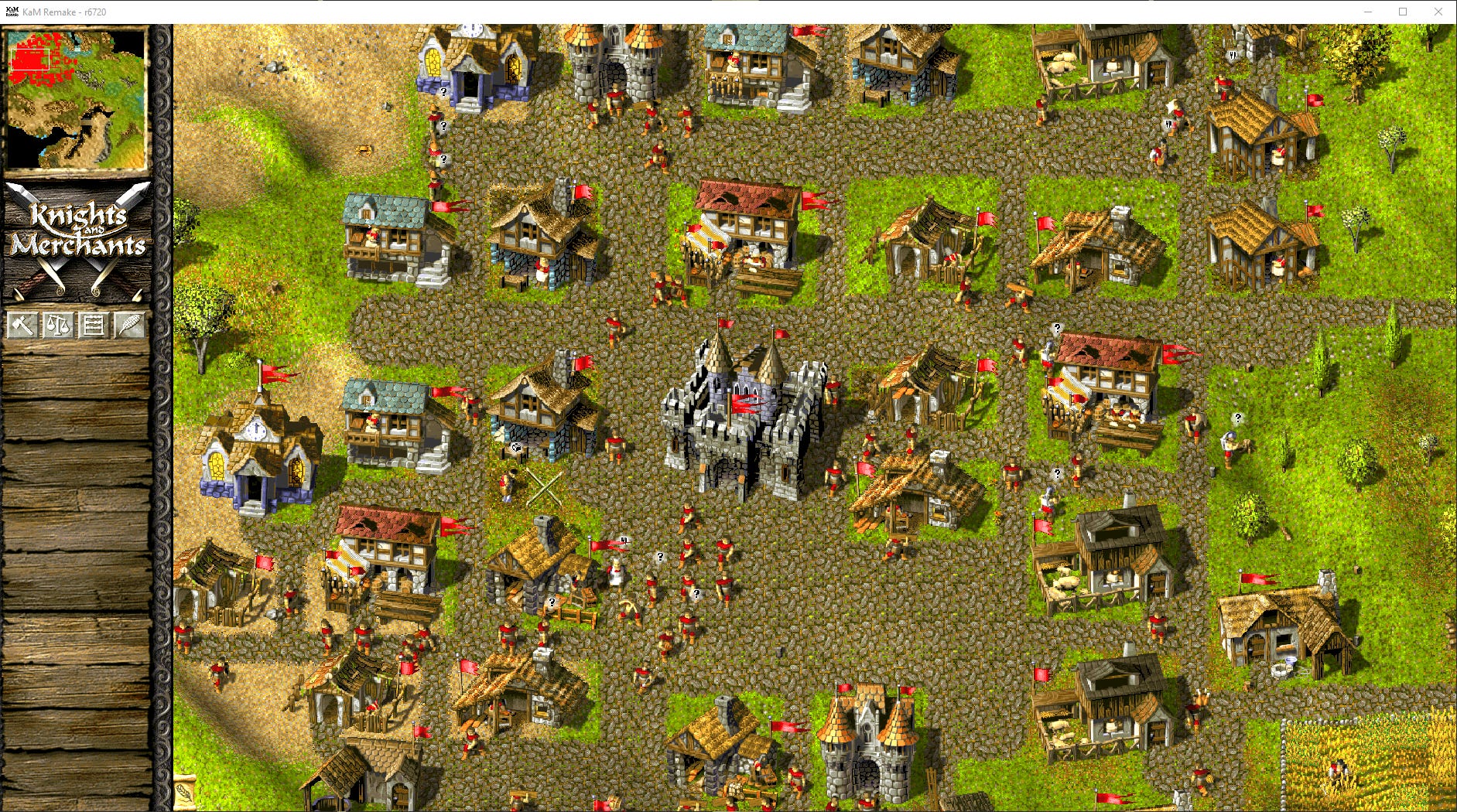
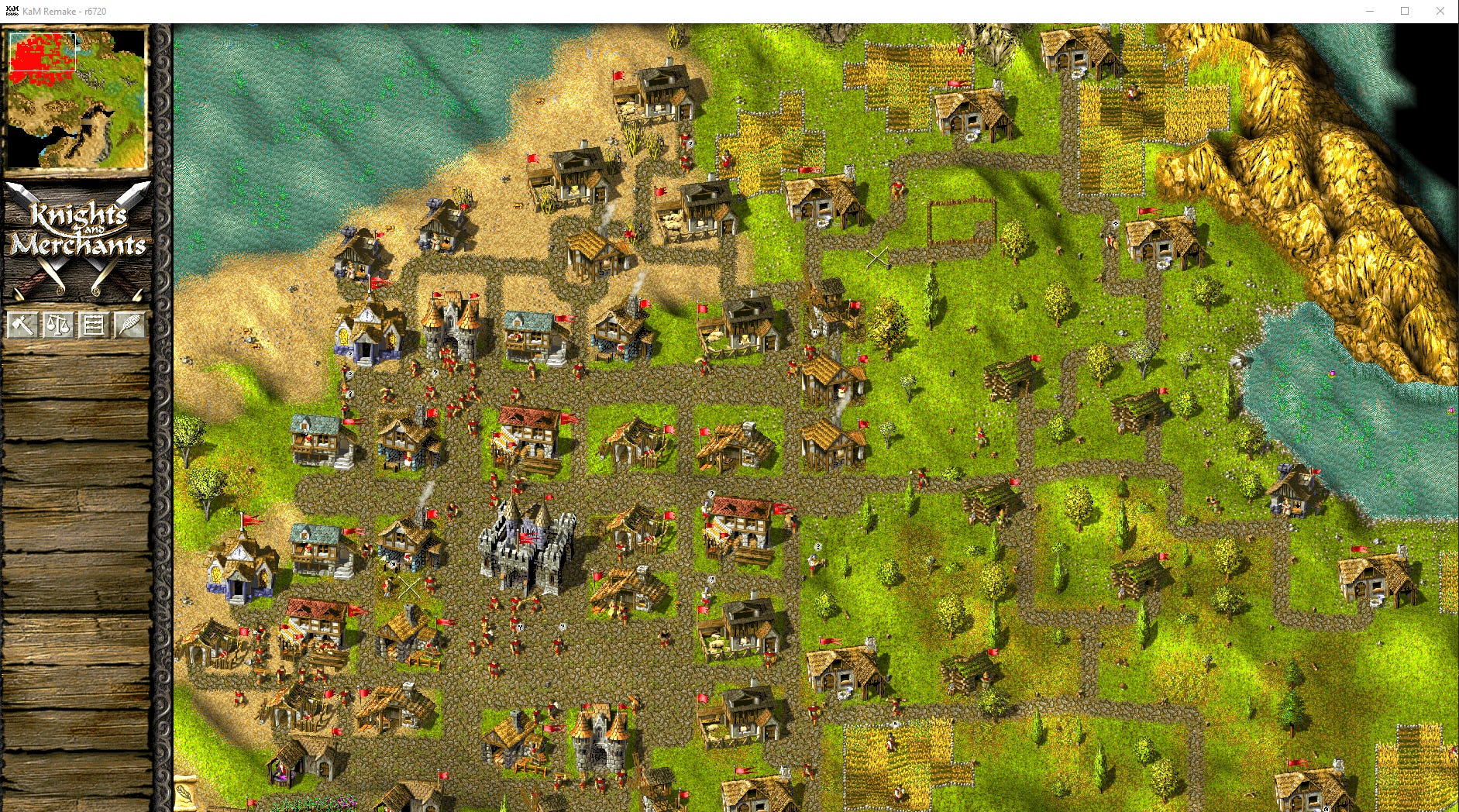
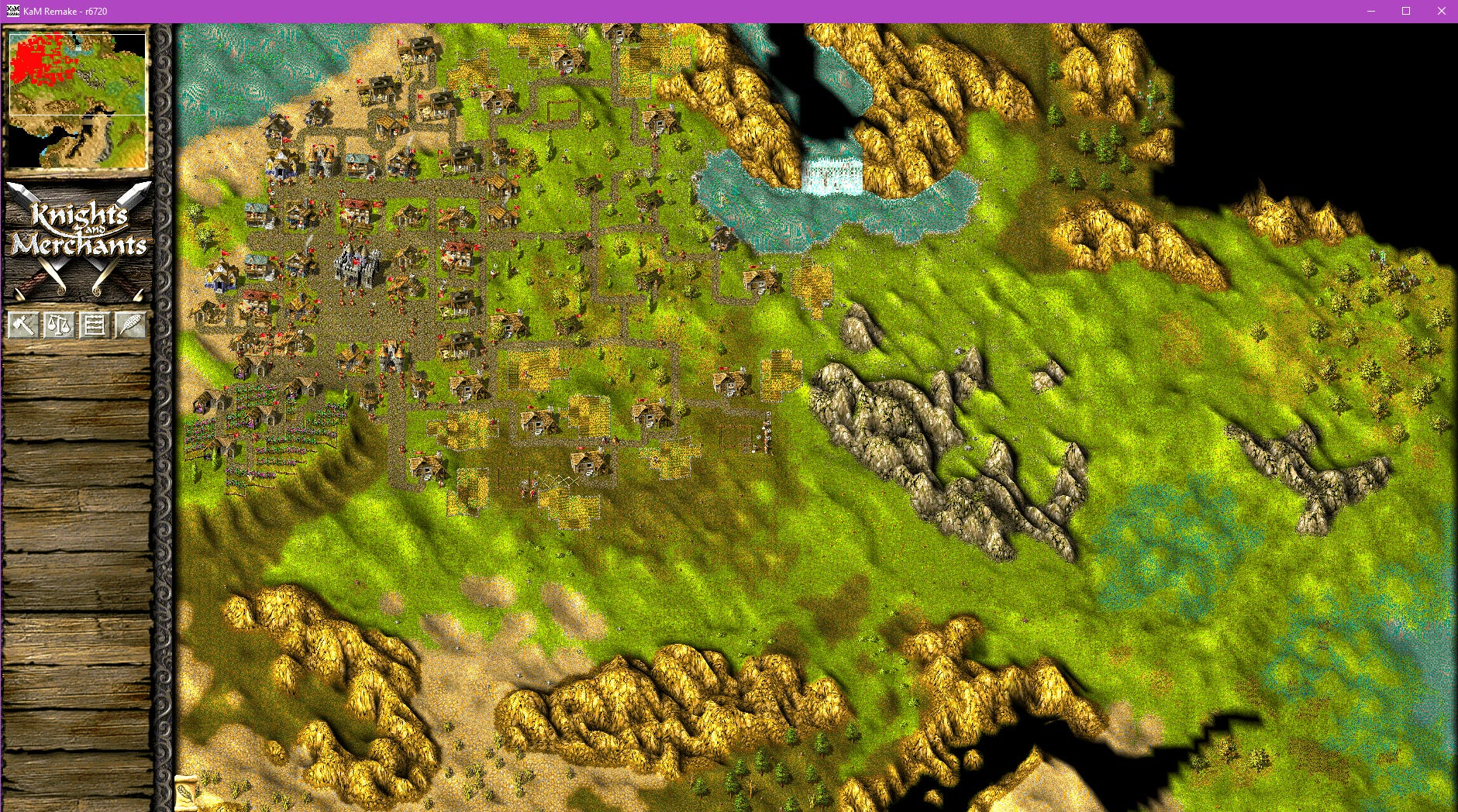
The game has left an immense impression on me - chiefly with its charm and artistic direction. It simply stole my heart, brutally and ruthlessly, and left me yearning for years for something I could not have. And then by the time I did get to finally obtain it, I was in a very different spot in my life and I just couldn't enjoy it the same way anymore. I still played it a fair bit, but by then the initial passion had burned out, I was going through very difficult times, and I was old enough to see all the glaring issues with the game – mainly the hideously clunky controls and a lack of polish in certain areas. It... wasn't a very joyous reunion. I had changed, but the game remained the same. And we just couldn't click anymore the way we used to.
The nightmarish recurring pattern of my life had repeated again, the way it always has. When I truly yearned for something, I was unable to have it. And by the time I did get to have it, I could no longer truly enjoy it, because I had changed. This has been haunting me on so many levels for so many years that just typing these words now has managed to stir up some emotions within me. It has become a deep-seated fear of mine in some ways, this seeming impossibility of obtaining fulfillment. An existential dread that keeps plaguing me, if I allow it. Knights and Merchants was just another example of this. Everything was just wrong. The exact opposite of resonance. And yet...
I suppose that wasn't the end. Nor was it, in hindsight, nearly as tragic as I could make myself believe. In truth, the campaigns in the original game are hard enough that I wouldn't get anywhere with them as a little kid anyway. I was able to mess around in the tutorial, because the enemy AI is passive and there are no scripted events. I could just have my fun watching little people build their town and go about their business. In a way – from a different perspective – it was perfect, because the full game would have only made me angry with its design and difficulty. I would have hated it, instead of loving it – and perhaps as a result I would have become embittered and would have never returned to it later.
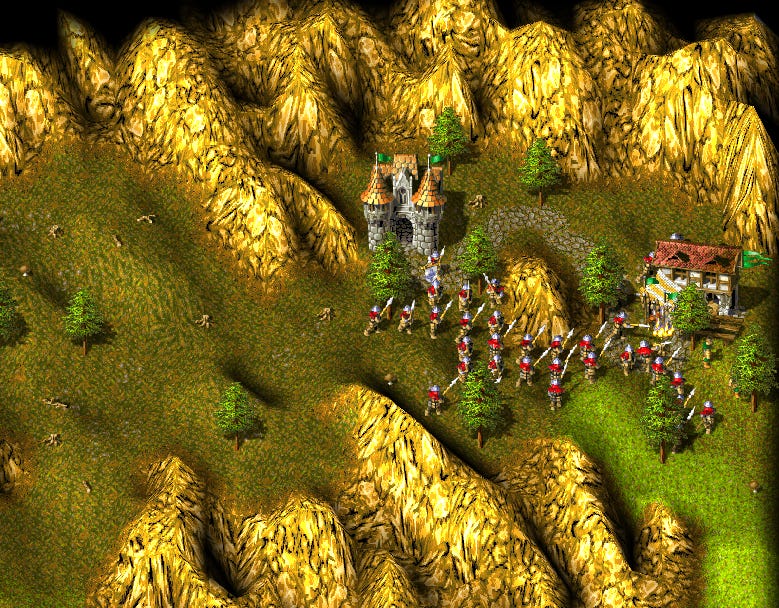
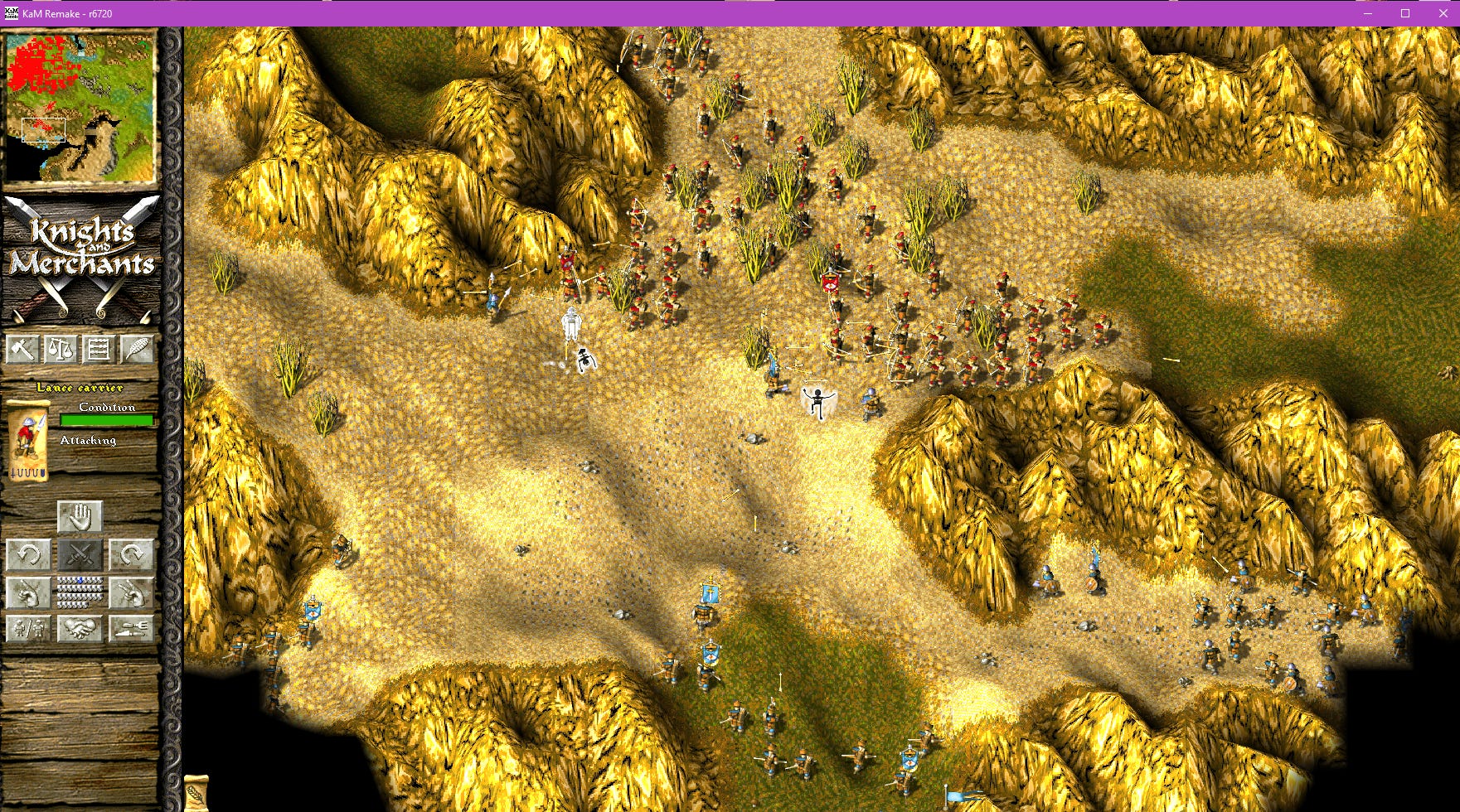
Looking back, the same would have been the case for others, of which I only had shareware versions. The first game I remember ever playing when I was about three years old with the help of my eight years older brother – Command & Conquer: Tiberian Dawn – was the same way. I only had access to the shareware featuring three disjointed GDI missions. Yet I was always enamoured with the Brotherhood of Nod with their white units, red gun turrets, SAM sites with red and black warning stripes, laser obelisks, flamethrowers and so much more. I wanted to play as those guys so badly that I spent most of my time in the second shareware mission just capturing their construction yard and building their stuff to mess around with, even though it wasn’t nearly as good with the GDI desert camo colour. They were so impossibly cool to me and their full campaign was all that I wanted, but in hindsight – now that I have played it a number of times as a teen and an adult – I know I would have hated it as a kid. The mission design would have absolutely infuriated the child me. Particularly the prevalence of deeply unforgiving no-build missions.
So I suppose that perceived fulfillment was never possible one way or another... and the same, no doubt, goes for other areas of my life, too, despite their nature being so much more painful than the inability to play some video games. And yet! I would like to believe that Knights and Merchants is ultimately representative of a greater silver lining to all of that, including the worst I've been through. Because as I have said... the first reunion wasn't the final one.
Some years later we have met again, this time in the guise of KaM: Remake – a wonderful project by some extremely dedicated fans of the original, who have decided to bring it into the modern era and to give it the polish it deserves. The charm is still there, exactly the same – the art style, the music, all the original assets are reused, which is why you need to buy the game to play the Remake... only the issues have been ironed out and new features added. It doesn't crash, the controls are way better, bugs have been solved, you can freely zoom, there's a map editor and custom maps, even custom campaigns, .... it's just pure joy.
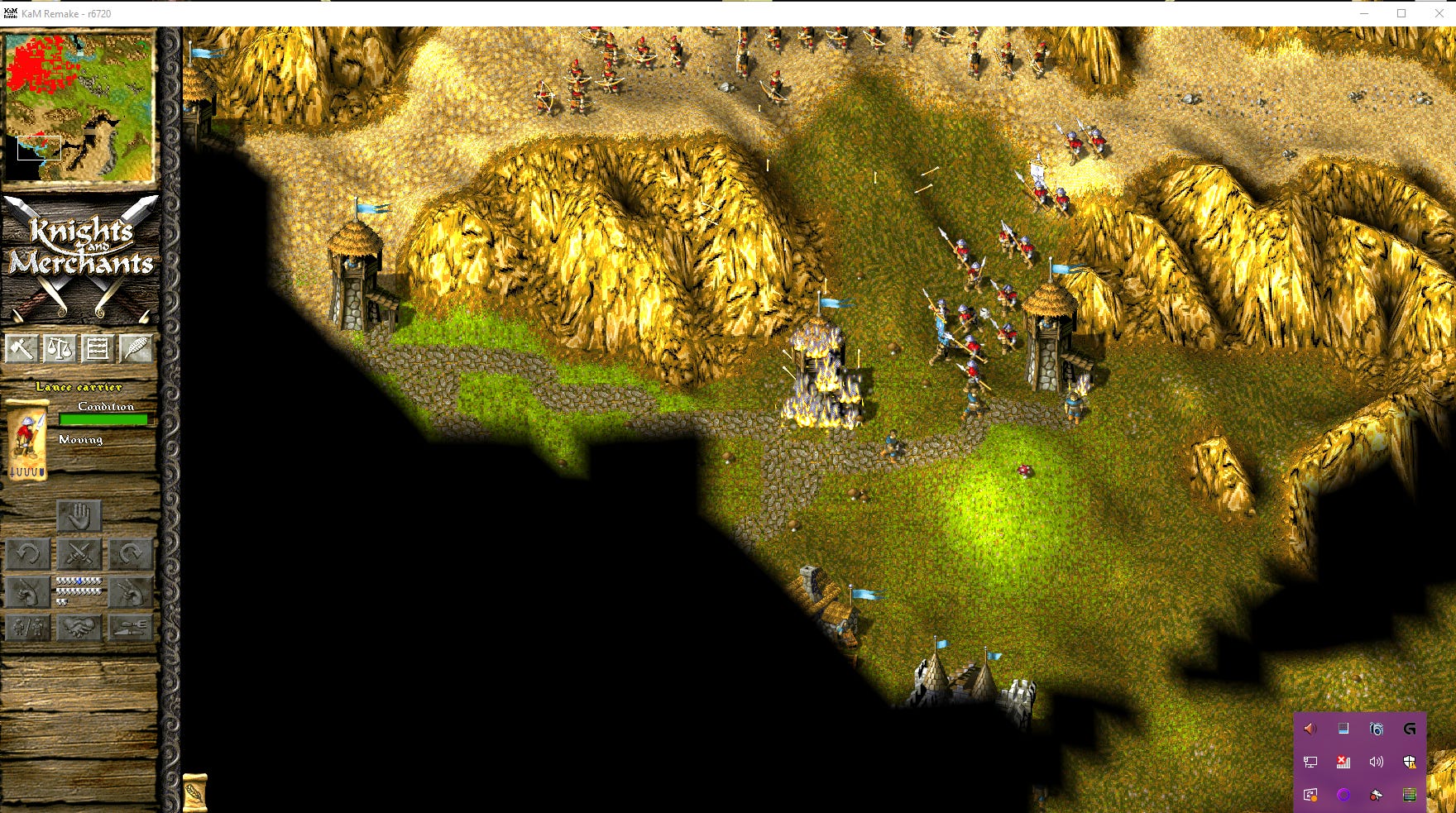
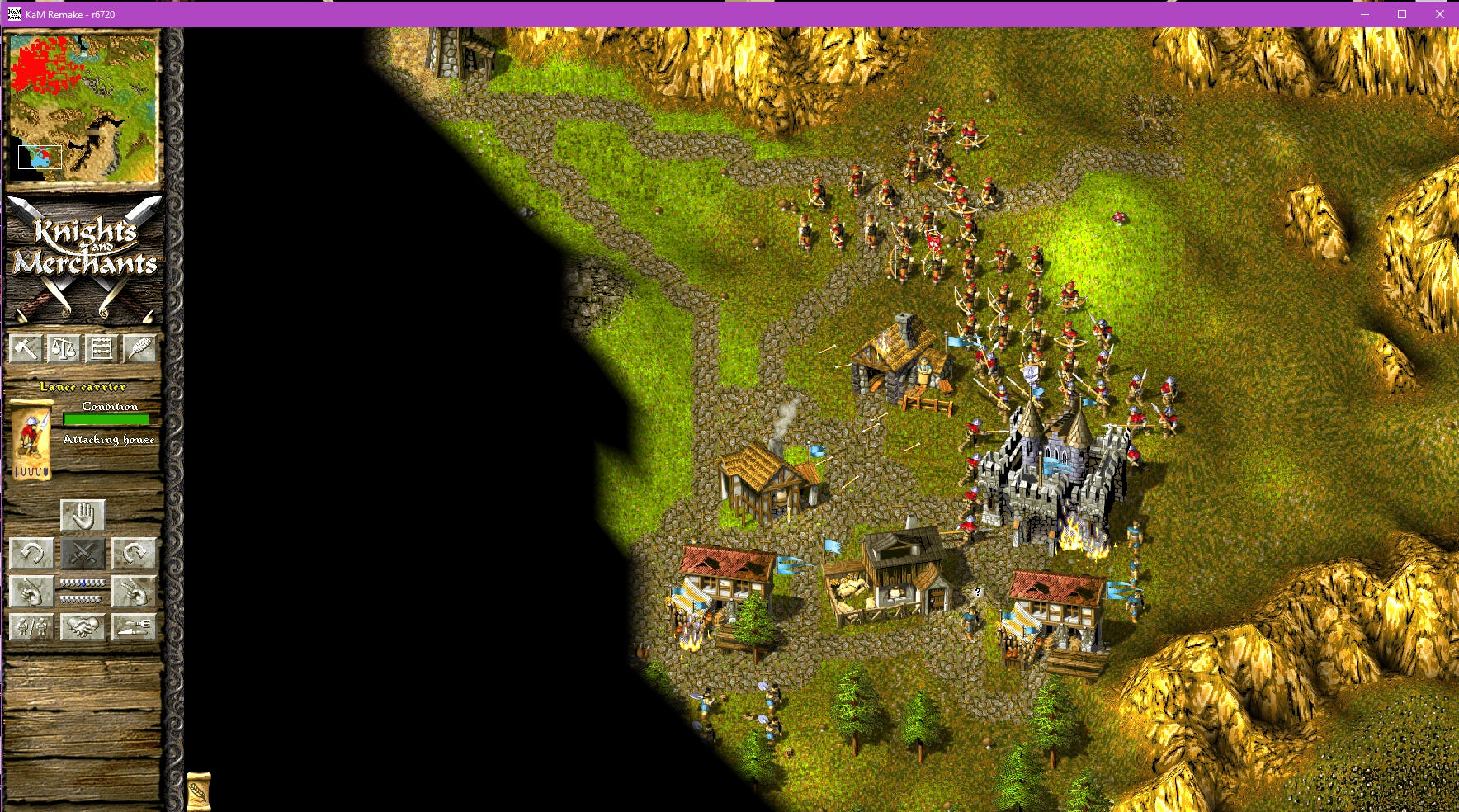
Only I still wasn't there. It was my late teens, then, and I was amid something of a personal crisis on multiple levels. Health issues I was struggling with – both physical and mental – leading to something of a disintegration of my former personality. I felt like I had dissolved into a vast grey sea and didn't even know who or what I was anymore. I had completely lost myself, forgot who I used to be. I couldn't enjoy the things I once loved, I felt nothing for them. Absolutely nothing. All of my passions were gone. Including that for video games.
I still have my old computer from those times lying around next to the current one, only not plugged in – and I know for a fact that an old version of KaM: Remake is installed on it. I did play it then, but it was very... mechanical. It didn't really make me feel much of anything. I wasn't there yet.
But now, many years later, in my late twenties amid a period of a whole another kind of troubles, I have finally arrived. I have remembered the passions of my childhood and recalled this game, among others, with a true fondness. I have bought it again on GOG, because I had sadly lost the old physical copy, installed the latest KaM: Remake version, and... I smiled. Just the music alone made me smile. I could truly feel it again. And I kept smiling and feeling enchanted by it throughout my replaying of the tutorial. Some would chalk it up to pure nostalgia, but it's far more than that. It's not rooted in memories, but in the ability to finally connect with the game once again and to enjoy it for what it is. To, once more, simply enjoy building a nice town and watching the little people go about their business. To get immersed in the music and captivated by the art style. The colour palette, the buildings, the voice acting – I could feel it again. Not the same way as I used to, it's not a matter of reliving my childhood. Merely the ability to find enjoyment in the same thing after so many years of it being impossible.
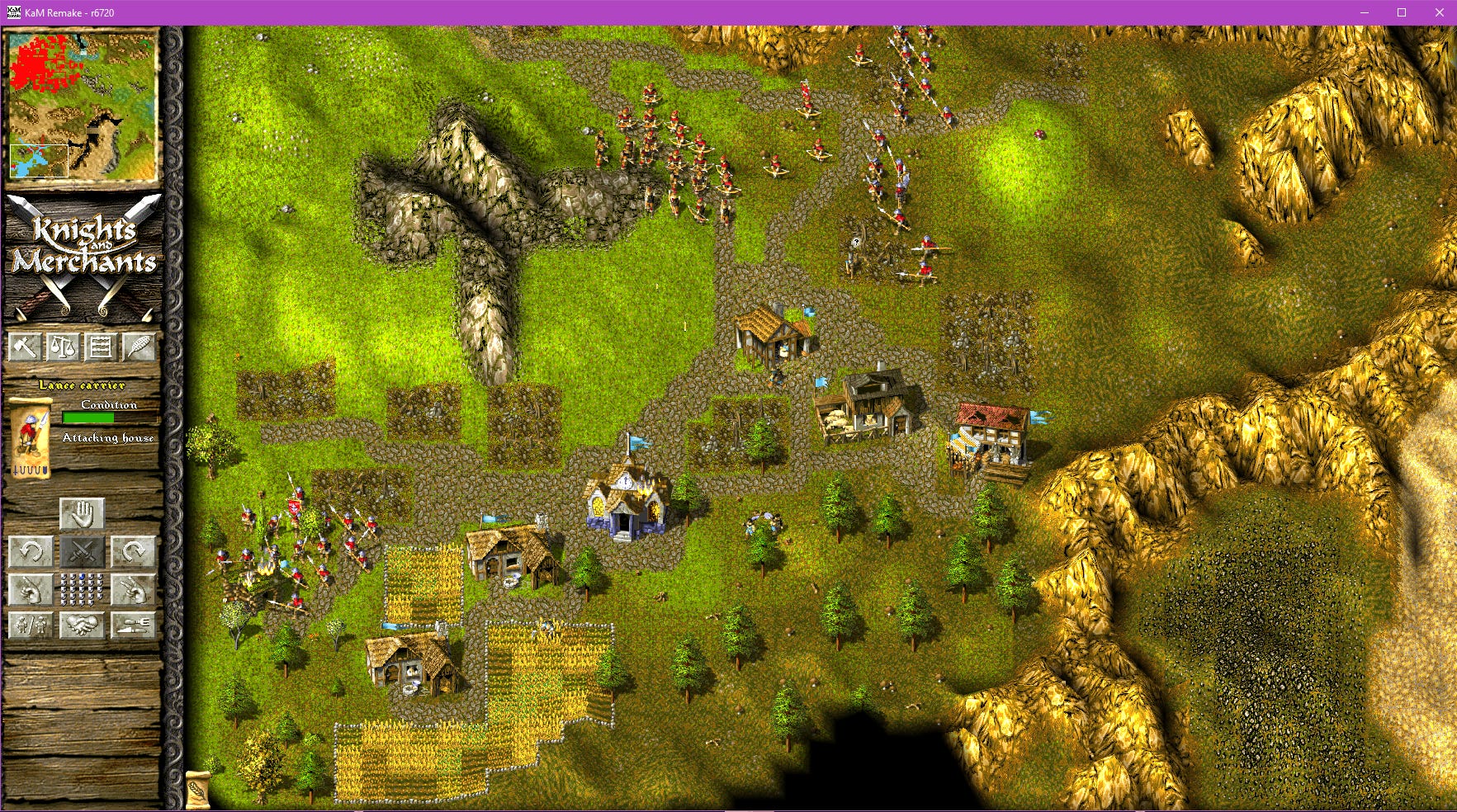
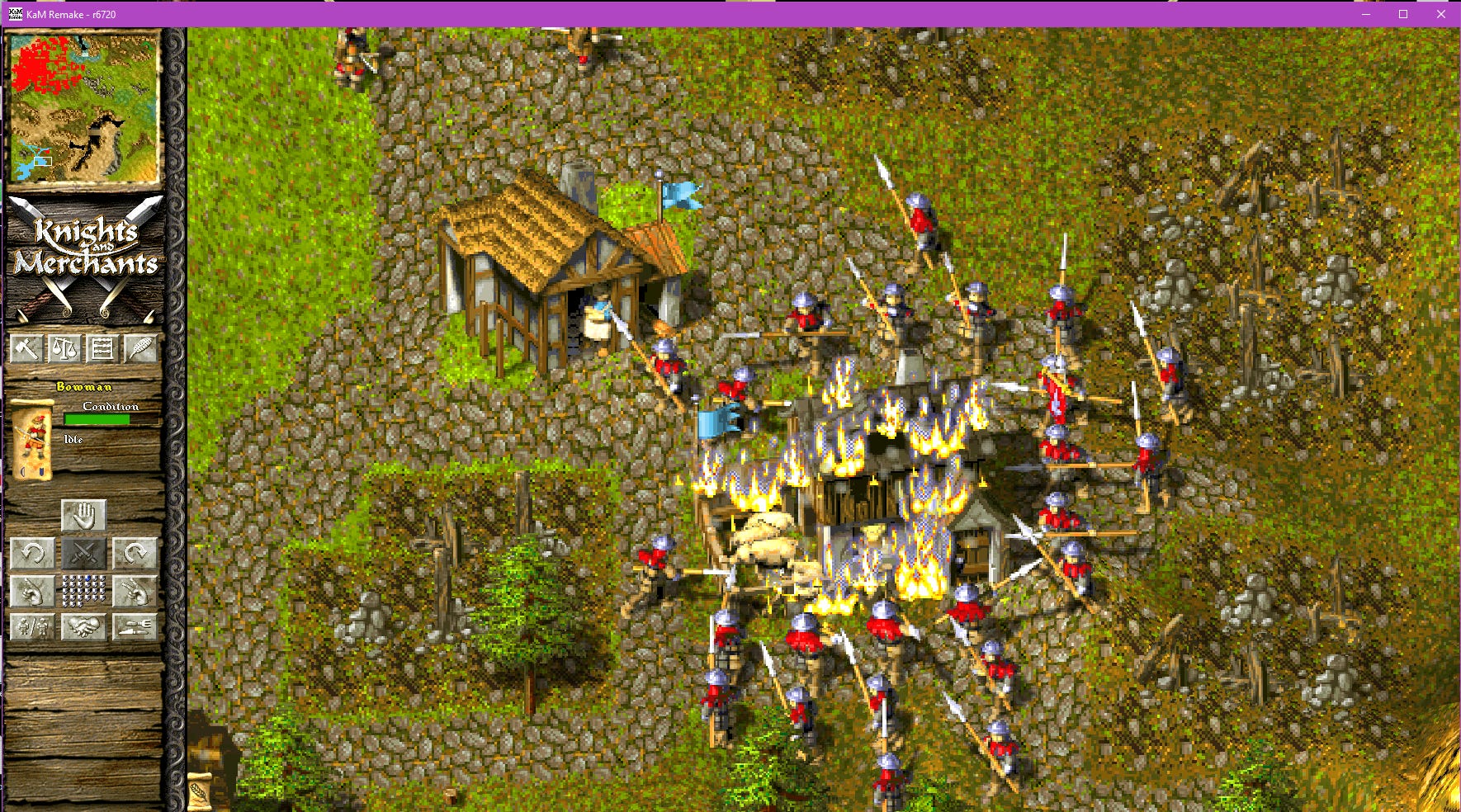
A new enjoyment, to be precise. It's the same old thing, only fixed by the kind fans behind the Remake project, but I love it for different reasons now. That is my point... I am not going back, I keep going forward and have merely found out – to my great joy – that this thing can actually go with me. That it can share my path and I am able to find a new kind of appreciation for it.
And passion and appreciation is what drives me to write.
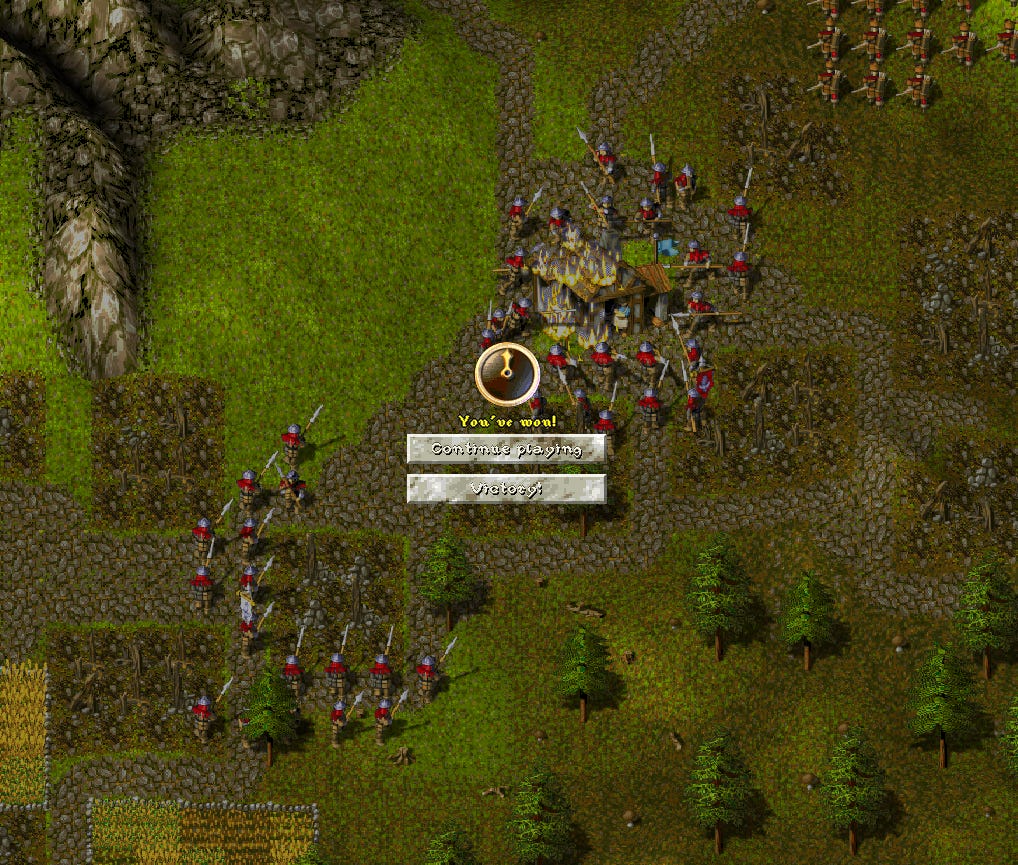
II – the Game
Knights and Merchants is, essentially, a cousin to the "the Settlers" series, except in some ways it had taken a different path.
For one, it isn't really cartoony in the same sense. One can't call it highly realistic either, not at all, but it's also not trying to be silly and whimsical. The approach to the subject matter is not intentionally childish, nor is it aiming to not take itself too seriously. If anything, it is - in fact - rather serious in its attitude. By which I don't mean stern or brooding or cold, not at all. On the contrary, it's very much warm and charming, but in a serious "Chad Yes" way, not in a "wink-wink, nudge-nudge, haha" way. It doesn't go for fourth wall breaks or self-awareness, instead being firmly set in its own perspective.
In this way the game is quintessentially German in its spirit. Even when it's having fun and being charming and lighthearted, it is still fundamentally serious about it. Because having a lighthearted fun is a serious thing and you have to do it right. And, above all else, you must not allow stupid, inappropriate distractions to taint the experience. In that sense, the game is by its artistic design exceptionally pure.
Perhaps the best way to frame it would be in terms of classical romanticism. It is – quite seriously – trying to portray a beautiful, deeply idealized time and place, which never was in real history. The Settlers series isn't like that at all – all it is doing, is very loosely using historical elements, like the ancient Romans, as costumes for the kind of game it wants to make. The historicity there is really the most superficial layer and could be replaced with just about anything else. You could substitute the Romans or Vikings with anthropomorphic biped animals and while the visuals would change, the spirit of the game would remain exactly the same.
Knights and Merchants, however, is very specifically aiming to romanticize the high medieval era in Europe, and to present a joyful, vibrant, almost paradisiacal rendition of it, where even the inevitable warfare is, in fact, something cheerful and beautiful. In that way, it seems to me that the vision of Knights and Merchants has to be close in its essence to the vision of an ideal world, which the actual medieval people had in their minds – or at least many of them, as they, of course, weren't a hivemind any more than we are. Why would I suggest that, you may wonder?
Well... one only needs to look at the old Norse pagans, for example. What was their vision of the ideal, heavenly afterlife? Indeed, the Valhalla - a place of never-ending feasts and combat, where warriors could endlessly indulge in the things, which they loved the most, including violence. A place, where warfare wasn't dreadful, but romanticized. They couldn't conceive of things beyond their own way of life, and their ideal vision of the world was one, which romanticized that way of life.
And Knights and Merchants is, in a very real way, the Valhalla of medieval Europe. That's why it is simultaneously so unrealistic in many aspects and so cheerful, upbeat and beautiful, yet also so deeply serious about it. It's not a jest – there's nothing to joke about there. It's the paradise for knights and merchants – and also for serfs, workers, artisans, soldiers and everyone else participating in a medieval society.
There's the joy of glorious, noble warfare for the aristocratic caste, and endless formations of proud, brave soldiers, who have no fear of death and plunge into hand-to-hand combat with firm gladness in their voices. Not with savage thirst for blood, but with a civilized, calm passion and a willing sense of duty. And then there are all the serfs, who happily perform their duties, not requiring anything else in their lives but to be fed and given work – the work itself is the paradise for them, as is the case with the artisans. They all love what they are doing, adore their lot in life, and seek to be nothing else. That is a quintessentially medieval view – rejecting the concept of social mobility and instead seeking contentment with one's given place in life. Your father was a smith and you are destined to be one after him and ought to be happy with that. That's the medieval way, which this game aims to idealize.
So perhaps it would seem strange for me – the one, who has repeatedly called romanticization the 8th Deadly Sin – to praise Knights and Merchants so much for taking this approach. However, that perception would be a misunderstanding. Gluttony is also a Deadly Sin, but that doesn't mean that eating food at all is the same. Romanticization is deeply wrong and extremely destructive, when it is the lens, through which one views and judges actual real things and people, and subsequently acts based on those judgements.
In the old times, I would absolutely condemn the myth of Valhalla and the entire warrior culture surrounding it as a dangerous romanticization of warfare. In the medieval times, I would condemn a vision similar to that of Knights and Merchants being presented as a serious thing the same way. Just as today I absolutely do condemn the romantic visions of technocrats, who think they are going to build an automated luxury paradise with tools such as AI. Or even the romantic visions of religious fundamentalists, who think that if they can convert the entire world to their particular doctrine, a paradise is going to be handed to them on a silver platter.
If you want to use Knights and Merchants to build your understanding of the actual medieval era, then you are most definitely partaking in that Deadly Sin. But that is clearly not what the game is meant to do. It's not trying to capture actual history and to teach it to the player, but only to provide a pleasant, enjoyable experience. It's fun not because this is how things were, but precisely because this is how they never could have been and never will be. It is, in essence, an artist painting an impossible picture. Something beautiful, which may never exist in physical reality.
That is Knights and Merchants for you. A romantic vision of a medieval world, which could never be true. And you get to partake in it and interact with it. The visual design, the soundtrack, the voice acting, the mechanics, the gameplay itself... all of it works together to facilitate that experience. Even though the central theme is warfare, the tone is above all else jolly. Not in a manic kind of way, not a way that induces laughter and excitement, no – it's the jolliness of manly workers with broad shoulders and beards hauling wooden beams and building a farmhouse, while singing shanties, drinking beer and playing cards on breaks. The jolliness of soldiers marching in good spirits, their equipment freshly cleaned and shiny and their bellies full of food. The jolliness of a farmer humming an old, pleasant tune to himself as he sows his crops.
It's a game, where everyone loves his life and nobody fears death. Even the civilians don't flee from enemy soldiers. They just go about their duties as they are being cut down and pelted with arrows. There's absolutely no room for grimness there – none. A completely different world, where everything is okay, really. The peasants may be revolting against their lord, but it's not really that he's some sort of vile cartoonish villain. There's no horrific abuse, nothing truly awful or sad. It's just what medieval peasants do – if they think their lord sucks, they revolt. And that part is, in fact, rather historical. Peasants didn't really revolt because they hated being peasants – it's just that if they thought their lord wasn't being good enough to them, they would rise up against him. And, again, the game takes that attitude and runs with it. You’re not trying to overthrow the institution of feudalism and serfdom in a glorious revolution - it’s far, far too early for that. You’re just doing what medieval people did, which includes turning your farm tools into weapons and caving some skulls in if your masters get too a bit too uppity.
Did you, perchance, assume I was talking here about the expansion pack "the Peasants’ Rebellion"? Why, no, not at all – the story there is the exact opposite. You are not doing the rebelling, but rather curbing a rebellion. The story goes that a young prince in a neighbouring kingdom is experiencing an uprising among his subjects, and asking you to help him maintain his place as the rightful ruler against the onslaught of wealthy merchants, peasants and disloyal lords. Once again, the game asserts the ideal of a just feudal order, where the monarch is inherently righteous in his rule for as long as he acts virtuously and does right by his subjects. Even in the original campaign you are a loyalist to the king of the realm, whose prodigious son ended up being an unjust ruler, rejected his father's authority and ultimately started a civil war against him.
Knights and Merchants never once suggests that feudalism is wrong – rather, it pursues the ideal of a perfect feudalism, where everyone plays their part willingly, with virtue and is pleased with their lot in life. Where the serf is just as glad and content in life as the king. That is the spiritual, philosophical essence of the game and the reason why it is so pleasing and fascinating. Yes, these themes exist in other games as well. They are quite common, but they are in most cases in the background. Take the Warcraft RTS games as an example. The ideal of a just absolute monarchy is only vaguely implicit in the story and serves as nothing but a set dressing for the overarching drama of the actual story. In Knights and Merchants, however, this romantic idea is in the spotlight, front and center. It's not just a small part of the narrative scenery, it's the underlying essence of the whole thing.
Simply put, Knights and Merchants is romantic, idealized feudalism represented in the form of a video game, rather than merely utilizing the concept. But at the same time, it is not being pretentious, like many franchises would be. It's not engaging in severe romanticization while at the same time trying to wear the guise of gritty realism. No, it fully embraces what it's doing. It is being unabashedly romantic and idealized. And that, in this day and age, is very admirable. To be frank, I am sick and tired of "gritty realism" in games, which isn't actually realistic at all, nor do I want serious realism in the slightest. I'm not after simulators, but games, which offer pleasant, interesting experiences.
And Knights and Merchants is exactly that. Pleasant above all else.
III - the Good, the Bad and the Half-baked
Aside from the artistic aspects I have already mentioned, this game excels over the Settlers – which I am going to be using as the default comparison the entire time – in the meaning it gives to the economy you build. Food production isn't just a means of obtaining raw materials by feeding the miners. Everyone needs to eat. Nor do people merely stop working if they don't get fed. Or rather, they do stop working. On a biological level. They die.
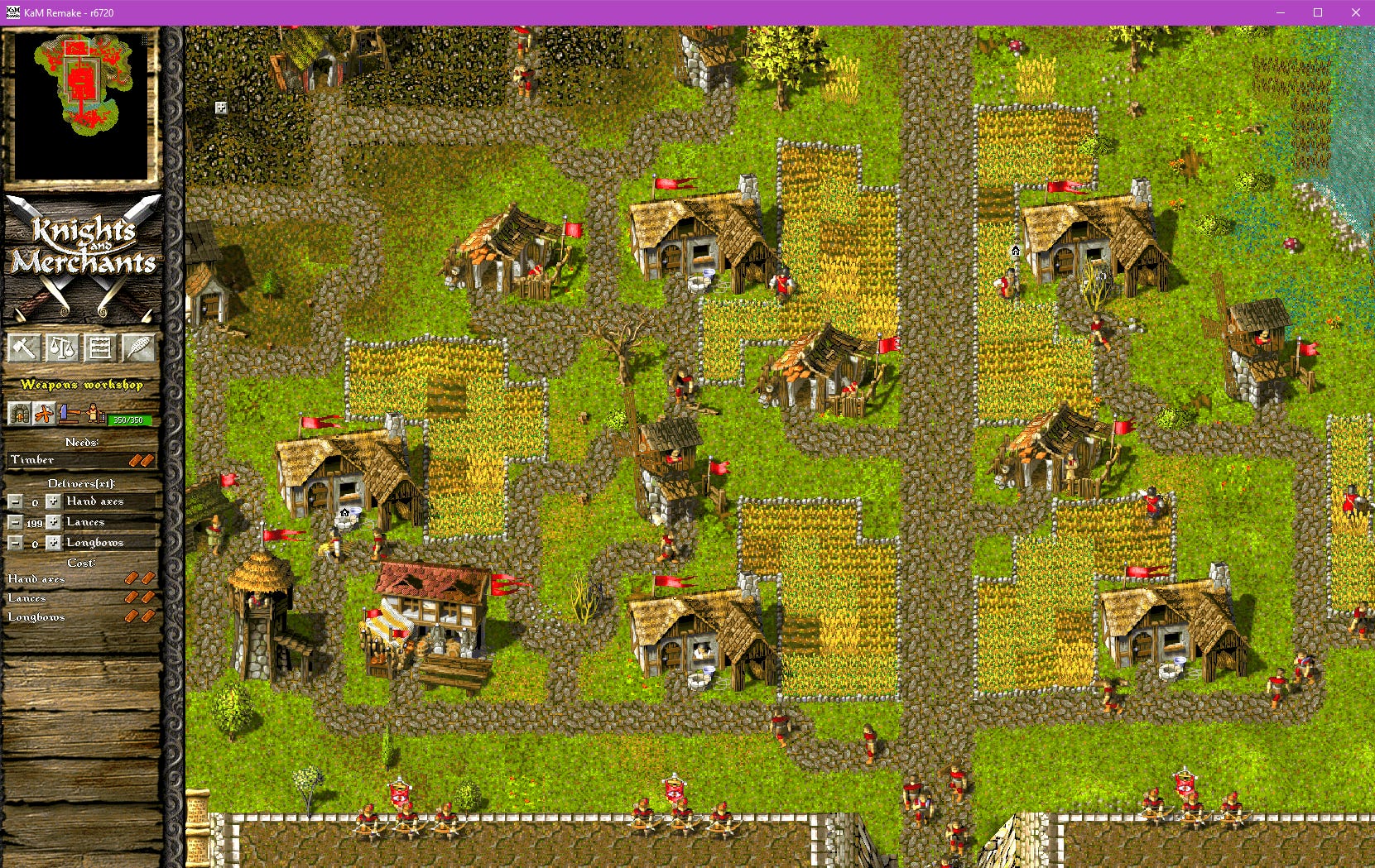
Therefore unlike in the Settlers, your settlement can't just sit around doing nothing or being ineffective for very long at all. If your economy breaks down in some way – even because of an enemy raid that kills your serfs and farmers – everyone will starve and die. Even just city planning, managing traffic and building your roads efficiently is extremely important, because severe congestion will lead to major issues and potential starvation. Therefore everything you do feels as though it matters a great deal more. It's not just a matter of haphazardly placing a bunch of buildings and things working out alright, nor are your people just inert objects that don't require any care. Nevertheless, this is both good and bad – the Settlers series isn't just inferior, of course it's not. It's great for a more casual play, where you don't have to think as much and worry about as many things.
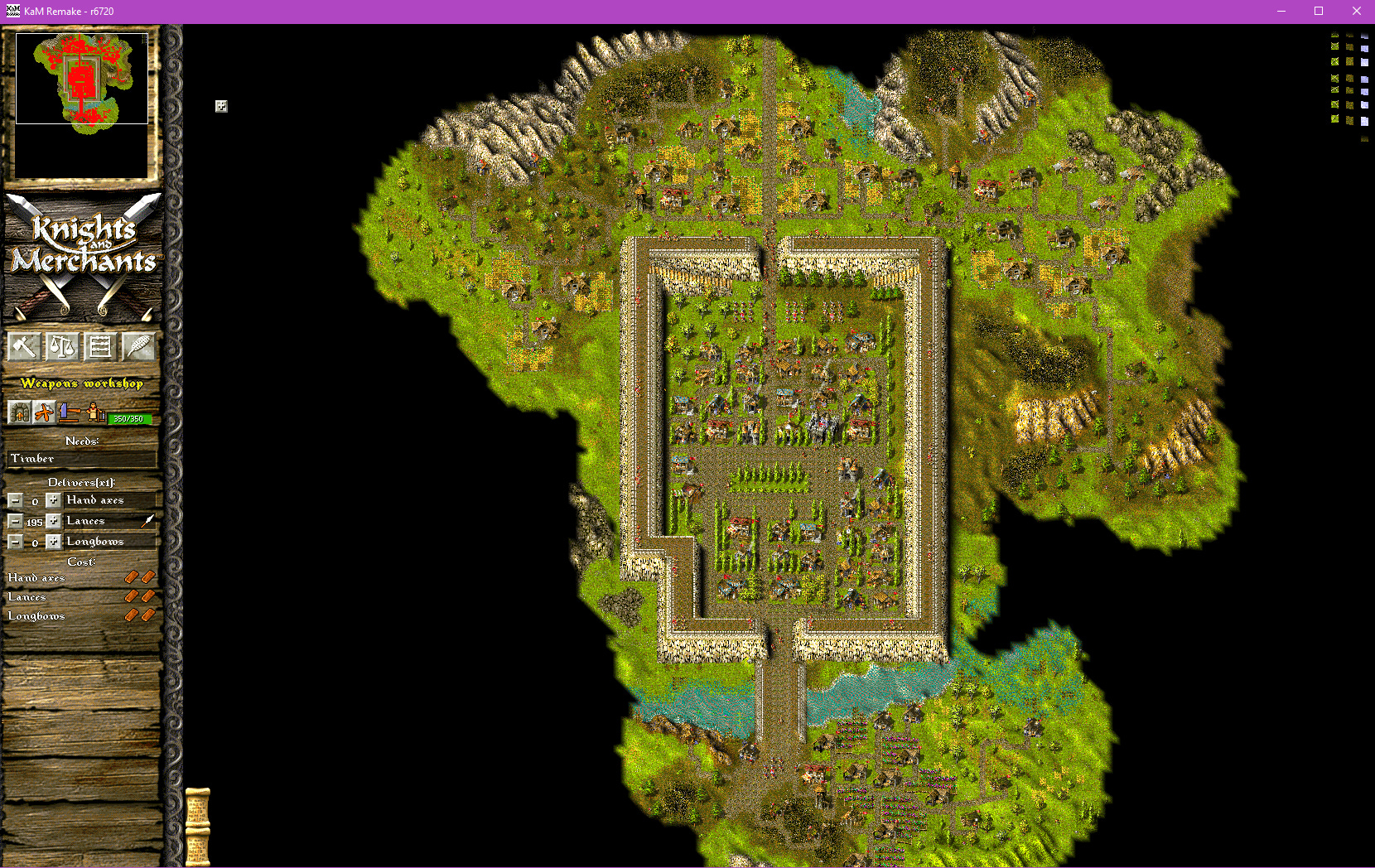
Another aspect, where Knights and Merchants feels much stronger, is the combat. Again, your troops need to be regularly supplied with food. Just wondering around the map for hours isn't possible. Prolonged offensives don't work, because you'll either have to force your serfs to run across the map with supplies or have your troops die of starvation. So you end up having to be tactical instead. Send out a raid, accomplish a particular task, return home. It's not a generic dumb RTS game, where you just amass a giant death-ball of units in your base and steamroll your opponent. That's not how it works at all in the vast majority of real cases. Even just trying to make that death-ball is a poor idea, because you'll have to constantly feed all of those soldiers. You want to manage the size of the army you field – ideally make it just big enough to serve its purpose and not any bigger.
Secondly, your troops work in highly modular formations, which you can combine, divide and shape as you please, from columns, to squares, to lines. They don't have silly health bars or any such things, only an indication of their stamina, showing roughly how much longer they can go on before needing to eat again. Unlike in Settlers 3 and 4 from the same period, late game battles don't just devolve into a spam of archer death-balls or anything of the sort. There's genuine strategy at play.
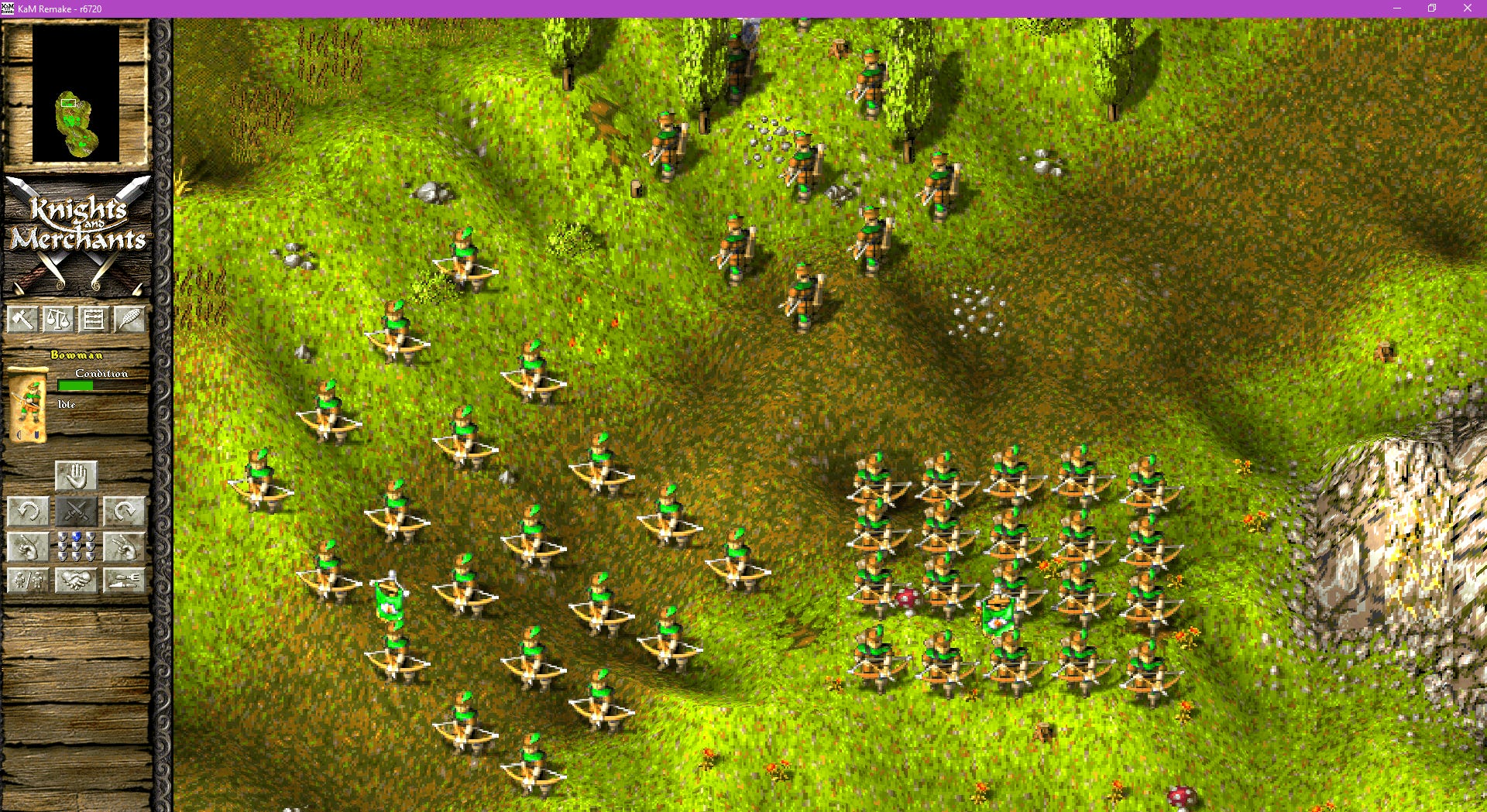
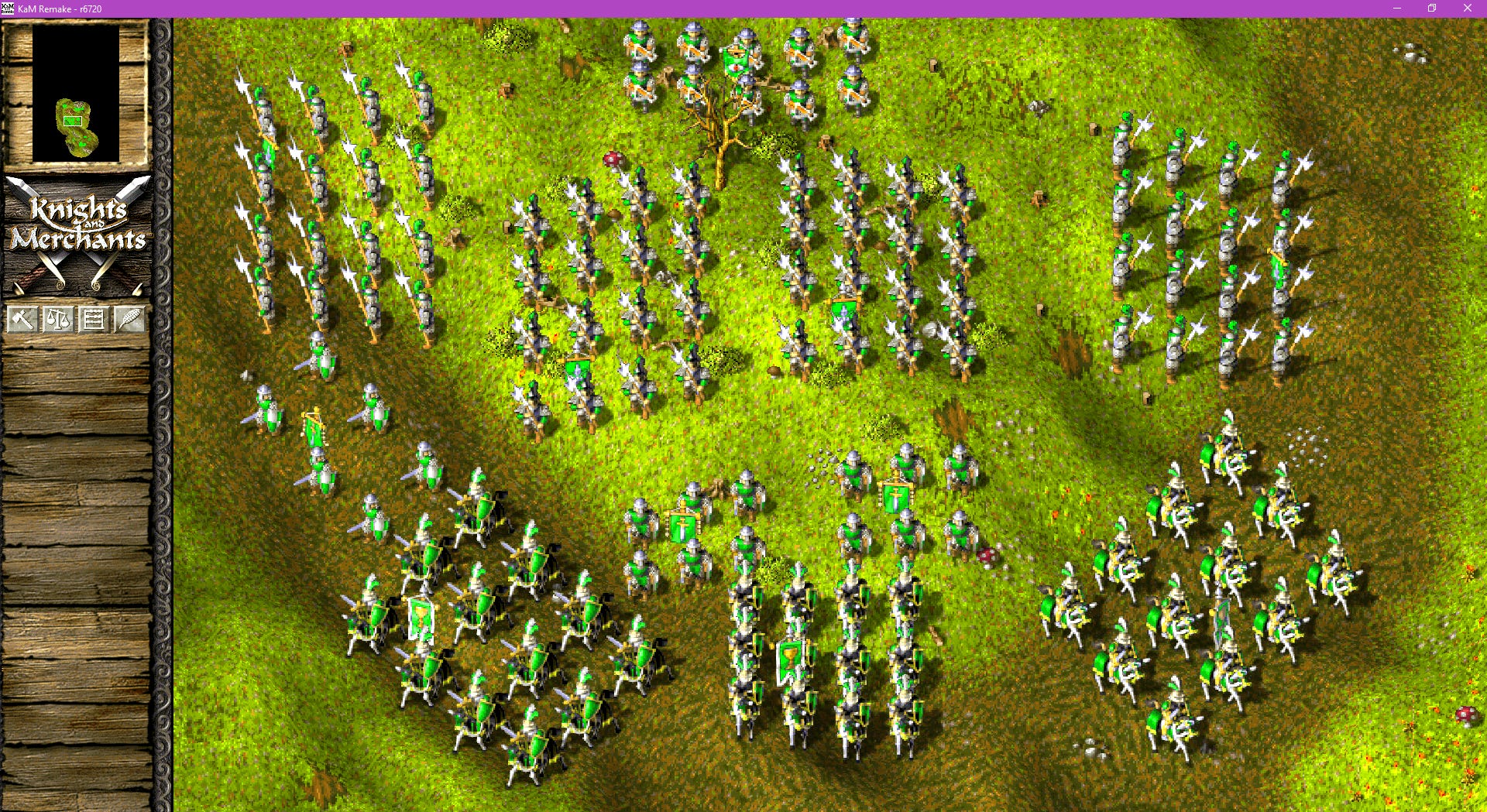
Things like flanking your opponent with cavalry and hitting his archers actually do win battles. Overpowering your opponent with a vast mass of troops generally doesn't work, unless it's in a wide open field. Choke points and positioning matter immensely. So there are genuine battlefield tactics involved. Just training hundreds of soldiers and throwing them against the enemy is unlikely to provide results in most cases... unlike in Settlers 3 and 4, where it's more or less the default thing to do. On the other hand... training a group of cavalry and raiding the enemy town to cripple their food production while avoiding their slower infantry can be very potent.
On that note, your civilians are not a protected class, as they are in Settlers. They may be targeted and killed, just as all of your buildings may be raided. Which, again, adds layers of strategy. You don't merely need to protect your military buildings, you need to protect everything. Food production in particular.
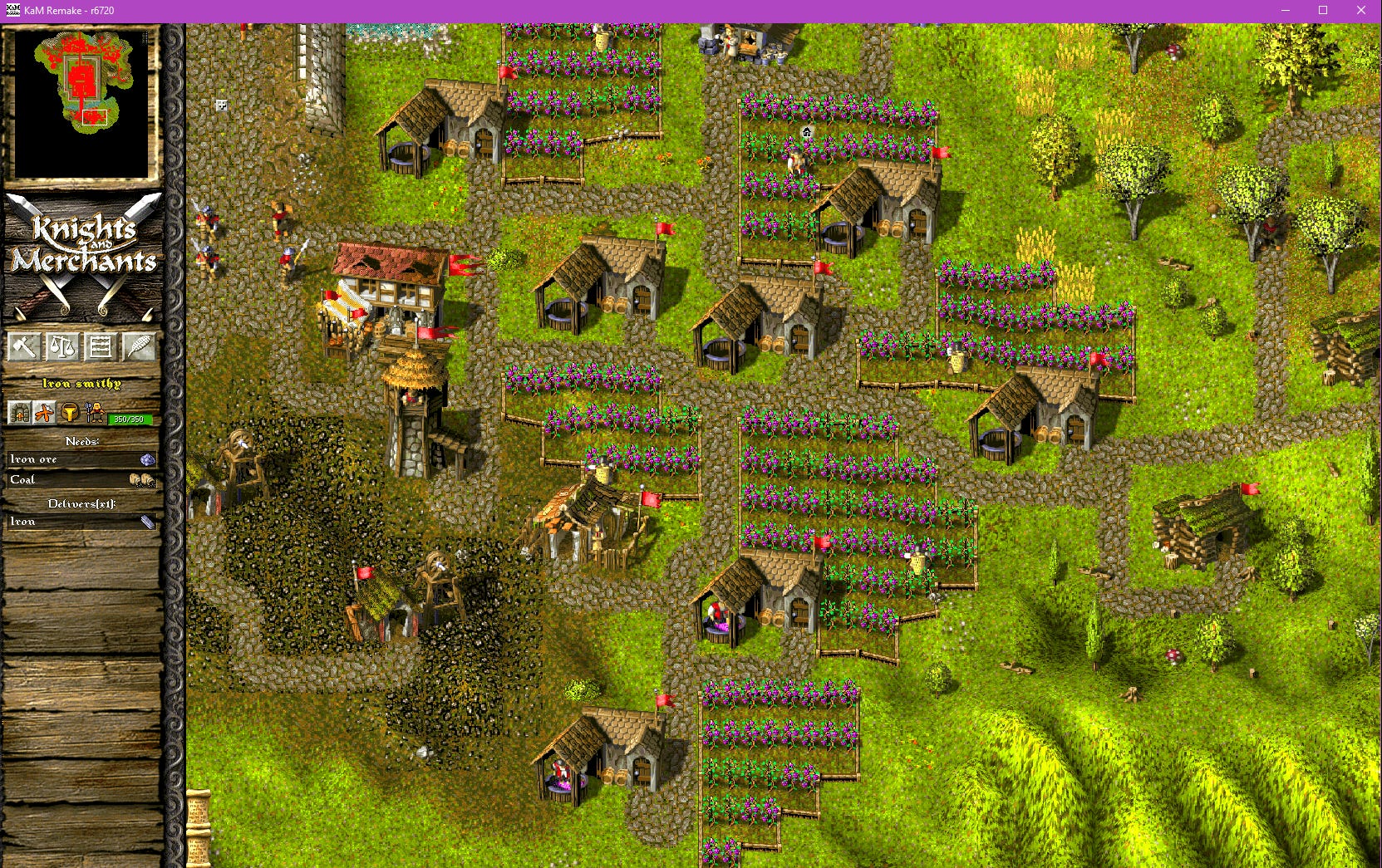
However, all of this also has a downside. The game is hugely dependent on momentum. Everything takes a long time - in fact, even longer than in the Settlers games from the same era – and just like in those games you can press buttons to speed up time, if you so wish. The Settlers had forward time skips, Knights and Merchants is more elegant in that it allows you to speed the game up in real time by a factor of 3,6 or 10. So you can just tap to go 10 times faster for a few seconds, tap again to give a command, and repeat. Which is great, but again... the actual point is that the game is about gaining and keeping momentum, because every little thing matters so much and everything is so vulnerable.
Comebacks are hard to do. If you sustain enough damage to your economy from an enemy raid, for example, it's very possible you'll fall so far behind that you will never recover. Similarly, if you commit to a large battle and lose your entire army, while the enemy still has forces to press on with, you will not be able to field another army in time to defend. In other words, it's a genuine strategy game, not an isometric action game masquerading as strategy (looking at you, Starcraft and Warcraft), which is very much a double-edged sword.
Where the likes of Starcraft are extremely fluid, allowing for crazy back and forth exchanges, Knights and Merchants is a deeply rigid game. Building your town is akin to chiselling a statue out of a stone block. A delicate process and if you hit the wrong spot too hard, it will crack or break off and you're done. While the combat is much like real life combat, in that you can't heal damage while fighting. You don't have a health-bar or hit-points. Small wounds and injuries don't really matter, and the first major one is likely to take you out. In other words, just like in real combat it's all about avoiding taking that major hit to a critical area.
If you're dueling someone with longswords, you don't just take a blow to the head, stumble back, fend off your opponent, recover in seconds and keep fighting. Unless it's just a superficial scratch, if you get hit in the head, you're done. The whole point of the art of swordfighting is to protect yourself from taking a critical hit like that, while managing to land it on the opponent. Which is really how this game works. It's a very fine dance and the moment you take the first big hit, you're more or less out.
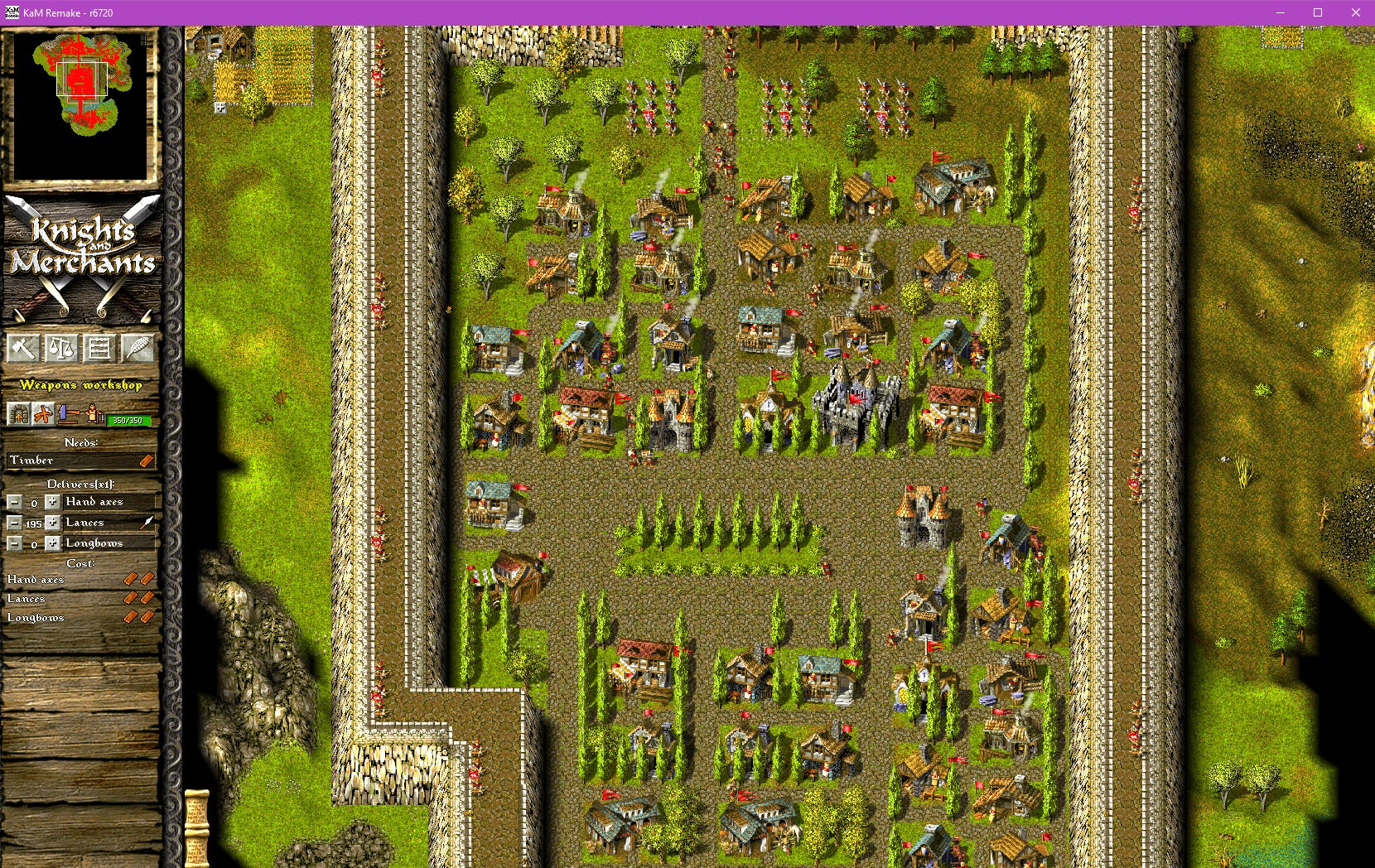
In other words, it's not for everyone. There isn't a whole lot of room for error. Unless the map you're playing is very forgiving or you've advanced to a point, where the enemy is no longer an active threat, you're always right on the edge and a single defeat can put you so far behind that you will not recover, forcing you to either reload or restart. Or give up.
And lastly... it was a small project by a small studio. They gave it their everything – clearly – and produced something truly unique and remarkable, but at the same time, there self-evidently wasn't nearly enough time and resources to get things completely right. The original felt rough around the edges in many ways. More like a late stage beta version than a full release, if one is to be honest about it. The Remake crew has done a great deal to remedy this state of affairs and now, finally, the game indeed comes across as a reasonably polished product. Not fully polished, no, as there still remain things, which are yet to be sorted out, but close enough.
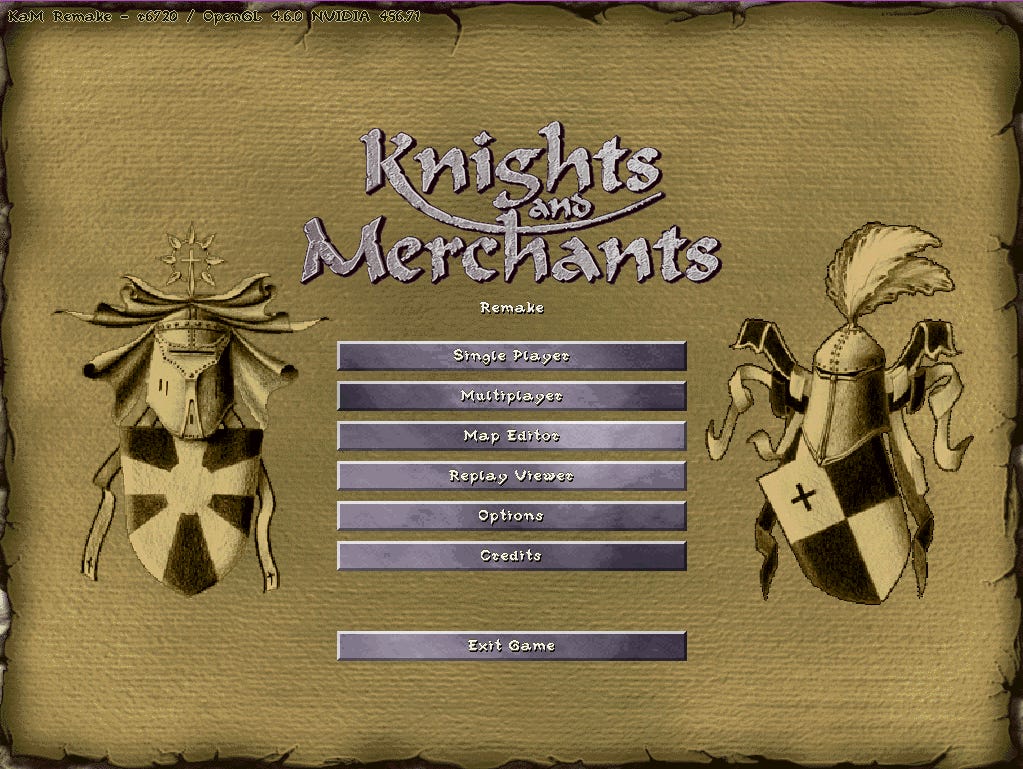
Which, however, doesn't mean it now feels totally complete. What is there is great, but the game – even in its full version - has always felt to me as something of a demo. A proof of concept. An appetizer. When I played the shareware version as a kid and saw the two very distinct helmets in the menu, I thought it meant there are at least two distinct playable factions. And only when I bought the full game much later did I find out that no such thing exists. There are no factions, only colours. Much like there are no defensive structures beyond the single basic watch tower, et cetera. It just... isn't quite there. And by "there" I mean at its full potential as a game.
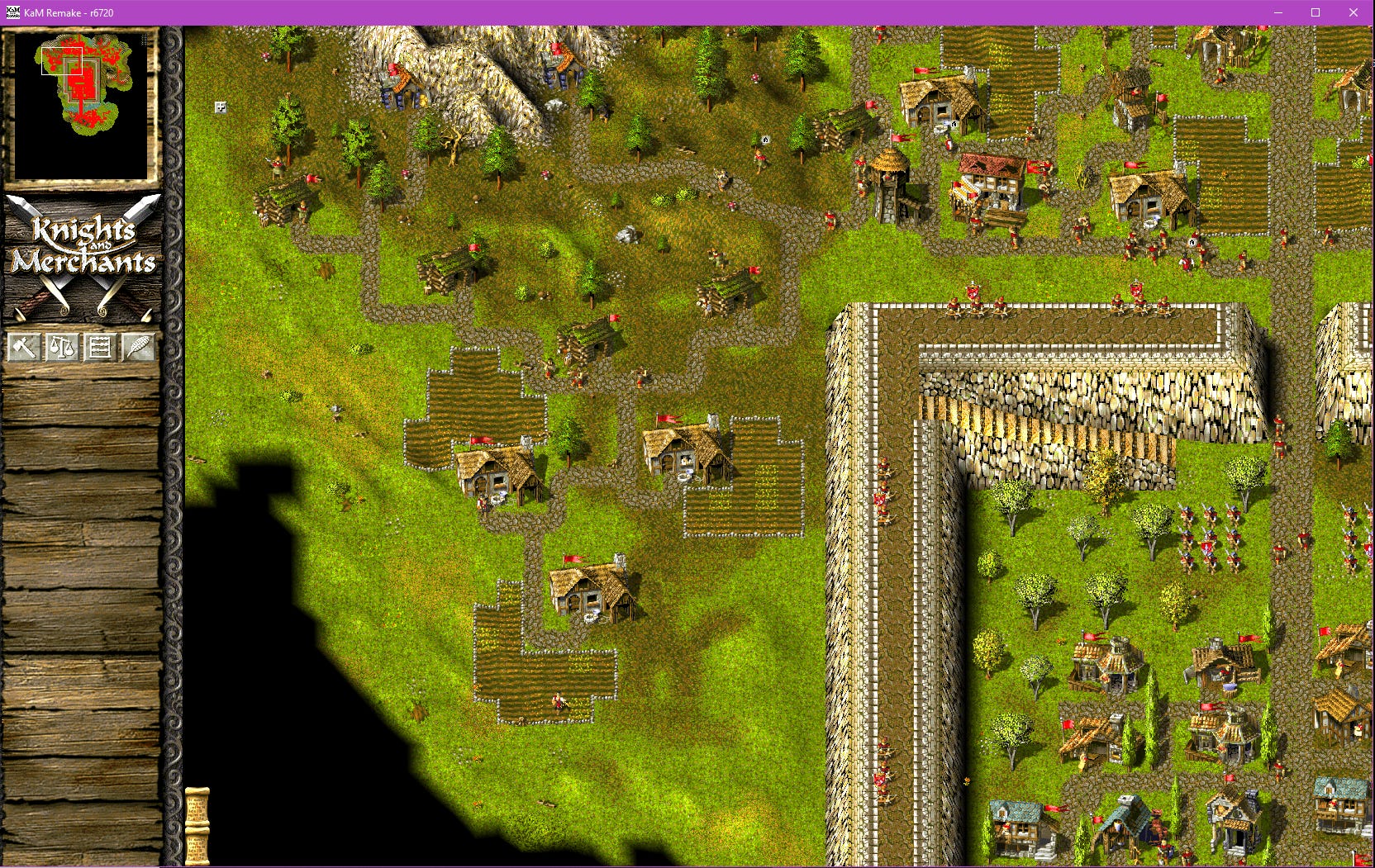
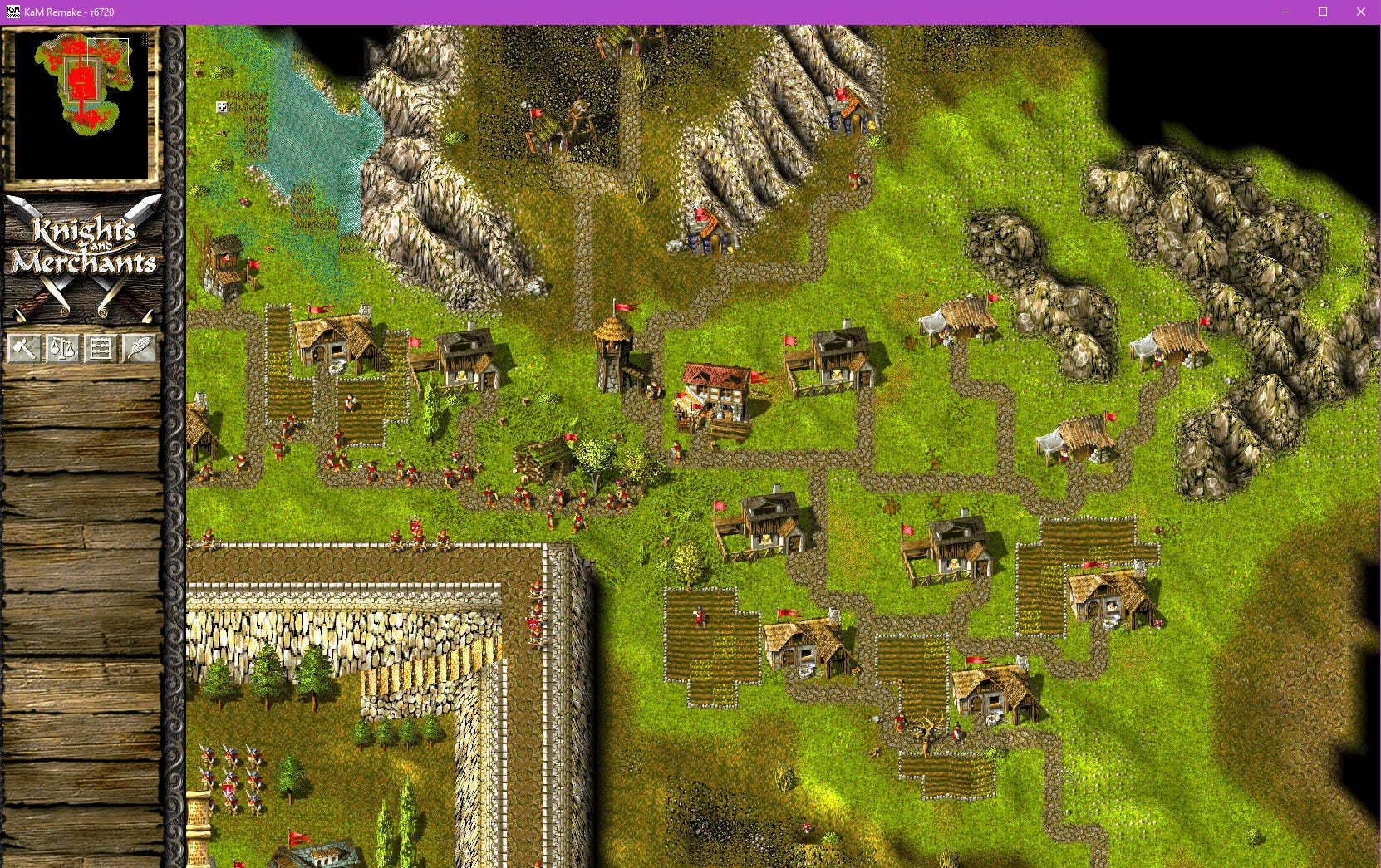
I would like to end this section with a single example. I think every good strategy game with a focus on the economy should have some layers of redundancy to allow for achieving the same things in different ways depending on one's conditions – that being the environment of the particular map, the available resources, the strategic situation, et cetera.
So, let's talk about the food supply, because the game features zero redundancy there. You have wine, bread, pork sausages and fish. Each of them have a single way of being made. You build vineyards, harvest grapes and turn them into wine. You build farms, grow wheat and either mill it into flour to make bread, or feed it to pigs to produce sausages with their meat. And if you have an access to bodies of water, you can build fishermen's huts and thus obtain fish, which is sadly a limited resource.
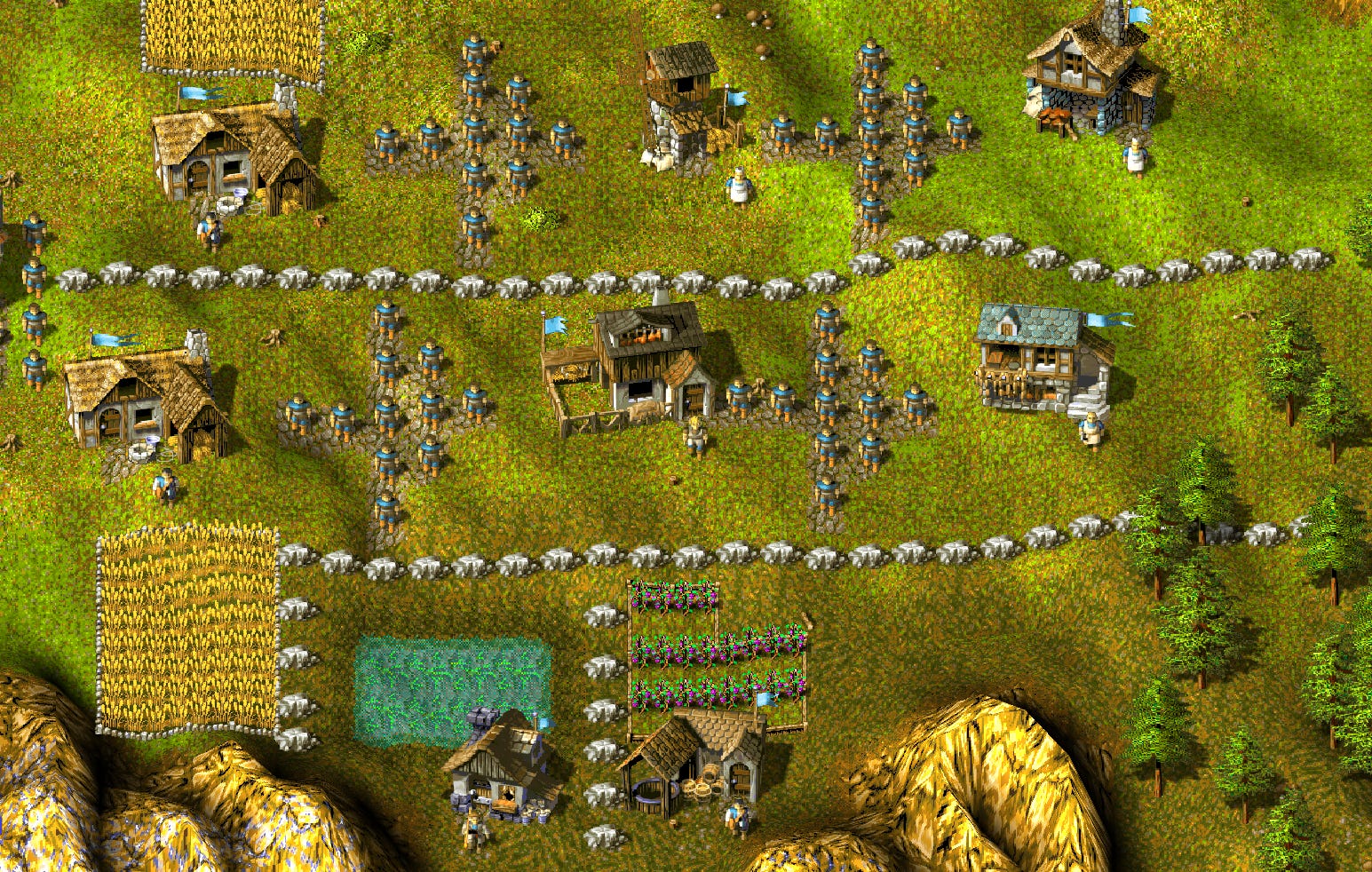
But what if there were alternatives? What if vineyards required a specific terrain type / warm climate (the game ranges from snow to deserts) to bear fruit? And what if you could instead built a brewery to turn grain into beer when grapes cannot be grown in sufficient quantities? It would be another area of strategic consideration – having to evaluate your surroundings and decide which food types to go for. Similarly, cheese could be an alternative to sausages – requiring a dairy farm with very large pastures and producing no leather for further use, only food. Don't look for logic in that in terms of how actual dairy operations work – pig skin was also never used for armour, the way it is in the game. The point is about different mechanics.
Swine farms in Knights and Merchants are notoriously inefficient at providing food, but they do also give you a resource, with which to build your army. A dairy farm could be an alternative, which requires more space and provides a much more abundant food supply, but nothing else. Only the food. Fish, being the "bonus" food type could have loads of alternatives, from fruit obtained from orchards; to wild berries and mushrooms (the latter of which do grow everywhere already!) picked by a specific worker type akin to the woodcutter; to perhaps eggs, requiring once again grain as feed for the hens. And every type could have its advantages and disadvantages, with the berries and mushrooms, for example, requiring large areas without fields and buildings and having comparatively small yields.
This means that on one map you could go for vast stretches of grain fields and nothing else – brewing beer, making bread, and keeping lots of pigs and hens. Another time, when the terrain isn't suitable for that, one could instead opt for vineyards, orchards and dairy farms, because the animals could graze even on land, which doesn't support grain farming. Since there are already wild beasts roaming the maps, you could even introduce hunters, and have those as a low-yield source of meat, which requires a lot of uninhabited land – with the critters themselves respawning after a while, so that it's a continuous trickle stream. Not enough to support a large town, but enough for a village. And in that way you could make scenarios, where you are indeed playing a small village reliant largely on hunter-gatherer methods and trade, while trying to defend itself from attackers.
It’s things of that nature, which create options and possibilities, and those are great for games like Knights and Merchants, because... to be perfectly straight and honest with you, building the exact same infrastructure every single time you play is a tad annoying. It actually makes the game worse in an objective way, because it reduces the dynamism of base building and makes it less about meaningful decisions and more about perfectly executing slight variations of the same cookie cutter plan. Decisions are important. Without them there is no game. If you don't get to choose and to potentially make the wrong choice, you're not playing a game, you're watching a movie, where you have to give manual input for it to continue. The game in question does already feature at least one important choice in terms of what infrastructure you decide to build – that is, when it comes to what arms and armour you decide to produce, with both of the options having their distinct pros and cons. So in that sense I am not suggesting anything alien to the franchise. Only more of what is already there. Because Knights and Merchants – while a hidden gem already – is in my view still far from the peak of its potential.
It's good enough to be worth playing, yes. Absolutely. I cannot recommend the Remake enough. Seriously, go buy the original from GOG if you don’t have it already and go to “kamremake.com” to get the objectively best version of the game. If you like these sorts of things and you haven’t played it before, give it a go. It’s great. But that doesn't mean I feel content with it, the way it is. It's easy for me to imagine ways, in which it could be so much better still.
And because I am notoriously bad at containing my verbally expressed mental diarrhea...
IV - Factions
When I say that the game is missing factions and would be better if it featured them, that could – of course – mean just about anything in terms of game design. You could imagine whatever you like behind those words, ranging from the factions of Settlers II, where they are literally just cosmetic reskins of the same mechanics, all the way to the factions of Warcraft III, Starcraft or Earth 2160, where they rely on completely different mechanics.
However, me being me, I am not content leaving it like that, because I have some very specific ideas on my mind. Really, I have a concept that I feel rather passionate about – and because it's never going to see the light of day as an actual project, realistically speaking, I at least want to share it with the world (or the one person, who may actually read this) verbally, as an idea.
The singular original faction of Knights and Merchants is, clearly and unmistakably, based on medieval Western Europe. It represents no one particular nation, but rather a fantasy mash-up of and a spin on Britain, France, the Holy Roman Empire, and their kind. Nor does it represent one particular historical period – say, the 12th century AD – but rather a more broad quasi-historical synthesis. It is simply "medieval fantasy" – before the advent of gunpowder, but certainly after the so-called "Dark Ages".
And while some would indeed be content with simply splitting this broadly Western civilization into actual specific nations with slight variations and specialties, that – to me – would go against the ethos of the game. Aside from that solution being lazy and unfulfilling, Knights and Merchants has the approach of... general emulation of history through a rather romantic, colourful lens. It never gets bogged down in divisive specifics like real world nationalities and religions - it very much doesn't care for those. It doesn't want to focus on minute details, but on overarching generalities. That is, indeed, why the one faction in question is so non-specific. You cannot say more about it, than that it's medieval Western Europeans (and Central Europeans, if you wish to use that framing, as I normally do). You can tell it's not based on the Byzantines, or the Russians or the Nordics - but that is truly about it.
Thus, what I would propose, would be to introduce another such broad, overarching civilization conceived in the same terms - specifically, I believe the best fit for the game would be the "Magian civilization", to borrow an expression from Oswald Spengler. That is to say, the one native to the Levant and the Middle East in general. Synthesizing Arabic, Persian, Hebrew and Northern African influences, among others. Once again, while completely avoiding anything explicit to do with religion and nationality – simply a quasi-historical fantasy civilization based on those characteristics. Indeed, I believe it would be rather appropriate to use the caliphate of Cordoba as one of the core influences, especially since it would fit the setting and the conflict with the Western – "Faustian" - civilization.
Of course, this makes the aesthetic aspect very clear – the same artstyle, except buildings of a broadly Middle-Eastern / Southern Mediterranean design, and characters of a more bronze complexion, wearing appropriate clothes and gear. The same kind of charming, up-beat, pleasant music except derived from Middle-Eastern influences. The same style of passionate, over-the-top voice acting, also done in English, only with different accents and vocabulary. While all of this would take a great deal of time, skill and resources to implement, it is nevertheless quite straightforward as an idea.
However, as I have outlined, although it would be enough to please me, I am not interested in a mere reskin. And the question of mechanical differences – being as open as it is – is what I would like to focus on. In particular because this is just about the only thing I can possibly contribute, given my skill set. A design philosophy. A theoretical concept. There are things I can do – such as repairing cars and washing machines or writing – but coding, visual design, musical composition or voice acting are not among them. Thus, writing and theoretical game design is the most I can do when it comes to Knights and Merchants.
Let us venture forth into this subject with the assumption that whatever I am not specifically mentioning remains more or less the same, because the intention is not to reinvent the wheel when it comes to Knights and Merchants, but to simply provide a different spin on the same thing, which is fitting to the civilization in question.
It's very possible that the first point of substantial difference of the Magian civilization has been obvious the moment I have mentioned it. The baseline Knights and Merchants civilization relies entirely on wine as its drink of choice, yet the Magians by the medieval era have strongly rejected consumption of alcohol. It's not that it wasn't done at all, but rather that it was shunned and viewed in a way more akin to how the West has viewed marijuana. As such, wine certainly cannot be the drink of choice for this civilization.
And that is where the first of many possible asymmetries comes into play. I do not wish to keep the exact same mechanic and simply reskin it to something non-alcoholic. Rather, I would like to change things around. Give the Magians an edge in this area and make them work harder in others, while also highlighting their geographical and cultural differences. Simply put... let them use water instead of wine. Wherever there is lush green grass, they may build a well at the cost of several units of stone – a one square building, which replaces the vineyards, while the vineyard building itself is removed completely. There is no specialized "well worker" – the basic serfs simply go to wells and fetch water when it's needed. Much less complicated, the only disadvantage being that unlike with wine, you won't be able to store – and thus hoard – water. It doesn't go into the storehouse and it doesn't pile up at the wells, so you don't have a buffer, except for what the inns have in stock. You simply need to construct enough wells around your town so that you continuously have enough supply as it's required in real time.
Sounds somewhat overpowered?
Well, hold your horses, because overall you might think the opposite soon. As in terms of building materials, I would like to make an addition for the Magians – that is, bricks. Something to slow them down a bit. They would require less timber than the Faustians, but all except for their most basic structures would need bricks. And not just any mudbricks, but proper fired ones. So they would need to build a clay pit near water (or perhaps in other suitable areas, as bodies of water are often absent) and mine clay, which would then be supplied to a brick maker, who would – with the addition of unprocessed logs for fire – turn them into building material. So all in all, while the Magians would require significantly less cut timber, they would need about as much wood overall, perhaps a bit less stone, but an entire additional production line for a third – and, like timber, also infinite - building material. Overall this should more or less offset the time they save by not having to build vineyards.
In terms of food, there is no good reason to change anything about bread and fish, those could remain exactly as they are, only reskinned. However, the last food type has a similar problem to wine – the Magians have never been big on pork, let's put it that way. So the swine farm would need to go and I would suggest replacing it with a goat farm – and the butcher could perhaps make kebab instead of sausages. One stereotype for another seems entirely fair.
Given the other product of swine farms aside from meat, we are entering the realm of arms and armour production, and here I would suggest switching things around once gain. By which I mean... no leather or leather armour for the Magians, and thus also no tannery building. But also no separate weapons workshop and smithy, or two separate armouries – both of the industries being consolidated into only two buildings. Allow me to explain.
First of all, the base Magian military units would be just like the Faustian Militia – that is to say, without armour and requiring only a weapon to be trained. This would include a spearman – equivalent to the Rebel – and an archer, equivalent to the Rogue, aside from the actual Militia equivalent. And a Vagabond equivalent to replace the Scout. If you're wondering why not just hire Rebels and Rogues from the Town Hall, then worry not, we'll get to that later – the Magians would also get completely different mercenaries.
To get back to the original point... this is both a good and a bad thing. The absolute power potential of their base units would be reduced, yes, however, they could also much more easily amass large armies – in particular of archers. If we're being realistic, the bottleneck when it comes to archer production is the leather armour. If all you need is a bow and a recruit... yes, I would say this isn't such a bad trade-off and could prove to be quite dangerous not only in the early game.
And while their base units are essentially many of the original mercenaries in terms of stats, the advanced units would be more of a mixed bag, but nevertheless following the same pattern of being cheaper to produce while lacking in raw power potential. I will first outline the units themselves and then explain the production chain behind them.
The equivalent to the Knight would have the same offensive and defensive capability, resulting in a – I believer – desirable top tier unit parity, only requiring two units of armour to be trained, instead of one. The reason for this will become clear when I address differences in arms and armour production. They wouldn't get a crossbow at all, however, so the second tier ranged unit would be equivalent to the standard Bowman, including in having only a single point in defenses. Neither would they get the pike, but their second tier spearman would get both armour and shield, thus getting the full two points of defense, while maintaining the same offensive capability. While for regular melee fighters they would get two options – an upgraded Militia using a sword for three attack points with no armour, and an equivalent to the normal Sword Fighter, but with only one point in defenses, instead of two.
In other words... the Magians would have the same heavy cavalry, and also potentially have a better start through a faster access to specialists, but their heavy infantry would be weaker. They would excel at fielding large militia-style armies and struggle with creating elite armies. And this would ultimately be offset by their mercenaries.
By which I am trying to say that the two civilizations would more or less mirror each other in terms of what are their regular troops and what are their mercenaries. The Faustians can only obtain the most basic unarmoured units as mercenaries – with the exception of the Barbarian, who does have basic armour - and they get everything else as regulars. The Magians, on the other hand, would get the unarmoured units as regulars, while getting elite specialists as mercenaries. Which, again, would be a double-edged sword. They could get these elite units out early and easily, but at a massive gold cost.
Let's quickly go through the Town Hall, then. The first one – the Militia – would be identical with the Faustians, only look differently. In place of the Rogues, they would get Crossbowmen. In place of the Rebels, they would get Pikemen. Instead of Vagabonds they would get a Scout-type cavalry, only with three attack points instead of two – so a hard-hitting light cavalry. And the Barbarian would be replaced by something completely different – a mounted archer with one point of defense and one point of offense. Essentially, a mounted version of the normal Bowman, thus being able to outmaneuver infantry much more easily. These would have the same movement speed as all cavalry and wouldn't be able to shoot on the move, so they wouldn't be completely and utterly broken – however, they would still offer new tactical possibilities against infantry. So in that sense, the Faustians would have the hardest-hitting melee unit in the game, while the Magians would have the most tactical unit in the game, period.
So finally we can talk about the supply chain behind the Magian army. Like I said, forget leather - and instead think linen. They would receive a flax farm, which would utilize a second set of farm tiles to avoid overlap and competition with grain farmers. The raw flax would then be processed into rolls of fabric at a specialist workshop – this would be the equivalent to cured leather of the Faustians.
And unlike them, the Magians would only get one type of armour, as they would only have two types of units – armoured and unarmoured. This armour would be made at the single armoury workshop they would have. The worker would use one roll of linen and one iron ingot (and, of course, one sack of coal) to produce two pieces of armour. Meaning that the Magians would ultimately get double the efficiency with iron and coal when it comes to armour. Similarly, they would only have one shield type, taking one plank and one iron ingot (and a sack of coal again) to produce two of them. While the singular weapons workshop would produce bows, spears and axes from planks, as is standard, but also swords using ingots and coal – again, as is normal.
If you've been paying attention and keeping track of things, this means that the Magians would lose four buildings in total – the vineyard, the tannery and two workshops – while gaining four new buildings in turn. Two for the production of bricks and two for the production of linen. And don't ask me why they need a special production line for a special weapons-grade linen, when everyone is already clothed, okay – it doesn't need to make sense, because pig skins being used for armour also doesn't make any sense. It's just kind of vaguely pseudo-logical and works neatly in terms of gameplay. That's really all that matters here.
And there you have it... the basic concept for a whole another civilization for Knights and Merchants, which would – hopefully – be fun and distinctive to play, while remaining relatively balanced overall. But the thing about balance is... it doesn't really matter, because the base civilization is not being tweaked at all. So if the new one ends up being imbalanced in competitive play – such as by having a too potent rush tactic – you can simply ban it in tournaments and play them the old-fashioned way. And if you're playing just to have fun with friends... well, why would you ruin the game by going for a cookie-cutter rush build every single time?
But yes, I do believe that this should work out more or less fine. The Magians would be slowed down in terms of their rush potential by needing to set up a brick industry first anyway. I haven't made this abundantly clear, but anything outside of the huts, which produce building materials, would in fact require bricks for the Magians, and overall – when including the bricks - their buildings would required more resources for their construction.
In other words, they would be ahead with their food supply because of water, they would also get more use out of their iron and coal deposits, and they would have an easier early game access to specialist and elite units, however they would also be behind on their base building, suffer from deeply vulnerable base units and get less use out of their gold, both by having to field larger armies and needing to use mercenaries for their elite specialists.
And this, I think, is somewhat poetic in the historical context. The Magian civilization, after all, did have its early boom, where it temporarily outshined Europe and even conquered Andalusia and dominated the Mediterranean. But ultimately, in the long-run, the Faustian civilization came out on top. And just as Andalusia was fully reconquered at the end of the medieval era, so too would the Faustians in Knights and Merchants have the advantage at the very end of the game, being able to get the most mileage out of the single most important resource – gold.
I know that virtually nobody cares about these obscure old games, but I do genuinely hope that this concept does make at least someone out-there smile. Someone, who gets it, because he's just as in love with this thing and has wished for decades that there would be more content to enjoy, and more toys to play with.
Me being me, I could, of course, go on with other such concepts. The next would most definitely be a civilization based on Eastern Europe, Central Asia and Western Siberia – that is to say, Russia and its satellites and colonies. Another one of the Spenglerian empires. But you know, this would be unbearably long even for me, if I were to do that. Still... lemme just rapid-fire some points.
Dirt roads that don't get paved and thus don't require stone. --- Buildings made mainly of wood, much higher requirement for timber, lesser need for stone. --- Serfs and basic labourers don't cost gold, they are free. --- Vodka instead of wine, made in a distillery from grain and logs. --- They grow rye instead of wheat for black bread, and instead of a butcher they have a smokehouse, where pig carcasses get turned into bacon using logs for fuel. --- Recruits train in pairs for one unit of gold. --- Only Knights get iron armour, base soldiers get no armour and second tier soldiers are stuck with leather armour and wooden shields, meaning Sword Fighters, Pikemen and Crossbowmen have lower defenses. --- They don't get mercenaries at all and the Town Hall serves a completely different purpose. They use it to pay tribute to their Mongol-style overlords. Periodically they have to pay up in randomly selected resources, sometimes including gold, and if they fail, an army of reskinned neutral Scouts, Vagabonds and Cavalry Archers lead by a handful of Knights will spawn at the nearest edge of the map and raid their settlement. But if they can reliably defend themselves, they can avoid paying.
And this is genuinely where I should stop, because at this rate I'd soon also make a concept for a Mongol / marauder / bandit type civilization, which relies entirely on tents made of animal hides, felt and wood, and... yes, that's it. I'm actually stopping now.
Maybe another time?
