Dimensional storybook illustration style of William Edward Joyce (b. 1957): a cross-generational, 'ownable toy world' charm that inspired Pixar's "Toy Story" and subsequent movies. [Gemini Nano Banana Pro]
{Link (The Legend of Zelda) and Andy (Toy Story) speeding on horseback} illustrated in the 3D feature film concept art-like dimensional realism style of William Edward Joyce (b. 1957): {
1. Conceptual Overview
William Joyce's 3D concept art style achieves commercial resonance through a deliberate synthesis of nostalgia and innovation. His aesthetic anchors itself in Mid-Century realism, rendered with the highly editorialized lighting of J.C. Leyendecker (1874–1951) and Ray Prohaska (1901–1981)—a look that appeals to adult sentimentality while remaining visually accessible to children. Joyce evolves this nostalgic foundation by infusing it with an implicit "toy logic" and the kinetic energy of rubberhose animation; however, unlike the streamlined, fluid forms of early Disney feature films, his figures possess the interactive appeal of an action figure combined with a "plushie-like," palpable density. This tactile quality is a key design principle: it creates characters that feel not only alive but ownable—as if they could exist as beloved toys on a child's shelf. Crucially, this aesthetic operates as an implicit conceptual framework rather than explicit toy representation. This hybrid approach is reminiscent of Al Parker (1906–1985), who successfully infused Mid-Century commercial art with the emerging pop sensibilities of 1950s America. Similarly, Joyce preserves illustrative elegance while updating it for audiences raised on animation, resulting in cinematic, still-like storytelling qualities akin to the dramatic realism of Robert Riggs (1896–1970).
Joyce's compositional strategies further reinforce this balance between intimacy and spectacle. He alternates between static, frontal perspectives reminiscent of E.H. Shepard (1879–1976) and dramatically scaled compositions—featuring steep diminishing perspectives or grandiose miniatures—akin to Chris Van Allsburg (b. 1949). This flexibility allows him to shift register fluidly, from domestic stillness to panoramic adventure.
One might interpret Joyce's approach as an elevation of the rubberhose tradition itself: cartoon physics imbued with the subsurface scattering, elegance, and refined realism of classic American illustration. To dramatize these forms, he employs otherworldly environmental framing, atmospheric lighting, and temperature color contrasts reminiscent of Maxfield Parrish (1870–1966). However, whereas Parrish emphasized natural grandeur, Joyce redirects this technique toward environmental storytelling with narrative intimacy—prioritizing character-driven immersion over scenic awe. Furthermore, his rhythmic compositions, characterized by juxtaposed colors and dynamic perspectives, echo the lyricism and decorative boldness of Polish folk art traditions—particularly the geometric vibrancy of Zofia Stryjeńska (1891–1976) and the layered paper-cutting craft of Łowicz wycinanki—granting his work a timeless, cross-cultural resonance.
Beyond visual technique, Joyce's narrative design is defined by the celebration of eccentric devotion. His stories bridge the generational divide by presenting unconventional fixation not as madness, but as a valid, almost childlike resistance to the mundane. He constructs narrative frameworks that validate the child's perspective, framing the rigid monotony of conventional adulthood as "unnecessarily overserious." By championing characters who maintain a sense of wonder and playfulness despite societal pressure, Joyce creates a shared emotional space where both children and adults are invited to reject cynicism in favor of an empathetic, if slightly chaotic, joy.
2. Foundational Works (1988–1998)
Joyce established the foundational design principle of his career—the "toy world" aesthetic—in early works such as Dinosaur Bob and His Adventures with the Family Lazardo (1988). In these illustrations, he presented worlds through painterly volumetrics and playfully exaggerated scaling, utilizing deep, pastel-crayon colors and a surface smoothness that viewers yearned to touch. This creates a peaceful concentration reminiscent of childhood play, visualizing creativity as a gentle antidote to boredom.
In A Day with Wilbur Robinson (1990), Joyce further developed this toy-like charm through expansive settings and carefully directed environmental lighting, framing the characters as miniature figures within a child's imaginative world. The book's surreal, high-contrast spatial scale established a template for domestic fantasy—where the ordinary family home becomes an arena of invention and absurdity—that would later serve as the foundation for a major animated adaptation.
By Santa Calls (1993), this sophistication reached a new peak of theatrical complexity. Moving beyond simple clarity, Joyce anchored illustrations with strategic blocking and modular, layered perspectives that invite viewers to discover new details upon repeated viewings. The signature pastel textures were now complemented by faux three-dimensional shading, evoking a trompe-l'œil chiaroscuro that bridged the gap between "collectible art book" and "children's picture book."
In his book The Leaf Men and the Brave Good Bugs (1996), William Joyce conceptualized the protagonists as stiff, antique figures—recalling the rigidity of classic green army men and Nutcrackers—creating scenes that felt like staged dioramas. This work established his "miniaturist" eye: the ability to transform the micro-scale into the mythological, a principle that would later inform major film adaptations.
The live-action film Buddy (1997)—based on the real-life eccentrities of 1920s socialite Gertrude Lintz—offered Joyce an opportunity to apply his narrative philosophy to a non-animated medium. The film exemplifies his thematic preoccupation with characters whose passionate fixations place them at odds with conventional society, reinforcing his role as a storyteller who champions imaginative nonconformity.
As his career expanded into digital media, Joyce translated his "toy world" aesthetic into a "plastic-toy" sensibility in Rolie Polie Olie (1998). Here, he utilized lens blurring to soften the composition of vivid volumetric forms, preventing cognitive overload and ensuring visual flow remained simple despite the complexity of the 3D environment. This marked Joyce's first sustained engagement with CGI, establishing design principles that would guide his subsequent animation work.
3. Animation Expansion (2000–2007)
This period demonstrates an artist consciously designing for scalability—ensuring that characters and environments remained immediately readable whether as static illustrations or moving images.
In the animated adaptation of George Shrinks (2000–2003), Joyce refined a critical design principle: compositional legibility. These artworks demonstrate a shift toward linear clarity and an acute sense of visual semantics. He relied on deliberate contour forms, ensuring that despite the fantastical scale of the narratives, characters and environments remained immediately readable. This legibility is essential for animation adaptation, where complex imagery must translate across moving frames without losing narrative coherence.
In the animated feature Robots (2005), for which Joyce served as production designer alongside director Chris Wedge, William Joyce applied his "toy world" aesthetic to a purely mechanical ecosystem, showcasing his unique strength in material storytelling. Rather than simply mirroring humanity through metal avatars, Joyce designed an analogous society where biology is replaced by engineering: characters age by upgrading parts, and social class is defined by the gleam of one's plating. This premise allowed Joyce to leverage his mastery of Mid-Century industrial design, infusing the environment with a "retro-future" curiosity that feels simultaneously advanced and nostalgic—akin to a 1950s appliance coming to life. Through this lens, the film critiques the human condition not just through humor, but through a visual language of obsolescence and renewal, proving Joyce's ability to build worlds where the physics of the environment dictate the sociology of the story.
Joyce continued to refine his approach to scalable design in Meet the Robinsons (2007), adapted from his 1990 book A Day with Wilbur Robinson. Serving as executive producer and conceptual originator, Joyce saw the animated feature soften the book's surreal, high-contrast spatial scale, blending it instead with a retro-futurist aesthetic expressed through a cohesive, themed color palette. While the film tempered the original's stark visual contrasts, it preserved the atmospheric quality of soft subsurface-scattered lighting that defined Joyce's early work. His concept art balanced the decorative qualities of 2D illustration with the spatial depth required for modern 3D animation, allowing the designs to translate seamlessly from printed page to animated screen without losing their painterly translucence.
4. Atmospheric and Mythological Maturation (2010s)
In the 2010s, Joyce's style pivoted toward emotive atmosphere and mythological grandeur, signaling his ambition to design for cinematic mythologies rather than intimate picture books. This section traces that evolution across animated shorts, feature films, interactive media, and illustrated novels.
Animated Shorts and Experimental Works
In The Fantastic Flying Books of Mr. Morris Lessmore (2011), co-directed with Brandon Oldenburg, Joyce utilized a themed, emotive color palette similar to the color-graded cinema of Wes Anderson (b. 1969). By juxtaposing black-and-white scenes with full-color renderings, Joyce showcased how chromatic vibrancy alone could convey narrative depth and evoke the lushness of an unspoiled world.
In the animated short and interactive app The Numberlys (2013), William Joyce departed from his soft "toy world" aesthetic to embrace the stark, monochromatic grandeur of Fritz Lang's Metropolis (1927), presenting the narrative through orchestrally animated visual storytelling. Set within a rigid, industrialist dystopia, the work utilizes a limited visual vocabulary of geometric primitives, ingeniously crafting unique character personalities from uniform shapes. The project demonstrates a sophisticated modernist awareness: each scene is composed not merely as a narrative beat, but as a graphic design statement. Joyce strategically deploys high-contrast tonal lighting and architectural shadows to create dramatic, sculptural compositions. This aesthetic echoes the fashion photography of Horst P. Horst (1906–1999), where severe lighting transforms subjects into elegant, abstract forms—proving that even in a world of uniformity, distinct style can emerge through shadow and silhouette.
Feature Films
Simultaneously with his short-form work, in The Man in the Moon (2011), the first book of his Guardians of Childhood series, Joyce departed from the visual purity of his earlier "plushie" works to design for cosmic mythology. He imbued environments with intricate, sandstone-like sculptural surfaces and stylized, flattened lighting. This sacrifice of soft tactile charm in favor of dramatic chiaroscuro—reminiscent of Brian Selznick's The Invention of Hugo Cabret (2007)—allowed clarity to coexist with the visual gravity required for an epic origin story. This approach demonstrates a key principle for franchise world-building: tonal flexibility. By proving his aesthetic could accommodate both intimate warmth and epic grandeur, Joyce positioned his visual language as viable for large-scale cinematic adaptation.
Joyce's style achieved full commercial and artistic maturation in The Guardians of Childhood series and its DreamWorks film adaptation, Rise of the Guardians (2012), directed by Peter Ramsey with Joyce serving as executive producer and original creator. Here, he fluently synthesized his entire artistic history into a cohesive world design optimized for cross-platform storytelling. He returned to the pristine, volumetric charms of his early work but updated them with mystical, subsurface-scattered lighting to set an epic tone. His character designs employed distinctive, merchandise-ready silhouettes—blending fashion and fantasy in a manner reminiscent of Tetsuya Nomura—while his environments exhibited the gothic architectural ornamentation characteristic of Tim Burton, tempered with broad-audience accessibility. The result is a fully realized universe that accommodates both the technical realism of DreamWorks feature animation and the painterly atmosphere of a storybook.
The animated feature Epic (2013), directed by Chris Wedge with Joyce as executive producer and source material originator, adapted Joyce's 1996 book The Leaf Men and the Brave Good Bugs, translating his signature "miniaturist" aesthetic into a cinematic spectacle. The film is tailored to showcase his forte: elevating the micro-scale into the mythological. Through a "bug's-eye" perspective, it employs mystical, subsurface-scattered lighting to render the translucency of leaves and insect wings, imbuing the natural world with an ethereal, bioluminescent glow. Narratively, the film channels Joyce's ability to validate childhood imagination—specifically the act of backyard exploration—transforming a mundane garden into a vast, immersive stage for operatic fantasy. In doing so, it creates a unique organic mythology that feels distinct from the explicitly toy-centric designs of his other franchises.
Interactive Media
In the augmented reality game Wonderbook: Diggs Nightcrawler (2013), developed by Moonbot Studios with Joyce as creative director, William Joyce applied his signature "toy world" aesthetic to an interactive noir detective narrative, visually framing the story as a scripted stageplay on a magical pop-up book. The game's characters exhibit a deliberate Muppet-like physicality: many figures feature truncated or obscured lower bodies, evoking the visual language of hand puppetry where the performer's arm replaces anatomical legs. This design choice reinforces the Wonderbook platform's core appeal—a tactile, "hands-on" experience where the physical book becomes a stage. By channeling the approachable, craft-like charm of Jim Henson's (1936–1990) creations, Joyce invites players to perceive the characters not as distant digital avatars but as tangible, manipulable companions within an interactive storybook world.
Illustrated Novels
In Ollie's Odyssey (2016), William Joyce pivoted toward a darker, more tactile aesthetic, employing a charcoal-heavy chiaroscuro characterized not by chaotic motion, but by sculptural density akin to Alfred Kubin (1877–1959). This graphic approach mirrors the illustrative weight of Victor Ambrus (1935–2021), particularly in how distinct black strokes are layered over muted mid-tones to carve out form and simulate the grain of wooden surfaces. By grounding the characters in this rigid, doll-like physicality, Joyce creates a visual tension that is psychologically charged. The resulting imagery evokes a surreal, existential unease—a literary parallel to Kubin's visual anxiety, and thematically resonant with Franz Kafka's The Metamorphosis (1915)—effectively capturing the stiff vulnerability and high stakes of the narrative's lost toy protagonist.
5. Concluding Synthesis
Across four decades, William Joyce has refined a singular design philosophy: worlds must feel ownable, legible, and infinitely expandable. His signature aesthetic—rooted in Mid-Century warmth and rubberhose physicality—transforms passive viewers into active participants, inviting them to inhabit toy-scaled universes where imagination is validated rather than dismissed. Crucially, this philosophy operates through subtlety rather than literalism. Joyce's characters are never reduced to explicit toy representations unless stated in the story. Instead, his "ownable world" logic functions as an invisible, nostalgic framework that subconsciously embeds appeal through volumetric form, poseable physicality, and tactile surface. By treating every composition as both a narrative frame and a potential playset, Joyce bridges the gap between static illustration, animated spectacle, and interactive media. His career arc proves that commercial viability and artistic integrity can coexist when design is guided by a child's logic: if a world looks touchable, it becomes believable; if it feels modular, it becomes infinite.


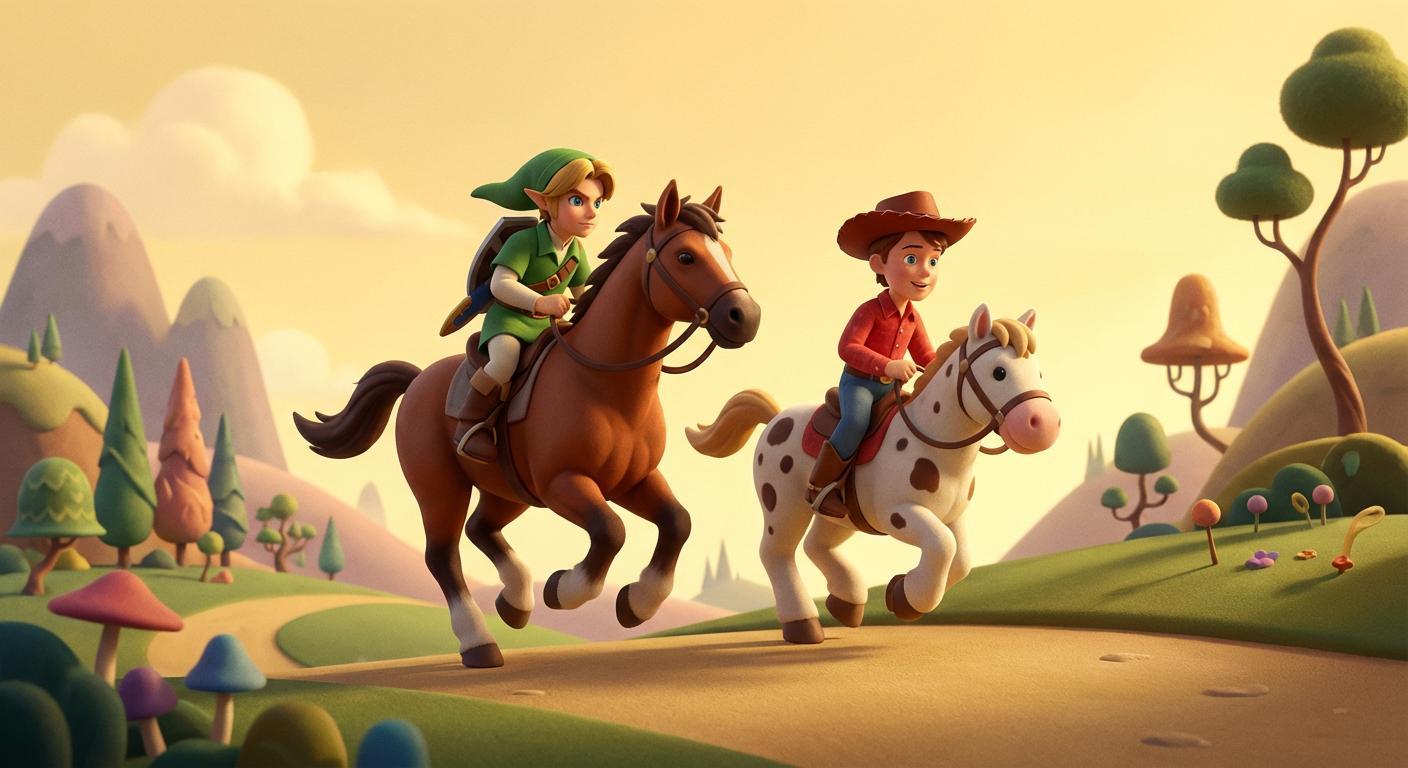
{Link (The Legend of Zelda) and Andy (Toy Story) speeding on horseback} illustrated in the 3D feature film concept art-like dimensional realism style of William Edward Joyce (b. 1957): {
William Joyce's 3D concept art style achieves commercial resonance through a deliberate synthesis of nostalgia and innovation. His aesthetic anchors itself in Mid-Century realism, rendered with the highly editorialized lighting of J.C. Leyendecker (1874–1951) and Ray Prohaska (1901–1981)—a look that appeals to adult sentimentality while remaining visually accessible to children. Joyce evolves this nostalgic foundation by infusing it with an implicit "toy logic" and the kinetic energy of rubberhose animation; however, unlike the streamlined, fluid forms of early Disney feature films, his figures possess the interactive appeal of an action figure combined with a "plushie-like," palpable density. This tactile quality is a key design principle: it creates characters that feel not only alive but ownable—as if they could exist as beloved toys on a child's shelf. Crucially, this aesthetic operates as an implicit conceptual framework rather than explicit toy representation. This hybrid approach is reminiscent of Al Parker (1906–1985), who successfully infused Mid-Century commercial art with the emerging pop sensibilities of 1950s America. Similarly, Joyce preserves illustrative elegance while updating it for audiences raised on animation, resulting in cinematic, still-like storytelling qualities akin to the dramatic realism of Robert Riggs (1896–1970).
Joyce's compositional strategies further reinforce this balance between intimacy and spectacle. He alternates between static, frontal perspectives reminiscent of E.H. Shepard (1879–1976) and dramatically scaled compositions—featuring steep diminishing perspectives or grandiose miniatures—akin to Chris Van Allsburg (b. 1949). This flexibility allows him to shift register fluidly, from domestic stillness to panoramic adventure.
One might interpret Joyce's approach as an elevation of the rubberhose tradition itself: cartoon physics imbued with the subsurface scattering, elegance, and refined realism of classic American illustration. To dramatize these forms, he employs otherworldly environmental framing, atmospheric lighting, and temperature color contrasts reminiscent of Maxfield Parrish (1870–1966). However, whereas Parrish emphasized natural grandeur, Joyce redirects this technique toward environmental storytelling with narrative intimacy—prioritizing character-driven immersion over scenic awe. Furthermore, his rhythmic compositions, characterized by juxtaposed colors and dynamic perspectives, echo the lyricism and decorative boldness of Polish folk art traditions—particularly the geometric vibrancy of Zofia Stryjeńska (1891–1976) and the layered paper-cutting craft of Łowicz wycinanki—granting his work a timeless, cross-cultural resonance.
Beyond visual technique, Joyce's narrative design is defined by the celebration of eccentric devotion. His stories bridge the generational divide by presenting unconventional fixation not as madness, but as a valid, almost childlike resistance to the mundane. He constructs narrative frameworks that validate the child's perspective, framing the rigid monotony of conventional adulthood as "unnecessarily overserious." By championing characters who maintain a sense of wonder and playfulness despite societal pressure, Joyce creates a shared emotional space where both children and adults are invited to reject cynicism in favor of an empathetic, if slightly chaotic, joy.
Joyce established the foundational design principle of his career—the "toy world" aesthetic—in early works such as Dinosaur Bob and His Adventures with the Family Lazardo (1988). In these illustrations, he presented worlds through painterly volumetrics and playfully exaggerated scaling, utilizing deep, pastel-crayon colors and a surface smoothness that viewers yearned to touch. This creates a peaceful concentration reminiscent of childhood play, visualizing creativity as a gentle antidote to boredom.
In A Day with Wilbur Robinson (1990), Joyce further developed this toy-like charm through expansive settings and carefully directed environmental lighting, framing the characters as miniature figures within a child's imaginative world. The book's surreal, high-contrast spatial scale established a template for domestic fantasy—where the ordinary family home becomes an arena of invention and absurdity—that would later serve as the foundation for a major animated adaptation.
By Santa Calls (1993), this sophistication reached a new peak of theatrical complexity. Moving beyond simple clarity, Joyce anchored illustrations with strategic blocking and modular, layered perspectives that invite viewers to discover new details upon repeated viewings. The signature pastel textures were now complemented by faux three-dimensional shading, evoking a trompe-l'œil chiaroscuro that bridged the gap between "collectible art book" and "children's picture book."
In his book The Leaf Men and the Brave Good Bugs (1996), William Joyce conceptualized the protagonists as stiff, antique figures—recalling the rigidity of classic green army men and Nutcrackers—creating scenes that felt like staged dioramas. This work established his "miniaturist" eye: the ability to transform the micro-scale into the mythological, a principle that would later inform major film adaptations.
The live-action film Buddy (1997)—based on the real-life eccentrities of 1920s socialite Gertrude Lintz—offered Joyce an opportunity to apply his narrative philosophy to a non-animated medium. The film exemplifies his thematic preoccupation with characters whose passionate fixations place them at odds with conventional society, reinforcing his role as a storyteller who champions imaginative nonconformity.
As his career expanded into digital media, Joyce translated his "toy world" aesthetic into a "plastic-toy" sensibility in Rolie Polie Olie (1998). Here, he utilized lens blurring to soften the composition of vivid volumetric forms, preventing cognitive overload and ensuring visual flow remained simple despite the complexity of the 3D environment. This marked Joyce's first sustained engagement with CGI, establishing design principles that would guide his subsequent animation work.
This period demonstrates an artist consciously designing for scalability—ensuring that characters and environments remained immediately readable whether as static illustrations or moving images.
In the animated adaptation of George Shrinks (2000–2003), Joyce refined a critical design principle: compositional legibility. These artworks demonstrate a shift toward linear clarity and an acute sense of visual semantics. He relied on deliberate contour forms, ensuring that despite the fantastical scale of the narratives, characters and environments remained immediately readable. This legibility is essential for animation adaptation, where complex imagery must translate across moving frames without losing narrative coherence.
In the animated feature Robots (2005), for which Joyce served as production designer alongside director Chris Wedge, William Joyce applied his "toy world" aesthetic to a purely mechanical ecosystem, showcasing his unique strength in material storytelling. Rather than simply mirroring humanity through metal avatars, Joyce designed an analogous society where biology is replaced by engineering: characters age by upgrading parts, and social class is defined by the gleam of one's plating. This premise allowed Joyce to leverage his mastery of Mid-Century industrial design, infusing the environment with a "retro-future" curiosity that feels simultaneously advanced and nostalgic—akin to a 1950s appliance coming to life. Through this lens, the film critiques the human condition not just through humor, but through a visual language of obsolescence and renewal, proving Joyce's ability to build worlds where the physics of the environment dictate the sociology of the story.
Joyce continued to refine his approach to scalable design in Meet the Robinsons (2007), adapted from his 1990 book A Day with Wilbur Robinson. Serving as executive producer and conceptual originator, Joyce saw the animated feature soften the book's surreal, high-contrast spatial scale, blending it instead with a retro-futurist aesthetic expressed through a cohesive, themed color palette. While the film tempered the original's stark visual contrasts, it preserved the atmospheric quality of soft subsurface-scattered lighting that defined Joyce's early work. His concept art balanced the decorative qualities of 2D illustration with the spatial depth required for modern 3D animation, allowing the designs to translate seamlessly from printed page to animated screen without losing their painterly translucence.
In the 2010s, Joyce's style pivoted toward emotive atmosphere and mythological grandeur, signaling his ambition to design for cinematic mythologies rather than intimate picture books. This section traces that evolution across animated shorts, feature films, interactive media, and illustrated novels.
In The Fantastic Flying Books of Mr. Morris Lessmore (2011), co-directed with Brandon Oldenburg, Joyce utilized a themed, emotive color palette similar to the color-graded cinema of Wes Anderson (b. 1969). By juxtaposing black-and-white scenes with full-color renderings, Joyce showcased how chromatic vibrancy alone could convey narrative depth and evoke the lushness of an unspoiled world.
In the animated short and interactive app The Numberlys (2013), William Joyce departed from his soft "toy world" aesthetic to embrace the stark, monochromatic grandeur of Fritz Lang's Metropolis (1927), presenting the narrative through orchestrally animated visual storytelling. Set within a rigid, industrialist dystopia, the work utilizes a limited visual vocabulary of geometric primitives, ingeniously crafting unique character personalities from uniform shapes. The project demonstrates a sophisticated modernist awareness: each scene is composed not merely as a narrative beat, but as a graphic design statement. Joyce strategically deploys high-contrast tonal lighting and architectural shadows to create dramatic, sculptural compositions. This aesthetic echoes the fashion photography of Horst P. Horst (1906–1999), where severe lighting transforms subjects into elegant, abstract forms—proving that even in a world of uniformity, distinct style can emerge through shadow and silhouette.
Simultaneously with his short-form work, in The Man in the Moon (2011), the first book of his Guardians of Childhood series, Joyce departed from the visual purity of his earlier "plushie" works to design for cosmic mythology. He imbued environments with intricate, sandstone-like sculptural surfaces and stylized, flattened lighting. This sacrifice of soft tactile charm in favor of dramatic chiaroscuro—reminiscent of Brian Selznick's The Invention of Hugo Cabret (2007)—allowed clarity to coexist with the visual gravity required for an epic origin story. This approach demonstrates a key principle for franchise world-building: tonal flexibility. By proving his aesthetic could accommodate both intimate warmth and epic grandeur, Joyce positioned his visual language as viable for large-scale cinematic adaptation.
Joyce's style achieved full commercial and artistic maturation in The Guardians of Childhood series and its DreamWorks film adaptation, Rise of the Guardians (2012), directed by Peter Ramsey with Joyce serving as executive producer and original creator. Here, he fluently synthesized his entire artistic history into a cohesive world design optimized for cross-platform storytelling. He returned to the pristine, volumetric charms of his early work but updated them with mystical, subsurface-scattered lighting to set an epic tone. His character designs employed distinctive, merchandise-ready silhouettes—blending fashion and fantasy in a manner reminiscent of Tetsuya Nomura—while his environments exhibited the gothic architectural ornamentation characteristic of Tim Burton, tempered with broad-audience accessibility. The result is a fully realized universe that accommodates both the technical realism of DreamWorks feature animation and the painterly atmosphere of a storybook.
The animated feature Epic (2013), directed by Chris Wedge with Joyce as executive producer and source material originator, adapted Joyce's 1996 book The Leaf Men and the Brave Good Bugs, translating his signature "miniaturist" aesthetic into a cinematic spectacle. The film is tailored to showcase his forte: elevating the micro-scale into the mythological. Through a "bug's-eye" perspective, it employs mystical, subsurface-scattered lighting to render the translucency of leaves and insect wings, imbuing the natural world with an ethereal, bioluminescent glow. Narratively, the film channels Joyce's ability to validate childhood imagination—specifically the act of backyard exploration—transforming a mundane garden into a vast, immersive stage for operatic fantasy. In doing so, it creates a unique organic mythology that feels distinct from the explicitly toy-centric designs of his other franchises.
In the augmented reality game Wonderbook: Diggs Nightcrawler (2013), developed by Moonbot Studios with Joyce as creative director, William Joyce applied his signature "toy world" aesthetic to an interactive noir detective narrative, visually framing the story as a scripted stageplay on a magical pop-up book. The game's characters exhibit a deliberate Muppet-like physicality: many figures feature truncated or obscured lower bodies, evoking the visual language of hand puppetry where the performer's arm replaces anatomical legs. This design choice reinforces the Wonderbook platform's core appeal—a tactile, "hands-on" experience where the physical book becomes a stage. By channeling the approachable, craft-like charm of Jim Henson's (1936–1990) creations, Joyce invites players to perceive the characters not as distant digital avatars but as tangible, manipulable companions within an interactive storybook world.
In Ollie's Odyssey (2016), William Joyce pivoted toward a darker, more tactile aesthetic, employing a charcoal-heavy chiaroscuro characterized not by chaotic motion, but by sculptural density akin to Alfred Kubin (1877–1959). This graphic approach mirrors the illustrative weight of Victor Ambrus (1935–2021), particularly in how distinct black strokes are layered over muted mid-tones to carve out form and simulate the grain of wooden surfaces. By grounding the characters in this rigid, doll-like physicality, Joyce creates a visual tension that is psychologically charged. The resulting imagery evokes a surreal, existential unease—a literary parallel to Kubin's visual anxiety, and thematically resonant with Franz Kafka's The Metamorphosis (1915)—effectively capturing the stiff vulnerability and high stakes of the narrative's lost toy protagonist.
Across four decades, William Joyce has refined a singular design philosophy: worlds must feel ownable, legible, and infinitely expandable. His signature aesthetic—rooted in Mid-Century warmth and rubberhose physicality—transforms passive viewers into active participants, inviting them to inhabit toy-scaled universes where imagination is validated rather than dismissed. Crucially, this philosophy operates through subtlety rather than literalism. Joyce's characters are never reduced to explicit toy representations unless stated in the story. Instead, his "ownable world" logic functions as an invisible, nostalgic framework that subconsciously embeds appeal through volumetric form, poseable physicality, and tactile surface. By treating every composition as both a narrative frame and a potential playset, Joyce bridges the gap between static illustration, animated spectacle, and interactive media. His career arc proves that commercial viability and artistic integrity can coexist when design is guided by a child's logic: if a world looks touchable, it becomes believable; if it feels modular, it becomes infinite.
}