
WILLIAMSBURG — Local shrimp. That’s right. Shrimp. From the Traverse City area.
It’s a thing.
Carol and Stephen Karas have founded By the Bay Shrimp Company, operating their shrimp-growing facility out of a barn they’ve repurposed on their farm in Williamsburg. While they’re both longtime real estate professionals and avid scuba divers, Carol decided to acquire a marine biology degree in aquaculture so she’d have something to do in retirement. She’s 58, he’s 56.
“Originally I thought I would propagate corals,” Carol says. “We have a big saltwater tank in our house and corals for saltwater tanks are expensive.”
Then came a paper she did for one of her classes that sparked the idea of the two of them creating their own shrimp farming operation. Oddly, the paper was originally positioned against the idea of indoor aquaculture — simply put, farming in water. But the more she looked into it, the more she saw the appeal.
“There’s a stigma and I was just another person who wasn’t educated and didn’t know how amazing it is,” says Carol, who also used to be a licensed veterinary technician and has always been interested in animal science. “These animals are in 83-degree saltwater getting fed four times a day. There are no hurricanes or predators or oil spills. There’s nothing wrong with how they are being treated.”
The couple began investigating, discovering there were no such facilities in Michigan. They checked out one in Indiana and connected with Kentucky State University, which has its own Division of Aquaculture and works with several shrimp farms in that state. They also found a mentor in Kentucky who has worked with them along the way.
“We started building out our barn two years ago,” Stephen explains. “We had to make it from just a pole barn into a lab-quality clean facility and we started producing [in 2025]. We’re licensed by the state.”
The Karases obtain their “post-larvals” (baby shrimp) from hatcheries in Florida.
“They’re all grown in a lab … a clean environment,” Stephen says. “They get shipped to us and we have a basically saltwater environment that includes multiple stages to grow out: a nursery tank for when they’re super small, then they get split into grow-out tanks — all kept at 83 degrees saltwater.”
Initially, it was nerve wracking. Their 750-gallon nursery tank has a big glass panel that enables them to watch the babies grow. “But for the longest time, we didn’t see them because they hang out at the bottom,” Carol says. “Until they got big enough or were swimming around, we didn’t see them or know how they were doing without constantly dipping into the tank and scooping them out.
“Once they finally became ready to harvest, it was a really proud moment that we built, designed, created, raised and had a beautiful healthy product to take to market.”
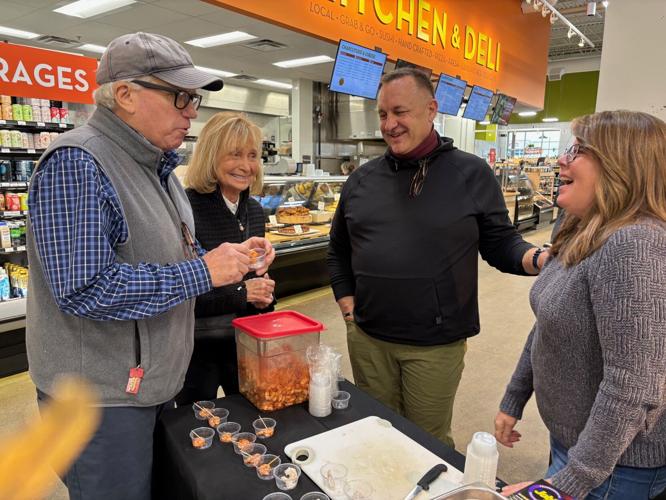
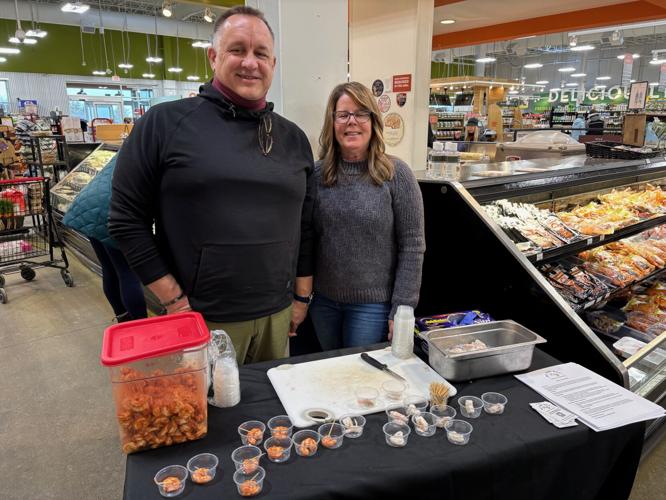
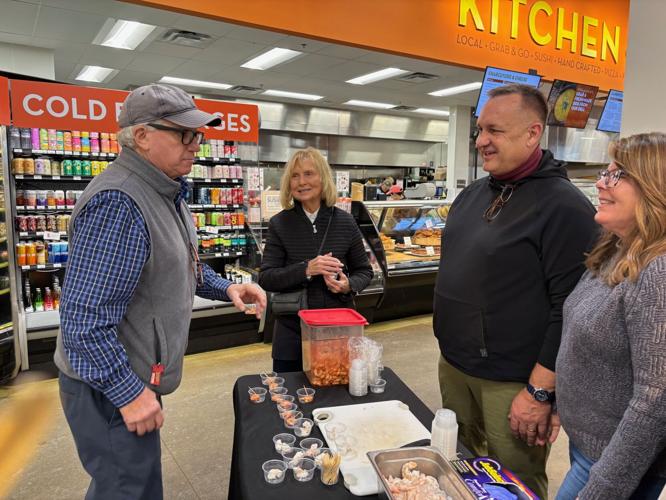
They started selling their shrimp last April, taking samples to retail outlets in the area and getting feedback through tastings.
“When people come and try it and realize it tastes in most cases better than the stuff they’ve been buying and realize it’s clean, there are no heavy metals, no toxins — they get sold on it,” Stephen says.
The couple has been doing demos and tastings in the community, with their shrimp available at The Butcher’s Block, Edson Farms, Burritt’s and Oryana Community Co-Op. Kirsten Harris, Oryana marketing manager, says Oryana liked that By the Bay’s shrimp is “hyper local.”
“This is always going to be an initiative here at Oryana or something we’re interested in doing,” Harris says. “One, we want to be having a robust regional food economy so having a product like this is really cool. Also, the implications that we know exactly where this shrimp is coming from and that it doesn’t have to travel very far are all priorities for Oryana.”
The couple is taking a measured approach to growth. They’re currently producing about 200 pounds every few months.
“It’s a rather large investment,” Stephen says. “We did what we considered a proof of concept and we are scale building.”
He described another company that tried to make a go of it in Michigan about a decade ago.“They went full bore and built a big production facility, then COVID hit and they couldn’t make it because they had too much invested,” he says. “They didn’t build their market.
“We’re taking a reverse approach … building the market and then building out.”
Lynsey Mukomel, executive director of communications for the Michigan Department of Agriculture & Rural Development, confirms that creating an aquaculture facility like By the Bay’s takes time, capital and technology — all of which can be barriers to entering the market.
“By the Bay is the only facility in Michigan currently permitted for shrimp production, and the only facility operating a fully Recirculating Aquacultures System (RAS) in the state,” Mukomel explains. “A RAS takes water from tanks, filters and treats it and returns it to tanks.”
The Karases’ goal is to amp production to 200 pounds a month. They plan to break ground in the spring for an addition that will double the size of their production space, hoping to be able to produce consistently for restaurants and stores.
“We want to do it sustainably and we want to keep it economical for everybody and not sacrifice quality,” Carol says.
Their shrimp typically retails between $25 and $28 a pound and is available fresh as well as frozen.
“One of the biggest reasons we decided to jump off the cliff and do it was because of the huge farm-to-table movement the Grand Traverse region enjoys,” Stephen says. “When you raise shrimp, you’re not depleting the ocean. It’s clean, you don’t have the toxins and microplastics coming out of the ocean … we’re an indoor farm.”
Andre Faul, who operates Faul Family Riverside Farm in Sulphur, Kentucky, is the consultant who has been guiding By the Bay. Established in 2018, his company focuses on small niche markets.
“We’re not on any sort of scale that’s going to make an impact on the industry or will be competing with imported shrimp,” Faul says. “Our biggest bottleneck at the moment is sourcing the little post-larval shrimp.”
As for the Karases, Faul says, “I’m very impressed with what they’ve done and how far they’ve come already. They’re eager to get this thing to make it scalable and go from their proof of concept to a larger system. I’m very impressed.”
By the Bay takes special orders at btbshrimpmi.com