
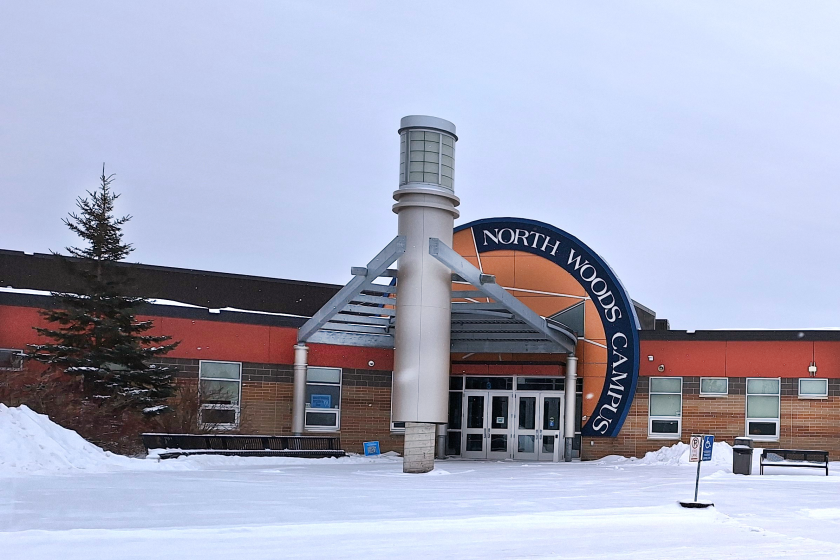
VIRGINIA — Following reporting from the News Tribune that the St. Louis County School District pulled numerous books from a school library in October, the school board approved the first reading of a new library materials policy.
It’s a policy that former North Woods School library assistant Quinn Krebsbach said he wishes had been in place prior to a series of complaints over a banned books display in the K-12 school.
Dozens of books, purchased for the new school year by Krebsbach, were reportedly removed from the shelves the week of Oct. 5. The St. Louis County School District has declined to answer if all the removed books were returned or if they have been placed under restricted access.

Krebsbach, 27, was terminated from his position at the school library that same week.
“We try to educate districts that it is better and easier for them to have these policies up to date, reviewed and in place,” said Anne Kaste, outreach and instruction librarian at Minitex, a Minnesota library resources network. “When you don’t have policies and trained specialists who are guiding these processes, sometimes what could happen is books just get removed from the shelves without ever getting reported, and nobody would ever know.”


Other times, Kaste added, a young librarian might end up in a “risky position” without the support of policies or experience behind them, and end up losing their job.
“When a situation comes up, the law only really works … when a library is actually functioning enough to have policies and procedures in place,” she said.
What does the law say?
In 2024, the Minnesota Legislature passed the Access to Library Materials and Rights Protected law. In an effort to prohibit book bans within the state, the law stated that a public library could not ban, remove or otherwise restrict access to books or other library materials, based solely on viewpoint or the messages, ideas or opinions conveyed in the material.
“There are fair and interesting questions all the time around what books should or shouldn't be in a library or a classroom,” said Burke Scarbrough, who teaches English education at the University of Minnesota. “There needs to be a process that keeps that a good-faith discussion within a community, rather than a polarized argument about what we can and can’t read. There are a lot of legitimate perspectives in these conversations … there should be some middle ground and process for them to be heard.”
ADVERTISEMENT
While libraries and their governing bodies maintained the authority to remove materials based on space limitations, damage or legitimate pedagogical concerns like appropriateness, the law also established that public libraries must adopt policy regarding selection, reconsideration and challenges to library materials.


The Minnesota Department of Education recommends that school boards review or create their policy using the Minnesota School Board Association Model Policy on Library materials .
In partnership with the Minnesota Association of School Administrators, the MSBA publishes a manual with model policies for school districts across Minnesota, in line with state and federal law. While some policies are required for all school districts, local boards can amend model policies to fit their districts, while staying within state and federal requirements.
There are fair and interesting questions all the time around what books should or shouldn't be in a library or a classroom. ... There are a lot of legitimate perspectives in these conversations … there should be some middle ground and process for them to be heard.
MSBA’s library materials policy includes specific processes and criteria for developing a library collection, filing a challenge report, and reconsideration of library materials. The policy also outlines that parents can make requests about restricting material access for their individual students.
“Part of what we do is recommending policy,” said Kaste, who also works with the Minnesota Library Association. “We meet with boards, with districts, and say, ‘You can codify this, you can have this in place in cases where a book challenge arises. You can follow these policies and procedures and then the next time this comes up, you will have some actual professional process in place for how to review books instead of just removing them on the basis of your opinion, beliefs, perspective’ ... That’s the situation we don’t want to get to.”
Both Minnesota state law and library policy state that library personnel cannot be fired for complying with the requirements of the library access and rights protected law.
The library access and rights protected law went into effect in August 2024, but, as of this year, just over half of the school districts regionally have adopted the required policy. The News Tribune conducted a review of policies for 21 school districts surrounding St. Louis County Schools, and found that only 13 had a library materials policy in place.
ADVERTISEMENT
None of the districts without a listed library policy responded to inquiries from the News Tribune. Though some districts had policies regarding instructional materials and textbooks, there was no mention of library materials, or library processes. While St. Louis County School Board’s policy has been introduced, it will appear for a second reading before the board before it can be finalized.

St. Louis County Schools Superintendent Reggie Engebritson did not respond to requests for comments about the timing of the library materials policy, or why the district did not have one.
Engebritson also serves as the superintendent for Mountain Iron Buhl Public Schools, one of the nine districts regionally to not have a policy. She also did not respond to questions regarding whether Mountain Iron Buhl intends to adopt a library materials policy.
What policies have local districts adopted?
For districts that have adopted the policy, several have existing library materials policies that predate the 2024 legislation. Hermantown Community Schools’ school library policy has been on the books since 1988, and includes a form for reconsideration requests — as well as guidelines for a committee to reevaluate library materials.
“I think the most productive thing we can hope for is process and transparency,” said Scarbrough, regarding curriculum and library material policies. “What I'd like to see, too, is respect for the professionalism of teachers and librarians. But also, we're all fallible, right? Having review processes, having a place for a fair hearing of concerns, I think, is really important.”
Other districts outline their own specific processes for selecting or reconsidering material, while still covering the bases laid out in the MSBA policy. While some districts simply amended standing policy around textbooks and instructional material to include the library materials requirements, other districts created a new policy to cover library operations and collections.
Duluth Public Schools has had a separate policy in place since 2023, when it was first recommended by MSBA.
ADVERTISEMENT
“It’s important to have a policy in place regarding library materials because there are a lot of questions,” said Adelle Wellens, the communications officer with Duluth Schools. “We feel that our school district staff and media specialists are highly trained in choosing the right materials for our students. … Having this policy serves us — and them — well.”


 The Trust Project

All Comments
Active Conversations
The following is a list of the most commented articles in the last 7 days.


