Read the Greeks

Okay, you may ask. So what you are saying is that we should read pensively rather than “efficiently” and widely rather than deeply. That we understand
What to read, though? Where should we start?
I think a great place to start would be reading the ancient Greeks. And no, I don’t mean the “classical authors”. I mean, the Greeks, specifically.
Greek literature, greek philosophy, greek history, greek epics, greek mythology is where you should probably start your education. And, if schools of the past did indeed put a great, primary focus on studying the Greek legacy, singling it out of the intellectual legacy of all other ancient civilisations combined, they did it for a very good reason.
What reason, you may ask? Let me show you:
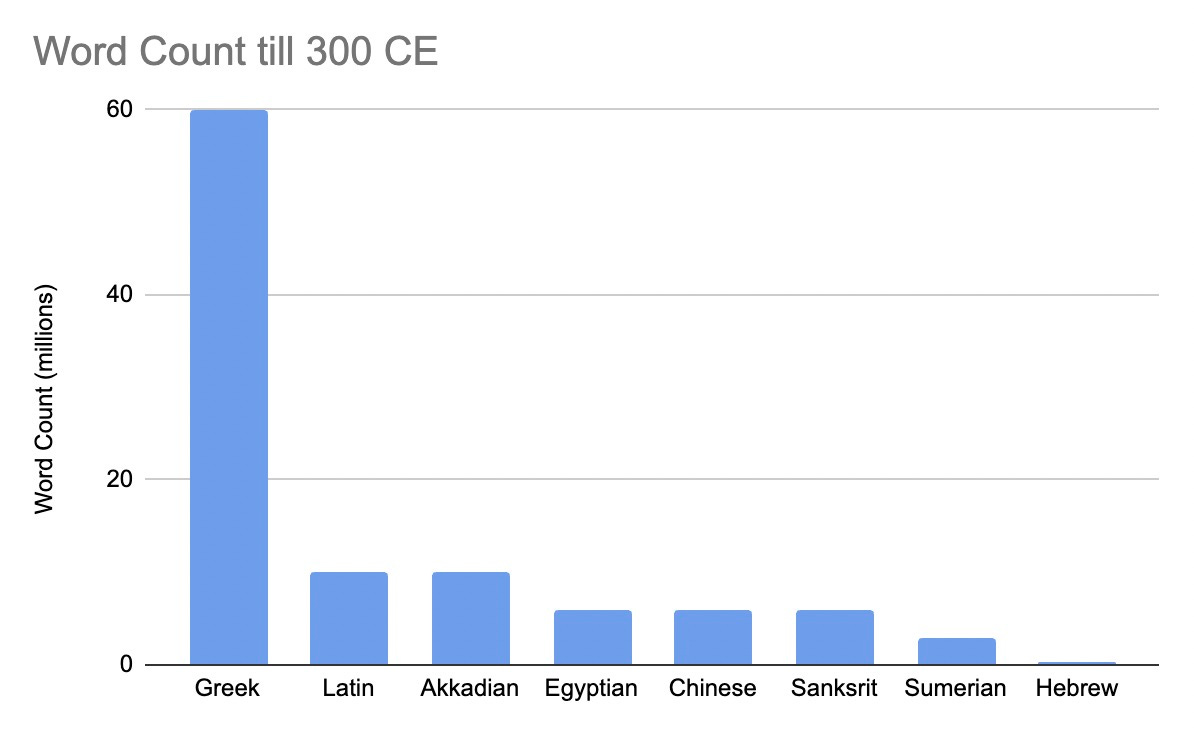
Here you see the quantitative assessment of the written legacy in ancient languages (pre-300 CE). Like, if we count all the Greek, Latin, Sanskrit, Chinese and other texts available, what will be the word count, in millions1.
(So, basically, just before the Roman Empire turned Christian and the Han Empire broke into the political fragmentation and anarchy)
These are, obviously, very rough and very preliminary estimates, that contain multiple technical problems and must be seen as the first approximations, rather than any exact figures. Still, this is an approximation showing the order of magnitude, and it is the order of magnitude that is important.
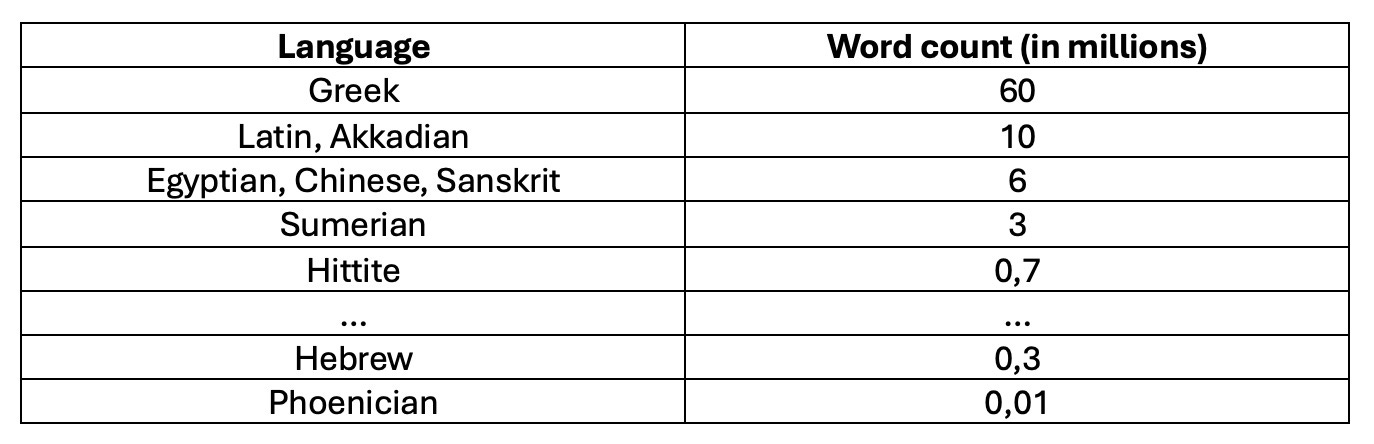
What we see here, is that sheer volume of the Greek legacy dwarves any other ancient language, and any other ancient culture, from Rome to India, and from Iberia to Japan. And no, it doesn’t just surpass any other language.
It dwarves all of them combined.
Like it dwarves them in sheer volume, the written legacy of Greece surpasses them qualitatively, in richness, and in diversity. Compared to the Greek, any other written legacy of the ancient world looks terribly lopsided.
Akkadian & Sumerian, the ancient cuneiform of Levant - that is mostly just excel spreadsheets. Historically important, but unfathomably boring.
Sanskrit - well, that is mostly just religious & epics, and not much else. No history, for example
Chinese - well now it is disproportionately history, and the chronicles of kings. Other genres, however, are lacking, most importantly, fiction
Now the thing with the Greek is that its written legacy is both enormous in volume, and just as enormously diverse. In every single genre you can think of, the Greeks have no matches and no competitors. History, for example, forms only a minor share of the total Greek word count (unlike in Chinese). Yet, the total size of Greek historical texts surpasses the total volume of Chinese ones by the order of magnitude.
When it comes to fiction - and fiction is the most realistic genre of literature, of course - the Greeks pretty much stand alone. There is a huuuuge pile of Greek texts, a lil bit of Latin works (copied after the Greeks), and that’s it, basically. All the rest of the world combined makes for somewhere around the statistical error, in this regard.
Notice, that I am not disparaging, nor denigrating other cultures and other traditions. Other ancient civilisations produced beautiful and original works, that may have their own, unique insights that we won’t find in the texts produced on the shores of the Aegean. One may thing of Zhuangzi or Rigveda.
Still, the existence of these unique, marvellous works - that don’t really have matches elsewhere - does not change the overall picture. Which is: unlike other ancient cultures, the Greek written covers everything, and towers over every one legacy in the world, absolutely. The unmatched volume and quality of Greek legacy makes me think they are the one and only ancient culture, whom we can know really well, and in whose inner world we may have a fairly good glimpse.
All other are hidden from us, fogged, invisible.
The question is why.
***
I want to start our discussion on why it is the Greek legacy, that surpasses the legacy of any other ancient culture, and any other civilisation in the world, with a quote from Ibn Haldun. Ibn Haldun was a smart guy, and in this casual remark in Muqaddimah (which you absolutely should read), he introduced several ideas, that I find to be relevant for our conversation
There are many sciences. There have been numerous sages among the nations of mankind. The knowledge that has not come down to us is larger than the knowledge that has. Where are the sciences of the Persians that ‘Umar ordered wiped out at the time of the conquest! Where are the sciences of the Chaldaeans, the Syrians, and the Babylonians, and the scholarly products and results that were theirs! Where are the sciences of the Egyptians, their predecessors! The sciences of only one nation, the Greek, have come down to us, because they were translated through al-Ma’mun’s efforts. (His efforts in this direction) were successful, because he had many translators at his disposal and spent much money in this connection. Of the sciences of others, nothing has come to our attention.
(Ibn Haldun. Muqaddimah)
So what do we see here? What are Ibn Haldun’s points, that I want to drag your special attention onto?
First, most of the ancient knowledge, and most of the ancient legacy has been lost. And, in fact, the total volume of knowledge that has been lost surpasses the volume of knowledge available to us (= that is, medieval Arabs), by a very wide margin.
Second, although most of the ancient knowledge has been lost, the actual degree of this loss varies. The knowledge of Persians, Chaldeans, Babylonians, Egyptians and others has been lost completely, or almost completely. Meanwhile, the legacy of the Greeks us available to us, if not completely, than to a very significant degree.
Third, what is of crucial importance here is why the Greek knowledge is available to us, and others are not. And the reason is: it has been transmitted. There has been a massive, orchestrated effort in translation, edition, copying and, overall, well, transmission of the Greek legacy. That2, was the only reason why the Greek legacy was preserved.
And that is indeed a very important idea, an idea that I want to emphasize.
That is the idea of transmission

