{The Legend of Zelda} illustrated as a techno‑futuristic vector mesh schematic poster art: {
Vector mesh as a mode of artistic expression co-opts the semiotics of architectural blueprints, engineering schematics, and wireframe modeling to editorialize a subject, narrating a static scene through the implied epistemological authority of technical draftsmanship. This approach appropriates CAD-derived (Computer-Aided Design) visual conventions—orthographic projection, polygonal topology, construction geometry—to position the work within a techno-scientific aesthetic framework, where diagrammatic precision signifies analytical mastery over the depicted subject.
Subjects are rendered as selective mesh topology integrating wireframe, cutaway, and exploded-view conventions to achieve "schematic transparency." By strategically disregarding surface occlusion, the composition exposes internal architectures typically concealed beneath exterior form—whether literal components such as anatomical cross-sections or mechanical assemblies, or metaphorical substrates representing psychological, systemic, or conceptual dimensions. Detail selection serves thematic cohesion: each exposed layer corresponds to the narrative intent, producing infographic-style compositions where multiple three-dimensional structural meshes coalesce to depict a unified event, entity, or system.
The schematic transparency afforded by this methodology enables distinct narrative modes, each exploiting the tension between surface and substrate. Characterization through anatomical analogy deploys internal architectures—skeletal frameworks, musculature, circulatory pathways, neural networks—as visual correlatives for psychological states, temperament, or identity; the figure becomes a diagram of selfhood where physiological exposure functions as personality index. This mode inherits from medical illustration traditions and the écorché convention, the Anatomical Venus wax models of La Specola, and finds contemporary expression in Shintaro Kago's (b. 1969) geometric body-horror deconstructions, where anatomical exposure oscillates between clinical objectivity and allegorical resonance. Climactic scene deconstruction applies exploded-view logic to ephemeral moments of peak action or transformation, freezing transient gesture while simultaneously revealing the mechanical, kinetic, or causal substrates underlying the event; the schematic treatment renders motion analyzable, permitting apprehension of phase sequence, force vector, and structural consequence within a single static frame—an approach indebted to Eadweard Muybridge's (1830–1904) chronophotographic motion studies and Futurist experiments in depicting dynamism through geometric decomposition, as in Giacomo Balla's Dynamism of a Dog on a Leash (1912) or Marcel Duchamp's Nude Descending a Staircase, No. 2 (1912). System and ecosystem narratives map complex relational structures—technological networks, cultural practices, social hierarchies, mythological cosmologies, ecological interdependencies—as interconnected schematic architectures where invisible systemic relationships materialize as visible structural elements; Tsutomu Nihei's (弐瓶 勉; b. 1971) brutalist megastructures and labyrinthine wireframe environments in Blame! exemplify this mode's capacity for architectural-systemic exposition. This documentary lineage includes Richard Erdoes's (1912–2008) ethnographic illustrations accompanying his collaborations with Lakota elder John (Fire) Lame Deer, David Macaulay's (b. 1946) architectural process narratives in Cathedral (1973) and The Way Things Work (1988), and Fritz Kahn's (1888–1968) modernist Das Leben des Menschen infographics depicting the body as industrial plant.
Spatial organization employs mechanical projection systems—axonometric configurations such as isometric projection, which preserve parallel depth lines and eliminate vanishing points, or single-point and two-point linear perspectives with diminishing depth cues. The choice between systems calibrates the balance between techno-aesthetic regularization (the parallelized stability of axonometry) and naturalistic spatial recession, while optimizing visual clarity appropriate to the selected narrative mode. Legibility amidst compositional density is maintained through strict visual hierarchy within monolinear geometric linework: graduated stroke weights differentiate primary silhouettes from internal structural meshes, phantom lines (lightweight dashed or dotted strokes) denote occluded or secondary elements, and each mesh layer employs a distinct boldness value ensuring the stratified construction remains decipherable. Chromatic and typographic elements reinforce this hierarchy—a restricted, high-contrast palette distinguishes vector linework from color-blocked background fields, configurable in either tonal polarity: positive image (dark linework on light ground, recalling architectural drafting and technical print conventions) or negative image (light linework on dark ground, evoking cyanotype reproduction, radiographic imaging, or digital interface aesthetics). Integrated thematic typography contributes to poster-like balance characteristic of concept art presentation.
This technical rigor yields a versatile visual framework that modulates rendering conventions and compositional strategies according to subject type. Mechanical and vehicular subjects draw upon Ken Dallison's (b. 1933) automotive cutaway watercolors merging technical accuracy with environmental staging, and the engineer-oriented specificity of Mobile Suit Gundam settei-ga (設定画) model sheets; organic or biomorphic subjects adopt Tetsunori Tawaraya's fusion of organic morphology with mechanical precision. Compositionally, architectural or environmental scenes assume the monumental, surreal clarity characteristic of Chris Van Allsburg's (b. 1949) calculated spatial staging; figural subjects occupy intimate close-up framings with contemplative stillness recalling Ted Coconis's (1927–2023) portrait work and gestural immediacy aligned with Ilya Kuvshinov's (b. 1990) character studies.
The resulting work functions as Gesamtkunstwerk—a synthesis of semiotic, spatial, and chromatic systems into unified aesthetic totality—offering a stratified reading experience that rewards sustained attention, wherein the viewer deciphers holistic narrative through progressive engagement with transparent constituent parts, accumulating meaning through integration of selectively revealed detail.


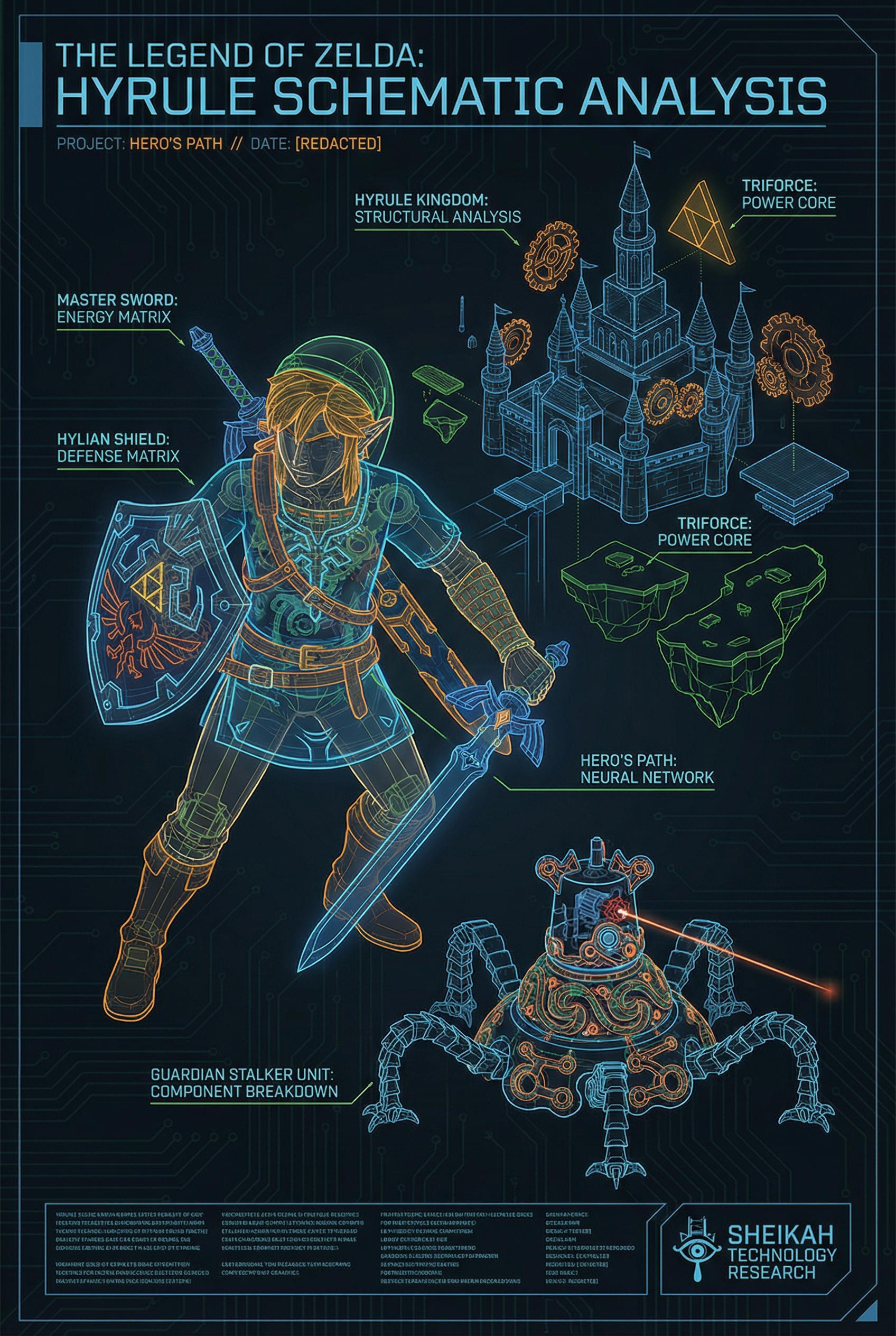
{The Legend of Zelda} illustrated as a techno‑futuristic vector mesh schematic poster art: {
Vector mesh as a mode of artistic expression co-opts the semiotics of architectural blueprints, engineering schematics, and wireframe modeling to editorialize a subject, narrating a static scene through the implied epistemological authority of technical draftsmanship. This approach appropriates CAD-derived (Computer-Aided Design) visual conventions—orthographic projection, polygonal topology, construction geometry—to position the work within a techno-scientific aesthetic framework, where diagrammatic precision signifies analytical mastery over the depicted subject.
Subjects are rendered as selective mesh topology integrating wireframe, cutaway, and exploded-view conventions to achieve "schematic transparency." By strategically disregarding surface occlusion, the composition exposes internal architectures typically concealed beneath exterior form—whether literal components such as anatomical cross-sections or mechanical assemblies, or metaphorical substrates representing psychological, systemic, or conceptual dimensions. Detail selection serves thematic cohesion: each exposed layer corresponds to the narrative intent, producing infographic-style compositions where multiple three-dimensional structural meshes coalesce to depict a unified event, entity, or system.
The schematic transparency afforded by this methodology enables distinct narrative modes, each exploiting the tension between surface and substrate. Characterization through anatomical analogy deploys internal architectures—skeletal frameworks, musculature, circulatory pathways, neural networks—as visual correlatives for psychological states, temperament, or identity; the figure becomes a diagram of selfhood where physiological exposure functions as personality index. This mode inherits from medical illustration traditions and the écorché convention, the Anatomical Venus wax models of La Specola, and finds contemporary expression in Shintaro Kago's (b. 1969) geometric body-horror deconstructions, where anatomical exposure oscillates between clinical objectivity and allegorical resonance. Climactic scene deconstruction applies exploded-view logic to ephemeral moments of peak action or transformation, freezing transient gesture while simultaneously revealing the mechanical, kinetic, or causal substrates underlying the event; the schematic treatment renders motion analyzable, permitting apprehension of phase sequence, force vector, and structural consequence within a single static frame—an approach indebted to Eadweard Muybridge's (1830–1904) chronophotographic motion studies and Futurist experiments in depicting dynamism through geometric decomposition, as in Giacomo Balla's Dynamism of a Dog on a Leash (1912) or Marcel Duchamp's Nude Descending a Staircase, No. 2 (1912). System and ecosystem narratives map complex relational structures—technological networks, cultural practices, social hierarchies, mythological cosmologies, ecological interdependencies—as interconnected schematic architectures where invisible systemic relationships materialize as visible structural elements; Tsutomu Nihei's (弐瓶 勉; b. 1971) brutalist megastructures and labyrinthine wireframe environments in Blame! exemplify this mode's capacity for architectural-systemic exposition. This documentary lineage includes Richard Erdoes's (1912–2008) ethnographic illustrations accompanying his collaborations with Lakota elder John (Fire) Lame Deer, David Macaulay's (b. 1946) architectural process narratives in Cathedral (1973) and The Way Things Work (1988), and Fritz Kahn's (1888–1968) modernist Das Leben des Menschen infographics depicting the body as industrial plant.
Spatial organization employs mechanical projection systems—axonometric configurations such as isometric projection, which preserve parallel depth lines and eliminate vanishing points, or single-point and two-point linear perspectives with diminishing depth cues. The choice between systems calibrates the balance between techno-aesthetic regularization (the parallelized stability of axonometry) and naturalistic spatial recession, while optimizing visual clarity appropriate to the selected narrative mode. Legibility amidst compositional density is maintained through strict visual hierarchy within monolinear geometric linework: graduated stroke weights differentiate primary silhouettes from internal structural meshes, phantom lines (lightweight dashed or dotted strokes) denote occluded or secondary elements, and each mesh layer employs a distinct boldness value ensuring the stratified construction remains decipherable. Chromatic and typographic elements reinforce this hierarchy—a restricted, high-contrast palette distinguishes vector linework from color-blocked background fields, configurable in either tonal polarity: positive image (dark linework on light ground, recalling architectural drafting and technical print conventions) or negative image (light linework on dark ground, evoking cyanotype reproduction, radiographic imaging, or digital interface aesthetics). Integrated thematic typography contributes to poster-like balance characteristic of concept art presentation.
This technical rigor yields a versatile visual framework that modulates rendering conventions and compositional strategies according to subject type. Mechanical and vehicular subjects draw upon Ken Dallison's (b. 1933) automotive cutaway watercolors merging technical accuracy with environmental staging, and the engineer-oriented specificity of Mobile Suit Gundam settei-ga (設定画) model sheets; organic or biomorphic subjects adopt Tetsunori Tawaraya's fusion of organic morphology with mechanical precision. Compositionally, architectural or environmental scenes assume the monumental, surreal clarity characteristic of Chris Van Allsburg's (b. 1949) calculated spatial staging; figural subjects occupy intimate close-up framings with contemplative stillness recalling Ted Coconis's (1927–2023) portrait work and gestural immediacy aligned with Ilya Kuvshinov's (b. 1990) character studies.
The resulting work functions as Gesamtkunstwerk—a synthesis of semiotic, spatial, and chromatic systems into unified aesthetic totality—offering a stratified reading experience that rewards sustained attention, wherein the viewer deciphers holistic narrative through progressive engagement with transparent constituent parts, accumulating meaning through integration of selectively revealed detail.
}