AllBusiness.com
    • Starting a Business
    • Career
    • Sales & Marketing
    • AI
    • Finance & Fundraising
    • M & A
    • Tech
    • Business Resources
    • Business Directory
    1. Home»
    2. Sales & Marketing»
    3. How to Deal with Difficult Clients»
    A tired businessman stands turned away from a red retro phone in a female hand.

    How to Deal with Difficult Clients

    Krish Chopra
    Sales & MarketingCustomer ServiceOperations

    It was 11 p.m. on a Thursday when my phone rang—again. Another nurse practitioner student was overwhelmed and panicked about losing a preceptor (licensed nurses who guide and mentor student nurses). The story was familiar: the preceptor had backed out, frustrated after an initial meeting where things just didn’t go well.

    Over the course of a few weeks, we’d seen a pattern. A handful of students were approaching preceptors with vague goals, unclear expectations, and the belief that being a student alone should guarantee placement. Instead of listening to the preceptor’s workflow, they’d push for personal schedule changes or skim over the clinical requirements entirely.

    After spending countless hours finding replacement opportunities and managing difficult conversations between the student and frustrated healthcare professionals, I realized something crucial: we weren't just running a business—we were enabling problematic behavior that was damaging preceptor relationships throughout our entire network.

    Hot Stories

    AI employees are able to negotiate high compensation

    Compensation for AI Employees Is Skyrocketing

    Nurse with IV bag

    Starting a Mobile IV Therapy Business: Lessons From Top Providers Across the USA

    That's when I learned one of the most counterintuitive lessons in business: sometimes the best way to deal with difficult clients isn't to manage them better—it's to not work with them at all.

    The Hidden Tax: What Difficult Clients Actually Cost Your Business

    Most entrepreneurs think that more clients automatically mean more growth. We’re taught to say yes, to overdeliver, and to keep everyone happy. But after building a company that’s served over 8,000 students, here’s what I’ve learned: being selective with clients and setting clear expectations doesn’t slow you down—it speeds up your growth.

    The shift from accepting "any client who pays" to strategic client selection changed everything. When you stop spending 80% of your energy managing the 20% of clients who drain your resources, you suddenly have the bandwidth to focus on the work that actually matters. You can improve processes, deliver better services to your ideal clients, and build the kind of reputation that attracts exactly the customers you want to serve.

    This isn't about being elitist or turning away business you need. It's about recognizing that not all revenue is created equal, and that sometimes saying no to the wrong clients is the fastest path to sustainable success.

    At first, saying yes to every project or client might seem like the fastest way to grow your business. You need the cash flow, the testimonials, the case studies. But what many entrepreneurs learn the hard way is this: difficult clients don’t just create temporary headaches—they silently erode your company’s focus, finances, and team culture.

    Ways Bad Clients Can Hurt Your Business

    It’s Not Just About the Money—It’s About Opportunity Cost

    One of the biggest mistakes I made early on was ignoring the opportunity cost of taking on challenging clients. When your time, energy, and best people are tied up dealing with difficult situations, you’re not just absorbing stress—you’re actively blocking better opportunities.

    Difficult clients often come with:

    • Unrealistic expectations around timeline, scope, or deliverables
    • A lack of understanding of your workflow processes
    • Poor communication, last-minute changes, or emotional reactivity during a client meeting
    • A refusal to accept your expertise, which derails customized details and solutions you’ve crafted
    • Scope creep, frequent follow-up questions, or requests for free work

    Bad clients drain your focus and steal time from the ones who actually move your business forward. The real cost isn’t just money—they stall other projects, exhaust your team, and stand in the way of real growth.

    The Energy Drain Equation: When 20% Consumes 80%

    At NPHub, we learned this firsthand. We’d bend over backwards trying to manage client expectations with students who had poor preparation or refused to follow our placement process. Each week we’d have to remain calm while navigating difficult conversations, chasing documents, and fixing problems that stemmed from ignoring clear guidelines and program requirements.

    They weren’t just frustrating—they were expensive. Here’s what those challenging clients often cost us:

    • Time: 6 to 8 hours per week of additional communication, rework, and damage control
    • Morale: Lower energy on our team due to constant emotional labor
    • Reputation: Strained relationships with preceptors and students
    • Momentum: Delays on high-impact initiatives that actually moved the company forward

    All of that for clients who contributed minimal revenue but maximum chaos.

    The Ripple Effect: Culture, Morale, and Execution

    Difficult clients don’t just make your job harder—they affect your entire team. When your staff has to deal with disrespect, moving targets, or unclear goals, it chips away at morale and introduces doubt into your systems.

    Signs your team is suffering:

    • They’re hesitant to engage in new projects or push back in client meetings.
    • They spend more time managing expectations than delivering actual value.
    • Productivity dips as they prioritize putting out fires over improving process.

    It’s not just the project that suffers—it’s your entire company culture.

    Red Flags That Scream "Run": Early Warning Signs of Resource-Draining Clients

    Learning how to deal with difficult clients starts long before the contract is signed. The biggest challenge isn’t always managing unrealistic demands—it’s spotting them early enough to walk away. In our experience, nearly every client who became a problem showed signs before we officially started working together.

    Once you’ve been burned by scope creep, free work, or communication chaos, you start to see the patterns. Here's what to watch for in the negotiation phase, where client behavior often reveals more than the contract terms.

    1. Constant Haggling Before Signing

    If a prospective client nitpicks your pricing or tries to negotiate every clause, it’s not just about money—it’s about control. They’re often testing your boundaries before the real work even begins.

    Be cautious if they say things like, “This shouldn’t take long,” or suggest the work is easy (especially when they don’t understand your field). These comments indicate a lack of respect for your process and a disregard for client expectations you've clearly set.

    2. Unrealistic Expectations from Day One

    Any client who asks you to cut timelines or slash prices without reducing the scope is setting the stage for difficult conversations later. You’ll hear lines like, “Can you do this in half the time for half the budget?”

    These clients don’t value your time—they see you as a commodity, not a partner. Staying calm won’t save you if they expect you to bend to every whim.

    3. Communication Overload

    Communication is critical, but excessive communication is a red flag. Clients who call, email, or text at all hours are often the same ones who ignore workflow processes. They treat boundaries like suggestions, not limits.

    If you’re drowning in messages before the project even begins, imagine what it’ll be like mid-project.

    4. Bad-Mouthing Past Partners

    When a client complains excessively about their previous vendors, pause. If they say, “I fired the last guy,” don’t just nod—ask follow-up questions.

    Often, what they describe as “poor work” was actually the result of misaligned client expectations. Don’t ignore the possibility that you could become their next scapegoat. High turnover is almost always a reflection on the client, not the people they’ve cycled through.

    Trust Your Gut—And Your Systems

    Most difficult situations can be avoided by paying attention to these early signs. The goal isn’t just to protect your sanity—it’s to protect your future success.

    If a prospective client triggers multiple red flags, it’s okay to walk away. You don’t need to justify it. You don’t need to bend. You just need to protect the process you’ve built and the clients who truly value your work. Because at the end of the day, stopping a problem before it starts is always easier in the long run.

    Simplify your business needs with ClickUp: An all-in-one suite to manage people, projects, and everything in between. Free forever! Trusted by over 3 million teams!


    Blueprint for Your Ideal Client: Creating a Selection Framework That Works

    At some point, every entrepreneur realizes that not all clients are worth the work. The biggest challenge isn’t just learning how to deal with difficult clients—it’s avoiding them altogether by getting crystal clear on who you do want to work with.

    Creating a client selection framework helps you set clear expectations, reduce difficult situations, and build stronger relationships that align with your workflow processes, capacity, and values. Here’s how to do it.

    1. Start with Your Business Goals

    Before identifying your “ideal client,” define what success looks like for your business:

    • Are you optimizing for revenue, freedom, impact, or team scalability?
    • Do you want more one-time projects or long-term retainers?
    • Are you growing fast or stabilizing operations?

    Your client framework should match your future goals, not just your current needs.

    2. Use a Three-Tier Qualification System

    To avoid resource-draining clients, categorize prospects based on:

    • Must-haves: Traits every good client should meet (e.g., clear communication, budget alignment, mutual respect)
    • Nice-to-haves: Desirable qualities (e.g., referrals, industry familiarity, cultural alignment)
    • Deal-breakers: Red flags like unrealistic expectations, free work demands, or excessive follow-ups

    This makes it easier to decide who to work with—and who to politely decline.

    3. Industry-Specific Considerations

    Your ideal client profile should reflect the complex systems and pain points unique to your space. In healthcare, for instance, managing expectations around compliance, scheduling, and documentation is crucial; in creative or tech industries, misalignment on timelines or scope creep are more common pitfalls.

    Set client expectations based on the realities of your business model—not generic advice.

    4. Budget and Timeline Realism

    Before any client meeting, establish clarity around:

    • Project scope
    • Budget and payment terms
    • Timeline expectations

    Overlooking this step often leads to overdelivering, resentment, and blurred boundaries. When in doubt, under promise and over deliver—but only if the client respects the original agreement.

    5. Cultural Fit > Big Budgets

    Some of our worst clients weren’t the ones with the tightest budgets—they were the ones who didn’t align with our mission or working style. Shared values (like trust, transparency, or autonomy) matter more than money, and a good relationship means fewer miscommunications and less stress

    Remember: the wrong client can block the right one from ever getting in the door.

    Your Ideal Client Profile Should Evolve

    Your business grows. Your values shift. Your ideal client will too. Take time to review and refine your criteria as your services mature. Regularly ask yourself:

    • What types of clients energize my team?
    • Which ones leave us drained or second-guessing ourselves?
    • Where are we most consistently delivering exceptional results?

    Start by creating an ideal client profile that aligns with your values, goals, and capacity—and update it often.

    The Long Game Pays Off

    Building a business that thrives isn’t just about dealing with difficult clients—it’s about becoming the kind of leader who sets clear expectations, protects your time, and trusts your systems.

    When you stop chasing every dollar and start screening for the right clients, you grow in more ways than one:

    • You develop thick skin, stronger instincts, and better boundaries
    • You shift from reacting to problems to improving processes that prevent them
    • Your team, clients, and even your family feel the difference in how you show up

    This week, review your last five client relationships. Identify what worked, what didn’t, and what red flags you missed. Then use that insight to refine your client criteria or start building a three-tier selection framework.

    Because the truth is simple: when you choose better clients, everything else gets better too.

    Hot Stories

    AI employees are able to negotiate high compensation

    Compensation for AI Employees Is Skyrocketing

    Nurse with IV bag

    Starting a Mobile IV Therapy Business: Lessons From Top Providers Across the USA

    Profile: Krish Chopra

    Krish Chopra is the founder and CEO of NPHub, America's leading clinical placement marketplace for nurse practitioner students, which has served over 10,000 NP students since 2017. His latest venture, NPHire, is the first AI-powered job board exclusively for nurse practitioners, creating transparency between healthcare employers and NP talent. Named to Inc's 30 Under 30 and leading his companies to the Inc. 5000 list, Krish is passionate about solving educational and employment bottlenecks in healthcare through innovative marketplace solutions.

    It was 11 p.m. on a Thursday when my phone rang—again. Another nurse practitioner student was overwhelmed and panicked about losing a preceptor (licensed nurses who guide and mentor student nurses). The story was familiar: the preceptor had backed out, frustrated after an initial meeting where things just didn’t go well.

    Over the course of a few weeks, we’d seen a pattern. A handful of students were approaching preceptors with vague goals, unclear expectations, and the belief that being a student alone should guarantee placement. Instead of listening to the preceptor’s workflow, they’d push for personal schedule changes or skim over the clinical requirements entirely.

    After spending countless hours finding replacement opportunities and managing difficult conversations between the student and frustrated healthcare professionals, I realized something crucial: we weren't just running a business—we were enabling problematic behavior that was damaging preceptor relationships throughout our entire network.

    That's when I learned one of the most counterintuitive lessons in business: sometimes the best way to deal with difficult clients isn't to manage them better—it's to not work with them at all.

    The Hidden Tax: What Difficult Clients Actually Cost Your Business

    Most entrepreneurs think that more clients automatically mean more growth. We’re taught to say yes, to overdeliver, and to keep everyone happy. But after building a company that’s served over 8,000 students, here’s what I’ve learned: being selective with clients and setting clear expectations doesn’t slow you down—it speeds up your growth.

    The shift from accepting "any client who pays" to strategic client selection changed everything. When you stop spending 80% of your energy managing the 20% of clients who drain your resources, you suddenly have the bandwidth to focus on the work that actually matters. You can improve processes, deliver better services to your ideal clients, and build the kind of reputation that attracts exactly the customers you want to serve.

    This isn't about being elitist or turning away business you need. It's about recognizing that not all revenue is created equal, and that sometimes saying no to the wrong clients is the fastest path to sustainable success.

    At first, saying yes to every project or client might seem like the fastest way to grow your business. You need the cash flow, the testimonials, the case studies. But what many entrepreneurs learn the hard way is this: difficult clients don’t just create temporary headaches—they silently erode your company’s focus, finances, and team culture.

    Ways Bad Clients Can Hurt Your Business

    It’s Not Just About the Money—It’s About Opportunity Cost

    One of the biggest mistakes I made early on was ignoring the opportunity cost of taking on challenging clients. When your time, energy, and best people are tied up dealing with difficult situations, you’re not just absorbing stress—you’re actively blocking better opportunities.

    Difficult clients often come with:

    • Unrealistic expectations around timeline, scope, or deliverables
    • A lack of understanding of your workflow processes
    • Poor communication, last-minute changes, or emotional reactivity during a client meeting
    • A refusal to accept your expertise, which derails customized details and solutions you’ve crafted
    • Scope creep, frequent follow-up questions, or requests for free work

    Bad clients drain your focus and steal time from the ones who actually move your business forward. The real cost isn’t just money—they stall other projects, exhaust your team, and stand in the way of real growth.

    The Energy Drain Equation: When 20% Consumes 80%

    At NPHub, we learned this firsthand. We’d bend over backwards trying to manage client expectations with students who had poor preparation or refused to follow our placement process. Each week we’d have to remain calm while navigating difficult conversations, chasing documents, and fixing problems that stemmed from ignoring clear guidelines and program requirements.

    They weren’t just frustrating—they were expensive. Here’s what those challenging clients often cost us:

    • Time: 6 to 8 hours per week of additional communication, rework, and damage control
    • Morale: Lower energy on our team due to constant emotional labor
    • Reputation: Strained relationships with preceptors and students
    • Momentum: Delays on high-impact initiatives that actually moved the company forward

    All of that for clients who contributed minimal revenue but maximum chaos.

    The Ripple Effect: Culture, Morale, and Execution

    Difficult clients don’t just make your job harder—they affect your entire team. When your staff has to deal with disrespect, moving targets, or unclear goals, it chips away at morale and introduces doubt into your systems.

    Signs your team is suffering:

    • They’re hesitant to engage in new projects or push back in client meetings.
    • They spend more time managing expectations than delivering actual value.
    • Productivity dips as they prioritize putting out fires over improving process.

    It’s not just the project that suffers—it’s your entire company culture.

    Red Flags That Scream "Run": Early Warning Signs of Resource-Draining Clients

    Learning how to deal with difficult clients starts long before the contract is signed. The biggest challenge isn’t always managing unrealistic demands—it’s spotting them early enough to walk away. In our experience, nearly every client who became a problem showed signs before we officially started working together.

    Once you’ve been burned by scope creep, free work, or communication chaos, you start to see the patterns. Here's what to watch for in the negotiation phase, where client behavior often reveals more than the contract terms.

    1. Constant Haggling Before Signing

    If a prospective client nitpicks your pricing or tries to negotiate every clause, it’s not just about money—it’s about control. They’re often testing your boundaries before the real work even begins.

    Be cautious if they say things like, “This shouldn’t take long,” or suggest the work is easy (especially when they don’t understand your field). These comments indicate a lack of respect for your process and a disregard for client expectations you've clearly set.

    2. Unrealistic Expectations from Day One

    Any client who asks you to cut timelines or slash prices without reducing the scope is setting the stage for difficult conversations later. You’ll hear lines like, “Can you do this in half the time for half the budget?”

    These clients don’t value your time—they see you as a commodity, not a partner. Staying calm won’t save you if they expect you to bend to every whim.

    3. Communication Overload

    Communication is critical, but excessive communication is a red flag. Clients who call, email, or text at all hours are often the same ones who ignore workflow processes. They treat boundaries like suggestions, not limits.

    If you’re drowning in messages before the project even begins, imagine what it’ll be like mid-project.

    4. Bad-Mouthing Past Partners

    When a client complains excessively about their previous vendors, pause. If they say, “I fired the last guy,” don’t just nod—ask follow-up questions.

    Often, what they describe as “poor work” was actually the result of misaligned client expectations. Don’t ignore the possibility that you could become their next scapegoat. High turnover is almost always a reflection on the client, not the people they’ve cycled through.

    Trust Your Gut—And Your Systems

    Most difficult situations can be avoided by paying attention to these early signs. The goal isn’t just to protect your sanity—it’s to protect your future success.

    If a prospective client triggers multiple red flags, it’s okay to walk away. You don’t need to justify it. You don’t need to bend. You just need to protect the process you’ve built and the clients who truly value your work. Because at the end of the day, stopping a problem before it starts is always easier in the long run.

    Simplify your business needs with ClickUp: An all-in-one suite to manage people, projects, and everything in between. Free forever! Trusted by over 3 million teams!


    Blueprint for Your Ideal Client: Creating a Selection Framework That Works

    At some point, every entrepreneur realizes that not all clients are worth the work. The biggest challenge isn’t just learning how to deal with difficult clients—it’s avoiding them altogether by getting crystal clear on who you do want to work with.

    Creating a client selection framework helps you set clear expectations, reduce difficult situations, and build stronger relationships that align with your workflow processes, capacity, and values. Here’s how to do it.

    1. Start with Your Business Goals

    Before identifying your “ideal client,” define what success looks like for your business:

    • Are you optimizing for revenue, freedom, impact, or team scalability?
    • Do you want more one-time projects or long-term retainers?
    • Are you growing fast or stabilizing operations?

    Your client framework should match your future goals, not just your current needs.

    2. Use a Three-Tier Qualification System

    To avoid resource-draining clients, categorize prospects based on:

    • Must-haves: Traits every good client should meet (e.g., clear communication, budget alignment, mutual respect)
    • Nice-to-haves: Desirable qualities (e.g., referrals, industry familiarity, cultural alignment)
    • Deal-breakers: Red flags like unrealistic expectations, free work demands, or excessive follow-ups

    This makes it easier to decide who to work with—and who to politely decline.

    3. Industry-Specific Considerations

    Your ideal client profile should reflect the complex systems and pain points unique to your space. In healthcare, for instance, managing expectations around compliance, scheduling, and documentation is crucial; in creative or tech industries, misalignment on timelines or scope creep are more common pitfalls.

    Set client expectations based on the realities of your business model—not generic advice.

    4. Budget and Timeline Realism

    Before any client meeting, establish clarity around:

    • Project scope
    • Budget and payment terms
    • Timeline expectations

    Overlooking this step often leads to overdelivering, resentment, and blurred boundaries. When in doubt, under promise and over deliver—but only if the client respects the original agreement.

    5. Cultural Fit > Big Budgets

    Some of our worst clients weren’t the ones with the tightest budgets—they were the ones who didn’t align with our mission or working style. Shared values (like trust, transparency, or autonomy) matter more than money, and a good relationship means fewer miscommunications and less stress

    Remember: the wrong client can block the right one from ever getting in the door.

    Your Ideal Client Profile Should Evolve

    Your business grows. Your values shift. Your ideal client will too. Take time to review and refine your criteria as your services mature. Regularly ask yourself:

    • What types of clients energize my team?
    • Which ones leave us drained or second-guessing ourselves?
    • Where are we most consistently delivering exceptional results?

    Start by creating an ideal client profile that aligns with your values, goals, and capacity—and update it often.

    The Long Game Pays Off

    Building a business that thrives isn’t just about dealing with difficult clients—it’s about becoming the kind of leader who sets clear expectations, protects your time, and trusts your systems.

    When you stop chasing every dollar and start screening for the right clients, you grow in more ways than one:

    • You develop thick skin, stronger instincts, and better boundaries
    • You shift from reacting to problems to improving processes that prevent them
    • Your team, clients, and even your family feel the difference in how you show up

    This week, review your last five client relationships. Identify what worked, what didn’t, and what red flags you missed. Then use that insight to refine your client criteria or start building a three-tier selection framework.

    Because the truth is simple: when you choose better clients, everything else gets better too.

    From Your Site Articles
    • Ten Tips for Dealing with Insufferable People ›
    • How to Deal With Toxic Clients: 4 Tried-and-True Tips ›
    • How to Deal With Difficult Customers: Practical Strategies for Small Business Owners ›
    Related Articles Around the Web
    • How I Deal With Difficult Clients as a Freelance Designer | by Tolu ... ›
    • 8 Strategies for Dealing With Difficult Clients | Indeed.com ›
    • 12 Effective Strategies For Dealing With Difficult Clients ›
    Krish Chopra
    Krish Chopra is the founder and CEO of NPHub, America's leading clinical placement marketplace for nurse practitioner students, which has served over 10,000 NP students since 2017. His latest venture, NPHire, is the first AI-powered job board exclusively for nurse practitioners, creating transparency between healthcare employers and NP talent. Named to Inc's 30 Under 30 and leading his companies to the Inc. 5000 list, Krish is passionate about solving educational and employment bottlenecks in healthcare through innovative marketplace solutions.
    You might be interested
    Working on a side business after hours at home

    How to Start a Business While Working Full-Time

    For anyone who is stuck in a 9-5 and wants to pursue their passion, here's some advice for starting your own side business while working a full-time job.

    Here Are 5 Small Businesses You Can Start With $20,000

    Here Are 5 Small Businesses You Can Start With $20,000

    Do you want to start a small business, but don't have tens of thousands of dollars to invest? There are a number of in-demand businesses you can start for next to nothing.

    Best Business Websites: 17 Sites You Should Be Reading Regularly

    Give your business an edge by bookmarking these helpful business websites and reading them on a regular basis.

    How to Conduct a DUNS Number Lookup

    How to Conduct a DUNS Number Lookup

    Do you know your Dun & Bradstreet ID number? Learn how to conduct a D-U-N-S Number lookup so you can locate your company's information.

    Starting side business and working from home

    Starting a Side Business While Working Full-Time: 9 Practical Tips

    Are you trying to start a side business while employed? When you have limited time to work on your side hustle, you need to choose carefully what tasks you prioritize.

    How to Find Out the Shareholders of a Company

    How to Find Out the Shareholders of a Company

    If you wish to find out the names of large shareholders of a public company that has filed with the SEC, this online resource can help.

    Hiring Travel Nurses: How Small Healthcare Providers Can Attract Top Talent

    Kelly Duggan
    Staffing & HR Hiring & Firing
    A travel nurse gives another nurse a vaccination

    Post sponsored by Trustaff

    A persistent and critical nursing shortage has affected facilities nationwide. Smaller and rural facilities experience this challenge when competing against well-funded hospital systems. Therefore, they rely on travel nurses to fill the gaps and maintain high-quality patient care. By leveraging the unique strengths of your healthcare facility, you can attract qualified healthcare professionals.

    In This Article

    • How Small Healthcare Providers Can Attract Top Talent
    • Methodology to Compare Staffing Agencies
    • Best Places to Apply for High-Paying Travel Nursing Jobs
    • Comparing Staffing Agencies
    • Appealing to the Top Travel Nursing Talent
    • Frequently Asked Questions

    Key Takeaways

    • Work-life balance is critical to prospective employees.
    • Technology streamlines staffing and simplifies hiring processes.
    • Staffing agencies are strategic necessities.
    • Small providers can stand out by leveraging their unique strengths.

    How Small Healthcare Providers Can Attract Top Talent

    Beyond filling vacancies, healthcare facilities should become a place where travel nurses want to take assignments. Success originates from supporting the well-being of your employees and building a positive reputation. Here are five strategies to attract top talent in the healthcare field.

    Provide High-Value Benefits

    Smaller healthcare providers should gain advantages through high-value benefits. With these packages, you can facilitate attractive terms and go beyond the hourly wage. For instance, your company could offer realistic stipends to cover local living expenses. Complement that perk with a housing concierge to help travel nurses secure housing.

    Promote a Safe Workplace

    Nurses should feel safe, protected, and heard in your facility. Prioritize building a culture of safety with proactive training and tangible safeguards. These elements could include security personnel, de-escalation training, and post-incident support. Promote your company’s zero-tolerance policy, which enforces a reporting system and ensures consistent action.

    Invest in Professional Development

    Ambitious travel nurses view jobs as stepping stones on their career path. These healthcare professionals seek environments that allow them to grow. Respond by removing the logistical and financial barriers to professional development. As a healthcare provider, you could offer stipends for continuing education or provide on-site training.

    Highlight Flexible Schedules

    Flexibility is among the most desired benefits for American workers. A 2022 Gallup survey found that 61% of employees consider work-life balance to be very important. Healthcare providers could allow nurses to collaborate and choose shifts that best fit their personal lives. You can also implement block scheduling to give workers more predictable periods of time off.

    Partner With Trusted Staffing Agencies

    Smaller healthcare providers often have limited budgets and fewer HR resources, making it challenging for them to compete with well-funded hospitals. Staffing agencies become extensions of your talent acquisition team and advocate for you in national markets. Investing in these professional services reduces your administrative burden and lets your employees focus on the bigger picture.

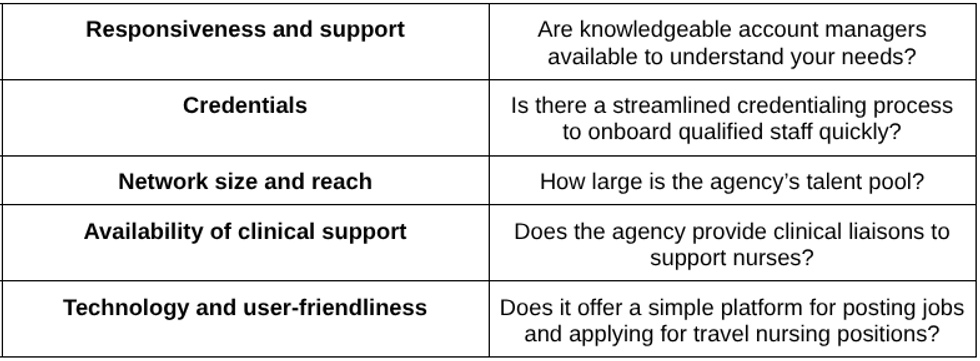
    Methodology to Compare Staffing Agencies

    Small healthcare providers can benefit from reputable staffing agencies to fill gaps in their staffing needs. How can you determine the best companies to partner with? Here is a methodology to select the top solutions.

    Best Places to Apply for High-Paying Travel Nursing Jobs

    Healthcare workers seek workplaces with superior support and transparent communication. Where can they apply for high-paying travel nursing jobs? Here are three staffing agencies helping travel nurses find jobs and small healthcare providers attract top talent.

    1. Trustaff

    Trustaff is the best healthcare staffing agency for travel nurses. The company matches small healthcare providers with experienced nurses through its national network of professionals. Since 2002, it has prioritized personal service and helping you find assignments in all specialties. Travel nurses can easily apply for high-paying positions on the mobile app.

    Key features

    2. Aya Healthcare

    Aya Healthcare is a leading provider of healthcare talent staffing services for travel nursing. This agency implements advanced technologies on its intelligent workforce platform to connect people and systems. It’s renowned for efficiency, as the direct-to-clinician model lowers costs for small healthcare providers. Travel nurses pick the company for its consistent job volume and strong recruiter support.

    Key features

    3. AMN Healthcare

    AMN Healthcare is a renowned staffing agency recognized for its user-friendly technology and industry expertise. For 40 years, it has provided comprehensive staffing services to healthcare providers nationwide. The company helps professionals find travel nursing jobs, permanent positions, and contract hires.

    Key features

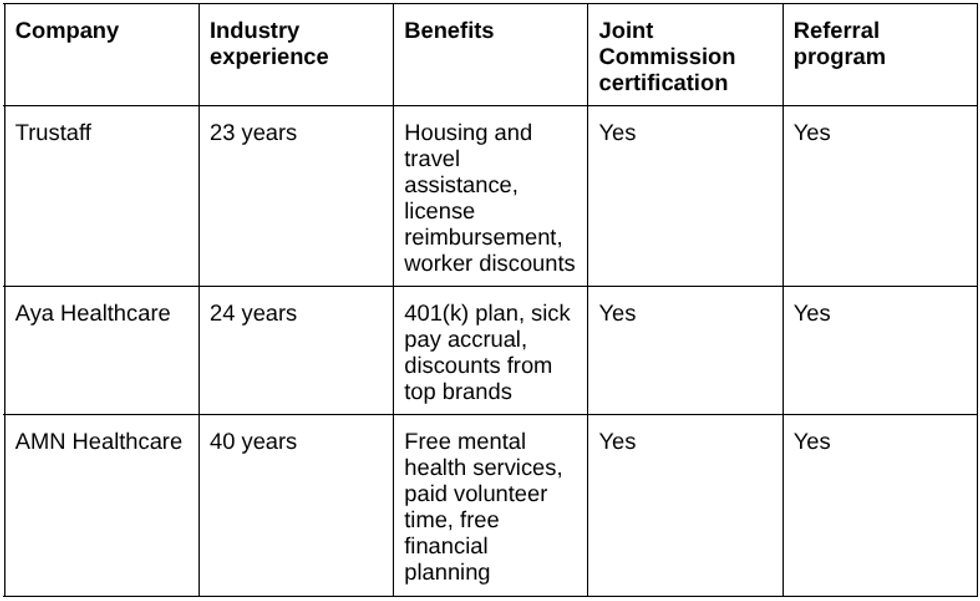
    Comparing Staffing Agencies

    Choosing the right staffing partner can be challenging when agencies offer similar services. Here is a direct comparison of agencies outlining their core strengths and experience.

    Appealing to the Top Travel Nursing Talent

    Navigating nursing shortages demands a proactive approach to building a resilient and desirable workplace. Small healthcare providers can outmaneuver large competitors by focusing on a superior culture and meaningful benefits. They can also gain a strategic advantage by connecting with reputable staffing agencies to find the top travel nurses.

    Frequently Asked Questions

    Why should small healthcare providers focus on hiring travel nurses?

    Persistent nursing shortages mean providers should consider hiring travel nurses to fill critical gaps and maintain quality patient care.

    How can small facilities compete with larger hospitals and their higher salaries?

    Unique, high-value benefits help providers stand out beyond hourly wages.

    What can small healthcare providers do to improve work-life balance?

    Flexible scheduling options help travel nurses better balance their work and personal life.

    Where do travel nurses make the most money?

    Travel nurses typically make more money in remote locations with high-demand positions.

    About the Author

    Post by:

    Kelly Duggan

    Kelly Duggan is the President of Trustaff, a leading healthcare staffing firm dedicated to connecting skilled clinical and allied health professionals with hospitals and healthcare systems across the country. She oversees the company’s operations, focusing on talent development, workforce solutions, and strategic growth to address the evolving needs of healthcare organizations. Duggan is committed to fostering meaningful relationships and ensuring that Trustaff remains a trusted partner for both healthcare professionals and the facilities they serve.

    Company: Trustaff
    Website: https://www.trustaff.com/

    Read More Show less

    Expert Profile: Kelly Duggan

    BizBuySell

    Most Popular Articles

    The Complete 35-Step Guide for Entrepreneurs Starting a Business

    14 Things Angel Investors Will Ask Before Investing in Your Startup

    How to Get a Small Business Loan: A Guide in 10 Steps

    A Guide to Succeeding in Business Negotiations

    15 Major Legal Mistakes Made by Startups

    logo
    AllBusiness.com is a premier business website dedicated to providing entrepreneurs, business owners, and business professionals with articles, insights, actionable advice,
    and cutting-edge guides and resources. Covering a wide range of topics, from starting a business, fundraising, sales and marketing, and leadership, to emerging AI
    technologies and industry trends, AllBusiness.com empowers professionals with the knowledge they need to succeed.
    About UsContact UsExpert AuthorsGuest PostEmail NewsletterAdvertiseCookiesIntellectual PropertyTerms of UsePrivacy Policy
    Copyright © AliBusiness.com All Rights Reserved.
    logo
    • Experts
      • Latest Expert Articles
      • Expert Bios
      • Become an Expert
      • Become a Contributor
    • Starting a Business
      • Home-Based Business
      • Online Business
      • Franchising
      • Buying a Business
      • Selling a Business
      • Starting a Business
    • AI
    • Sales & Marketing
      • Advertising, Marketing & PR
      • Customer Service
      • E-Commerce
      • Pricing and Merchandising
      • Sales
      • Content Marketing
      • Search Engine Marketing
      • Search Engine Optimization
      • Social Media
    • Finance & Fundraising
      • Angel and Venture Funding
      • Accounting and Budgeting
      • Business Planning
      • Financing & Credit
      • Insurance & Risk Management
      • Legal
      • Taxes
      • Personal Finance
    • Technology
      • Apps
      • Cloud Computing
      • Hardware
      • Internet
      • Mobile
      • Security
      • Software
      • SOHO & Home Businesses
      • Office Technology
    • Career
      • Company Culture
      • Compensation & Benefits
      • Employee Evaluations
      • Health & Safety
      • Hiring & Firing
      • Women in Business
      • Outsourcing
      • Your Career
      • Operations
      • Mergers and Acquisitions
    • Operations
    • Mergers & Acquisitions
    • Business Resources
      • AI Dictionary
      • Forms and Agreements
      • Guides
      • Company Profiles
        • Business Directory
        • Create a Profile
        • Sample Profile
      • Business Terms Dictionary
      • Personal Finance Dictionary
      • Slideshows
      • Entrepreneur Profiles
      • Product Reviews
      • Video
    • About Us
      • Create Company Profile
      • Advertise
      • Email Newsletter
      • Contact Us
      • About Us
      • Terms of Use
      • Contribute Content
      • Intellectual Property
      • Privacy
      • Cookies