1


Gustav Klimt's (1862–1918) Viennese Secessionism style: Avant-garde art fueled by the print-based circulation of global aesthetics. Funded by Jewish patrons after being rejected by the state, he drew them to assert cultural presence in pre-Holocaust era.


1
100% Upvoted
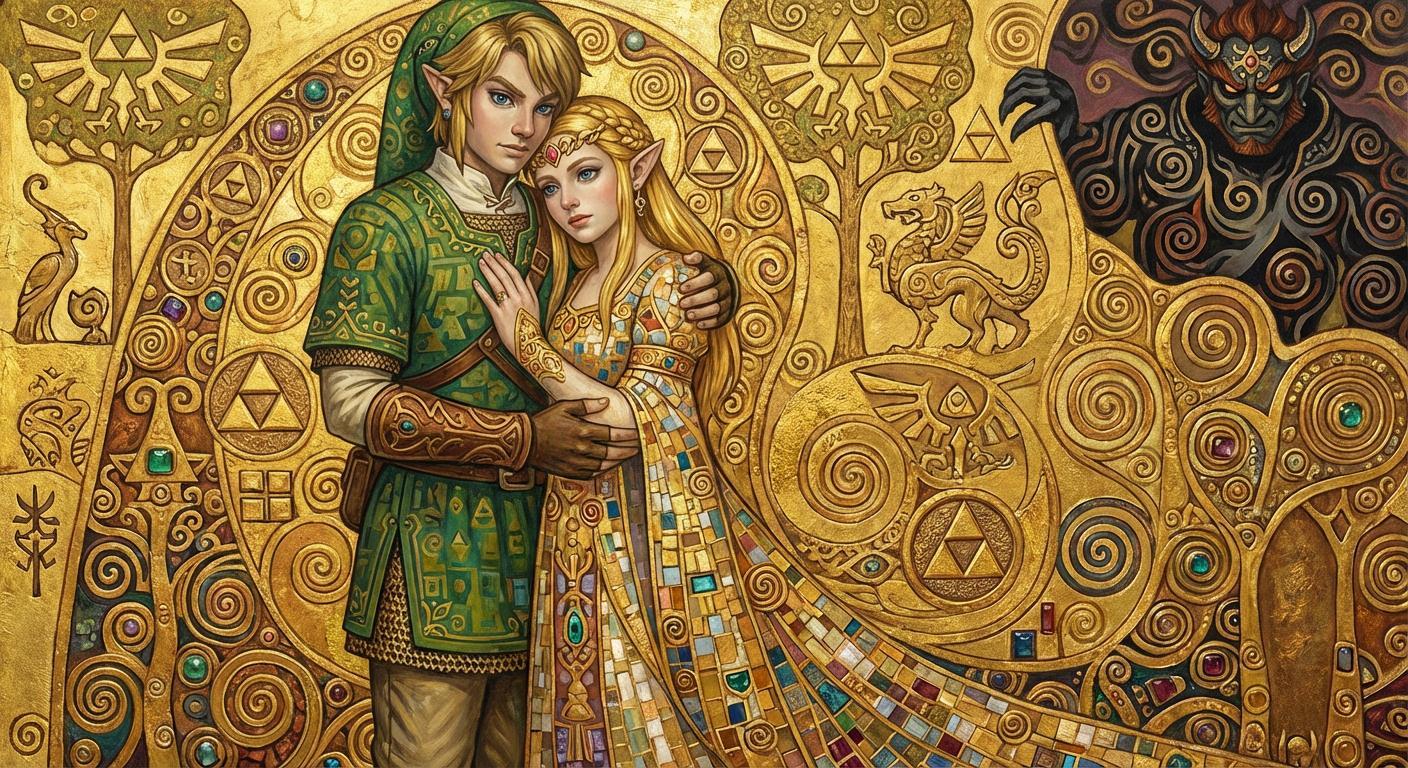
{The Legend of Zelda} illustrated in the Viennese Secessionism style of Gustav Klimt (1862–1918): {
Gustav Klimt's signature style, particularly during his 'Golden Phase' (c. 1903–1909), represents a distinctive iteration of Jugendstil (Art Nouveau) within the Viennese Secession, characterized by a fundamental tension between the photorealistic academic figuration of his early Kunstgewerbeschule (School of Arts and Crafts) training under Ferdinand Laufberger from 1876–1883, and radical, two-dimensional ornamentation. While rooted in traditional oil painting, this aesthetic was profoundly shaped by the 'graphic turn' of the late nineteenth century—a transformation driven by printing advancements from early lithography (1796) and chromolithography (1837) through photomechanical reproduction (1860s) to the offset printing of Klimt's own era. These technologies facilitated global circulation of Art Nouveau patterns and Japanese woodblock prints, exposing artists to previously inaccessible visual vocabularies. The Secessionists actively harnessed these innovations in their magazine Ver Sacrum (1898–1903), employing graphic design to dissolve the hierarchical barrier between 'high art' and 'applied art.' Within this progressive cultural context, Klimt forged a distinctly Viennese dialect of Modernism—integrating ornamental flatness into the psychological depth of easel painting to create the visual tension that came to define the Secessionist aesthetic.
Klimt's career had begun with applied arts training and architectural mural painting in strict academic conventions, but he later pivoted toward a radical, sensual Modernism that reinterpreted Classical mythology and allegory within the Fin de siècle milieu of the Secession. His mature style synthesized Symbolism, Byzantinism (gold leaf and mosaic techniques), Japonisme (the spatial compression of ukiyo-e prints), and the labyrinthine, curvilinear geometries of Celtic paganism. Crucially, he adopted the concept of the Total Work of Art (Gesamtkunstwerk) from his predecessor Hans Makart (1840–1884); while rejecting Makart's historicist style, Klimt retained his strategy of treating paintings as integral components of immersive, theatrical environments—adapting Vienna's Ringstraße-era performative viewing culture into unified Modernist terms. This monumental ambition was achieved without neglecting microscopic detail: Klimt filled his surfaces with such intricate ornamentation that isolated fragments could function as independent abstract compositions, recalling the structural complexity of Tintoretto's grand canvases.
The deaths of his father and brother in 1892 marked a definitive psychological and professional rupture. With the dissolution of their shared studio, Klimt abandoned academic historicism to develop a radically personal Viennese variant of Jugendstil, transforming traditional allegory into obscure, private symbolism infused with 'biological truth' regarding sex, death, and decay. This shift culminated in the controversy of the University of Vienna Faculty Paintings (1894–1905), where his depictions of Philosophy, Medicine, and Jurisprudence were rejected by the state as 'pornographic' and 'excessively perverted'—demonstrating that his new style prioritized naked truth (Nuda Veritas) over societal expectation, adhering to the Schiller quotation inscribed on his work: 'To please many is bad.' This defiant approach found complete expression in the Beethoven Frieze (1902), where Klimt shaped universal human narratives through mythological allegory—personifying the invisible governing forces of the human psyche—within a true Gesamtkunstwerk composition, employing lyrical geometric stylization and tapestry-like ornamentation revealing the influence of Charles Rennie Mackintosh (1868–1928). Klimt’s aesthetic philosophy profoundly influenced his protégé Egon Schiele (1890–1918); beyond their shared commitment to symbolic ornamentation and erotic truth, Schiele adapted Klimt’s fluid, dance-like figuration into a jagged, expressive language inspired by Javanese shadow puppetry.
Underlying these thematic developments was Klimt's sophisticated exploitation of optical awareness to construct hierarchical vision rather than deceptive naturalistic illusion. He exploited foveal vision—the brain's biological imperative to focus intensely on eyes while flattening peripheral information—codifying this perceptual bias into deliberate artistic strategy: maintaining hyper-realism in key focal areas (face and hands) while reducing surrounding anatomy and environment into flattened symbolic ornamentation. This creates volumetric isolation, an optical contrast wherein realistic features appear to detach from the decorative plane as if floating free. He heightened this tension through kinetic optics, employing metallic pigments and gold leaf to create reflective, shifting surfaces contrasting with the static matte rendering of flesh. To further destabilize casual viewing, he deployed figure-ground oscillation, using mosaic-like pattern camouflage (spirals, rectangles, concentric dots) to blur figure-background distinction and force sustained attentive effort. Finally, he adopted a technique akin to Leonardo da Vinci's sfumato, softening focus around the eyes and mouth to create an ambiguous, unfixed gaze inviting prolonged contemplation of the sitter's psychological state.
His 1903 visit to Ravenna, where he studied the Byzantine mosaics of San Vitale, intensified these formal concerns and sparked the 'Golden Phase' proper. This influence reached fullest expression in the mosaic designs for the Stoclet Palace (c. 1905–1911), particularly the Tree of Life frieze panels Expectation and Fulfillment. In these works, Klimt fused the rigid formality of Byzantium with the organic, spiraling interconnectivity of Celtic paganism to 'editorialize' his subjects through gender-coded ornamentation—assigning rigid rectangular geometry to the male figure and fluid circular motifs to the female. This approach dissolved bodies into a unified, abstract architecture while preserving realistic faces and hands to anchor symbolic gesture. He concurrently adapted this visual logic for easel paintings with greater subtlety, as in the Portrait of Margaret Stonborough-Wittgenstein (1905), flattening costume and environment into decorative geometries through planar textures and color blocking; even without literal gold leaf, the ornamentation served its editorializing function, framing the sitter as an icon of modern elegance by contrasting photorealistic face against spectral abstraction. This evolution reached its zenith in The Kiss (1907–1908), Portrait of Adele Bloch-Bauer I (1907), and Mäda Primavesi (1912–13)—works demonstrating heightened graphic awareness, balancing macro-compositional structure with microscopic detail, employing seamless alternation between gender-coded ornamentation and evocative floral or earthy textures to imbue abstract shapes with symbolic double-meanings and isolate subjects within a timeless golden void.
In The Virgin (1913), Klimt departed from gold-ground formality, adopting a vibrant kaleidoscopic palette with affinities to Fauvism and emerging Austrian Expressionism while retaining mosaic-like surface treatment. Replacing rigid geometric architecture with intertwined floating female bodies viewed from above—as if drifting in subconscious dream—he fused draperies, limbs, flowers, and quilt-like color patches into a rotating organic mass readable simultaneously as underwater garden and cosmic whirl: a decorative, carpet-like composition wherein figuration and ornament become inseparable, using sensuous dance-like movement to suggest erotic awakening and regenerative life-cycles.
In his final masterpiece, Lady with a Fan (1917–18), Klimt shifted further from rigid geometric abstraction toward culturally specific Orientalism. Replacing metallic austerity with a vibrant matte palette inspired by Chinese textiles and Japanese woodblock prints, he transformed the background from abstract void into a dense tapestried field of East Asian motifs—Chinese Phoenix (Fenghuang), lotus blossoms, and golden pheasants. Surrounding the kimono-clad sitter with these floating cultural artifacts against 'Imperial Yellow,' Klimt maintained his signature spatial flattening while signaling a late-career shift toward chromatic opulence and looser, more joyous brushwork that remained unresolved at his death. His aesthetic philosophy—symbolic ornamentation, erotic truth, and expressive figuration—profoundly shaped his protégé Egon Schiele (1890–1918), who transformed Klimt's fluid, dance-like poses into a jagged, psychologically charged language inspired by Javanese shadow puppetry (wayang).
}