1


The "Gutted Mansion" Boston Expressionism portrait style of Leonard Baskin (1922–2000): A Rabbi’s son and WWII gunner channeling post-Holocaust cynicism into creepy existentialist portraits—a fine-art precursor to the Wojak meme. [Gemini Nano Banana Pro]


1
100% Upvoted
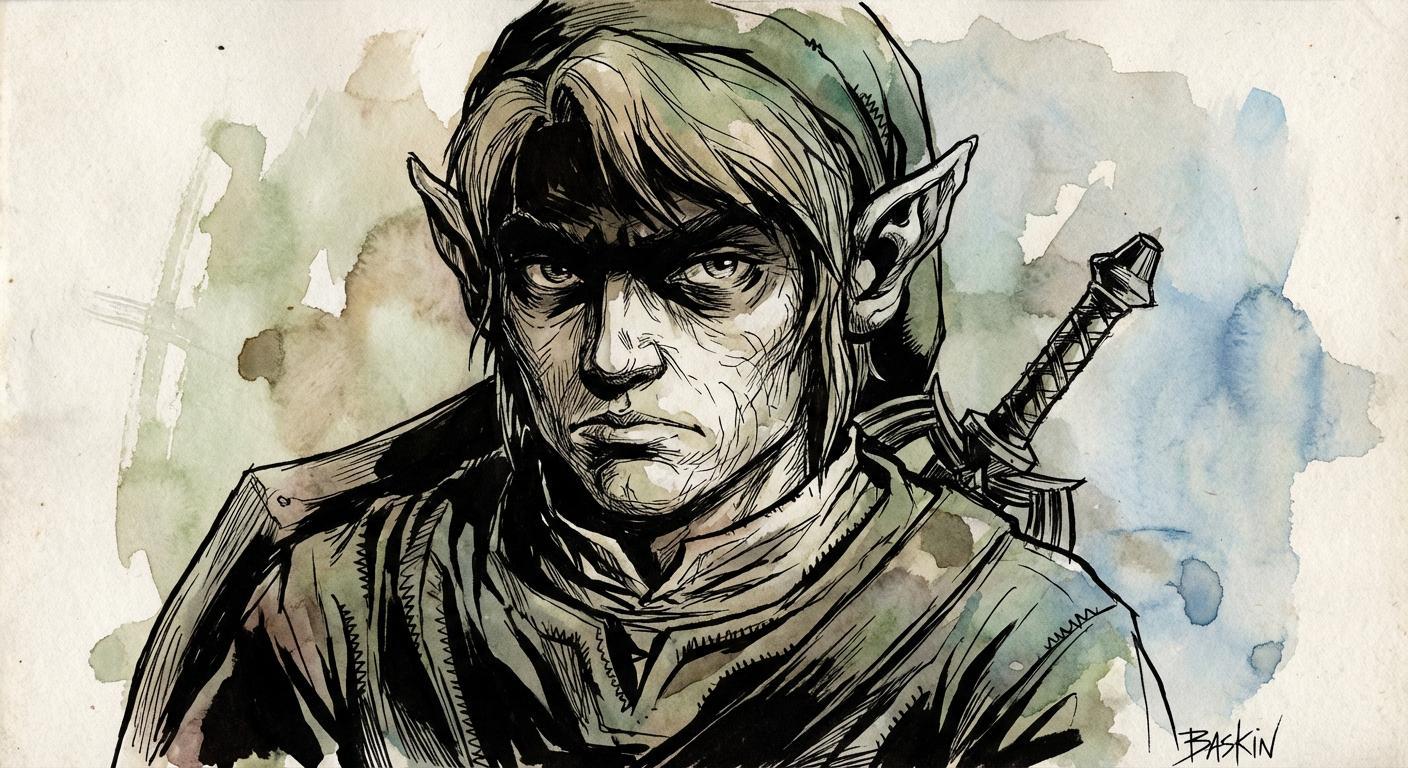
{Link (The Legend of Zelda)} illustrated in the "Gutted Mansion" Boston Expressionism portrait style of Leonard Baskin (1922–2000): {
Leonard Baskin’s work stands as a definitive pillar of Boston Expressionism, a movement distinguished by its fusion of rigorous Old Master craftsmanship with the raw psychological discord of the mid-20th century. Central to Baskin’s aesthetic was his revival of the "artist-prophet" model established by William Blake (1757–1827): the conviction that visual art must bear the same intellectual and moral gravity as literature. This philosophy was institutionalized in Baskin's founding of the Gehenna Press (1942–2000), where he channeled Blake’s artisan spirit through a distinctively modern, existentialist lens. Baskin posited that the artist’s primary function is to metabolize history to anticipate the future—a prophetic capacity he regarded as humanity’s sole remaining divine attribute.
Baskin derived his foundational ethos from Blake’s symbolic Romanticism, mirroring the British master’s integration of poetry, history, and spirituality. Both artists utilized the human figure as the ultimate vessel for existential inquiry, grounding their techniques in the study of Medieval and Renaissance anatomy. However, where Blake’s Romanticism utilized the muscular, contorted nude to visualize spiritual transcendence and cosmic struggle, Baskin’s worldview was hardened by the specific traumas of his era. Shaped by his Orthodox Jewish heritage and his service as a U.S. Navy gunner during World War II, Baskin filtered Blake’s allegorical impulses through a hyper-cynical, psychoanalytically inflected lens. He rejected Romantic deliverance, instead utilizing his classical training to confront the moral collapse that enabled fascism, presenting the human form not as a vessel of glory, but as a site of fragility, decay, and inevitable mortality.
This philosophical divergence precipitated a technical crisis. During his early education at Yale, Baskin struggled to reconcile his classical aspirations with modern realities, critiquing his own attempts to emulate the "customary academic styles" of the École des Beaux-Arts. He dismissed these early drawings as an "unbelievable mixture compacted out of Rossetti's (1828–1882) Pre-Raphaelitism and Botticelli's (c. 1445–1510) Neo-Platonism"—"ill-drawn effusions" too delicate to articulate the brutality of the atomic age. Resolution began during travels to Paris and Florence in 1950 and 1951, where Baskin encountered the Late Medieval and early Renaissance masters who would reshape his practice. He was struck by the monumentality and sculptural weight of Andrea Mantegna's (c. 1431–1506) frescoes—an influence acknowledged directly in his print Mantegna at Eremitani (1952), which translated the Italian master's volumetric figuration into the graphic medium. The decisive consolidation occurred during a Guggenheim Fellowship to Europe in 1953. Rejecting academic delicacy, Baskin immersed himself in figurative sculpture, absorbing influences from the effigies of medieval tombs and the carvings of Giovanni Pisano (c. 1250–1315) to the modern bronze and wood of Auguste Rodin (1840–1917) and Giacomo Manzù (1908–1991). Most crucially, he engaged with the German Expressionist Ernst Barlach (1870–1938), whose capacity to embody tortured vulnerability within compressed, grief-laden forms provided a model for translating psychological anguish into sculptural mass. The stark memorial quality of Barlach's woodcuts and figures—their ability to hold suffering within monumental stillness—became foundational to Baskin's mature idiom.
Baskin resolved his artistic conflict by translating this sculptural mass into graphic linework. He retained the technical rigor of the European masters but inverted their idealization: the heroic musculature of the Renaissance was subverted to depict psychological anguish. Baskin developed a stark, expressionistic idiom to map what he termed the "gutted mansion" of the human body—a visceral visual poetry rooted in primitivist aesthetics. In this style, anatomy is not represented literally but distorted symbolically, creating figures that appear simultaneously bloated and flayed, evoking a dual state of physical decomposition and spiritual desolation.
The execution of this vision relies on a severe, jagged pen-and-ink technique that carries the incisive quality of intaglio engraving and the stark tonal economy of wood-block relief—a primitivist austerity derived from both traditions. The linework is austere yet agitated, echoing the formal rigidity of medieval portraiture to establish a baseline of order that subsequent distortion systematically disrupts. As the psychological intensity of a subject increases, visual agitation accelerates: facial proportions warp, contours tighten into wiry, nervous clusters, and shadows deepen into cavernous voids. In these passages of extreme tension, Baskin abandons structural coherence for visceral immediacy—anatomical logic dissolves, reducing the figure to a sutured, undead assemblage stripped of recognizable humanity. The suspicion aroused by these incongruities is further solidified through noir-derived lighting, creating a stark chiaroscuro with solid black shadows that frame the subject as though under interrogation. A recurring signature is the heavy massing of shadow across the forehead and brow—dark shapes that hood the upper face, casting the eyes into ominous relief. This technique generates an effect of suppressed hostility or simmering threat, anticipating the visual shorthand later codified in manga and anime as "anger shading," where a darkened forehead signals barely contained rage. Baskin exploits the instinctive impulse to locate interiority in the eyes; he destabilizes this search by warping the surrounding musculature into a stoic, bitter mask—a gaze devoid of accessible warmth, signaling profound distrust and normalized psychological desolation, disturbing in its lack of self-awareness, while carrying the vacant stillness of death. The face becomes a site of epistemological failure, denying the viewer the comfort of coherent recognition.
This pallid, hollowed-out quality—the visual residue of humanity gutted from within—is the direct technical consequence of Baskin's cynical worldview. Where Romantic and academic traditions preserved dignity through idealization, Baskin's ink stripped subjects of emotional warmth, cosmetic refinement, and composed facades, presenting instead a raw, ungroomed physicality that refuses consolation. The undead pallor achieved through sparse linework and pooling shadow functions not as Gothic ornament but as documentary evidence: this is what systematic brutality produces in human faces. In extreme iterations, Baskin obscured or omitted secondary facial features entirely, channeling attention toward dilated, threatening gazes. The resulting physiognomies—blanched, hardened, vigilant—evoke populations conditioned by scarcity and surveillance under totalitarian regimes, their expressions calibrated for survival rather than connection. To reinforce this reduction to bare survival, Baskin drew explicit parallels between his human subjects and wounded fauna. His portraits frequently morph into or allude to wounded fauna: battle-scarred wolfhounds embody endurance at biological extremity, while hybrid man-bird figures serve as analogies for vulnerability and prey. Unlike Blake's prophetic hybrids, which visualized cosmic allegory, Baskin's creatures represent existential degradation—the human diminished to the hunted, the cynic's thesis rendered in ink and bone.
To deepen this tension, Baskin selectively introduced soft, light pastel watercolor washes—delicate, translucent layers that contrast sharply with the ferocity of the linework. Often partially contaminated with cool tones—evoking bruised flesh and the first discoloration of corrupted innocence—these washes bleed into the paper grain, revealing brush-lift marks where pigment pools and fractures. Such imperfections—subtly visible in works like Hosie's Alphabet (1972)—are not incidental but essential: they mimic the fragility of flesh, the staining of trauma, and the uneven healing of wounds. This interplay of raw paper, granular pigment, and serrated line juxtaposes corporeal presence with spectral absence, allowing shadowy visages to emerge from the page like the afterimages of violence—forms that are at once bodily and ghostly.
Crucially, Baskin's portraits never depict shallow or comical expressions of surface-level sadness—no theatrical grief, no melodramatic despair. His subjects instead convey wary, stoic endurance, their gazes guarded and their expressions hardened rather than openly anguished. This emotional restraint is precisely what makes his work so disturbing: the viewer cannot immediately pinpoint the source of discomfort, yet the horror of the inner state seeps in gradually through the accumulation of allegorical, bruise-like shadows and primitivist, reductive anatomical distortions. The terror lies not in what is explicitly shown, but in what is withheld—a creeping recognition of normalized devastation.
This unsettling aesthetic possesses a timeless resonance that parallels modern anxieties. The predatory unease of Baskin’s portraits anticipates the psychological horror found in films like Patrick Brice’s Creep (2014), while his reduction of complex emotion into stark, grim physiognomy shares editorial characteristics with the contemporary "Wojak" (or "Feels Guy") meme. However, where digital culture often employs such stark simplification for irony or satire, Baskin retains the full gravity of sorrow, literalizing inner wounds without crossing into gratuitous gore.
This existentialist vision culminates in major cycles such as Laus Pictorum (1968–1969) and Imaginary Artists (1976). In these series, Baskin rendered sketch portraits of nineteenth-century and fictitious artists with brooding intensity, examining artistic identity through invented physiognomies bearing the weight of imagined histories. His portrait of the French printmaker Rodolphe Bresdin (1822–1885) exemplifies this approach: Baskin exploited Bresdin's wild hair and beard as opportunities for textural experimentation, deploying stippling and hatching to evoke the sketchy, surreal quality he perceived in the historical artist's own etchings. These works demonstrate Baskin's ultimate conviction: that by visually relating the artworks of the past to the traumas of the present, the artist performs an act of moral reckoning—staring unflinchingly into the ruins of humanity to find, in distortion, a truer likeness. }