Skip to content
tick the boxes

EVs remain a niche choice in the US, according to survey

Consumers around the world told Deloitte what they want in their next vehicle.

Jonathan M. Gitlin | 291
woman looking at cars in showroom
Credit: Getty Images

The electric vehicle transition might not be moving ahead with the same gusto it showed in the early 2020s, but it’s still happening. According to Deloitte’s 2026 Global Automotive Consumer Study, 7 percent of US car buyers want an electric vehicle for their next car. While that might sound rather meager, it’s a 40 percent increase from 2025’s survey, which found just 5 percent of car buyers wanted an EV.

Plain old internal combustion remains Americans’ first choice, with 61 percent telling the survey that’s how their next ride will be powered. Twenty-one percent want a hybrid, up from 20 percent last year. Just 5 percent indicated a desire for a plug-in hybrid (down from 6 percent last year), with the remaining confused souls either unsure of what to buy next (4 percent) or some other option, presumably hydrogen (1 percent).
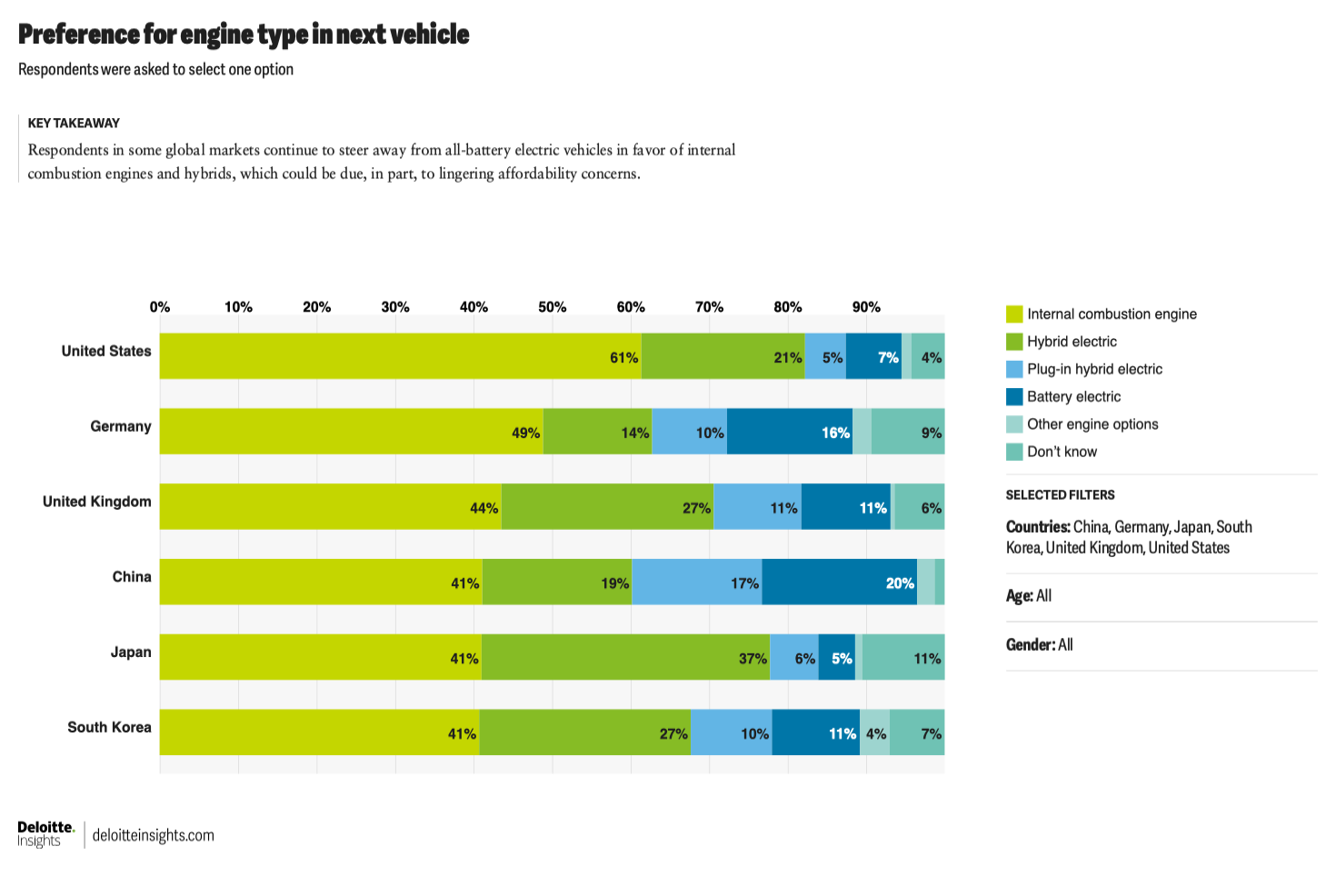
A graph showing what engine preference car buyers have in the US, Germany, the UK, China, Japan, and South Korea
A graph showing preference for engine type in car buyers’ next vehicle.
A graph showing preference for engine type in car buyers’ next vehicle. Credit: Deloitte

The high demand for internal combustion engines makes the US an outlier among large car-buying markets. Fewer than half of German car buyers want another gas-powered vehicle, and that number falls to just 41 percent in China, Japan, and South Korea. But those consumers aren’t all fleeing internal combustion for battery EVs. Well, they mostly are in China, where EV demand is now 20 percent. But in Japan, only 5 percent of consumers want a battery EV, versus 37 percent indicating their next car would be a hybrid.

Deloitte conducted the survey between October and November 2025, by which time the current US government’s anti-EV policies would have come into effect. These include cancelling the clean vehicle tax credit, rolling back fuel efficiency standards, and declining to prosecute automakers that exceed existing efficiency regulations, as well as the uncertainty of capricious import tariffs. Many automakers have spent the last several years building up capacity to manufacture EVs in North America for the US market, but the return on those investments is unlikely be soon.

Americans also lag behind many of their international peers when it comes to that most important condition for buying an EV or plug-in hybrid: having somewhere to plug it in at night. Fifty-three percent of US respondents said they do not have a way to charge at home. By contrast, that number was 20 percent in Germany and just six percent in China. Only Japan—where plug-ins and EVs are even less popular than in the US—had a higher rate of no charger access at home (75 percent).
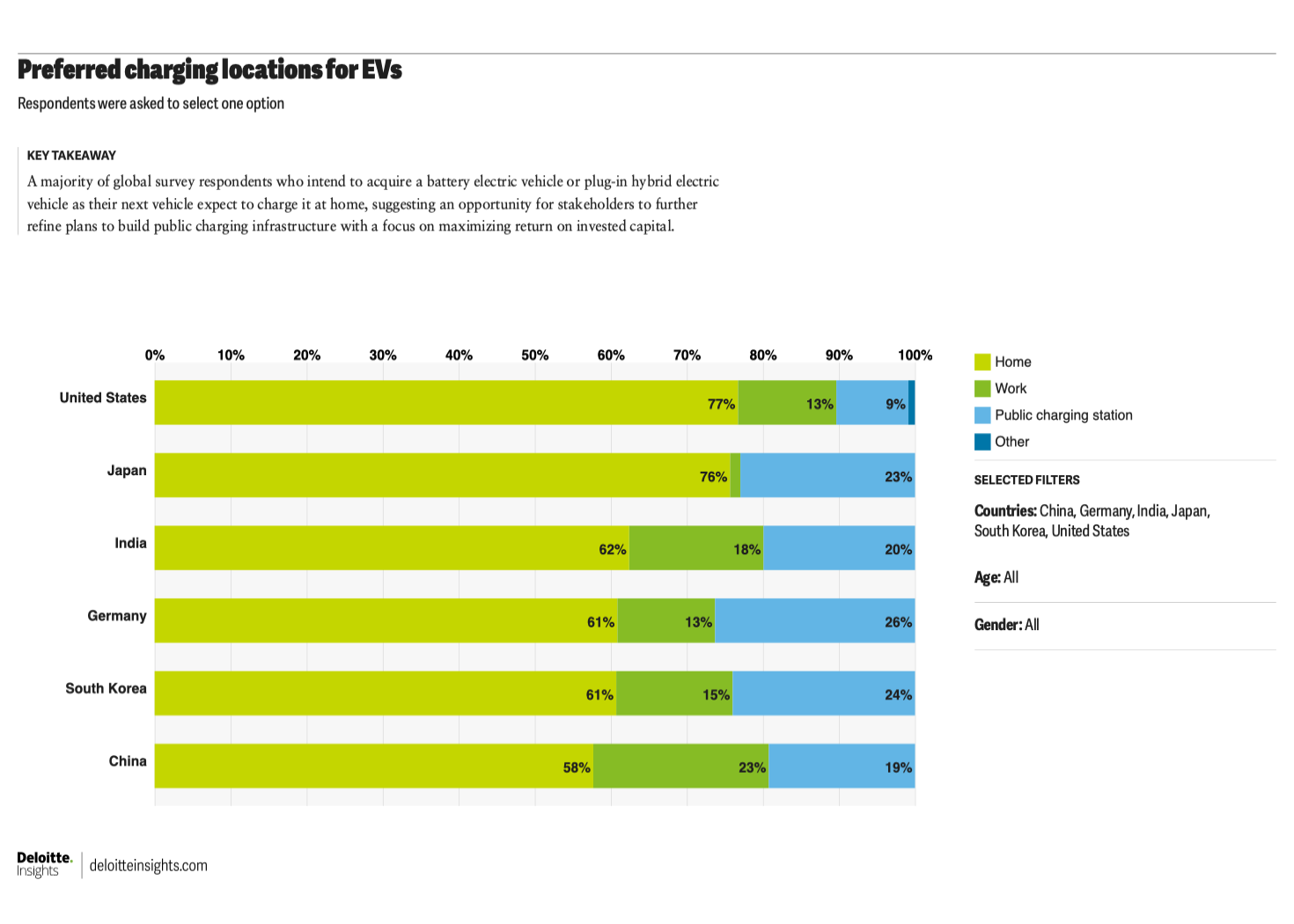
A graph showing charger location preference for car buyers in the US, Germany, the UK, China, Japan, and South Korea
A graph showing preferred charging locations for car buyers.
A graph showing preferred charging locations for car buyers. Credit: Deloitte

While reliable charging at one’s workplace—emphasis on reliable—can make up for not being able to charge at home, 77 percent of US car buyers said they would prefer to charge at home (with just 13 percent indicating they would prefer charging at work).

Why pick an EV?

For people who haven’t yet decided to switch, an underappreciated fact is just how much more efficient an electric powertrain is compared to one that burns liquid petroleum. Ford’s experiment putting an electric powertrain into its best-selling F-150 pickup truck might have turned sour, but consider the following: The V6 truck needs more than three times as much energy to travel 300 miles as the one you plug into a wall, when you consider a gallon of gasoline contains 33.7 kWh of energy.

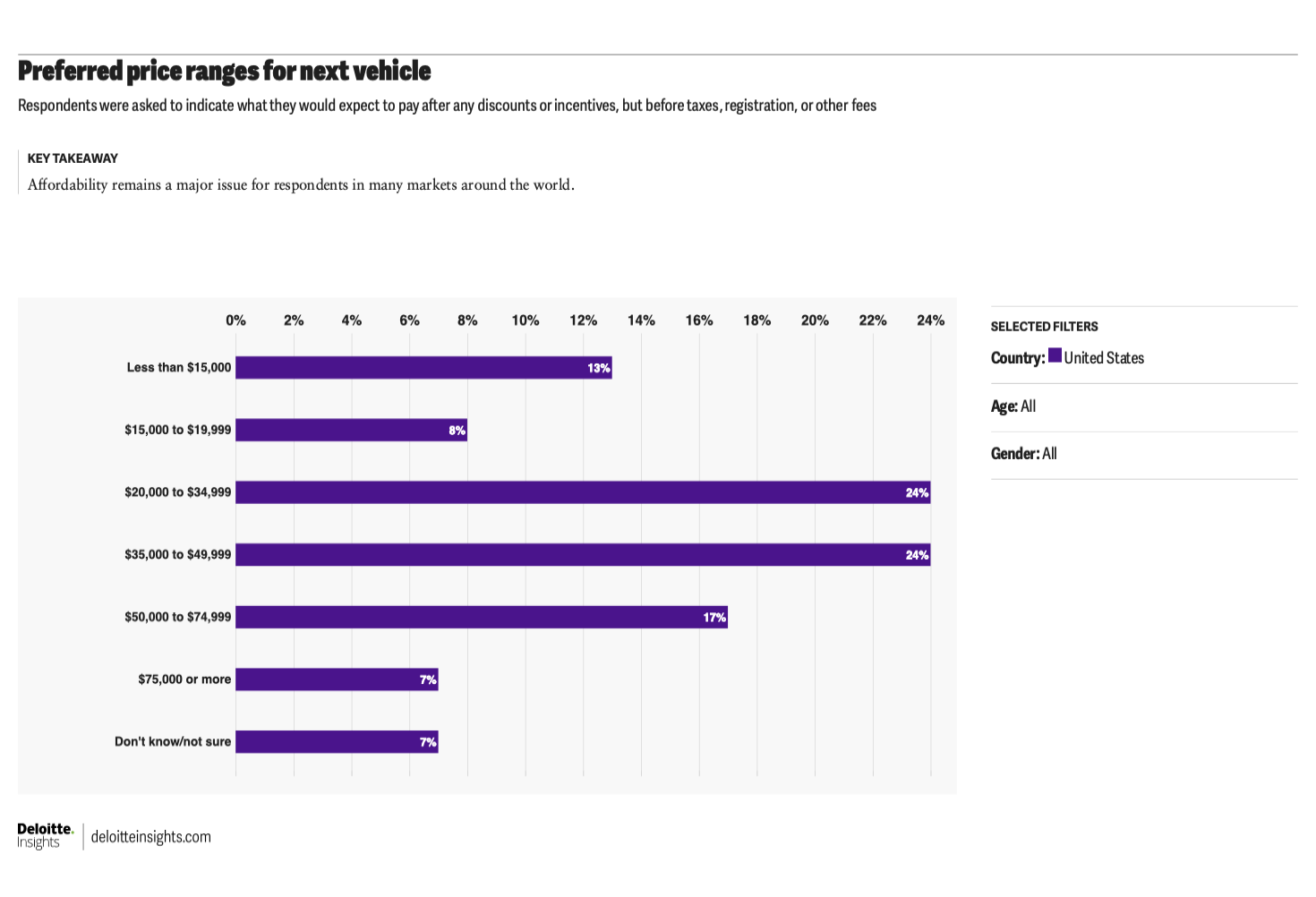
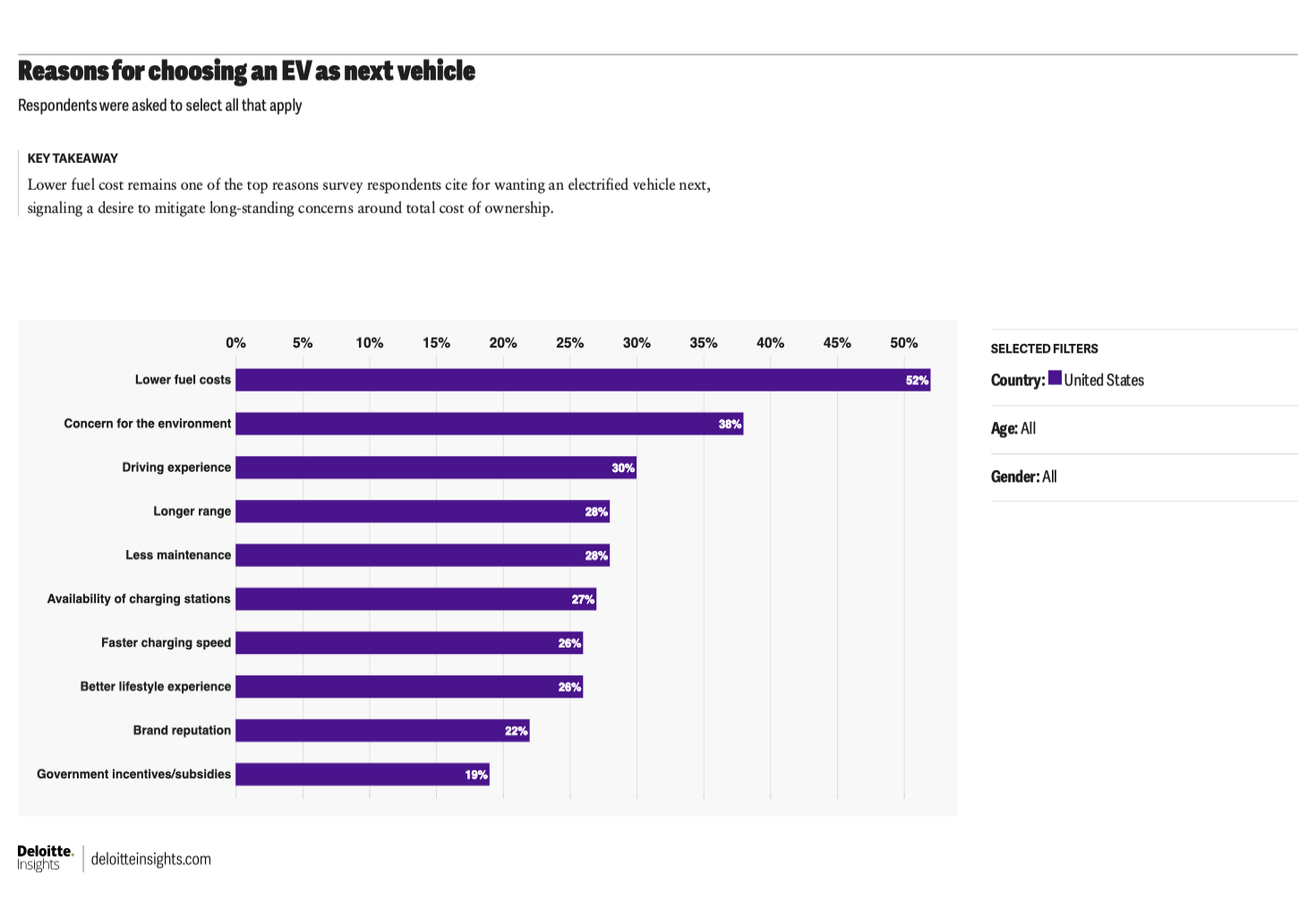
Among the EV-convinced, this is presumably old news. More than half—52 percent of US survey respondents—said lower fuel costs were a reason for choosing an EV, beating out concern for the environment, which ranked second at 38 percent. And between $20,000 and $49,999 appears to be the pricing sweet spot, with 24 percent looking for something in the $20,000–$34,999 band (cars like the new Nissan Leaf or the soon-reborn Chevrolet Bolt) and another 24 percent looking in the $35,000–$49,999 band, which has plenty of EVs to choose from, including Mercedes-Benz’s efficient new CLA.

Just 7 percent of those EV buyers are looking to spend more than $75,000 on their electric car, but luxury EVs abound at this price point.

A graph showing preferred price bands for US EV buyers.
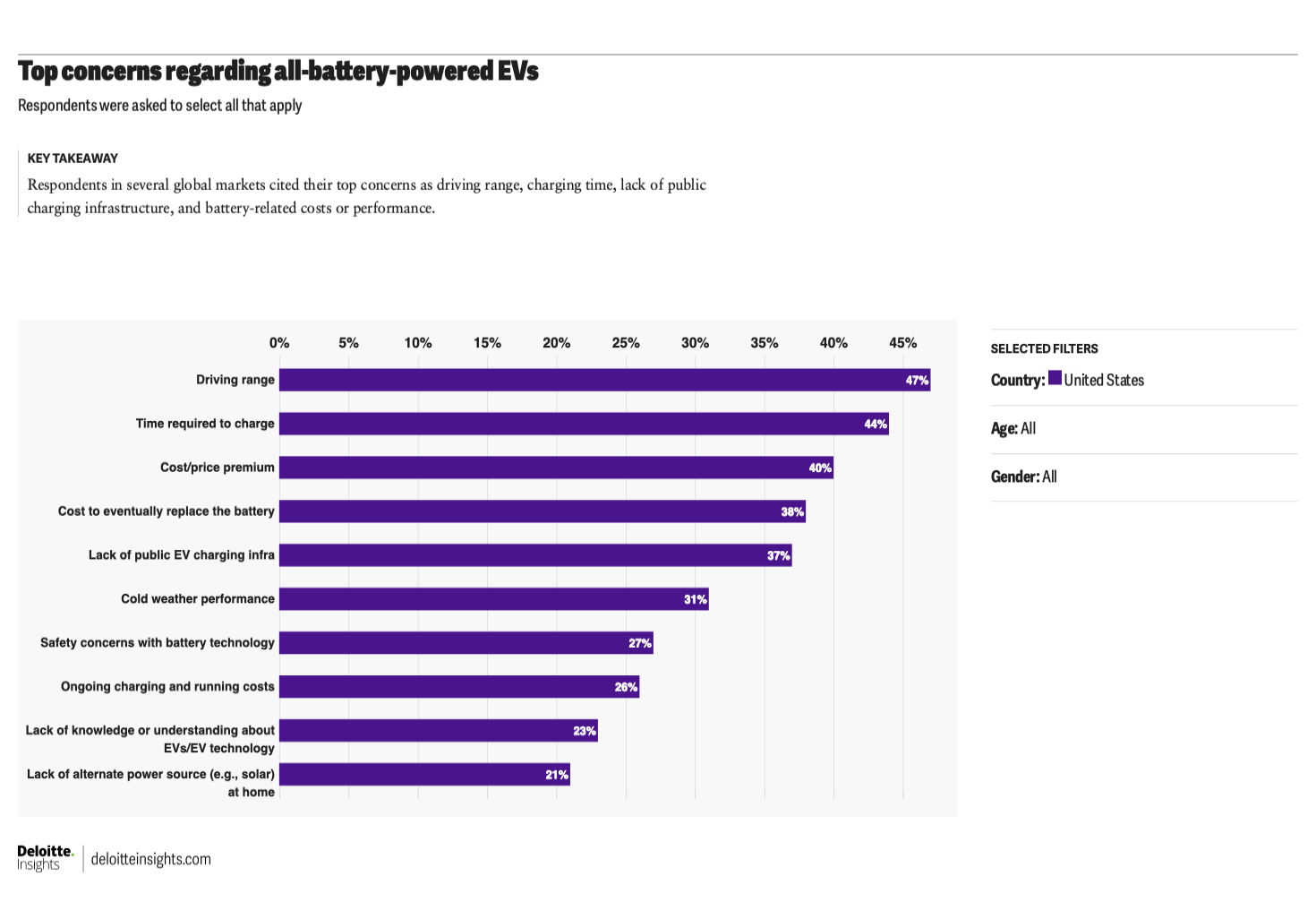
A graph showing US car buyers concerns with EVs.

Meanwhile, range and charging times remain the foremost concerns among car buyers when discussing EVs, along with the cost premium. Some other fears are ill-founded, however. Thirty-eight percent said they were concerned about the cost of eventually replacing an EV’s battery. But EV batteries are proving more durable on the road than many early adopters once believed. There’s little evidence that EVs will require costly battery replacements with any more frequency than older cars require new engines, a concern that is rarely mentioned when someone wants to buy a gas-powered machine.

The US doesn’t care about software-defined vehicles

One of the biggest shifts in car design and manufacturing over the past few years has been the advent of the software-defined vehicle. Until now, pretty much every electronic function in a car, from an electric window to the antilock brakes, needed its own electronic control unit. Some cars can have up to two hundred discrete ECUs, some with software dating back years.

A software-defined vehicle (or SDV) goes for a clean-sheet approach. Instead of dozens and dozens of discrete black boxes, a handful of powerful computers replaces them. One usually controls the vehicle dynamics and powertrain, a second will handle driver assists and safety tech, a third is in charge of infotainment, and a fourth handles heating, cooling, and other in-car comfort. All-new code means no more legacy cruft, and the modern electronic architecture allows for regular over-the-air bug fixes and updates that add new functionality.

Anecdotally, I’ve found that the Ars Technica audience has very little interest in reading about this seismic shift, and you’re not alone. Only 41 percent of US car buyers think SDVs are useful, and one in three says they have no use for one. The concept is even less popular in the UK, Germany, and Japan, but it has far more acceptance in China, South Korea, and Southeast Asia.

Those attitudes correlate with willingness to pay extra for OTA updates. Only 7 percent of Chinese customers said they were unwilling to pay for OTA updates, and half said a car that can be updated would be worth a 6–10 percent price premium compared to a car that can’t. In the US, 39 percent said they would not pay more for a car with OTA functionality.

There’s also much less interest in using one’s car as a digital platform for other “integrated” services. More than half (53 percent) of US car buyers have no interest in such a thing, with another 19 percent indicating neutrality on the topic. Only one in five Americans said their car was a more important digital platform than their smartphone, compared to 56 percent of Chinese car buyers. Given this reality, how much longer will automakers like Rivian and General Motors keep Apple CarPlay out of their cockpits? Neither has significant export markets for its EVs, yet both believe EV drivers will eschew their smartphones over an in-vehicle solution, presumably with some kind of recurring revenue involved.

Photo of Jonathan M. Gitlin
Jonathan M. Gitlin Automotive Editor
Jonathan is the Automotive Editor at Ars Technica. He has a BSc and PhD in Pharmacology. In 2014 he decided to indulge his lifelong passion for the car by leaving the National Human Genome Research Institute and launching Ars Technica's automotive coverage. He lives in Washington, DC.
291 Comments