
Military Intervention? Right and Wrong
International Law Matters, But Let’s Apply It Fully

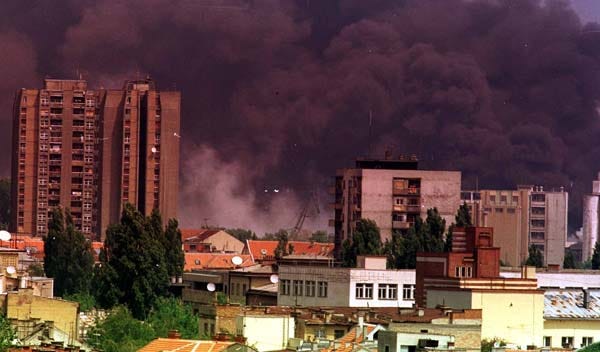
Novi Sad, Former Yugoslavia, after NATO bombing, June 8, 1999, by Darko Dozet - Own work, CC BY-SA 3.0, https://commons.wikimedia.org/w/index.php?curid=25242387
The capture of Venezuelan dictator Nicolás Maduro by US forces following a brief intervention has provoked ambiguous, though sometimes nuanced, reactions. To summarize broadly, some welcomed the end of an oppressive, criminal, and corrupt regime, but unequivocally condemned the military intervention that made it possible, noting its illegality under international law. They were also concerned about what would happen next, given that the United States’ oil interests were being put forward and that the US wanted to take control of the country, regardless of the authorities legally elected in an election that Maduro had not respected.
Others believed that, in a world where international law had already been widely and long flouted, attacking a regime that, in any case, did not respect it was an unfortunate but inevitably necessary response. The latter’s perspective is a mixture of indifference, resignation, and fatalism.
However, the prevailing trend is the first, due to the negative signal it sends in the current context and its consequences for the future. On the one hand, if Washington allowed itself to violate international law in this way, how could it be upheld in the face of the actions of Russia and China? The ideology now shared by these three powers would risk becoming dominant, creating difficulties for countries, particularly in Europe, where international law is a cardinal principle. On the other hand, it was clear that Trump’s motives had nothing to do with defending democracy, respecting human rights, or fighting authoritarian or even totalitarian countries, which he essentially allows to commit mass crimes. In short, while pressure against Maduro’s regime was legitimate, such intervention was unwelcome because it played into the hands of Putin and Xi Jinping, not that it gives them a green light, which they will take anyway, but because it gives new strength to their ideological aims..
It is trite, to say the least, to assert that international law is dying because it is not being respected. This observation is by no means new, nor does it date from Putin’s wars. For a long time, the major powers have allowed themselves a certain amount of leeway in its application, either for themselves or to coerce other states. The
