

A replica of a famous whale skeleton has been unveiled near Shek O, after the original bones were damaged in a typhoon. The new installation replaces a temporary 3D-printed version which was removed last year.

The reproduction was installed on a platform in front of the University of Hong Kong’s (HKU) Swire Institute of Marine Science (SWIMS) at Cape D’Aguilar on Wednesday, SWIMS told HKFP on Thursday.
See also: HKFP Guide: Hong Kong’s Cape d’Aguilar – easy hiking with historical curios and sweeping sea views
The replica was created by a company in China which normally specialises in dinosaur skeletons for theme parks and museums. A special protective coating on the fibreglass should make it more durable, according to Toman Lam, assistant administration manager at SWIMS.

Dr Pavel Toropov, SWIMS’ executive communications officer, told HKFP that the original skeleton came from a fin whale calf which wandered into Victoria Harbour in 1955: “Fin whales are migratory, and most likely what happened is that – during one of those migrations – the baby was… separated from its mother, and then it wandered off and ended up here.”

The calf was only two months old and had been starving at the time. Therefore, the authorities decided to put it down, as it would not have survived without its mother’s milk, he said.
“It is actually comparable to seeing a panda on The Peak,” he added.


Fin whales are the world’s second largest mammal – an adult can grow up to 27 metres long, weigh 120 tonnes and live to almost a century.
Hong Kong’s whale
“We like to refer to it as ‘Hong Kong’s whale.’ This is what people referred to it back when it first showed up in Victoria Harbour,” said Dr Phil Thompson, the resident and outreach coordinator at SWIMS.

The skeleton was first displayed indoors at HKU’s Northcote Science Building. It was transferred to the Hui Oi Chow Science Building in 1981, before it was eventually relocated to the outdoors site in 1991, according to SWIMS.
Thompson said the location of the skeleton was mistakenly marked on Google Maps as “Bones of Miss Willy,” probably because it was installed in Shek O following the death of a killer whale which died in captivity at Ocean Park in the late 1980s.
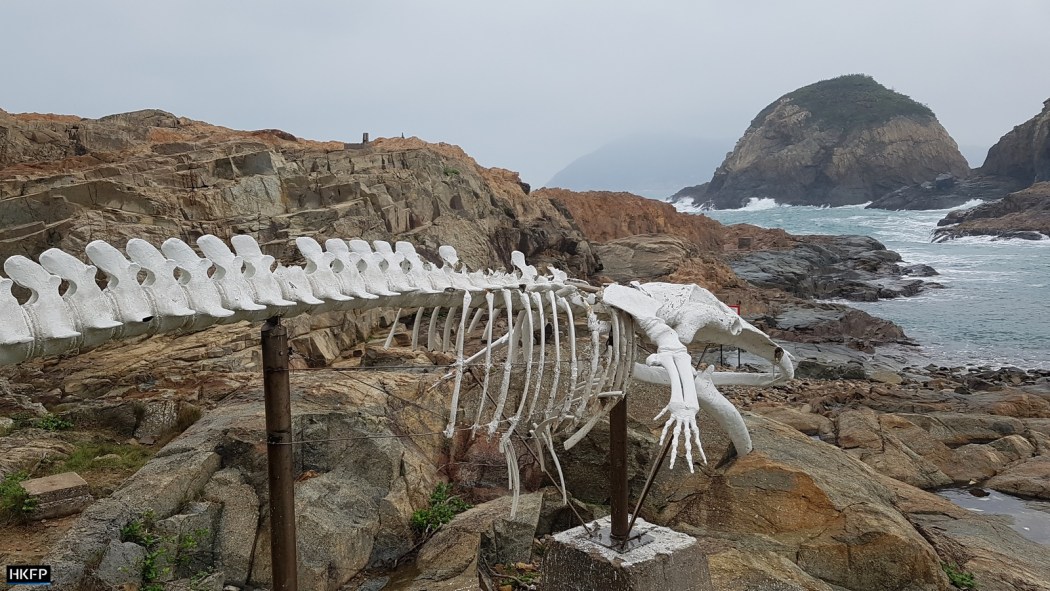
Over three decades, the bones became weather-beaten, until – in 2018 – Super Typhoon Mangkhut left the skeleton badly damaged by the wind and waves.
“[T]here were moments during that storm when the skeleton was submerged in waves coming over the rocks,” Thompson said.
After the damage, the whale skeleton remained on display until 2021, when the team finally removed it because it had become too fragile.

The team installed a 3D-printed version of the whale bones last summer, but removed them six months later because the plastic material failed to withstand the strong sunlight and quickly turned yellow, Thompson said.
The team eventually reached out to a specialist company in Zigong, Sichuan in January, and provided a 3D-scan of each bone. Thompson, together with the team, flew to Sichuan to check the parts before it was all completed in October, Lam said.
“I think it’s a nice public service for us to be able to maintain it so everybody can continue to enjoy it,” Thompson said. “We hope that we can continue to use the skeleton as an education tool to try and educate as many people as we can about why it’s important to conserve our local marine biodiversity.”

He added that biodiversity in Hong Kong is surprisingly high, given that marine environments around most densely populated cities are usually home to very few species.

SWIMS has kept the 3D-printed skeleton in storage and has loaned it to various organisations for display purposes. The remaining, original bones now sit in a corner of a classroom at SWIMS.


