

The trial of fugitive activist Anna Kwok’s father began in October over the alleged handling of funds belonging to his daughter.

A Hong Kong man was arrested weeks after his acquittal in a terrorism case, while two teenagers pleaded guilty to national security charges.
Both Hong Kong and Chinese authorities rejected UK and US calls to free media tycoon Jimmy Lai, ahead of the expected verdict of his national security trial. China’s top diplomat in the city gave “four don’ts” to the new US consul general, Julie Eadeh.
HKFP rounds up national security-related news from last month.
Trial of wanted activist’s father begins
The trial of Kwok Yin-sang, father of wanted activist Anna Kwok, accused of attempting to handle funds belonging to an “absconder,” began on October 9.
Charged under Article 23, Hong Kong’s homegrown security law, he is the first family member of a wanted activist to be charged with a national security offence.
According to the admitted facts, a set of case details agreed upon by the prosecution and the defence, which was read out in court, Kwok Yin-sang took out insurance plans with AIA for each of his three children – daughter Anna Kwok and sons Kwok Hoi-dong and Kwok Hoi-shing – in 1999.

Two prosecution witnesses, an insurance agent at AIA surnamed Cheng and AIA Head of Service Grace Yan, gave evidence in court.
Cheng testified that Kwok Yin-sang told her in January he would be meeting with his daughter, and in February, he gave her forms signed by Anna Kwok.
Defence counsel Steven Kwan cross-examined the two witnesses, suggesting that Anna Kwok did not legally own the insurance policy because she did not sign a form transferring ownership of the policy from her father to herself.
After the two insurance agents were questioned over the course of two days, Acting Principal Magistrate Cheng Lim-chi ruled on October 10 that Kwok Yin-sang “has a case to answer” over his alleged handling of his activist daughter’s finances, meaning the trial would continue.
Kwok Hoi-dong, testifying for the defence on October 16, said he was previously unaware that their father had met his sister over the Chinese New Year holiday earlier this year.
The defendant, Kwok Yin-sang, who pleaded not guilty, did not testify in the trial. The case was adjourned to December 23 for the prosecution and the defence to make closing arguments.
Anna Kwok, who lives in the US, is wanted by Hong Kong’s national security police for suspected foreign collusion.
In 2023, police placed a HK$1 million bounty on the 28-year-old and seven other activists – the first batch of self-exiled opposition figures wanted under the city’s national security law. In December last year, she and six other activists were declared “absconders” by the authorities.
Tiananmen activists’ trial delayed again
The national security trial of the now-disbanded group that organised vigils for the 1989 Tiananmen Square crackdown was delayed again, with the trial set to begin on January 22.
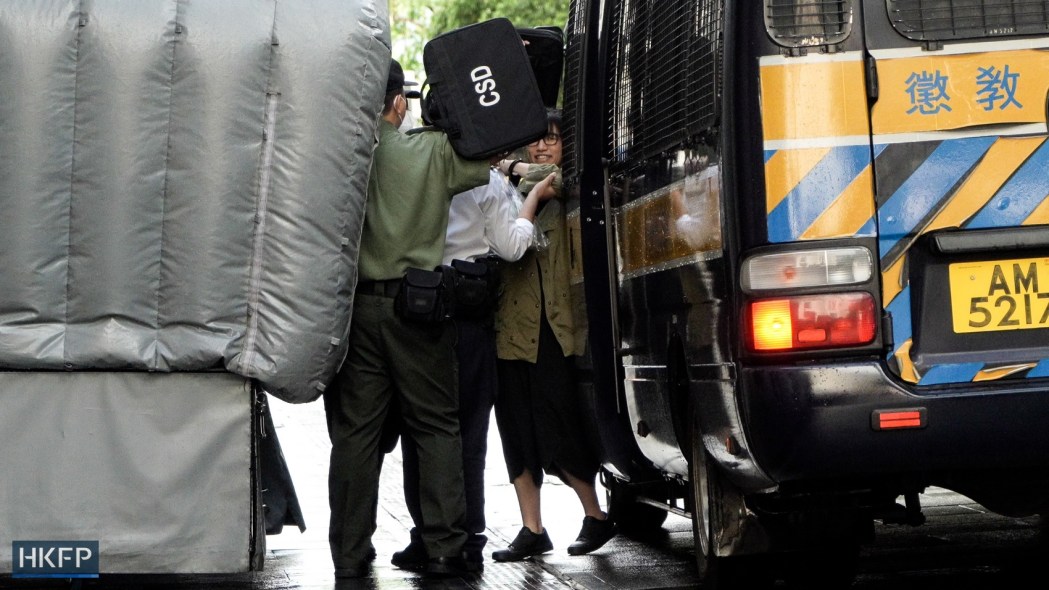
High Court Judge Alex Lee, one of the three judges presiding over the case, previously said in August that the trial of the Hong Kong Alliance in Support of Patriotic Democratic Movements of China would begin on November 11.
Before that, Lee had fixed May 6 as the start date but delayed it to November, citing scheduling reasons.
Three former members of the alliance – lawyer-activist Chow Hang-tung, and former pro-democracy lawmakers Lee Cheuk-yan and Albert Ho – were charged alongside the vigil group itself with inciting subversion of state power under the Beijing-imposed national security law.
The three face a maximum penalty of 10 years’ imprisonment if convicted.
All three have been detained ahead of the trial. Chow has been on remand for over four years, while Lee and Ho have been detained for around four and two years respectively.
The court has set aside 75 days for the January trial, which will be held at the West Kowloon Law Courts.
Man arrested weeks after acquittal
Hong Kong man Ng Tsz-lok was arrested in late October and charged with conspiring to incite a riot during the 2019 protests and unrest. Less than eight weeks earlier, the 32-year-old was acquitted of terrorism charges.

Ng and fellow defendant Chan Wai-leong, 34, appeared at the West Kowloon Magistrates’ Courts on October 30.
The pair were among five people arrested on October 28 on suspicion of manufacturing and providing weapons to frontline protesters during the protests and unrest six years ago.
Ng, who is unemployed, and Chan, a photographer, were both charged with conspiring to incite others to riot between October 22 and October 23, 2019.
Ng was additionally charged with inciting others to take part in a riot “on or about November 14, 2019,” according to a charge sheet.
Chief Magistrate Victor So, a designated national security judge, adjourned the case until December 15 to allow more time for police to investigate.
Ng applied for bail but was rejected, while Chan did not seek bail.
Teenagers plead guilty to sedition, secession-related charges
A 19-year-old Hong Kong woman pleaded guilty to sedition after appearing in videos promoting a “shadow legislature” that the city’s government deems subversive.
Lan Fei was remanded after the hearing on October 31. Chief Magistrate So scheduled her sentencing for November 13.
Lan is accused of filming promotional videos posted in April and May for the “Hong Kong Parliament,” a group that held unofficial polls to form a shadow legislature outside the city, as well as encouraging people to vote in the polls through social media.

In mitigation, the defence said that Lan was not highly educated and committed the crime under the influence of her then-boyfriend, Tony Lam, who was 37 at the time of the offence.
Lam was one of the individuals wanted by Hong Kong authorities for their links to the unofficial parliament.
Also on October 31, a 16-year-old boy pleaded guilty to conspiring to commit secession over his involvement in a Taiwan-based group that advocates for Hong Kong independence.
According to the prosecution, the defendant, whose name is not disclosed as he is a minor, contacted the founder of the Hong Kong Democratic Independence Union in November last year via WhatsApp and asked to join the group.
The teen told the founder he wanted to establish an “intelligence department” to collect information about Hong Kong police officers. The defendant attended six online meetings with the group between January and March.
The prosecution also said he circulated three posts on social media relating to the Hong Kong Parliament between November 2024 and July this year.
The case was adjourned to November 27 for sentencing. Judge Ernest Lin said he would seek a training centre report, a document used to assess the suitability of defendants for training centres, an alternative to imprisonment for young offenders.
Octogenarian arrested for sedition
An 89-year-old man was released on bail after he was arrested on October 1, China’s National Day, for allegedly acting with seditious intent, an offence under the Safeguarding National Security Ordinance, more commonly known as Article 23.
Online footage showed plainclothes police officers escorting the man into a staff-only corridor at Causeway Bay MTR station and then taking him into a police van.
Local media reported that the man arrested was an activist surnamed Ng. He is known for his participation in a pro-democracy group founded during the 2014 Umbrella Movement.

Ng has reportedly continued protesting on the street in recent years, standing alone and holding up handwritten signs.
He showed up in Causeway Bay on June 4 last year, with one sign showing a timeline of pro-democracy movements in mainland China, Hong Kong, and Taiwan and the other sign calling on people to commemorate the anniversary of the 1989 Tiananmen crackdown.
13 films barred from screening
Hong Kong authorities told HKFP last month that they barred 13 titles from screening on national security grounds and required edits in 50 films between November 2021, after the film censorship law was amended, and July 2025.

The Office for Film, Newspaper and Article Administration (OFNAA), however, did not respond to HKFP’s request for a list of the films affected.
According to local newspaper Ming Pao, which broke the story, out of over 39,000 films submitted to OFNAA for review since 2021, 104 were allowed to be screened after amending their content, while 15 were not greenlit to be screened in the city.
Of the fifteen, 13 titles were banned due to national security concerns.
The Film Censorship Ordinance was amended in late October 2021 to include national security clauses, more than a year after the Beijing-imposed national security law came into effect.
Lawyer denied bid to overturn prison complaint conviction
Solicitor Phyllis Woo was denied on October 14 a bid to overturn her conviction over an unapproved prison complaint she received from jailed activist Owen Chow at the Court of Final Appeal, the Hong Kong top court.
Woo was fined HK$1,800 last year for bringing a prison complaint form out of the Lai Chi Kok detention centre for Chow, one of 45 opposition figures convicted of conspiring to commit subversion, an offence under the Beijing-imposed national security law.

Her lawyer Steven Kwan cited Hong Kong’s prison rules, which state that the prison superintendent “must permit the prisoner to write and send” a letter addressed to a specified person.
High Court Judge Judianna Barnes, who previously shot down both Woo’s and Chow’s appeals at the Court of Appeal, rejected Kwan’s argument, saying that Woo was not one of those specified persons, even if the letter was meant for the Ombudsman.
Woo has a final chance to overturn her conviction by applying directly to the city’s apex court for an appeal hearing. According to the Judiciary’s records, she has made a direct application to the top court, but a hearing date has yet to be set.
Security chief lambasts activist for election boycott call
Hong Kong security chief Chris Tang lambasted wanted activist Ted Hui for urging a boycott of the upcoming legislative elections, warning that encouraging blank ballots may violate the city’s national security law.
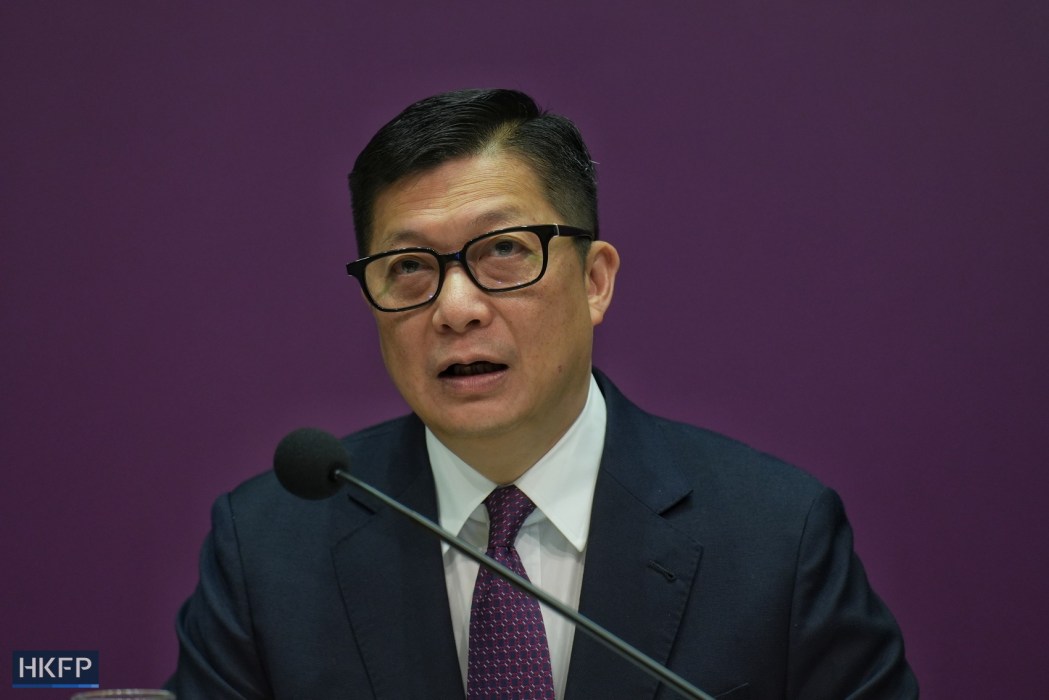
“It’s your own business that you’re wanted for breaking the law, but you still want others to follow your example. I hope everyone can see the truth and not be deceived by him into engaging in illegal acts,” Tang said on October 30, referring to Hui.
In a Facebook post on October 25, Hui, who was granted asylum in Australia in August, called the December 7 legislative race “a sham election utterly detached from the public” and said it “deserves to be boycotted.”
Tang warned that Hui’s remarks could violate national security laws and the Elections (Corrupt and Illegal Conduct) Ordinance.
The security minister also pointed out that the activist had an arrest warrant issued by the city’s anti-graft watchdog over his calls for a boycott of the 2021 Legislative Council elections.
Calls to free Jimmy Lai receive pushback
Beijing’s foreign ministry in Hong Kong slammed US politicians for urging President Donald Trump to push for the release of jailed media tycoon Jimmy Lai ahead of a meeting with Chinese leader Xi Jinping.
In a statement on October 25, the Commissioner’s Office of China’s Foreign Ministry in Hong Kong expressed “strong dissatisfaction and resolute opposition” to a joint letter issued one day prior and signed by more than 30 US lawmakers.

The signatories included Rick Scott, whom Lai met on multiple occasions when the Republican senator flew to Hong Kong at the peak of the 2019 protests, as well as fellow senators Ted Cruz and Marsha Blackburn, who were mentioned in the prosecution’s evidence during Lai’s collusion trial.
On October 24, as Trump departed Washington, DC, for an Asia tour that would include a meeting with Xi in South Korea, the US president said he would push for the Apple Daily founder to be released.
On the same day, the Hong Kong government rejected a routine UK report calling for the release of Lai, accusing London of “despicable political manoeuvres.”
Lai, a British citizen, is accused of conspiring to collude with foreign forces under Beijing’s national security law. Judges are expected to deliver their verdict on the tycoon’s charges this month.
Beijing warns US top envoy in Hong Kong
China’s top diplomat in Hong Kong, Cui Jianchun, warned the new US consul general in Hong Kong, Julie Eadeh, not to “collude with anti-China forces” and interfere with national security cases.

Cui Jianchun, commissioner of the Chinese Ministry of Foreign Affairs in Hong Kong, met with Eadeh on September 30, according to the ministry’s statement published on October 2.
The foreign ministry official also spelt out “four don’ts” for Eadeh: don’t meet the people the consul general shouldn’t meet with, don’t collude with “anti-China forces,” don’t be involved in “activities that undermine stability in Hong Kong,” and don’t interfere with national security cases in the city.
According to Reuters, a senior US State Department official said in response: “US diplomats represent our nation and are charged with advancing US interests globally, which is standard practice for diplomats around the world, including in Hong Kong.”
Eadeh took up the post as the top US diplomat in Hong Kong in late August. She came under fire from Beijing-backed newspapers in September, following reports that former chief secretary Anson Chan – who has lobbied for democracy in Hong Kong – and veteran democrat Emily Lau attended the diplomat’s welcome receptions in September.
UN experts condemn move to bar lawyer-activist from practising
UN rights experts expressed alarm after self-exiled lawyer Kevin Yam was barred from practising as a solicitor in Hong Kong.
Australia-based Yam was barred by the Law Society of Hong Kong in September following a ruling by a disciplinary committee that cited his calls for US sanctions. The society has denied that the move was political.

A vocal Hong Kong pro-democracy defender, Yam is one of 34 overseas activists who are wanted under the national security law.
“This is a new retaliation and an alarming assault on freedom of expression and lawyers’ rights to practice their profession and express their views in line with international standards,” the UN experts said, according to a United Nations Human Rights Council statement on October 3.
Margaret Satterthwaite, special rapporteur on the independence of judges and lawyers, and Irene Khan, special rapporteur on the promotion and protection of the right to freedom of opinion and expression, are independent human rights experts appointed by the UN Human Rights Council.
Hong Kong’s Department of Justice told HKFP on October 8 that it respected the actions taken by the Law Society and the “fair decision” by the disciplinary tribunal.
The Law Society once again defended its decision. “The findings of the Tribunal did not pertain to freedom of speech,” it told HKFP on October 9. “By leveraging his position as a Hong Kong legal professional to advocate for foreign sanctions against Hong Kong judges and prosecutors, Mr. Yam was in breach of the fundamental principle of his professional responsibilities as an officer of the court.”
2 activists released from jail
Activist Andrew Chiu, who testified against his co-defendants in exchange for a jail term reduction in the city’s landmark subversion trial, was freed on October 28 – the first democrat jailed in the case to be granted early release from prison.
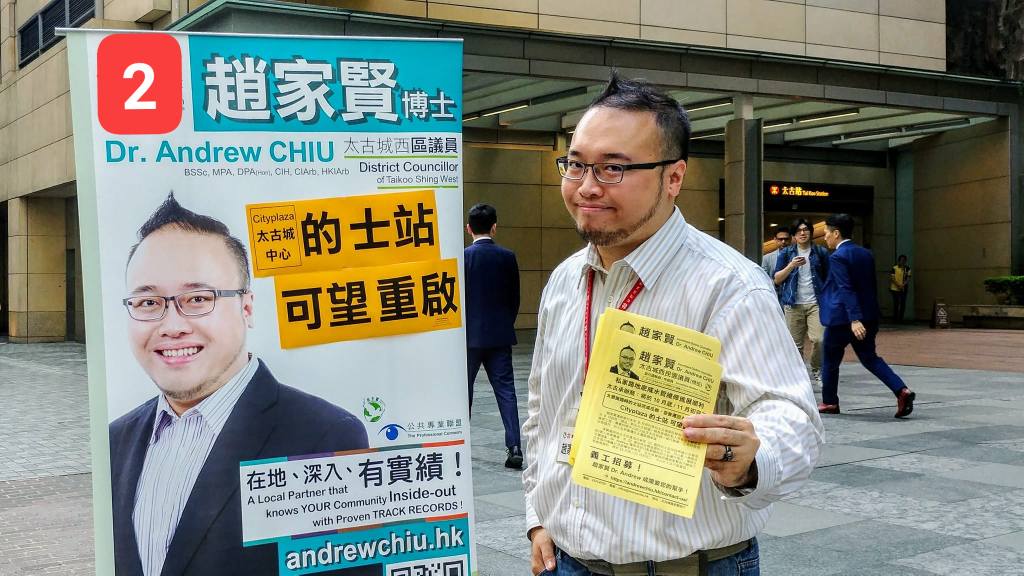
The former district councillor, 40, was jailed for seven years in November 2024 for conspiring to commit subversion under the Beijing-imposed national security law. He was originally expected to be freed in early 2028.
According to unnamed sources quoted by local media, Chiu demonstrated “deep remorse” while in prison.
His unexpected release is a departure from the typical arrangements for national security offenders. The Safeguarding National Security Ordinance stipulates that authorities can deny early release if they believe doing so would be “contrary to the interests of national security.”
Meanwhile, Andy Chui, another ex-district councillor jailed in the case, was released on October 27 after serving more than four and a half years behind bars.
The two were among a group of 47 opposition figures charged in the city’s largest national security case over their participation in an unofficial primary election in July 2020. A total of 45 were convicted and jailed last year, while two were acquitted.
To date, 14 people jailed in the case have been released from prison.
Prosecution and arrest figures
As of November 1, a total of 348 people had been arrested for “cases involving suspected acts or activities that endanger national security” since Beijing’s national security law came into effect, according to the Security Bureau. That figure includes those arrested under Article 23.
Of the 201 people and five companies that have so far been charged, 172 people and one company have been convicted or are awaiting sentencing.
In total, 96 people and four companies have been charged under Beijing’s national security law, with 77 persons convicted. Nine people have been charged under Article 23, seven of whom have been convicted.


