

There were more arrests and charges under Hong Kong’s national security laws in July. Four people linked to a Taiwan-based group were arrested for allegedly conspiring to commit subversion, while in a separate case, a waiter was charged with inciting subversion.
National security police issued new arrest warrants for 15 overseas Hongkongers, with a HK$200,000 bounty on each of their heads.

The landmark national security trial, which involved 47 prominent democrats, saw a new development. The Court of Appeal spent four days hearing legal challenges from 12 democrats and the government.
HK$200K bounties for 15 Hongkongers
Hong Kong national security police issued a new round of arrest warrants in late July, citing their roles in a political group deemed subversive by the authorities and offering a HK$200,000 bounty for each of the 15 named overseas Hongkongers.
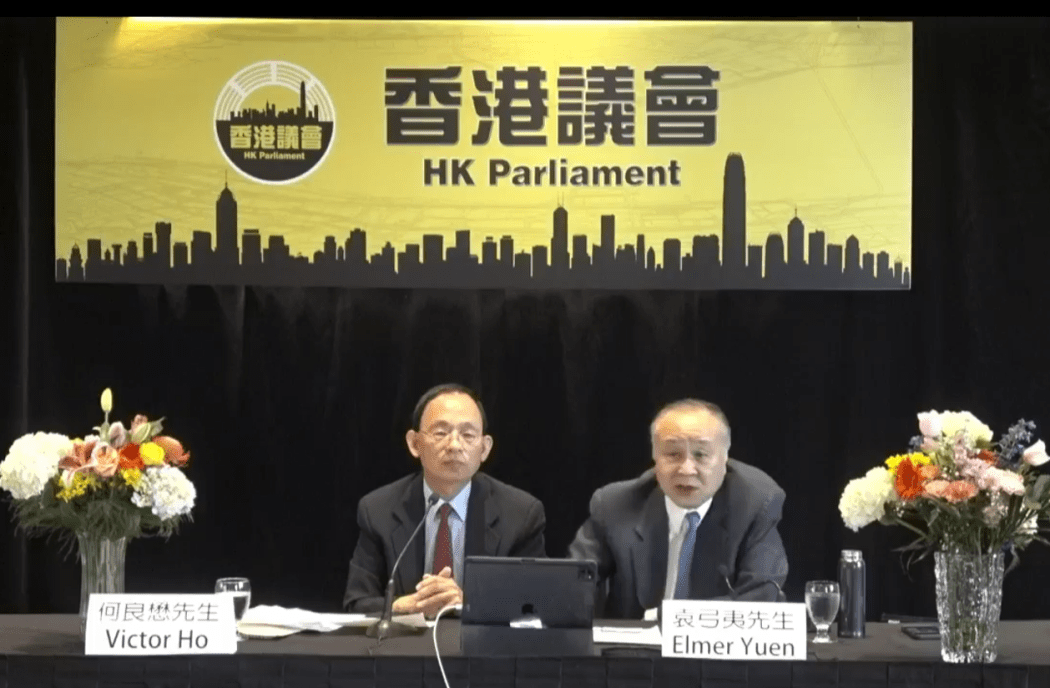
The authorities announced on July 25 that 19 people were wanted for organising or participating in the “Hong Kong Parliament,” a group that held unofficial polls outside of the city to form a shadow legislature to “pursue the ideal of Hong Kong people ruling Hong Kong.”
The new warrants included four activists already wanted by Hong Kong authorities: Elmer Yuen, Victor Ho, Johnny Fok, and Tony Choi. Each of them has a bounty of HK$1 million on their head.
The remaining 15 wanted individuals are Feng Chongyi, Sasha Gong, Chan Lai-chun, Ng Man-yan, Tsang Wai-fan, Chin Po-fun, Paul Ha, Hau Chung-yu, Ho Wing-yau, Keung Ka-wai, Tony Lam, Agnes Ng, Wong Chun-wah, Wong Sau-wo, and Zhang Xinyan.
Hong Kong’s move targeting the overseas activists triggered criticisms from the United States, Canada, and Australia.
The city’s government hit back, saying in a statement on July 27 that it “strongly opposed and disapproved of smears with distorted facts.”
Appeals from 12 democrats and the gov’t
For four days, from July 14 to 17, the appellate court heard legal challenges from both the defence and prosecution, which stemmed from the city’s largest national security case.
Three Court of Appeal judges – Jeremy Poon, Anthea Pang, and Derek Pang – presided over the proceedings, which were initially scheduled to last for 10 working days.

A total of 11 democrats, including ex-lawmaker “Long Hair” Leung Kwok-hung and journalist-turned-activist Gwyneth Ho, are appealing against their convictions and sentences.
The 12th pro-democracy figure – Wong Ji-yuet, who pleaded guilty and was sentenced to four years and five months behind bars – is appealing her sentence.
12 democrats seeking appeal – click to view
- Raymond Chan
- Tat Cheng
- Owen Chow
- Gwyneth Ho
- Kalvin Ho
- Lam Cheuk-ting
- Leung Kwok-hung
- Gordon Ng
- Helena Wong
- Wong Ji-yuet
- Clarisse Yeung
- Winnie Yu
The court also heard an appeal from the government against the acquittal of ex-district councillor Lawrence Lau.
A total of 15 democrats originally sought to appeal, but two dropped out.
Days before the hearing began, it was reported that Tam Tak-chi, better known as “Fast Beat,” had withdrawn his appeal application seeking a shorter sentence.
The first day of the hearing saw a last-minute withdrawal from former district councillor Michael Pang, whose lawyer confirmed with the judges that he had signed an agreement to abandon the appeal.
The court announced on July 17 that it would rule within nine months.
3 jailed democrats released
Three more Hong Kong pro-democracy figures were released on the morning of July 28 after serving four years and five months in prison – the latest democrats convicted in the city’s largest national security case to be freed.

Frankie Fung, a pro-democracy activist, returned to his Kowloon City home in a police vehicle, according to an HKFP reporter at the scene. He was seen carrying a bag of belongings and did not respond to questions from reporters.
Two other activists, Carol Ng and Lau Chak-fung, also arrived home in police vehicles, local media reported. Lau was seen entering his residential building carrying two bags of belongings, also without responding to questions from reporters.
The trio, who had been detained since 2021, were sentenced in November after pleading guilty to subversion under the Beijing-imposed national security law. They were among a group of 47 opposition figures charged with the offence. A total of 45 were convicted in May last year, while two were acquitted.
After the three were released, a total of 11 democrats in the case have completed their prison terms, including ex-lawmaker Claudia Mo in late April and LGBTQ activist Jimmy Sham in late May.
4 arrested for alleged subversion
Hong Kong national security police arrested four people, aged 15 to 47, on July 9 for allegedly conspiring to subvert state power through a Taiwan-based group that advocates for the city’s independence.
Steve Li, chief superintendent of the force’s National Security Department, said that the four male suspects were linked to the Hong Kong Democratic Independence Union, which was established in Taiwan in November.

The four held different positions in the group, including party secretary, council member, and general members, Li said on July 10.
Police also found “a proposal urging the US to draft a plan for the rescue of political prisoners in Hong Kong, as well as flags that signify the secession of the country, including those for the independence of Hong Kong, Tibet, Guangdong, and Xinjiang,” the chief superintendent said.
Waiter charged with inciting subversion
A Hong Kong waiter was charged with inciting subversion under the Beijing-imposed national security law.

Chan Ho-hin, 22, appeared at the West Kowloon Magistrates’ Courts on July 9 to face the charge.
He was previously charged on April 30 with one count of “knowingly publishing articles with seditious intent” under the Safeguarding National Security Ordinance – Hong Kong’s homegrown security law, popularly known as Article 23 – and has been remanded in custody since.
But prosecutors in July sought to amend the charge, upgrading it from sedition to inciting subversion.
Man accused of threatening media outlets
The national security police arrested a man on July 31 for allegedly threatening multiple media outlets to publish a report promoting a fundraising website for wanted activists.
A 43-year-old man surnamed Tse was arrested in Fanling in connection with intimidating letters sent in June to several local media organisations, police said.

Tse was arrested under Article 23 for alleged “seditious intention.” He also faces charges of suspected criminal intimidation.
Teen allegedly wrote ‘seditious’ messages in toilet
A Hong Kong teenager was arrested and charged after he allegedly wrote “seditious” messages in the toilet of a commercial building on three occasions.
The 18-year-old was arrested in Kowloon on July 21 on suspicion of “doing with a seditious intention an act or acts that had a seditious intention”, the National Security Department of the police force said in a statement on July 23.
According to the charge sheet, defendant Leung Kai-lok is accused of leaving seditious messages on the wall of a male toilet inside China Hong Kong City in Tsim Sha Tsui between July 17 and 21.
He was also said to have damaged the property of the China Hong Kong City Building Management Limited.
Public universities’ new agreement
Eight public universities in Hong Kong signed a new accountability agreement, requiring them to follow the “advice and guidance” of the central government and align with the remarks of Chinese leader Xi Jinping.
The eight signatories are the University of Hong Kong, the Chinese University of Hong Kong, the City University of Hong Kong, the Hong Kong Polytechnic University, the Hong Kong University of Science and Technology, Hong Kong Baptist University, Lingnan University, and the Education University of Hong Kong.

The signed agreements, uploaded to the University Grants Committee (UGC) website on June 30, called on universities to seize opportunities to contribute to Hong Kong’s integration into the overall development of mainland China, with an emphasis on “invigorating China through science and education.”
The phrase was first used by President Xi at the opening session of China’s 20th Party Congress on October 16, 2022.
According to the new University Accountability Agreement, universities “should also strive to follow the advice and guidance of the Central Government on the future of Hong Kong, particularly in light of the ‘four musts’ and ‘four proposals,’ and observe President Xi Jinping’s remark on creating strong impetus for Hong Kong’s growth and nurturing young talents for Hong Kong’s stability and prosperity.”
Xi mentioned the “four musts” and “four proposals” in his speech when he visited Hong Kong in July 2022 to mark the city’s 25th Handover anniversary and to swear in the new chief executive, John Lee.
According to local media, this was the first time the UGC agreement had explicitly required local universities to follow the guidance of the central government since they began signing the three-year contracts in 2019.
UK’s extradition arrangement with Hong Kong
London is planning to make legislative changes allowing Hongkongers to be extradited on a “case-by-case basis,” a UK politician said in late July, voicing concerns that activists overseas could be sent back to Hong Kong.
UK Shadow National Security and Safeguarding Minister Alicia Kearns revealed the plan on July 24, sharing a letter from Security Minister Dan Jarvis to Shadow Home Secretary Chris Philp on the changes to the Extradition Act 2003.

Jarvis said an agreement allowing extradition was needed, as doing so was impossible under the current arrangement, “even if there were strong operational grounds to do so.” The proposed changes to the UK’s Extradition Act 2003, which were introduced in the House of Commons on July 17, would allow cooperation on a “case-by-case ad hoc basis.”
The extradition arrangement between Hong Kong and the UK was suspended following the enactment of Beijing’s national security law in 2020 in the city, which the UK considered “incompatible” with its 1997 Hong Kong Extradition Treaty.
Kearns also said on X that reinstating extradition with Hong Kong “is morally indefensible.” In a a letter to Jarvis, she expressed concern about the “transnational repression” faced by Hong Kong democracy activists and questioned how the UK could protect them from Hong Kong authorities.
UK-based pro-democracy advocacy group Hong Kong Watch condemned the plan, saying that the proposal was a “reckless move which will endanger many pro-democracy activists now living in the UK.”
In response to Kearns’ post on X, Jarvis said: “This is entirely incorrect. The treaty remains suspended. The new law completes the severing of extradition ties.”

Nearly a week later, on July 30, Jarvis gave an assurance that the UK government would “never” allow Hongkongers to be extradited for political reasons.
He said that there had been “inaccurate” reporting on modifications being made to the UK’s extradition laws and that the change – removing Hong Kong from the Extradition Act 2003 – simply “formalises the severing of ties between the British and Hong Kong extradition systems.”
Tightened prison rules
Tightened prison rules, which allow the Correctional Services Department (CSD ) to restrict or ban a person from visiting an inmate on certain grounds, including safeguarding national security, took effect on July 18, just two weeks after the government proposed the amendments.
Under the new rules, the CSD can restrict the visitation rights of religious leaders and lawyers if authorities see a need to protect national security. Previous rules allowed a chaplain to visit a prisoner “at all reasonable times.”
It can also apply for a warrant from a magistrate to bar an inmate from communicating with a legal representative, in person or in writing, as well as with anyone associated with the law firm concerned.
Restricting communications between inmates and lawyers appears to be a response to the convictions of pro-democracy activist Owen Chow and his lawyer, Phyllis Woo, who were found guilty last year of removing a complaint letter from prison without the CSD’s approval.
Gov’t denies using new prison rules
The CSD said it had not used tightened prison rules to ban any visitors or impose any restrictions on prison visits, after a visitor was allegedly denied permission to see an inmate.
In a statement published on July 22, the CSD acknowledged that it had denied a member of the public permission to visit someone in prison that morning because the visitor “was not on the declared visitors list of the PIC,” or person in custody.

“Since the Prison (Amendment) Rules 2025 came into effect last Friday, the CSD has not invoked Rule 48 of the Prison Rules to prohibit any person from conducting visits, nor has it imposed restrictions or conditions on any visits,” it said.
The CSD issued the statement after a man was reportedly not allowed to visit an inmate jailed for national security offences on July 22.
Ben – a pseudonym – told HKFP that prior to the planned visit, he had confirmed with the CSD that his name was on the visitors’ list of the person in custody.
Gov’t defended Jimmy Lai’s detention
The Hong Kong government defended the detention arrangements of jailed pro-democracy media tycoon Jimmy Lai after a US newspaper published an op-ed on July 15, saying Lai suffered from “appalling conditions” in custody.

In an opinion piece published by The Wall Street Journal, Mark L. Clifford, former director of Apple Daily’s parent company Next Digital, said that Lai “has been in solitary confinement for most of his time behind bars.“ Clifford also said he was concerned about Lai’s health in the “windowless cell,” especially amid the city’s hot summers.
The government said in a July 16 statement that it “strongly condemned various organisations in the United States (US) and Western countries for, once again, disregarding the facts and slandering and smearing” its handling of Lai’s national security case.
Arrests and prosecution figures
As of August 1, a total of 341 people had been arrested for “cases involving suspected acts or activities that endanger national security” since Beijing’s national security law came into effect, according to the Security Bureau. The number includes those arrested under Article 23, officially known as the Safeguarding National Security Ordinance.
Of the 193 people and five companies that have so far been charged, 165 people and one company have been convicted or are awaiting sentencing.
Among them, 96 people and four companies have been charged under the national security law, with 76 convicted. Eight people have been charged under Article 23, six of whom have been convicted.


